How-To Guide
When to renew a creator partnership after mixed reach and qualified outcomes
Read reach and qualified outcomes apart, note which ones your records tie to the creator, then pick renew, change, test, pause or end with a stop rule.
By the Superdirector editorial team. FTC endorsement guidance reviewed October 30, 2026.
At a glance
When should a brand renew a creator partnership after mixed results?
Renew when your own records support one specific reason, not when one number looks good. Pin every earlier agreement and its real cost, read reach and qualified outcomes in separate columns using a definition you wrote before looking, and mark each outcome as recorded, unknown or none for how it ties to the creator’s posts. Then choose exactly one option: renew as is, change the scope, run a small test, pause or end. Write the stop condition before you ask, and draft the renewal as a new agreement with its own disclosure terms. The sheet organizes a decision. It does not predict results.
- Reach and qualified outcomes are different evidence; read them apart.
- An outcome with no recorded tie to the creator is unknown, not a miss.
- Choose one option and write its stop condition before asking.
Direct answer
Short answer: renew a creator partnership when your own records give you one specific reason to do so, and when you can say what would make you stop. A good-looking reach figure is not a reason by itself, and neither is a thin month of sales. Pin each earlier agreement and what it actually cost, read reach and qualified outcomes in separate columns, mark how each outcome ties to this creator’s posts as *recorded*, *unknown* or *none*, and only then choose a single option: renew as is, change the scope, run a small test, pause, or end.
This is for an agency or in-house marketer who has run two or more agreements with the same creator and now holds results that point in different directions: the posts reached many people but few of the outcomes you care about can be traced to them, or the reverse. The decision is narrow: what the next agreement, if any, should be, given what your records can and cannot show. It is not a forecast. Nothing on this page tells you how a creator will perform next time, what a normal renewal rate is, or what counts as a good result. Those numbers are not available to us and none is claimed.
The reason to use a sheet is that mixed results invite the wrong kind of argument. One person points at reach, another at the order count, and a third at how pleasant the creator was to work with. Each is a different kind of evidence. The blank renewal decision sheet, the CSV register and the decision map keep them apart. All three are blank or fictional teaching aids, and none represents a real campaign or creator.
Pin each past agreement and what it cost
Start with a list, not an opinion. For every earlier agreement with this creator, record the agreement ID and signed date, the period it covered, the fee and any in-kind value as agreed, the deliverables promised, and the posts you verified were actually published, with links and dates. If a post was agreed but you cannot show it went live on the contracted account, write that down as unverified. The account-to-post proof guide covers how to establish it.
Then add what you really paid, from your own books and not from memory: the creator fee, product or sample cost if you track it, paid-media spend behind their posts, agency or tooling time you can document, and any extra rights you purchased. Keep each line next to its source. If you cannot find a cost, write “not on file” rather than estimating it. A renewal decision made against a cost you guessed can only be as good as the guess. If you are comparing a bundle with per-post costs across agreements, the bundle quote guide shows how to line them up.
Agreements often change shape, so note each difference in format, length or goal on the sheet; they are not the same experiment run twice. A renewal is a new decision and deserves the same record the first one got.
Split reach evidence from qualified outcomes
Before you read any results, write down what a qualified outcome means for your business and date the note. It might be a trial that reached a stated first action, a lead that met your own screening rule, or a first order from a buyer who had not purchased before. It is your definition, not a platform’s, and you may have more than one. The point of writing it first is simple: a definition fitted afterwards to match the numbers can make any creator look good or bad. If you did not write one before, write it now and mark the read on the sheet as *redone*, so a reader knows the definition came late.
Then read the two kinds of evidence in separate columns. Reach is what the platforms or the creator reported about exposure to the posts: views, impressions or similar, with the source, the scope (organic, paid or both) and the date you read it. Qualified outcomes are what your own records show against your definition. Do not add them, average them or turn one into the other. Whether many views carried people to your destination is a different question, and the views-to-qualified-visits diagnostic walks through it. If organic and paid views are mixed in one figure, split them using the organic and paid results guide before you record the number.
Also record the observation window you used for each agreement. If the first agreement’s outcomes were read after a long window and the second’s after a short one, the two are not comparable, and the sheet should say so. The conversion observation window guide explains how to fix a window before reading. Where outcomes are still arriving, write “window open” and treat that agreement as incomplete rather than as a weak result.
| Pattern in your columns | What it can tell you | What it cannot tell you | Next question to put on the sheet |
|---|---|---|---|
| Reach recorded, outcomes thin | The posts were seen according to the reported source | That the content failed to persuade; the outcome record may not capture it | Do outcome records tie to the posts at all, and was the window long enough? |
| Outcomes recorded, reach thin | Some buyers or leads can be tied to the posts | That more exposure would bring more of them | Is the tie solid, and is the sample too small to read? |
| Both thin | Nothing favorable is on file for this creator yet | That the creator is a poor fit; the brief or offer may have been the problem | Which part of the brief or destination changed between agreements? |
| Both recorded, costs also high | What you gave up for what you can show | Whether the same cost is worth it next time | What price or scope would you accept, written before you ask? |
Grade how each outcome ties to the creator
For every qualified outcome you counted, write how your records tie it to this creator’s post. Use one of three labels. Recorded means a record names the link: a code the creator used, a tagged link visit that your own system logged, a form answer, or a buyer’s own statement of where they heard of you. Unknown means the outcome exists but no record connects it to the creator. None means a record shows it came from elsewhere. Keep the evidence beside each label, such as the code, the log line or the answer text.
The important rule is what you do with unknown. Do not count it as a success for the creator and do not count it as a failure. It is a gap in your measurement, and it belongs on the unresolved list. A code can be shared beyond the creator’s audience, a tagged link can be stripped when it is copied, and people often find a brand through several posts before acting. The coupon-code and tagged-link reconciliation guide shows how to compare two imperfect records instead of trusting either alone. If a tracking link was never tested end to end, the mobile link test is the first thing to fix before the next agreement.
Be careful with a post that the brand also promoted with paid spend. Outcomes after a boost may have come from the paid placement as much as from the creator’s own audience. If you cannot separate them, write the outcome as unknown against the creator and keep the paid lane separate. And be honest if your sample is small: two or three outcomes tell you what happened in those cases and little else. Say that on the sheet in plain words.
When enlarged, scroll horizontally to read the diagram.
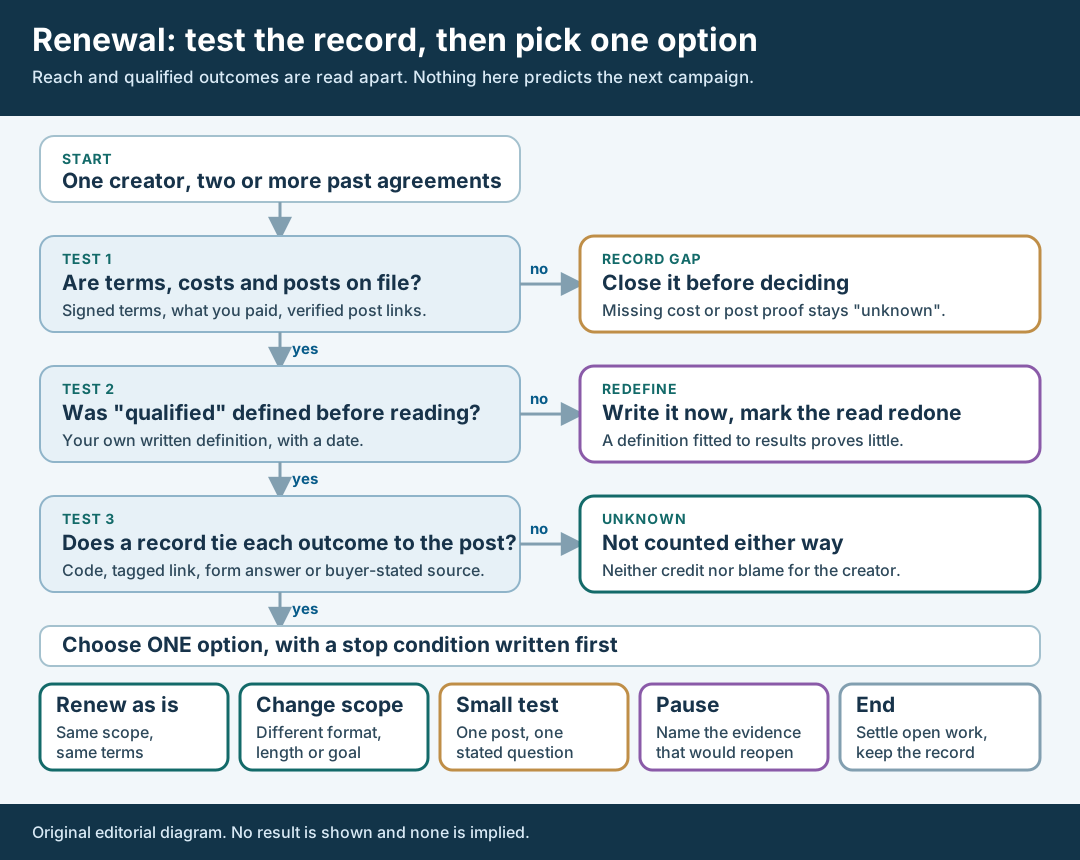
An original editorial decision map. It orders the record tests; it does not score or predict anything.
Original visual by Superdirector editorial team. Creation date not recorded.
Pick one renewal option and its stop condition
Choose exactly one of five options and write the reason in terms of lines on your sheet. The decision map shows the order of the record tests that come before this choice. The options below are an editorial framework for naming a decision. They are not validated thresholds, and no row is an automatic answer.
| Option | When your sheet may point here | Write this before you ask | Do not do this |
|---|---|---|---|
| Renew as is | Recorded ties and outcomes meet the definition you wrote, at costs you would accept again, and terms still fit | The stop condition and the date you review | Do not skip the new-agreement steps because the last one went well |
| Change scope | The evidence points to a format, offer, destination or goal that was off, not to the creator | Which element changes and which stay the same, so you can tell what moved | Do not change many things and then credit one |
| Small test | Ties are mostly unknown or the sample is too small, and one question could settle part of it | The single question, the measure, the window and the cost ceiling | Do not call a long deal a test |
| Pause | Costs are not on file, records conflict, or the offer or product is changing | The specific evidence that would reopen the question | Do not leave the creator guessing without a date for your next look |
| End | Ties are recorded, outcomes are thin against a sound definition, and no scope change addresses the cause | What is still owed, paid or unpublished, and who closes it | Do not erase the record; you may want it later |
Now write the stop condition, in advance, in a sentence anyone can check: “If by [date] the records show fewer than [your own threshold] qualified outcomes with a recorded tie, we do not extend.” Fill the threshold from your own economics, not from an industry figure. Renewing without a stop condition tends to turn a test into a standing arrangement because nobody wrote down when to look again. If your chosen goal was never settled, the measurable campaign objective guide is the place to repair that first.
Write renewal terms and disclosure as new
A renewal is a new agreement, so draft it as one. State its own scope, deliverables, dates, payment, revision rounds and rights. If the renewal changes how posts will be used, such as boosting or reusing a post as an ad, agree that explicitly; the paid-use agreement guide covers the questions to settle before a boost. Do not let rights, payment terms or disclosure expectations carry over from the earlier agreement just because they were never discussed again.
Disclosure deserves its own line in a repeat relationship. The FTC’s question-and-answer page on the Endorsement Guides says that if you have an ongoing relationship with a brand, you should still disclose it, and that where someone posts across a long sponsorship, each new endorsement made without a disclosure could be deceptive because viewers might not have seen earlier posts. FTC Endorsement Guides: What People Are Asking. The regulation itself says a connection that might materially affect the weight or credibility of an endorsement, and that the audience does not reasonably expect, must be disclosed clearly and conspicuously, and that material connections can include business, family or personal relationships, as well as payment or free or discounted products. 16 CFR 255.5. A creator who has worked with you for months is a relationship an audience may not expect, so do not assume familiarity makes it obvious.
On how, the FTC’s influencer guide (the page is dated November 2019) says to disclose when you have any financial, employment, personal or family relationship with a brand, that the disclosure should be placed with the endorsement message itself, and that in a video it should be in the video and not just in the description. FTC Disclosures 101 for Social Media Influencers. The same Q&A page says advertisers need reasonable programs to train and monitor their network, and that you should monitor an endorser during the length of a contract. Put those three things in the renewal: the disclosure expectation, your review of each post before it goes live, and who checks it. The disclosure caption and video guide gives a way to review it.
Keep the scope honest. These pages support the narrow statements above. They do not tell you that a particular renewal is lawful, how long a disclosure must continue after a relationship ends, or what any regulator would decide in a given case. On how long to keep disclosing, an FTC answer about a streamer given a free game a year earlier says it depends on the expectations of the audience. If a point turns on law or a contract clause, send it to counsel.
Walk through a fictional renewal
Fictional exercise: no real brand, creator, campaign or result was inspected. A made-up brand, Brand A, has worked with Creator Q under two agreements. The first asked for one long video; the second asked for two short ones and a pinned comment. Brand A wrote its qualified-outcome definition before the second agreement: a first order from a buyer with no earlier order. Brand A now holds a reach report for each agreement and an order list.
Pinning the agreements shows two differences between them: format and goal. The fee for the first is on file, but the second agreement’s product cost is not on file, and the sheet says so. Reading reach and outcomes apart, the reach report for the second agreement mixes organic and boosted views, so the team splits it before recording a figure. For the outcomes, a handful of first orders used Creator Q’s code, a few arrived through a tagged link, and more first orders came in during the same weeks with no record naming a source. The team labels the first two groups recorded and the last group unknown. None of the unknown orders count for or against Creator Q.
Choosing an option, the team sees that the recorded outcomes are few and the unknown ones are many, and that the two agreements differ in more than one way. A long renewal would be a guess, and ending would ignore the unknowns. They pick a small test: one short video with a new source question on the order form, one stated question (do first orders that name Creator Q increase when the question is asked?), a cost ceiling and a review date, with a stop condition written first. The renewal is drafted as a new agreement with disclosure wording and a post-by-post review. The scenario does not predict how any real creator would respond and carries no performance claim.
What this page does not decide
This sheet decides one thing: what the next agreement with this creator should be, given your own records. It does not choose the creator in the first place, set a price, or judge whether a post was good. Finding and comparing creators is covered by the shortlist by buyer task guide. Reviewing the content a creator delivers is covered by the first-cut review guide.
It also does not validate that a recorded tie caused an outcome. A buyer who used a code may have decided before seeing the post; a buyer with no record may have been moved by it. The sheet only keeps what you can show apart from what you cannot. There is no figure here for how often teams renew, how many campaigns are enough, or how well any rubric predicts the next result, and we do not claim one.
Finally, a renewal does not replace the checks that come after it: the verified post, the disclosure review and, where posts are boosted, the written rights. Each has its own record.