How-To Guide
What counts as strong reach in a creator partnership?
Strong creator reach is unique people beyond the usual followers who stay to watch. Which signals to ask for, how platforms count them, why no cutoff fits.
By the Superdirector editorial team. Platform documentation read November 6, 2026.
At a glance
What counts as strong reach in a creator partnership?
Strong reach is many unique people seeing a post, including people outside the creator's usual followers, who stay past the first seconds. Measure it with unique reach or unique viewers, not followers or raw views, and compare it with the creator's own recent posts and your target audience. No single number is good for every brand.
- Followers show potential audience; unique reach shows who actually saw it.
- YouTube shows new, casual and regular viewers; Instagram reach counts unique users at least once.
- Ask for dated post-level screenshots of several recent posts, with paid boosts marked.
Strong reach means many unique people, beyond the usual followers, who stayed
Strong reach is a lot of different people actually seeing the post. It is not the follower count and it is not raw views. The best evidence is the post's own unique reach (Instagram) or unique viewers (YouTube). Check how much of that came from people outside the creator's regular audience, and whether viewers stayed past the first seconds. Then compare it with the creator's own recent posts and with the audience you need. There is no universal number. Amazon Ads says in its reach guide that there isn't "a single number for good reach and frequency." So judge reach relative to the creator's baseline and to your goal.
This page lists the signals in order of how much they tell you, shows what each platform actually counts, and gives a request sheet you can send a creator. It deliberately prints no cutoff. We publish none because a fixed number would be wrong for most brands.
Rank the reach signals from weakest to strongest
- Followers or subscribers: who could see a post, not who did. YouTube's unique viewers help says the subscriber number "is not the most accurate way to estimate the size of your audience", because viewers subscribe to dozens of channels and skip many uploads.
- Views: how many times a video started. YouTube's reach help counts a view "the moment a video starts to play", so one viewer who replays a video adds several. Instagram's views metric counts plays on Instagram.
- Unique reach or unique viewers: how many different people saw it. Meta's reference defines Instagram reach as the number of unique users who saw the media at least once; YouTube estimates unique viewers over a chosen period and counts one person once, however many devices or times they watch.
- New-audience share: how much of that reach came from people who do not usually watch. YouTube's Audience tab shows the share of new, casual and regular viewers, and its unique viewers help suggests comparing audience size with the subscriber base to find videos that reached beyond it.
- Attention: whether people stayed. YouTube's stayed-to-watch figure is the percentage of times viewers watched past the first seconds of a Short, and its Shorts unique viewers are estimated from engaged views.
A creator with strong reach for your campaign does well on the last three, on posts like the one you are buying, and on the audience you sell to.
When enlarged, scroll horizontally to read the diagram.
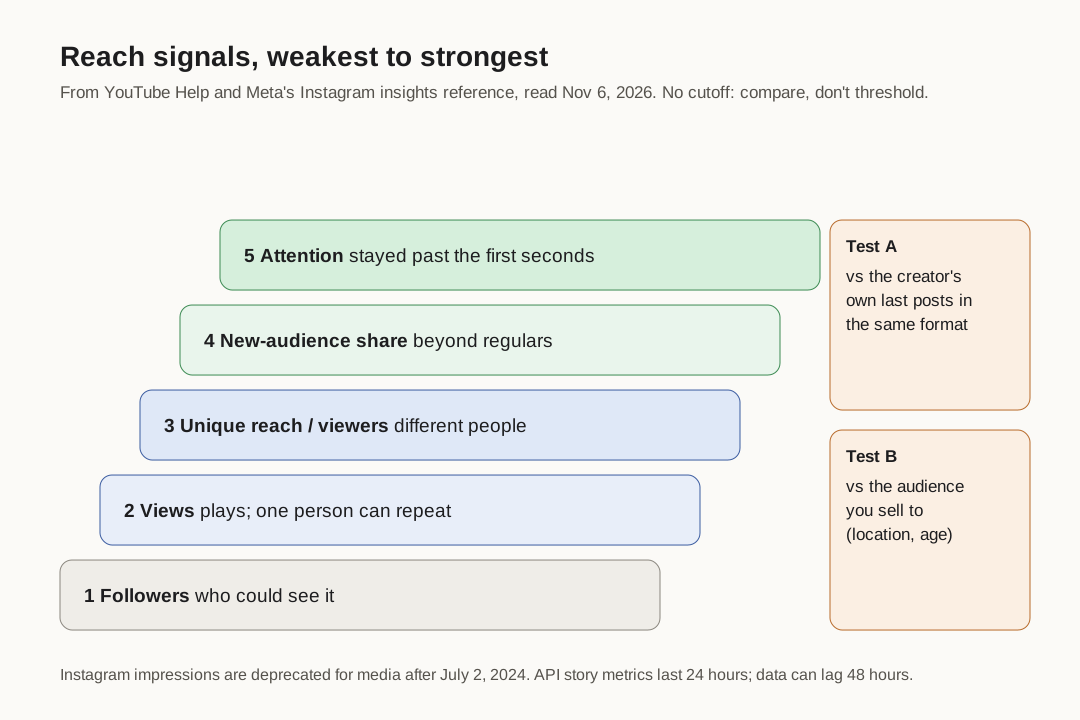
Original editorial diagram from YouTube Help and Meta's Instagram documentation, read November 6, 2026. It sets no numeric cutoff.
Original visual by Superdirector editorial team. Creation date not recorded.
Check what each platform actually counts
The same word means different things on different apps, so ask for the metric by its platform name. From YouTube's reach help, YouTube's unique viewers help and Meta's Instagram media insights reference:
| Signal | YouTube | Watch out for | |
|---|---|---|---|
| Plays | Views: counted when the video starts to play | Views: times the media was played on Instagram | Repeat plays by the same person count |
| Unique people | Unique viewers, available for periods up to 90 days | Reach: unique users who saw it at least once (estimated) | Instagram impressions are deprecated for media created after July 2, 2024 |
| Audience mix | New, casual and regular viewers on the Audience tab | Not defined in Meta's API reference; ask for any follower split the app shows | Geography and some other data may be limited |
| Attention | Stayed to watch (Shorts), average view duration | Average watch time and skip rate for reels | Short windows: Meta's API keeps story metrics for only 24 hours |
| Paid vs organic | Non-skippable ads never count as views; follow-on views are organic after promotion | The views and likes metrics are organic only; the separate total_views and total_likes include boosted and ad engagement | Ask whether the post was boosted before reading its reach |
We could not read TikTok's own metric definitions in full today, so this table leaves TikTok out rather than guess. Ask a TikTok creator to name each metric exactly as it appears in their analytics.
Judge reach against the creator's own baseline and your audience
Since no number works for every brand, use two comparisons instead.
- Against themselves: take the creator's last several posts in the same format (reels with reels, Shorts with Shorts) and look at the spread of unique reach. A sponsored post that lands far below their usual range is weak reach for them, whatever the absolute number. Our comparison of a sponsored post with the creator's usual posts walks through this.
- Against your goal: reach only counts if the people are ones you can sell to. Ask for audience location and age where the platform shows them, and remember YouTube notes that some data, such as geography, may be limited. Our page on reading partial audience geography covers incomplete splits.
Then look one step further. Amazon's reach guide makes the point that high reach with low conversions is a reason to ask why. Strong reach that sends nobody to your page is a creative or fit problem, not a win.
Ask for screenshots that prove reach, with dates
A creator can only show what their app shows them. Meta's Insights API overview returns data only for media owned by Instagram professional accounts, and some account metrics are not available for accounts under 100 followers. The same documentation says the data behind metrics can be delayed up to 48 hours, and that story metrics are available through the API for only 24 hours. So:
- Ask for post-level insights, not a profile summary: unique reach or unique viewers, views, the new-versus-returning or follower split, and watch time, each with the post date visible.
- Ask for the same screens for three to five recent posts in the format you are buying, so you can see their normal range.
- For stories, agree that the creator captures insights within the first day.
- Ask whether any post was boosted or run as an ad, and treat paid reach separately.
- Wait two days after posting before you judge the campaign post itself.
The request sheet lists these as rows you can paste into a message. If the numbers in a media kit and the screenshots disagree, our guide to what to verify in a media kit explains how to settle it.
Expect no industry standard yet
If this feels less settled than TV or display buying, it is. The IAB's January 2026 report on creator measurement says the industry "still lacks the measurement standards, currencies, and financial rigor" to fold creators fully into media plans. Its November 2025 showcase describes partnerships moving away from follower counts and engagement rates toward business outcomes. Marketers do not lead with reach either. In Influencer Marketing Hub's 2026 benchmark report, only 18% of brands increasing their budgets chose reach or impressions as a KPI.
So write down which reach signal you will use and how you will compare it before the post goes live, then use the same rule for every creator in the campaign. Our influencer marketing metrics guide shows how reach fits with the other numbers.