How-To Guide
Review a creator’s sponsorship disclosure in both the video and the caption
Check a finished creator post for sponsorship disclosure on three surfaces, video, caption and platform label, and write a fix request that names the surface.
By the Superdirector editorial team. FTC influencer guidance and platform help pages reviewed October 30, 2026.
At a glance
How should a reviewer check both the video and the caption for a sponsorship disclosure?
Treat them as separate surfaces and give each its own status. Watch the video twice, once with sound off and once with sound on, and record what is readable and what is said. Read the caption exactly as the feed first shows it, before any tap on more. Log the platform label separately. The FTC’s influencer guidance says a video disclosure should be in the video, not just the description, and that a platform tool should not be assumed to be enough. Decide against the campaign’s written requirement and name the surface in any fix request.
- Three surfaces, three statuses: video, caption, platform label.
- Two video passes: sound off for what can be read, sound on for what is said.
- The caption is judged as first shown, not after a tap on more.
- A clean receipt records an observation; it is not a legal finding.
Direct answer
Short answer: review one post as three separate surfaces, the video, the caption and the platform label, and record a status for each before you decide anything. The FTC’s Disclosures 101 for social media influencers says that when a post is a video, the disclosure should be in the video and not just in the description uploaded with it. It also says viewers may watch without sound and may not notice superimposed words, that audio plus visual disclosure is more likely to be noticed, and that a platform’s disclosure tool should not be assumed to be good enough. A check that looks only at the caption, or only at the platform badge, answers a smaller question than the one the brand needs answered.
This page is for the person who receives a creator’s finished or scheduled post and must decide: approve it, ask for a specific fix, or escalate it. It does not decide whether a legal obligation exists in your situation, and it does not predict what a regulator would conclude. It produces an evidence-bearing receipt of what a reviewer saw, where, and when.
Use the blank two-surface review card, the CSV register and the original surface map. They are blank teaching and recording assets; they represent no real post, creator or campaign.
What this page decides, and what it leaves to other pages
Several nearby checks touch disclosure without answering this question. The sponsor-category guide reads a creator’s past posts to classify which sponsorships are disclosed, for a competitor rule. The software proof-screen plan decides, before filming, where a disclosure fits in the shot list. The crop review checks whether interface elements cover on-screen text in each placement. The claim-evidence guide checks whether the product sentence is true. The account proof guide checks which account published.
This page starts after the creator has made the post. Its single decision is whether each surface of that one post carries the disclosure the campaign’s written requirement calls for, as a viewer would meet it. It borrows nothing from those pages except a division of labor: a post can have a true claim, the right account, a clean crop and a collected sponsor history, and still show its disclosure only on a surface many viewers will not reach.
| Question | Where it is answered |
|---|---|
| Is the product claim supported? | Claim evidence |
| Did the contracted account publish it? | Account proof |
| Is on-screen text covered by interface in a placement? | Crop review |
| Is the disclosure visible in the video, the caption and the label of this post? | This page |
| Is a boost or ad authorized to reuse the post? | Paid-use agreement |
Pin the post and the requirement you are judging against
Open the exact post and save its URL or shortcode, the platform and format, the viewer context (app or web, signed in or out, region where you can tell) and a checked-at time with a time zone. Then find where the campaign wrote its disclosure expectation: a brief clause, an agreement term or a policy page. Copy its reference into the card. If the requirement is silent or vague, record that. Do not invent a stricter rule after seeing the post, and do not quietly accept a weaker one because the post looks professional.
Name the connection to be disclosed as the agreement states it: a payment, a free product, a commission, an employee or family relationship, or something else. The FTC’s Endorsement Guides, in 16 CFR 255.5, treat a connection that might materially affect the weight or credibility of an endorsement, and that the audience would not reasonably expect, as one that must be disclosed clearly and conspicuously. They list monetary payment and free or discounted products among the connections, whether or not the advertiser requires an endorsement in return. Whether your particular relationship meets that test is a question for counsel. The card only asks you to say, in the campaign’s own words, what was supposed to be disclosed.
Keep private agreement text in your owned workspace. The card needs a reference, not a paste.
Watch the video twice, sound off and then sound on
The first pass is sound off. Play the video from the start and write down any disclosure that is readable: superimposed text, a sticker, a visible label inside the picture. Record the timecode where it appears and where it disappears. The FTC says some viewers may watch without sound and others may not notice superimposed words, so a sound-off pass tests the surface that depends on reading. The FTC does not set a minimum on-screen time in the sources reviewed here; its FAQ, in the Snapchat and Instagram Stories answer, says a disclosure should be easy to notice and read in the time viewers have to look at the image. Record the duration you observed and let your own requirement or counsel set a threshold.
The second pass is sound on. Listen for any spoken statement of the connection and note its timecode and exact words. The FTC says viewers are more likely to notice a disclosure made in both audio and video. Record whether the spoken and the written disclosure are both present, only one is present, or neither. Also compare languages: the FTC says the disclosure should be in the same language as the endorsement itself, so note the language of each, even when they match.
Two cautions keep this pass honest. First, where in the video matters as much as whether it appears: a disclosure that comes long after the product is endorsed is a different observation from one that accompanies the endorsement, and the FTC says to place it with the endorsement message itself. Write the endorsement’s timecode beside the disclosure’s. Second, for a livestream, the FTC says the disclosure should be repeated periodically so viewers who see only part of the stream still get it; a recorded review of a stream should check several points, not one.
Read the caption exactly as the feed first shows it
Open the post in the feed or on the post page and copy the caption exactly as first shown, before tapping any control that expands it. The FTC’s FAQ says that if an Instagram post makes its endorsement at the start of the description, any required disclosure should be visible without having to click “more.” Its influencer guide warns that disclosures are likely to be missed anywhere that requires a person to click more. So the review question is not only “is there a disclosure in the caption?” but also “is it reachable without a tap?” Record both the visible text and what the tap reveals, as separate lines.
Then note the disclosure’s position among hashtags and links. The FTC says not to mix the disclosure into a group of hashtags or links, and says a hashtag such as #ad or #sponsored is fine but not necessary. That makes the wording a judgment call and the placement an observation. A disclosure phrased in plain words at the start of the caption and a lone hashtag at the end of a long tag block are different observations even though both contain a sponsorship word. Record the exact characters, not a summary.
Caption length, truncation point and line breaks differ by platform, app version and device. Record the context you used. A truncation point you saw on one phone does not describe every viewer’s screen. If you cannot tell where a viewer’s caption would cut off, mark the caption status as unresolved with that reason rather than guessing.
Log the platform label as its own observation
Platforms offer tools that attach a label to a sponsored post. Instagram and Facebook offer a paid partnership label, described in Instagram’s Help Center and governed by Meta’s Branded Content Policies; read both for the current wording, since this review could not load their text. TikTok’s Disclose commercial content setting adds a “Commercial content” label to the post, and a “Paid partnership” label when the creator is promoting a third party and posting branded content; TikTok’s page says posted content must follow applicable laws and notes that in the United States the FTC’s Endorsement Guides apply. YouTube’s paid promotion setting adds a disclosure label at the beginning of the video, and YouTube states that creators and their partners are responsible for understanding and complying with all applicable legal requirements.
Log what you actually see: the wording, the position on the post and a screenshot reference. Labels can differ by platform, format and app version, so a label that you see in one viewing context may not match another. If you cannot see a label because of access or format, mark it unresolved, not absent.
The reason to log the label separately is the FTC’s caution: do not assume a platform’s disclosure tool is good enough. Its FAQ adds that the FTC would look at whether the tool alone clearly and conspicuously discloses the connection, and that responsibility rests with the endorser and the advertiser, not the platform. Whether a given label alone suffices is therefore not something a badge screenshot can settle. Treat the label as one more piece of evidence, and as the reason a reviewer should look for the other two surfaces, not skip them.
Write one receipt and a fix request that names the surface
Give each surface its own status, then decide against the written requirement. Statuses are observations, not verdicts.
| Surface | Observed statuses | What a gap usually asks for |
|---|---|---|
| Video | Seen in sound-off and sound-on passes; seen in one pass only; not observed; unresolved | Ask the creator to add or move the disclosure in the video, in the form the requirement names |
| Caption | Seen without a tap; seen only after a tap; not observed; unresolved | Ask for the disclosure ahead of the tap point and apart from the hashtag block |
| Platform label | Observed; not observed; unresolved (access or format limit) | Ask the creator to confirm the setting, or confirm it in the account-side view you are permitted to see |
Then write the decision in one sentence that names what each surface showed: “At [time, context], the post [URL] showed [video status], [caption status] and [label status] against requirement [reference]; decision: [approve, request fix, escalate].” Add the missing evidence and a next owner. The fix request should be as specific as the observation: “The caption shows the disclosure only after a tap; please move it ahead of the hashtags” is actionable, while “fix the disclosure” invites a guess. If you edit the post later, add a new dated row instead of rewriting the earlier one.
Decide in advance who reviews posts before they go live and who monitors afterward. The FTC’s FAQ says advertisers must have reasonable programs to train and monitor the people acting on their behalf, and that a company remains responsible for what others do for it. The receipt is the practical record that such a check happened. It is not itself the program.
Walk through a fictional review
Fictional exercise: no real creator, post or brand was inspected. A brief says Creator C must disclose the free product in the video and in the caption. The reviewer opens the post. With sound off, there is no readable disclosure anywhere in the 30-second video. With sound on, Creator C says at the 4-second mark that the product was a gift. The caption, as first shown, ends before the disclosure; the words “gifted by the brand” appear only after tapping more, mid-way through a block of hashtags. A platform label is visible at the top of the post.
The receipt reads: video, seen in one pass only (audio, 4 s); caption, seen only after a tap; label, observed. The decision is to request a fix, not to approve, because the requirement named both video and caption and the caption surface is reachable only after a tap. The fix request names the surface: “Please add readable on-screen text for the gift at the point of the product mention, and move the disclosure to the start of the caption, apart from the hashtags.” The reviewer does not conclude that the post violates anything. The receipt only says what was visible against the campaign’s own requirement.
In a second fictional branch the same post shows a label and a clear audio and written disclosure in the video, but the caption has no disclosure wording at all. The statuses are video, seen in both passes; caption, not observed; label, observed. Whether the requirement’s caption clause still needs satisfying is the written agreement’s call, so the reviewer records the gap and asks the deal owner, rather than deciding that the label makes the caption redundant. The surface map shows why neither branch can be settled by looking at the badge alone.
When enlarged, scroll horizontally to read the diagram.
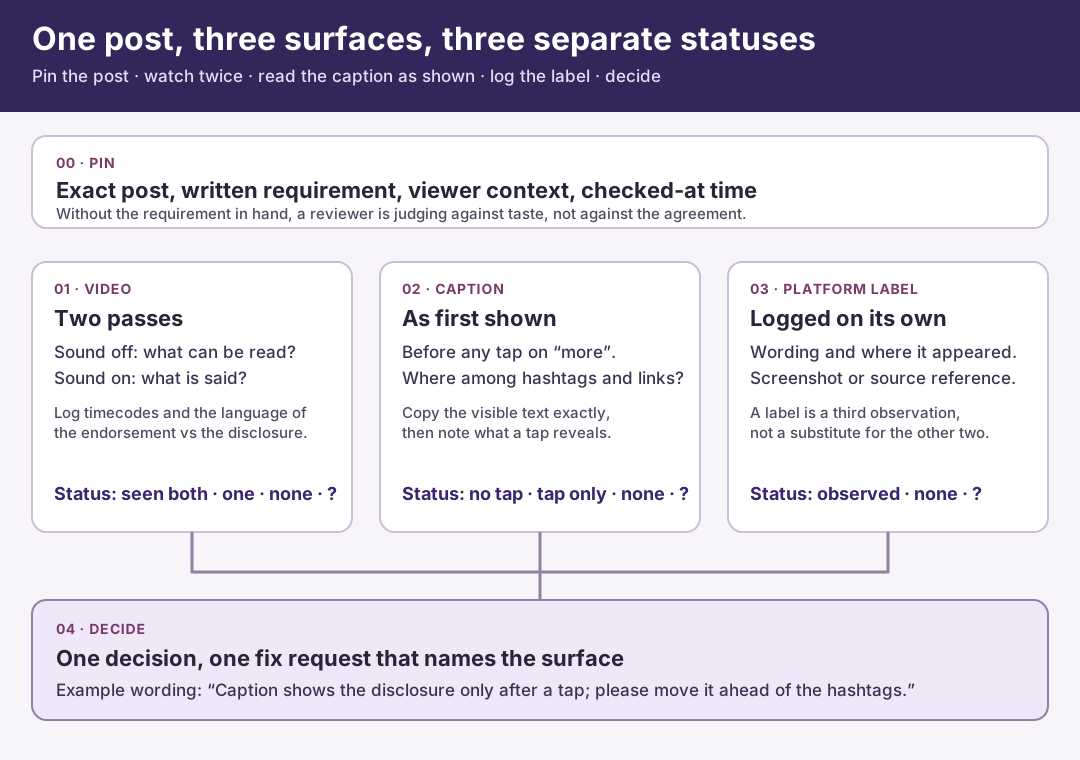
An original map of the three surfaces of one post. Each gets its own status before a single decision is made.
Original visual by Superdirector editorial team. Creation date not recorded.
Limits of this review
A reviewer’s observation proves what was visible to that reviewer, in that app and viewing context, at that time. It does not prove how many viewers noticed the disclosure, what a creator intended, whether the platform shows the same label to everyone, or whether the post would be judged adequate by a regulator. The FTC pages cited here are guidance, not a checklist that guarantees a particular result, and the platform pages describe features that can change. Re-open the cited pages before you rely on a specific wording or menu path. This article is editorial information, not legal advice.
No example here reports a real review, a measured effect of any disclosure style on audience response, or a count of how often posts miss a surface. Search demand for this topic is N/A: it was not measured for this page.