How-To Guide
How do you calculate influencer marketing return on investment?
Calculate influencer marketing ROI with a clear cost basket, refund cutoff and fictional contribution example. Keep tracked revenue and causal lift separate.
By Bell Chen, founder of Superdirector — how the analysis works.
At a glance
How do you calculate influencer marketing return on investment?
Calculate influencer marketing return from a declared revenue and cost scope. This guide uses contribution before campaign cost, subtracts the complete campaign investment, then divides by that investment. Reconcile discounts, refunds, product and variable costs, currency and reporting windows first. Keep tracked revenue ROAS separate, and do not call an associated result incremental profit.
- Define contribution before campaign cost and the campaign-investment basket separately.
- Use one reconciled order scope, currency and refund cutoff; preserve material unknowns.
- A paid revenue multiple does not establish profit or incremental lift.
Name the return and freeze its scope
A creator report can show sales while leaving the financial question unanswered. The useful question is how much of the associated revenue remains after serving those orders and funding the campaign. Start with a formula and the records it needs, then ask whether the inputs exist.
This guide uses a contribution-based return on campaign investment. Let P be retained associated revenue minus the matched product/service costs and variable fulfilment/payment costs, before campaign spending. Let C be the campaign investment, including creator work, gifts, production, allocated internal work and paid distribution. The calculation is (P−C)÷C×100, with C positive. State that definition beside the result. It is a campaign contribution measure, not a complete company-profit statement; another ROI denominator answers another question.
Record the campaign and placements, currency, order inclusion rule, order dates, time zone and refund-review cutoff. State how an order becomes associated: for example, an eligible code or documented tagged path under a rule chosen before reading the result. Neither a code occurrence nor an analytics credit proves the campaign caused the order.
An order-date window, an attribution lookback and a refund followup are three different clocks. Google’s attribution settings define lookback as how far back a touch can receive credit. Its reporting-model changes can affect historical event-scoped credit, while user/session source dimensions are unaffected. Preserve the actual rule and report version used; do not pick the model that makes the return look best.
If you still need to establish the source path, use the general social ROI guide. This page starts after that work and turns the reconciled records into a scoped financial interpretation. The metric definitions cover the broader reporting vocabulary.
Reconcile revenue and all relevant costs
Take amounts and status from the commerce/payment authority. Preserve the original order, discount, refund and cost records, then apply one consistent inclusion rule. The one-order guide handles duplicate code/link evidence. This calculation assumes that job is done; it does not add the two reports together.
A gross sales figure is not retained revenue. Deduct the discounts and refunded amounts that belong to these orders without deducting the same discount twice. Match the product cost after actual recoveries, fulfilment/return costs and payment fees under your chosen basis. A return processed later can change the financial result without changing what the creator posted. Date the revision.
Google’s ecommerce documentation treats purchase and refund as separate events, uses the transaction ID to identify the refunded purchase, and recommends item details for item-level refunds. It also requires event-level currency when sending revenue value. Those are collection instructions. An event name alone does not verify that your actual payments, refunds or product costs were collected correctly.
List campaign spending separately so no amount is charged twice. Include the creator invoice and any separate usage/production fee, gifted stock on a declared cost basis, gift shipping, agency work, internal work, tools allocated to this campaign and paid media. Record invoice tax/fees and currency conversion consistently where applicable. A product gift is not costless merely because no creator fee was paid; its cost basis is a reporting choice to disclose, not automatically its retail selling price.
Use actual charges where available and identify allocations. For staff time, retain hours and the chosen rate; for a shared tool, retain the allocation rule. Mark an estimate as an estimate. Do not quietly omit a material unknown cost or turn an unverified blank into zero. If an included input is missing, the complete calculation stays uncalculated; show a clearly named partial subtotal only if it helps resolve the missing input.
The blank return record and separate blank CSV keep each amount beside its unit, source and question. They are manual teaching aids, with no data connection, automatic calculation or saving.
Work through one fictional return record
Every number and record below is invented. No campaign, store, creator, customer result or analytics account was inspected. Imagine one campaign with organic creator work and paid distribution. Its order association rule counts an eligible order once across code/link evidence. The separate paid-credit rule identifies a subset for the paid-only revenue comparison. Those rules are assumptions of the exercise, not findings about a real attribution system.
All amounts are USD. The fictional store charges no customer shipping fee; sales tax is outside this product-revenue calculation. The shown product and variable costs are complete for the chosen order scope. The campaign-cost basket is assumed complete; general business overhead is outside this declared contribution measure. Refunds and cost recoveries are reconciled through the cutoff, with later changes requiring a new dated result.
| Line | Record or calculation | Fictional value and scope |
|---|---|---|
| 01 | Currency | USD throughout; no conversion in this exercise |
| 02 | Order cohort | November 1,2026 00:00 UTC inclusive to November 8 00:00 UTC exclusive |
| 03 | Refund review cutoff | December 8,2026 00:00 UTC; keep later adjustments as later revisions |
| 04 | Order evidence | 40 distinct paid orders associated by the declared code/link rule; overlapping evidence already reconciled |
| 05 | Gross item sales before discounts | 4,000 USD |
| 06 | Discounts on those items | 400 USD |
| 07 | Refunded net item amounts | 600 USD; after discounts, not the original list value |
| 08 | Retained net item revenue R | 4,000−400−600=3,000 USD |
| 09 | Product cost after recoveries | 1,050 USD for the same order cohort |
| 10 | Variable fulfilment and return handling | 450 USD, net of recoveries |
| 11 | Payment fees after any fee refunds | 100 USD |
| 12 | Contribution before campaign cost P | 3,000−1,050−450−100=1,400 USD |
| 13 | Creator invoice | 600 USD |
| 14 | Gifted product cost | 100 USD on the declared cost basis; not retail value |
| 15 | Gift shipping | 50 USD |
| 16 | Additional production/licensing | 150 USD; not already in the creator invoice |
| 17 | Internal work allocation | 100 USD assumed internal-work allocation |
| 18 | Paid distribution | 500 USD |
| 19 | Campaign investment C | 600+100+50+150+100+500=1,500 USD |
| 20 | Contribution after campaign cost | P−C=−100 USD |
| 21 | Contribution-based campaign ROI | −100÷1,500×100=−6.7%, rounded to one decimal |
| 22 | Paid-credit revenue subset | 1,000 USD of R under the separate declared paid-credit rule; not extra revenue |
| 23 | Tracked revenue ROAS for that paid subset | 1,000÷500=2.0×, or 200% |
| 24 | Incremental profit caused by the campaign | Unknown; no treatment/control evidence in this exercise |
The campaign has 3,000 USD retained revenue and a positive 1,400 USD contribution before campaign cost. After the 1,500 USD investment, the associated contribution is negative 100 USD. The resulting −6.7% does not mean the creator caused a 100 USD loss: it describes the chosen associated records and included costs.
A useful sensitivity question is which input is unresolved. If an additional 200 USD refund belongs in the same scope and no costs are recovered, P falls to 1,200 USD and this return becomes(1,200−1,500)÷1,500=−20%. That is a fictional adjustment, not a forecast. If stock or fees are recovered, update those costs too; do not assume revenue changes alone.
At this exercise’s cost scope, break-even contribution before campaign cost is 1,500 USD. The observed fictional P is 100 USD short. That is a gap to investigate in the records and economics, not a revenue promise, a creator fee recommendation or permission to spend more.
When enlarged, scroll horizontally to read the diagram.
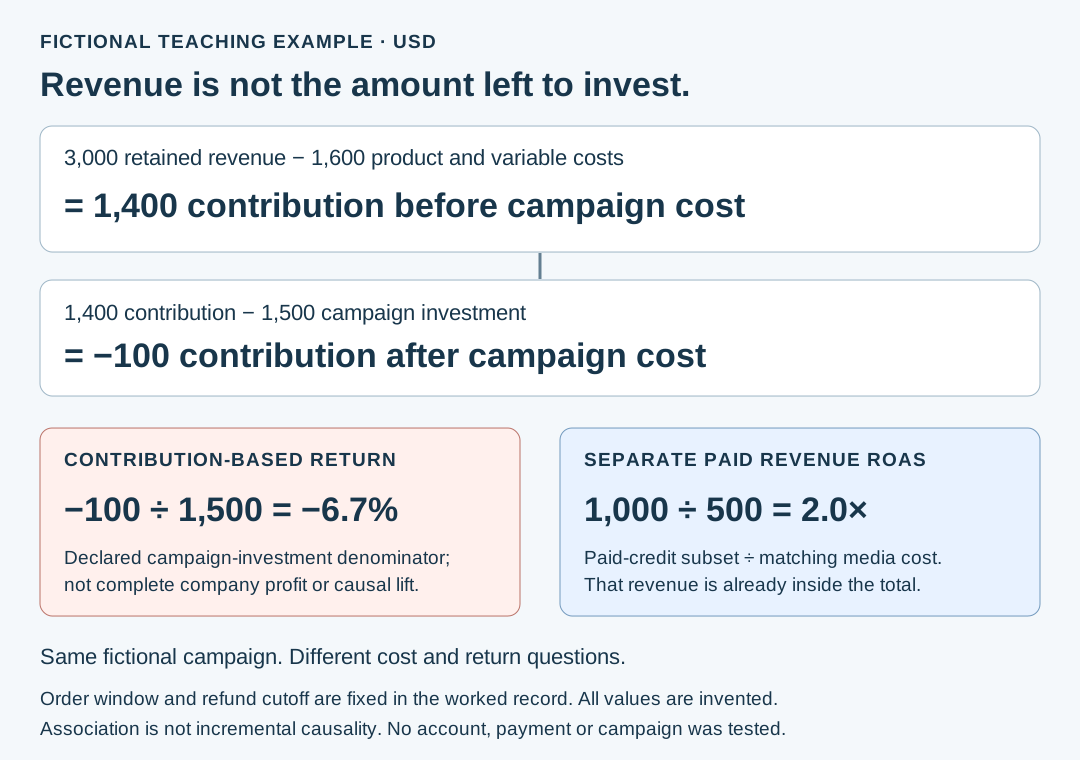
Original fictional teaching diagram; no measured campaign or account result.
Original visual by Superdirector editorial team. Creation date not recorded.
Keep paid ROAS and incremental return separate
For a tracked revenue ROAS, divide the revenue credited to the matching paid scope by that scope’s ad spend. Google’s Target ROAS explanation describes conversion value per dollar of ads; the value depends on what the account actually records. If values represent leads, assigned values or profit rather than revenue, do not rename that ratio revenue ROAS.
In the exercise, the paid-credit subset has 1,000 USD of retained revenue and 500 USD media spend:2.0× revenue ROAS. The whole campaign’s 3,000 USD revenue cannot all be divided by that 500 USD and called the paid result. The paid subset is already inside the total, so do not add its 1,000 USD again. Creator, product and other costs are not deducted by that 2.0× ratio.
Thus 2.0× paid revenue ROAS can coexist with negative contribution-based campaign ROI. Neither figure supplies the other. Do not allocate whole-campaign profit to a particular organic post or ad merely because one of its identifiers appears on an order.
Incrementality asks what would have happened without the campaign. Google’s user-based Conversion Lift documentation distinguishes treatment/control evidence from ordinary attributed conversions and describes intervals around estimates. The example above has no such comparison. A previous week, a tracking code, an attribution-model switch or an assumed lifetime value does not turn its associated contribution into causal incremental profit. A valid experiment would need its own design and outcome evidence; this worksheet does not run one.
Write the financial decision with its open questions
- State the return formula, currency, campaign/order scope, association rule, refund cutoff and cost inclusions in the same note as the number.
- Attach the revenue adjustments and cost sources. Separate verified amounts, estimates, material unknowns and later revisions.
- Keep any paid-subset revenue ROAS on its own scope. Keep unmeasured incremental return unknown.
- Name one next decision: reconcile a refund, obtain missing product cost, review an actual scope of work, or compare a later cohort under the same definition. Assign an owner and date.
An awareness campaign without verified financial return can still report its supported objective. Do not give likes or estimated media value a cash-revenue label to fill the gap. Kolsquare’s IAB UK member article makes that useful distinction: EMV is a comparison estimate, not cash. It is member-authored guidance, not proof of your campaign profit.
Superdirector can support upstream content planning around the intended outcome. Your order, payment and cost records remain the evidence for return; this article does not claim that the product verifies them or guarantees ROI. If the unresolved issue is a rate denominator rather than money, use the conversion-rate guide.
Sources and method
The complete Shopify educational article, Breef guide and Kolsquare member article were read before drafting. Their goal-first structure and investment questions informed the presentation. Revenue-only examples, secondary ROI averages, retail-valued gifts and claims about which creators perform best were not adopted as verified financial evidence.
Four complete Google primary texts support the narrow collection, attribution, ROAS and lift distinctions. Shopify help-report endpoints refused access, so no current account-report instructions are claimed from them. Sources were read November 5,2026,Pacific time; captures retain their UTC times. The cost baskets,24-line illustration, manual record and diagram are original editorial designs. No account, payment, campaign or financial outcome was tested. Retained keyword observations are historical topic research, not current traffic or citation promises.