How-To Guide
Choose a creator campaign objective you can actually measure
Choose a measurable creator campaign objective before launch. Separate exposure, qualified inquiries and verified sales, and name the gaps in your data.
By the Superdirector editorial team. Sources reviewed October 28, 2026.
At a glance
How should a team choose among awareness, qualified inquiries and sales?
Choose the strongest measure whose source, definition, owner and collection path can be checked before launch. Treat platform reach as an exposure proxy, form submission as a process measure, qualified cases as a separate business record, and sales as verified only against a reconciled order or payment authority. Keep unobserved outcomes unknown.
- Keep the business goal separate from the observable measure.
- Test the source path before launch; the future campaign value remains unknown until its own records arrive.
- Record the exact window, test receipt, decision rule and next measurement repair.
Direct answer
Choose the strongest campaign measure whose definition, owner, collection path and test you can show before the first creator post. This is a prelaunch choice of what you plan to observe; the campaign's measured value remains unknown until its actual records arrive. A platform reach count can be an exposure proxy; it cannot show that awareness increased. A submitted form is not a qualified inquiry until the client's stated criteria and case record say so. A GA4 purchase event is not a reconciled sale by itself. Keep the desired business goal in the brief even if the best measure available today sits earlier in the path. Name what remains unknown and the repair that would let the next campaign measure more.
A creator campaign can have a sales goal and still be evaluated this round on qualified inquiries. That is an honest, useful choice when the inquiry record is working and the order link is missing. Calling those inquiries “sales” would hide the very measurement gap the team needs to fix.
Start with the decision you will make
Before choosing a KPI, finish this sentence: “After this campaign, we will decide whether to ___.” Examples include inviting this creator to another brief, changing the landing task, or investing in a wider test. A metric is useful when it can inform that decision within a defined window. It does not have to pretend to measure a later outcome.
Write the business goal and the primary observable measure on separate lines. The goal might be more product sales. The current measure might be qualified demo requests because the sales team can review those requests but cannot yet connect purchases to creator traffic. This distinction follows the AMEC Integrated Evaluation Framework, which separates activity and outputs from audience responses, outcomes and organizational impact. Its planning approach starts with objectives and benchmarks; an output count does not become an outcome just because it is easy to export.
Use one primary measure for the campaign decision, then keep nearby signals as diagnostics. A tagged visit can help explain where an inquiry path failed. It should not be added to qualified inquiries as if both counted the same kind of result.
Trace the measurement path before choosing a number
A creator post, a visit, an inquiry, a qualified case and a paid order can live in five different systems. Draw the path with the owner of each record. Do not treat a gap between two systems as a zero.
| Evidence stage | Record you can inspect | What that record supports | What it does not establish |
|---|---|---|---|
| Exposure | Creator or platform report naming the metric, post, account and window | A reported reach or impression count at that platform's scope | A change in brand recognition, unique site visitors or a sale |
| Tagged visit | Destination URL and site analytics showing a campaign label in a matching window | Traffic associated with the tagged path, when collection worked | That every platform click became a visit, or that a visitor later bought |
| Submitted inquiry | Site form record and a tested submission event | A form or request was submitted | That the request meets the client's definition of a qualified inquiry |
| Qualified inquiry | A case record with predeclared criteria, reviewer, status and source link | An inquiry met those criteria within the stated window | That it became a sale or was caused solely by the creator |
| Verified sale | Order or payment authority, deduplicated and reconciled to the campaign rule | A real transaction associated with the declared campaign path | Incremental sales caused by the campaign without a suitable comparison design |
Google distinguishes generate_lead (a submitted form or request), qualify_lead (a lead marked as fitting qualification criteria) and purchase (a completed purchase) in its recommended event definitions. These events require implementation; Google says they are not sent automatically. An event name is a description of intended collection, not proof that this site or your client's site sends it correctly.
Campaign URL parameters can label referring traffic in GA4 when the tagged link and collection work. Keep the exact destination and tag convention with the brief. A tag is a label on an observed path, not a guarantee of complete attribution: people can see a post and arrive another way, and a click can fail to produce a recorded session.
Use the strongest supported branch, and stop when evidence stops
The downloadable observability decision tree turns this check into a reusable release card. Work from the desired business outcome downward:
- Can you verify a sale? Identify the order or payment authority, a deduplication rule, the campaign association rule and the time window. Reconcile a test path before launch. If those records work, “verified campaign-associated sales” can be the primary measure. It is an observed association, not proof of incremental effect. If the order link is absent, leave sales unresolved.
- Can you verify a qualified inquiry? Name the criteria before launch, the person or system that applies them, and the case record that retains the result. Test a submission and a qualification status. If both stages are observable, qualified inquiries can be primary. If only a tested
generate_leadsubmission exists, submitted inquiries can be a primary process measure when the decision is whether the form path elicits requests. Name that weaker measure plainly, keep qualification unresolved, and do not rename submissions qualified leads. If the form path also fails, continue to exposure. - Can you verify exposure? Before launch, confirm access to the creator's or platform's report and its reach or impression definition using a prior sample report. That establishes a feasible exposure-proxy plan, not a count for the future post. After publication, collect the actual report for the declared account, post and date window; only then report its count as an exposure proxy. Until that report exists, the campaign count is unknown and the business outcome remains unmeasured. A reach count is not a brand-lift study.
- If no source is reliable, mark the measure unresolved. Fix the missing report, destination, event or case link first. An empty dashboard caused by broken collection is not a zero-result campaign.
The order is about evidence, not prestige. A team should not choose “sales” merely because revenue is the ultimate goal, or choose reach merely because a platform exposes it. Choose the closest honest answer to the decision the team must make now.
When enlarged, scroll horizontally to read the diagram.
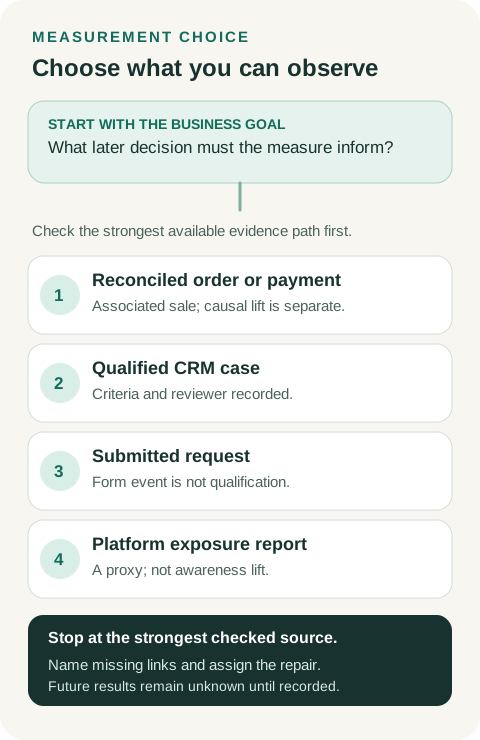
An original evidence ladder for choosing one measure. The full decision tree records the source, test and unresolved gap.
Original visual by Superdirector editorial team. Creation date not recorded.
Test the collection path without mistaking a test for performance
Before the first creator post, open the exact tagged destination on a phone and complete the intended task. Record the destination version, campaign tag and timestamp. If the primary measure depends on a site event, trigger one clearly marked internal test and check it in the analytics property. GA4's Realtime and DebugView guidance explains how to confirm that a configured key event is recorded. A successful test confirms one path at that moment; it does not prove every later visitor is counted.
Then read the next system. If the team claims qualified inquiries, verify that a test form record reaches the qualification queue, that the criteria can be applied, and that the campaign identity survives into the case record. If the team claims sales, verify that a test order can be linked without counting one transaction twice or confusing an event with the payment record. Keep test IDs separate from campaign results.
If a required stage cannot be tested, write unresolved beside it and choose a measure earlier in the path. Do not backfill an unobserved stage from a more convenient count.
Fictional example: a sales goal with a qualified-inquiry measure
This example is invented to teach the decision. It is not a Superdirector campaign, customer result or analytics screenshot. Mesa Shift is a fictional scheduling-software brand commissioning one creator video for U.S. operations teams. The business goal is paid subscriptions. The proposed video links to a demo page with a creator-specific campaign tag.
The fictional measurement map has access to a prior sample platform reach report with the metric definition; the future video's own report does not exist yet. The map also has a tested tagged mobile destination and a tested generate_lead form event. Its CRM owner defines a qualified inquiry in advance: an organization with at least 20 staff, a stated scheduling use case and a reachable contact who requested a demo. A test record can carry the campaign tag into the CRM and receive a dated qualification status. These are hypothetical setup checks, not campaign results. The brand has no reconciled order or payment link back to the campaign.
For precision, imagine an entirely fictional test receipt MS-TEST-20261028-01, recorded 2026-10-28 at 10:15 America/Los_Angeles. An internal tester opens the illustrative destination https://mesa-shift.example/demo?utm_source=creator&utm_medium=video&utm_campaign=mesa-demo&utm_content=creator-a, submits synthetic form details, sees one generate_lead test event, and confirms synthetic CRM case TEST-MS-001 retained the tag and dated qualification status. Neither ID is a real analytics or CRM record; both are excluded from campaign results. The illustrative post is planned for 2026-11-02 at 09:00 America/Los_Angeles, so the planned observation window runs from 2026-11-02 09:00 inclusive to 2026-11-16 09:00 exclusive in that timezone. If publication time changes, recalculate the window before comparing cases.
Mesa Shift therefore keeps paid subscriptions as the business goal but chooses unique CRM-qualified demo requests associated with the declared creator tag as the primary measure for this round. The numerator is distinct case IDs marked qualified under the stated rule during the planned 14-day window; the test case is excluded. The denominator is not applicable because the primary measure is a count, not a conversion rate. The CRM case record is the authority; the GA4 event and tagged sessions are diagnostics. Its decision rule is to inspect any qualified cases for buyer fit before repeating the creator brief; zero qualified cases after verified collection triggers a path review rather than a claim that the creator “failed.”
Sales remain unresolved, not zero. A tagged inquiry may later become a customer, but this setup cannot verify that outcome. Mesa Shift's next measurement repair is to carry the case ID into an order or payment record and define a reconciliation window. A later real campaign could then evaluate associated sales without retroactively claiming this round proved ROI.
If the fictional CRM qualification step were also missing, the team would stop one branch earlier: tested form submissions could be the primary process measure for a form-response decision, with platform exposure as a diagnostic once its actual report arrived. If the form path were untested too, the prior sample report could support a prelaunch exposure-proxy plan, with the future post's count still unknown. Neither setup would count qualified leads. The decision tree makes that stop visible.
Freeze the measure before publication
Put a one-page measurement card beside the creator brief. Include the business goal, primary measure and evidence tier; exact source and owner; metric or event definition; numerator and denominator (write “not applicable” for a count); campaign identity; included posts and destinations; start, end and timezone; test receipt; decision rule; and known attribution gaps. The blank CSV card and fictional filled example are plain-text copies of the asset.
After publication, compare records only at their actual scopes. Platform reach, tagged sessions, CRM-qualified inquiries and paid transactions have different units, windows and completeness. Keep missing collection unknown. If a source changes during the campaign, date the revision and avoid blending the old and new windows into one claim.
For the mechanics of tagging, use Google's campaign URL guidance. For the later client-facing summary, see the client report guide. This prelaunch choice is the earlier question: which result can the team genuinely observe, and what decision will it support?
The next decision
Take the decision tree into the campaign kickoff and complete one card before approving a measurement claim. If you use Superdirector to plan creator content, carry the selected business goal and observable measure into the brief. Your platform, analytics, CRM and payment records remain the evidence for outcomes.
Editorial source note
Editorial source note: The AMEC and Google documentation linked above supports the categories, event meanings and collection checks. The decision order, example brand, qualification criteria and 14-day window are an original teaching framework; they are not external benchmarks or claims about Superdirector's current integrations. No real campaign result or customer case is presented.