How-To Guide
What to agree before boosting an organic-only creator post
Turn one organic-only creator post into a scoped paid-use decision. Record the written change, exact-post authorization, disclosure and asset checks.
By the Superdirector editorial team. TikTok, FTC and U.S. Copyright Office sources reviewed October 29, 2026.
At a glance
What must be agreed before a brand boosts a creator post that was commissioned only for organic use?
Identify the exact post and read the original agreement. Record an accepted change for the proposed paid use: advertiser, post/account, TikTok route, markets, period, any edit or cross-platform use, consideration, renewal and stop process. Separately verify creator-side Spark authorization for that post and recheck its claims, disclosure and third-party audio in the paid context. A platform code, brand tag or organic publication receipt does not itself establish the commercial change or ad delivery.
- Pin the exact organic agreement and creator post before proposing paid use.
- Accept a written commercial change for the named advertiser, scope, period, edits and consideration.
- Verify separate exact-post Spark authorization and review claims, disclosure and third-party assets.
Direct answer
Direct answer: read the original deal and identify the exact public post before changing how it will be used. If the commission covered only the creator’s organic post, the brand and creator need a specific, recorded decision about the proposed paid use: which post and account, which advertiser and platform route, where and for how long it may run, whether the footage or creator identity may be edited or reused elsewhere, who supplies the platform authorization, what compensation or other terms apply, and how renewal or withdrawal will be handled. Then verify the separate TikTok Spark authorization for that post, review the post’s actual claims, disclosure and soundtrack in the proposed ad context, and give the ad owner a dated status. A platform code or brand-partner tag can make a post technically available to an advertiser; it does not by itself establish what the parties agreed commercially. A draft addendum, organic publication receipt or unused code does not prove commercial clearance or ad delivery.
This is a change-of-use decision for one commissioned post. The served UGC usage-rights checklist explains general grant terms and pricing considerations. The two-clock Spark guide separates the creator’s public post from later ad setup and delivery. This guide begins when a brand says, “We commissioned that post for organic use; now we want to boost that one.” Its working output is an organic-to-paid decision card, a blank CSV register, and an original decision map. The public assets contain no real deal, code, creator account or ad result.
Step 1: Pin the organic deal and the exact post
Open the version of the agreement that governed the commissioned work. Record what the creator promised to make and publish, on which account, and what the brand was expressly allowed to do with the finished content. “One organic TikTok post” may describe a deliverable but not every downstream use. Conversely, a contract may contain a broader paid-use clause even if a project brief casually calls the campaign organic. Read the actual words, amendments and agreed messages before labeling the paid scope absent or present. This guide cannot interpret an unknown contract, and the answer should be “needs deal-owner review” when the terms are unclear.
Save the exact post identity that the brand wants to amplify: platform URL, post ID, creator account, first verified public observation, present visibility, caption and the final video or post as observed. Do not substitute a draft file, an earlier post with similar footage, or a brand repost. The proposed change must point to something both sides can identify. If the post is not yet public, say “planned post” and hold the paid-use decision against the final public identity once it exists. If the creator later replaces or edits a post, keep both identities and ask whether the change applies to the replacement.
Separate three statements in the project record. First, organic delivery: the creator published the agreed post, if supported by a public or authorized receipt. Second, commercial permission: the parties agreed on a new paid-use scope, if a reviewable record says so. Third, platform authorization: the creator or their authorized route made the exact post selectable for Spark. None proves the other. TikTok’s Spark Ads overview says the format can use organic posts made by other creators with their authorization. That describes a platform route, not the content of a private commercial agreement.
The U.S. Copyright Office’s ownership overview explains why a paid commission alone should not be treated as a complete answer about rights: original works are generally owned by their creator when fixed, while ownership can also arise through qualifying work-made-for-hire arrangements or transfers. It does not decide who owns this post, whether a particular contract is work made for hire, or whether a particular paid-use license exists. If ownership or grant language matters to the change, put the actual signed documents before the deal owner or qualified rights reviewer. The operational rule is to record the authority relied on, not to guess from the fact that money changed hands.
Output: one post-and-agreement anchor in the decision card: agreement reference, exact post ID and account, current caption/asset reference, and what is known or unresolved about the original organic grant. Do not put private contract text in the public blank card.
Step 2: Write the proposed paid use in ordinary words
The brand should describe the paid use before requesting a Spark code. The creator cannot meaningfully accept “we might boost this” if the advertiser later chooses a different post, market, duration or purpose. A compact change order can say: “Brand [named entity] proposes to use [exact post ID and account] as a TikTok Spark Ad for [named campaign or purpose], in [markets], during [start/end window], with [agreed advertiser account or agency operator], under [fee or consideration and payment terms]. Other uses are [included or excluded].” Those are fields to settle, not a standard contract supplied by this article. The actual parties and their adviser decide wording, ownership and enforceability.
Specify what the brand can and cannot change. For a pulled existing organic post, TikTok’s manual/search Spark creation guide says an authorized post’s caption cannot be edited during that ad creation path and should be final beforehand. Its Spark overview says the ad’s display name and text reflect the chosen organic post. If the brand wants a different script, edit, caption, destination or call to action, name the proposed route and review the exact variant with the creator instead of assuming Ads Manager can silently rewrite the original post. The written change should distinguish boosting the existing post from uploading a separately edited file, using the creator’s identity, or cross-posting the footage to another platform. Those may require different permission and platform steps.
Define the time boundary in both the commercial record and the platform route. A thirty-day ad flight is not the same as a platform authorization that stays available longer; a code valid for a period does not commit a brand to spend for that whole period. Record proposed first-use and last-use dates, who may extend the grant, how the parties will handle a stop request, and who must confirm any extension. Avoid copying a default authorization duration into the deal as if it were the negotiated term. TikTok’s Content Suite guide says its authorization requests default to 365 days; its brand-partner tag guidance describes a different default 60-day pre-authorization route. Those are platform-route defaults, not universal Spark terms or evidence that this creator consented to the brand’s proposed commercial scope.
Settle the economic and operational terms without importing a generic percentage. The original organic fee may or may not have priced paid distribution. A new paid-use fee, included consideration, agency handling, usage caps or renewal price is for the parties to agree and record. The usage-rights checklist covers the general grant vocabulary. This article does not claim a market rate, a required surcharge, or that a platform authorization automatically changes what the creator is owed. The owner should be able to answer: “What are we buying now that the organic deal did not already include?” and point to the exact accepted record.
Output: a proposed change order with an explicit state: draft, accepted by the authorized parties, declined, or needs review. Do not upgrade a draft to accepted because a team member found the post in Content Suite.
When enlarged, scroll horizontally to read the diagram.
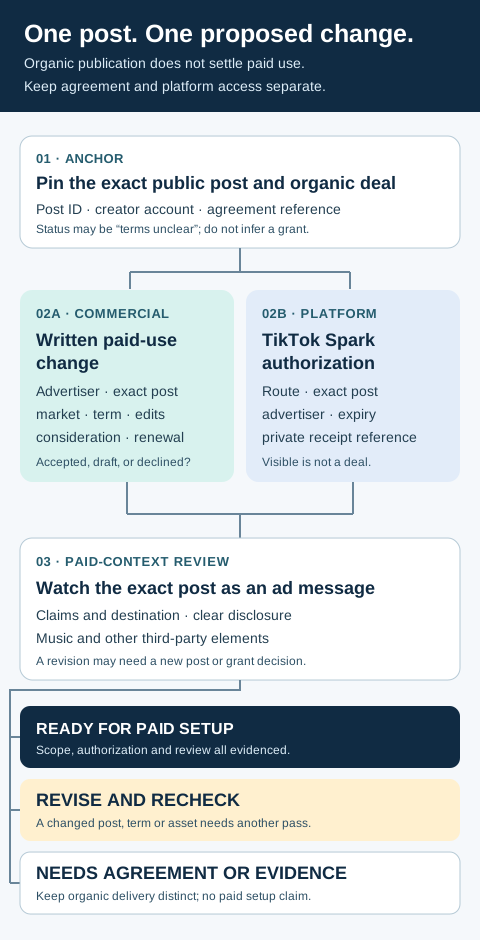
Original organic-to-paid decision map. A platform-ready post and a commercial grant are separate facts; ad delivery is a later event.
Original visual by Superdirector editorial team. Created 2026-10-29.
Step 4: Recheck the post as a paid message
The paid-use decision concerns the post viewers will actually see. Watch the video, read its caption and on-screen text, follow any visible destination, and compare the claims with current product evidence. A creator may have made a truthful personal statement for the organic context that remains truthful, but wider paid distribution can make an ambiguous line or outdated offer more consequential. Do not rewrite the creator’s opinion into a brand claim they did not make. For U.S. endorsements, the FTC Endorsement Guides FAQ says endorsements must reflect the endorser’s honest opinion and cannot be used to make a claim the marketer could not legally make.
Revisit the disclosure in the actual video and caption, not merely the deal file. A creator commissioned for an organic brand post had a material relationship already; contemplating Spark does not erase it or automatically prove that the existing disclosure remains adequate in the paid presentation. The FTC’s Disclosures 101 says a material connection should be clear, a video disclosure should appear in the video rather than only its description, and a platform’s disclosure tool alone should not be assumed enough. The qualified campaign reviewer should evaluate the post as presented to the intended U.S. audience. This article does not prescribe a universal legal phrase or claim that every disclosure is defective after amplification.
Check the soundtrack and other third-party elements separately. An organic creator post can contain music, stock images, collaborator footage, logos or another person’s appearance. A creator’s paid-use permission for their own post is not necessarily authority from every separate rights holder. TikTok’s Commercial Music Library overview says businesses cannot use its general music library for commercial usage and says other original or licensed sounds in paid content need proper license review. Record a soundtrack owner or qualified reviewer, exact asset and scope, and a clear unresolved state where evidence is missing. Avoid assuming a post that played organically can safely run as a paid ad.
Finally, confirm the post is still the same post the change order and platform grant name. A new edit, replacement post, revised caption, deleted post or changed destination can alter both the message and the evidence. If the original is no longer suitable, agree on the correction and recheck the relevant grant and platform route. Do not silently apply an earlier approval to different bytes or a different post ID.
Output: a dated content-and-third-party status for the exact paid presentation: supported, correction needed, or unresolved, with the owner and evidence reference. It sits beside the commercial and platform records.
Step 5: Decide what the ad owner may do next
Use three plain states. Ready for paid setup means the exact post is identified, the commercial change is accepted by the relevant parties, TikTok authorization for that post and advertiser is available within the intended period, and the post’s paid-context claims, disclosure and third-party elements have been reviewed with no unresolved material issue. That is an internal readiness decision for the proposed scope, not proof the ad was approved, delivered or effective. It should name the person who made it and the date.
Revise and recheck means a specific issue has a clear repair: the creator needs to correct a caption or disclosure, the brand wants a different edit, the music needs replacement, or the target period changed. State whether the proposed repair changes the original post, creates a new post, or creates a separate uploaded creative. Then re-read the written grant and platform authorization against the revised exact asset. A casual “approved after changes” note is not enough if the changes are what determine the use.
Needs agreement or evidence means the owner cannot establish the paid grant, creator consent, source rights, post identity or platform route. This is not a claim the creator refused or that the post is unlawful. It is a truthful status that blocks the team from treating a proposed paid use as settled. If the creator declines the new use, record the decline and keep the organic deliverable intact under its actual terms. Do not retroactively call the original post a paid ad or rewrite the organic agreement.
The decision card is designed for one post and one proposed paid scope. If the brand later changes market, flight, advertiser, placement, edit, platform or source file, create a new decision or an explicit amendment linked to the old one. Keeping the original row makes the history legible without inventing a second rights database. The authoritative agreement and platform receipt remain in the team’s existing private campaign system; the public blank card is only a method.
A visibly fictional organic-to-paid change order
Everything in this case is invented. “Harborline” is a fictional consumer brand, creator “Ari” is fictional, post P-17 is a made-up identity, and https://example.invalid/creator/post/P-17 is a deliberately nonfunctional placeholder. There is no real creator account, agreement, platform authorization, license, ad spend, impression, click or sale behind the story.
Imagine Harborline commissioned Ari to make and publish one TikTok post explaining a reusable water bottle’s cap. The fictional signed brief names one organic post on Ari’s account and permits the brand to link to it in its own organic channels. It says nothing clear about paid amplification, paid use of Ari’s handle, a new edited cut, or other platforms. Ari publishes the imagined post P-17, and an operator saves a dated public-post receipt. That receipt supports the organic delivery question; it does not itself answer the new paid-use request.
Two weeks later, Harborline asks its agency to “boost the good post next month.” The team first writes a proposal, not an approval: use P-17 as a pulled TikTok Spark Ad from Ari’s account; advertiser Harborline; proposed U.S. market; a proposed thirty-day flight; no cross-platform reuse or new edit; paid-use compensation and renewal to be separately accepted. This is a fictional example of fields, not recommended contract language or a suggested fee. The owner reads the post again: it has an on-video “Paid partnership with Harborline” disclosure, an ordinary product demonstration, and a music layer whose commercial-use evidence has not yet been supplied. Even if the disclosure is ultimately acceptable, the music evidence remains unresolved.
Now imagine P-17 carries a TikTok brand-partner tag that makes it appear available in Content Suite. TikTok’s documented default pre-authorization route explains why that could happen, but the agency’s card says: platform availability observed; paid commercial change still draft; soundtrack evidence unresolved. No one enters a code or launches an ad on that basis. The owner sends Ari the exact proposed change and asks the rights reviewer to check the actual music source. If Ari declines, the organic post stays an organic deliverable under its real terms. If Ari and Harborline later accept a written change, that acceptance has its own date and reference; it does not backdate the agreement to the organic publication.
Suppose, purely for teaching, the parties then accept a narrower written change for P-17 on TikTok Spark in the U.S. for a stated period, and a qualified reviewer confirms that the exact post’s soundtrack is usable for that scope. The operator still verifies that the actual platform authorization names the same post and advertiser and lasts through the intended setup period. The card can then move from “needs agreement/evidence” to “ready for paid setup” under those stated conditions. It does not say the ad passed TikTok review or delivered any impressions. If the brand instead asks for Canada or an edited cut, the scope has changed and needs another decision.
This exercise demonstrates why “Ari posted it,” “TikTok shows it as authorized,” and “the parties accepted paid use” are three separate sentences. Each can be true or false independently. The blank decision card keeps them apart; its CSV is a private-record starter, not an archive of real grants.
Common shortcuts that turn an organic post into a false paid claim
“We paid for production, so we own all use.” A production fee and a transfer of copyright or a paid-use license are different facts. The U.S. Copyright Office explains the possible ownership routes; it does not let this page decide a particular deal. Read the signed terms and amendments. If the team cannot identify the paid-use authority, keep it unresolved and ask the deal owner.
“The creator gave us a Spark code, so the commercial terms are done.” The code can be a platform authorization for a post. It does not state the brand’s fee, territories, exact ad flight, renewal, footage edits or off-platform use unless those were separately agreed. Preserve the platform receipt and the accepted commercial change as two sources.
“The brand tag is already on the post.” TikTok describes a default Spark pre-authorization from a brand-partner tag. That may make the post easy to find, but it does not tell the agency whether an organic-only private commission was amended. Look at the actual agreement and creator response before proceeding.
“The disclosure was there when the post went live.” That is a useful prior observation, not a complete current review. Watch the exact post in its paid presentation. Read the caption, check whether the in-video disclosure remains clear and the product claim remains supported, and record the reviewer’s decision. Do not treat a platform toggle as the entire U.S. disclosure analysis.
“The post is live, so its music and every visual are cleared.” Organic availability and paid third-party use can differ. Name the soundtrack and any other separately sourced element. Keep the music evidence as its own question and do not invent a license from the lack of a takedown.
“Set up” becomes “launched.” A signed change, visible authorized post, imported code or configured ad does not establish delivery. The later two-clock guide requires the matching ad record to describe paid exposure. This page ends with a scoped decision to proceed to setup.
Hand one precise decision to the ad owner
A useful private handoff reads: “Proposed paid use of [exact creator post ID and URL] by [named advertiser], through [TikTok Spark route], for [market and period]. Organic agreement [reference and scope]. Paid-use change [accepted/declined/draft/unresolved, dated reference]. Platform authorization [method, exact post/account, expiry and private receipt]. Content/disclosure [reviewed result and date]. Music/third-party material [source result or unresolved owner]. Status [ready for paid setup/revise and recheck/needs agreement or evidence]. Next owner/action [name and date].” The bracketed fields are a blank pattern, not a business claim.
After ad setup, use the existing publication-and-delivery record to say what actually ran and when. Do not report a Spark authorization as paid exposure or a visible post counter as an organic-only outcome after amplification; TikTok says paid engagement from Spark can accrue to the original post. If a client wants sales or incremental effect, that is a separate measurement design, not something the change order proves. This article claims no Superdirector connection to TikTok Ads Manager, no automated contract approval, no creator payment, and no campaign result.
Source and scope note
Current primary sources checked October 29, 2026: TikTok Spark Ads overview, manual/search Spark creation, Content Suite authorization sequence, brand-partner tag pre-authorization, TikTok CML overview, FTC Endorsement Guides FAQ, FTC Disclosures 101, and the U.S. Copyright Office ownership overview. The change-order fields and three-way decision are our editorial method. No unknown contract is interpreted here; a qualified reviewer must inspect the actual grant, third-party licenses and jurisdiction-specific obligations. The Harborline case is entirely fictional. Search volume, difficulty, ad delivery and business outcomes were not measured.