How-To Guide
Compare a creator’s bundled quote with separate video costs, line by line
Open a creator’s bundle quote into stated lines, shared work and rights, so every per-video cost is the creator’s own number or an allocation you label.
By the Superdirector editorial team. U.S. copyright statute and FTC endorsement guidance reviewed October 30, 2026.
At a glance
How can an agency compare a bundled creator quote with separate video deliverables?
Open the bundle into a ledger before dividing anything. Copy the quote as sent, split it into deliverable, shared, rights, expense and process lines, and mark each line as stated by the creator, inferred by you or missing. Then ask the creator in writing what the total becomes if one deliverable is dropped. A per-video cost is either a number the creator wrote or an allocation you label as yours, produced by one declared rule and checked against the others. Make a decision only from lines you can quote, and keep market rates, results and unwritten rights out of the comparison.
- A per-video cost is the creator’s stated number or a labelled allocation.
- Ask what the total becomes if one video is dropped; their written answer is the proof.
- Rights and expenses are lines of their own and are never folded into a video’s cost silently.
Direct answer
Short answer: do not divide the bundle total by the number of videos. Open the quote into a ledger of lines first. Copy it exactly as sent, split it into the kinds of work and rights it contains, mark every line as creator stated, we inferred or missing, and ask the creator one written question: what does the total become if one deliverable is dropped? Only a number the creator wrote can be called the creator’s cost for a video. Everything else is your allocation, produced by one declared rule and labelled that way.
This is for an agency or brand marketer holding a quote such as “three videos for one total” and a client who asks whether it beats buying the videos one at a time, or what a single video in it really costs. The decision is narrow: which of the quote’s lines you can attribute to which deliverable, and what that does to the choice in front of you. It does not say whether the total is a fair price, whether the creator’s work will perform, or whether the quote is typical. Those are different questions, and this page gives no figure for any of them.
Use the blank quote ledger card, the CSV register and the ledger map. All three are blank or fictional teaching aids. The numbers in the worked example below are invented units for arithmetic, not prices, and no real creator, quote or campaign sits behind them.
Copy the quote exactly as sent
Start with the document, not the sum. Record the quote version (a revised quote is a new quote), when you received it with a time zone, the currency, any expiry date, the total exactly as written and the inclusions in the creator’s own words. Paste the text or attach the message. A summary such as “three videos plus usage” already contains your reading of it, and you will compare your reading with the client’s question instead of the creator’s offer.
Then list the deliverables you are actually weighing, each with an ID, format, platform and due date. Copy these from the brief rather than from the quote, because a quote that says “three videos” may or may not match the three the client wants. If the quote does not name the deliverables, that is a finding, not a gap to fill silently. The method for turning a campaign request into one decision is in the one client decision guide; this page picks up after that decision exists and a quote has arrived.
Note anything the quote says about process: how many revision rounds, what happens on a reshoot, what happens if the schedule moves and what happens on cancellation. If the quote is silent, write “not stated” in the same field. A missing term is just as relevant to the comparison as a stated one, because the bundle and the separate option may carry different terms that nobody wrote down.
Split the quote into line types
Put every line of the quote into exactly one of five types, and mark each line with who stated it. The ledger map shows the same sequence as a picture.
| Line type | What it covers | Typical question to ask | Common mistake |
|---|---|---|---|
| Deliverable | Work that names one video: its own script, shoot or edit | Is this price for this video only? | Assuming every video line is equal when the quote never says so |
| Shared | Work done once for the set: concept, preparation, a single shoot day, a common edit | Does this line shrink if a video is dropped? | Hiding it inside each video’s share without saying so |
| Rights | Where, how long and by whom the finished video may be used, and any exclusivity | Which uses, channels and dates, and are they in the agreement? | Treating “includes usage” as a defined right |
| Expense | Travel, props, music or other costs the creator lists | Is it fixed, or does it change with the number of videos? | Mixing your own product and shipping cost into the creator’s fee |
| Process | Revision rounds, reshoots, rescheduling, cancellation | What changes the price after the quote is accepted? | Comparing totals while the two options carry different terms |
The who stated it mark is the safeguard. A line the creator wrote is stated. A line you worked out from other lines, such as “the rest must be shared prep,” is inferred, and an inferred line is a question for the creator, not a price. A term you expected and could not find is missing. If the quote is a single total with no lines at all, every line is missing, and the honest next step is to ask for the lines rather than to invent them.
Take rights seriously as a type of its own. The U.S. Copyright Office explains that the person who creates and fixes an original work is its author and owner and that others can get permission by buying or licensing it, and that ownership can also pass by contract. A bundle that says the videos can be “used for ads” is a rights line that needs its channels, dates and any exclusivity written down, not a free extra inside a video’s cost.
When enlarged, scroll horizontally to read the diagram.
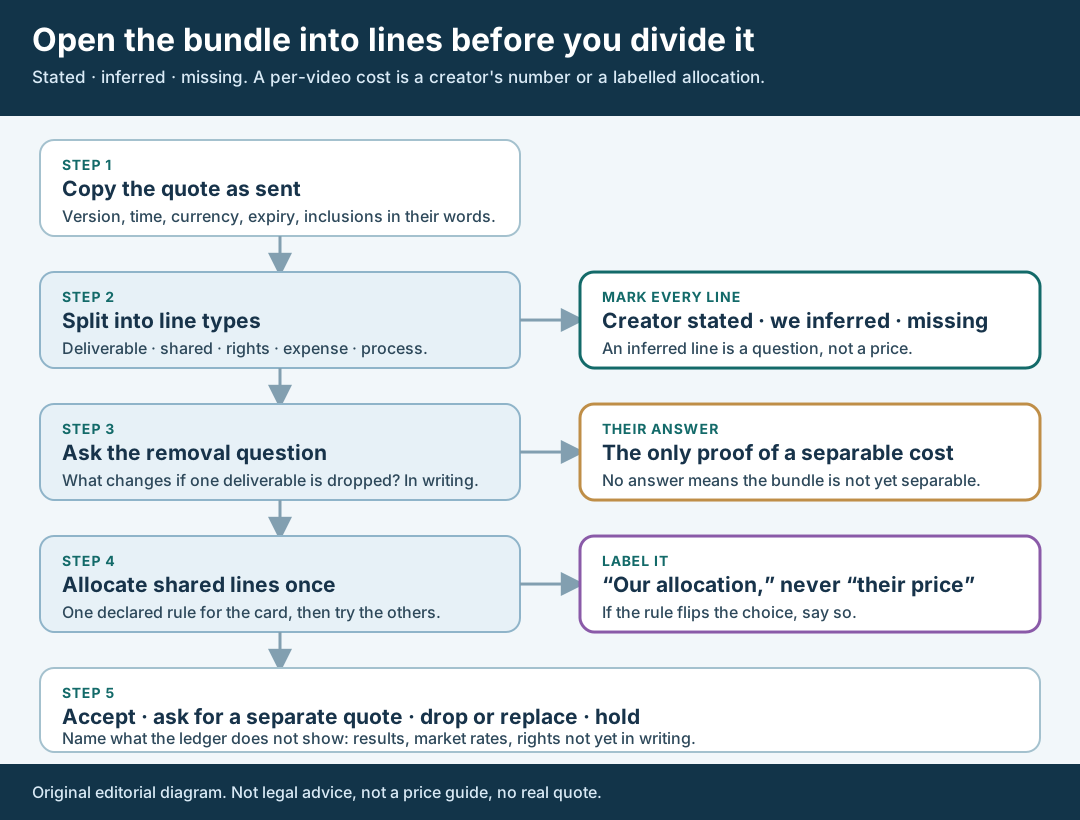
An original editorial ledger map. A per-video cost is the creator’s stated number or a labelled allocation.
Original visual by Superdirector editorial team. Creation date not recorded.
Ask the removal question in writing
Here is the step that most bundle comparisons skip. Ask the creator: “If we remove video B from this quote, what happens to each line and to the total?” Ask it once per deliverable you might drop, and ask for the answer in writing. The answer tells you what is separable. If dropping a video lowers the total by exactly the video’s stated line, that line was a real per-video price. If it lowers the total by less, part of the bundle is shared or discounted for the set. If the creator says the quote only works as a package, the bundle is the product, and a per-video cost does not exist to compare.
Record the answer as written, with the date and who confirmed it. Do not paraphrase “it’s flexible” into a number. A creator who replies “I could do two for less” has told you a second quote is possible; they have not told you what it is. Treat that as an open item and ask for the figure and the lines it keeps. You may find a creator who prefers to quote each video separately and a bundle line separately. That is also a valid answer, and the ledger holds it without change.
Ask about rights, expenses and process in the same message. Does the usage line change if only two videos are delivered? Does a travel line disappear if one shoot day goes? Do revision rounds apply per video or to the set? These answers frequently decide the comparison more than the video lines do. Keep the tone of an ordinary scoping question. You are asking what the quote covers, not asking the creator to justify the total.
If the quote will be used to authorize a platform’s paid distribution later, do not let the removal answer stand in for that. Platform authorization is a separate record, handled in the paid-use guide. TikTok’s Spark Ads page says only that the duration of a post authorization code can be customized, and it lists no durations, so do not infer a period from the quote’s wording.
Walk through a fictional bundle quote
Fictional exercise: no real brand, creator, quote or rate was inspected, and the units are invented. Brand A receives a quote from Creator Q: three videos, A, B and C, for a total of 3,000 units. The quote lists a shared preparation line of 300, three video lines of 700 each, and a paid-use line of 600. The lines sum to the total: 300 + 2,100 + 600 = 3,000. Brand A’s client wants only videos B and C and no paid use.
The shortcut is to divide 3,000 by three and call each video 1,000. That folds the 600 paid-use line the client does not want into every video. The ledger does it differently. Without paid use and without video A, the quoted lines left are 300 + 700 + 700 = 1,700, if the creator confirms in writing that dropping A and the paid-use line each removes only its own line. Under an equal split of the shared line, each remaining video is 700 + 150 = 850 units, our allocation. Under no allocation, each video is 700 stated, and the 300 shared line is shown on its own row.
Now suppose the creator answers the removal question differently: “dropping a single video lowers the total by 500, not 700.” The set was discounted, and the 700 lines were bundle prices. Dropping video A and paid use would then leave 3,000 − 500 − 600 = 1,900 for two videos, and the creator’s stated per-video figure is no longer 700. The comparison with buying the two videos separately cannot be made until the creator quotes them separately. If the creator then quotes two separate videos at a stated figure, Brand A can compare 1,900 against that figure, noting that process terms such as revision rounds must match before the two totals mean the same thing.
Nothing in the exercise says that 700 or 3,000 is a reasonable amount, that a bundle usually discounts, or how any real creator prices. The scenario shows only how the ledger changes the question from “what is a video worth?” to “which of these numbers did the creator write, and which did we compute?”
Decide what the ledger supports
Close the card with one of four outcomes. Accept the bundle when the lines, rights and process terms match what the client wants and the removal answers show nothing you would rather have separate. Ask for a separate quote when the removal answer is unclear or the creator’s lines do not map to your deliverables. Drop or replace a deliverable when the creator’s stated lines show a video you do not need, and the written removal answer confirms the total you would pay. Hold when a rights or process term is missing and the comparison would hide the difference.
Write the decision with the line IDs it rests on, the allocation rule if you used one, and whether a different rule would have changed the result. Name an owner and a date for the next step, such as the follow-up question to the creator. When the revised quote arrives, open a fresh card against that quote version and carry forward only what the creator confirmed in writing.
Two kinds of work should still be tracked as their own deliverable costs. Each post that requires a disclosure of a paid relationship needs it in that post. The FTC’s endorsement question-and-answer page says a disclosure belongs in each ad that would require one if seen on its own, and that a company which pre-approves paid posts should review them. Plan for a review step, and any revision it triggers, on every video in a bundle rather than assuming a set shares one. Review each cut against the brief with the first-cut review guide and its caption and video disclosure with the disclosure review guide.
For rights, remember how the statute is built. 17 U.S.C. § 204 says a transfer of copyright ownership is not valid unless it is in a writing signed by the owner of the rights conveyed or the owner’s authorized agent (transfers by operation of law are outside that requirement). The definitions in 17 U.S.C. § 101 include an exclusive license in “transfer of copyright ownership” and exclude a nonexclusive license. That is why an exclusivity or ownership line in a bundle is a legal term to get in a signed agreement, not a free option. The statute does not say what a given quote means or what any court would decide; refer those points to counsel.
What this page does not decide
This page is about reading one creator’s quote against the deliverables you might buy. It differs from the neighbouring guides in what it produces. The paid-use guide governs what must be agreed before a brand boosts a post that was commissioned only for organic use. The first-cut review guide governs whether a delivered cut meets the agreement. The one-sample scheduling guide governs timing around a single product sample. None of them breaks a bundled quote into lines or asks the removal question. This one does not set the rights, review the cut or plan the schedule.
It also differs from the site’s rate and budget pages, which discuss what to pay or how to size a budget. This page offers no benchmark, no typical figure and no budget advice. It takes a quote you already hold and makes its structure inspectable, so that when you tell a client what a video costs, the number has a source.
Nothing here measures how often bundles beat separate quotes, how creators usually price sets, or whether a lower cost produces better results. Those numbers are not available to us and are not claimed. The ledger asks only that a per-video cost show whether it was written by the creator or computed by you, and that rights, expenses and process terms stay visible next to the totals.