How-To Guide
Review a creator’s first cut against what was agreed, before you judge style
Sort each first-cut comment into obligation, legal gate, brief gap or preference, so a required fix always cites a signed clause or an outside rule.
By the Superdirector editorial team. FTC endorsement guidance reviewed October 30, 2026.
At a glance
How should a team review a creator’s first cut?
Review the first cut against the signed brief before judging style. Pin the brief version and the cut version, log each comment as written, then sort it in a fixed order: an obligation a signed clause names, a gate that an outside rule such as truthful claims or disclosure imposes, a brief gap the deal owner must settle, or a preference. Only the first two can be required fixes. Quote the clause or cite the outside source for each, send optional asks separately, and count a revision round only for comments the agreement actually covers.
- Test in order: obligation, gate, brief gap, preference.
- A required fix needs a quoted clause or a cited outside rule.
- Preferences are asks, and a gap in the brief is not the creator’s miss.
Direct answer
Short answer: review the first cut against the signed brief first and your taste second. Open the brief version you both agreed to, watch the cut in full, and write every reviewer comment down as spoken. Then sort each comment in a fixed order: obligation (a signed clause or accepted note names it), gate (an outside rule such as a truthful claim or a clear disclosure applies even without a clause), brief gap (the document is silent or can be read two ways) or preference (everything else). Only obligations and gates can become *required* fixes. Preferences are asks, and a gap goes to the person who owns the deal.
This is for an agency or brand marketer who has just received a creator’s first draft and must decide what to send back. The decision is narrow: what this cut owes under what was agreed, and what is merely something you would like. It does not decide whether the creator’s style is good, whether the post will perform, or whether it may be published. Those questions exist, and they have their own pages, listed in the boundary section below.
The reason to sort first is practical. A single message that mixes “the brief required a 20-second cut” with “I’d prefer a warmer opening” gives the creator no way to tell what is mandatory and what is negotiable. It also gives your team no clean record if the two sides later disagree about how many revision rounds were used. Use the blank first-cut review card, the CSV register and the sorting map. All three are blank or fictional teaching aids, and none represents a real campaign or creator.
Pin the signed brief and the exact cut
Before you press play, record two documents and one count. The first document is the brief or agreement as the creator signed or accepted it, with its version and date. The second is the exact file or link you are reviewing, with its version and the time you watched it in full. The count is which revision round this is and how many rounds the agreement allows. If the agreement does not state a number of rounds, write “not stated” rather than assuming one; that is itself a brief gap.
Then copy the deliverable in the agreement’s own words: format, length, required elements, platform, due date and anything the creator promised to show or say. Quote it; do not paraphrase it. A paraphrase quietly becomes your preferred reading of the brief, and you will end up reviewing the cut against your summary instead of the document the creator accepted. If the brief changed after signing, list each accepted change as its own note with who accepted it and when. A change one side proposed and the other never answered is not an accepted note.
Be careful with what you were told outside the document. A chat message that says “also keep it under a minute” may or may not have been accepted as a change. Record it as an unaccepted note until the creator or deal owner has confirmed it. This is the same discipline the one client decision guide applies at the start of a campaign, here applied to the review that comes after it.
Watch the whole cut once, then log comments
Watch the cut end to end with the sound on before typing a single note, then watch it again and write comments. Pausing on the first detail you dislike pushes later problems and strengths out of view, and a cut’s third beat sometimes answers the question you raised about its first. For each comment record a timecode or frame, who wrote it, and the sentence exactly as the reviewer wrote it. Do not tidy it into a request yet; the wording is the evidence for how you will sort it.
If several reviewers comment, merge duplicates only after logging them. Two people who say “the hook is slow” and “open faster” may be raising one point or two, and a team can argue about that later. Keep the original comment IDs so each line in the final message can be traced back to a person and a moment in the cut. If a comment is a question rather than a change (“is that the current screen?”), log it as a question and answer it from the record before it turns into a fix.
Reserve the rest of the review for what the cut does show. Write one line per required element in the agreed deliverable and note whether you saw it, did not see it or cannot tell. This list is your obligation checklist, and it is built from the brief rather than from the reviewers’ moods. A creator who delivered every required element in a style you would not have chosen has still delivered.
Sort every comment in a fixed order
Apply four tests, in this order, and stop at the first one that fits. The order matters because it stops a preference from borrowing the authority of a requirement. The sorting map shows the same flow as a picture.
| Lane | Test the comment must pass | Evidence you must record | What you may do |
|---|---|---|---|
| Obligation | A signed clause or accepted note names this element, length, claim, deadline or deliverable | The quoted words, brief version and date, plus what the cut shows | Mark met, not met or unclear; a not-met item is a required fix |
| Gate | An outside rule applies with no clause needed, such as a truthful claim or a clear disclosure | The outside source you read, its date and the exact moment in the cut | Require the fix and cite the source, not the brief |
| Brief gap | The brief is silent, or two honest readings exist | Both readings, side by side, and the clause they hinge on | Send to the deal owner; do not fault the creator or count the round yet |
| Preference | None of the above; it is taste, style or an idea | The comment as written and a note that no clause covers it | Ask, label it optional and let the deal owner weigh the round |
Notice what the table forbids. A comment such as “this doesn’t feel like us” cannot be a required fix unless a clause defines “feel like us” in checkable terms. A comment such as “the product name is misspelled on screen” can be an obligation if the brief requires the exact name, and may also be a gate if the misspelling misleads. Where a comment fits two lanes, record the stronger evidence and say why. Do not duplicate it into both to make the revision request look heavier.
The unclear result inside the obligation lane is useful. If a clause requires “a clear demonstration of the main feature” and you cannot agree whether three seconds of screen recording counts, write down what each reviewer would accept and escalate it as a gap. Marking it not met would convert your reading of a vague word into the creator’s failure.
When enlarged, scroll horizontally to read the diagram.
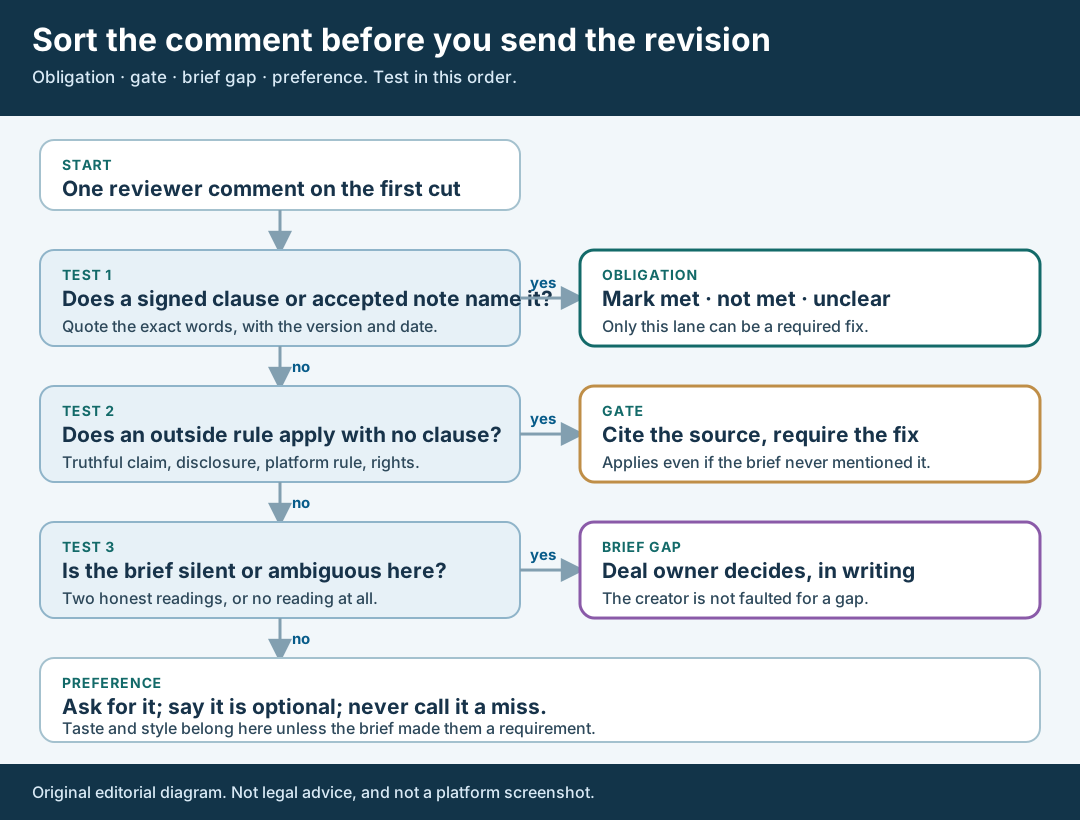
An original editorial sorting map. Only obligations and gates can become required fixes.
Original visual by Superdirector editorial team. Creation date not recorded.
Check outside rules against their own sources
Some comments do not depend on the brief at all. The FTC’s endorsement rules say an endorsement must reflect the endorser’s genuine opinions or experience, and that an advertiser can be held responsible for misleading or unsupported claims made through endorsements and for failing to disclose unexpected material connections to endorsers. The same rule says an advertiser can be liable even when the endorser is not, that instructing endorsers, monitoring and correcting problems can reduce an advertiser’s odds of facing an FTC enforcement action, and that these good-faith steps are not a safe harbor. 16 CFR 255.1 holds the exact text; read it rather than relying on this paraphrase.
For a team that pre-approves paid posts, the FTC’s own question-and-answer page says a company that pre-approves influencers’ paid posts should review them, and says the ultimate responsibility for a clear disclosure of a material connection lies with the influencer and brand, not with the platform. FTC Endorsement Guides: What People Are Asking. Reviewing a first cut is exactly that pre-approval step, so a truthfulness or disclosure comment belongs in the gate lane with that source cited.
On disclosure placement, the FTC’s influencer guide (the page is dated November 2019) says a disclosure should be hard to miss, that one in a bio, at the end of a post or behind a “more” link is likely to be overlooked, and that in a video the disclosure should be in the video itself rather than only in the description. It also says vague terms such as “collab” or “sp” are not clear. FTC Disclosures 101 for Social Media Influencers. If your cut shows a paid relationship disclosed only in a caption you have not yet seen, the correct gate comment is “disclosure not visible in the video itself,” with that page and the time you read it.
Keep the scope honest. These pages support the narrow statements above. They do not tell you that a particular cut is lawful, that a platform label is enough on its own, or what any court or regulator would decide. The FTC page on platform tools says only that responsibility stays with the influencer and the brand. If a point turns on law, send it to counsel; do not settle it in a comment thread. The claim-by-claim evidence method is in the creator product claims guide, which is the next stop for any claim that is not yet backed.
Walk through a fictional first cut
Fictional exercise: no real brand, creator, campaign or result was inspected. A made-up brand, Brand A, signed a brief with Creator Q for one vertical video of a stated length that must show the product in use and name it once on screen. A reviewer sends four comments on the first cut. Comment 1 says the cut runs several seconds over the stated length. Comment 2 says the product is never named on screen. Comment 3 says the opening “feels flat.” Comment 4 says the creator holds up a product but no paid relationship is visible in the video.
Sorting in order: comment 1 passes the first test because the brief states a length; the reviewer measures the cut, finds it over, and records obligation, not met. Comment 2 also passes test one, since the brief requires an on-screen name, so it is obligation, not met once the reviewer confirms the name never appears. Comment 3 fails tests one and two and is not ambiguous, so it is a preference: Brand A may ask for a stronger opening and must label it optional. Comment 4 does not depend on the brief at all, so it is a gate: the reviewer cites the FTC disclosure guidance and the date read, and marks the fix as required.
Suppose the brief had said “hook within the first moments” instead of naming a length. Comment 3 would then move to brief gap, because “moments” can be read as two seconds or as ten. The deal owner would write down which reading applies for this cut, and until then the creator would not be marked down. The scenario does not predict how any real creator would respond, and it carries no performance claim.
Send required fixes apart from asks
Write the message as three separate lists. The first list holds required fixes, each with its quoted clause or cited source. The second holds optional asks, worded as asks (“would you consider…”) so no one has to guess whether they are mandatory. The third is for the deal owner and holds brief gaps with their two readings; it usually does not go to the creator at all until it is decided. Put the original comment ID beside every line so you can trace it back to the log.
Then decide what counts as a revision round. Count a round only for the required-fix list the agreement covers. Do not count an optional ask, and do not count a fix the creator must make because the brief asked for something they did not deliver unless the agreement says otherwise. This is a decision for whoever owns the deal and its fees, so record it and let them confirm it rather than settling it inside the review. If the agreement states no limit, say so in the log instead of assuming one.
Finally, record what closes the round: the next version, the owner who will check it, and the date. When the next cut arrives, review it against the same pinned brief version with a fresh card, and carry forward only the items still open. A creator who fixed every required item has delivered what was agreed, even if some optional asks remain unmet. Keep that fact visible in the record so it is not lost when the next reviewer joins.
What this page does not decide
This method checks a cut against an agreed deliverable. It does not replace the checks next to it. How to write the brief in the first place is covered by the UGC content brief guide; the facts you hand a creator before they film are covered by the versioned product facts guide. Whether a footage frame shows an old interface is covered by the outdated product UI guide, and whether a crop survives each placement by the crop review guide.
Two later checks matter just as much. Verifying that the published post is the agreed one on the contracted account is in the account-to-post proof guide. Agreeing rights before a creator’s organic post is boosted is in the paid-use agreement guide. Passing a first-cut review is evidence on one question only: *did the cut meet what was agreed?*
Nothing here measures how often teams disagree about briefs, how many revisions are normal, or how well any rubric predicts post results. Those numbers are not available to us and are not claimed. The page is an editorial method for keeping obligations, outside rules, gaps and taste apart, and it asks only that a required fix show its evidence.