How-To Guide
Shortlist creators around the buyer's task instead of a broad creator category
Turn one buyer task into inspectable behaviors, check each candidate's actual work against them, and record match, mismatch and unknowns.
By the Superdirector editorial team. TikTok One's creator-discovery guide (updated June 2026) and YouTube's Advanced Mode help page reviewed October 30, 2026. The worked example is fictional.
At a glance
How can a team shortlist creators around the buyer's task instead of a broad creator category?
Write the buyer task as one observable action, turn it into two or three behaviors a reviewer can see in a clip, then inspect each candidate's dated works against those behaviors. Record observed match, observed mismatch and unresolved separately, with the URL and capture date beside each reason. Category labels and bios only suggest where to look. Reach, audience, rights and availability are separate questions asked after the content review, and the result is a per-candidate decision, not a prediction of sales.
- Define the task and product version before opening any search results.
- Judge the clip's visible behavior, not the creator's category label.
- Keep match, mismatch and unresolved as three different entries.
Direct answer
Short answer: begin with what your buyer needs to *see done*, not with the type of creator you want. Write that need as one observable action, list the two or three things a clip must visibly show for it to help, and then check each candidate's actual works against that list. Record what matched, what did not, and what you could not tell. A creator advances because their observed work addresses the task, not because a search tag, bio or follower filter put them in the results.
This page is for an agency or brand sourcer holding a long list returned by a broad category search. It does not rank creators, estimate sales or predict a result. It also adds no view-metric rules: for comparing numbers across platforms, use the YouTube creator metrics worksheet. For filtering a specific game-creator search, see the Steam horror demo shortlist. For scoring broad account signals later, use the 100-point vetting rubric. The question here comes before both: does this creator's work show the thing our buyer needs to understand?
Use the original flow diagram, the blank task-fit matrix card and the blank CSV register. They are empty teaching and recording tools. No row in them is a real campaign, creator or result.
What the platform guides do and do not support
TikTok One's guide to finding creators, last updated June 2026, describes searching by a keyword such as a topic, narrowing results with filters for creator details, audience details and performance metrics, and sorting by fields like follower count, engagement rate or most recent posts. It tells advertisers to watch a creator's recent organic and sponsored videos to judge content style, quality and brand fit before choosing, and it describes an Add to shortlist button that saves creators to a list for later review.
That supports one narrow point: discovery tools are expected to be followed by looking at actual videos. It does not say what counts as a fit for your particular product job, and it does not claim that a topic keyword equals expertise at a task. Search results show who has posted *about* a keyword. Whether a given video demonstrates your buyer's action is a judgment you make from the video. The matrix on this page is Superdirector's own method for making that judgment visible and repeatable. It is not a TikTok feature.
YouTube's Advanced Mode help page describes comparing content, groups and date ranges and filtering by format, such as Shorts, in a channel's analytics, on computer web browsers. Those are a creator's own analytics reports. A public post does not expose a format-filtered report to you. If you want that kind of evidence for a candidate, ask the creator to supply it, label it as creator-provided, and keep it out of the content-fit columns. The two guides justify one habit: know which data you can observe yourself and which has to be handed over. They do not justify a single cross-platform ranking formula, and this page does not offer one.
Write the buyer task as one observable action
A buyer task is not "reach people who care about productivity." It is something a person is trying to do, or a question they are trying to answer, that your product helps with. Write one sentence that a stranger could watch happen: "A small shop owner imports a spreadsheet of orders, sees one row rejected, corrects it and prints the batch." If the sentence contains only adjectives about the audience, it is a target description, not a task, and a reviewer cannot check a video against it.
Then anchor it to facts that stop the task from drifting. Record the product and version the task uses, because a workflow shown for an older release may no longer match what the buyer will touch. Record the intended user in plain terms, the source of the task (a support thread, a sales call note, a product walkthrough) and its date, and the operator's reason it matters. If the task came from a real customer conversation, keep the private details in your own campaign record and put only a redacted version in anything you share. If you cannot name a source, say so on the card; an unsourced task is a hypothesis.
Check that the task matches what the product really does. A creator who convincingly shows a feature you do not have, or one that works differently in your current build, creates a mismatch that no amount of enthusiasm repairs. If footage might show an outdated interface, the outdated product UI guide covers that check once you are at the review stage.
Translate the task into two or three visible behaviors
A task is too abstract to check, so split it into the content behaviors that would let a viewer understand or complete it. Two or three is the useful range: with more, every candidate fails something and the matrix stops discriminating; with one, you are back to a category. Good behaviors are things you can point to in a clip. Examples are showing a setup similar to the buyer's, explaining an objection the buyer is likely to have, or walking through a comparable workflow from start to finish rather than a highlight.
Write each behavior so that "yes" and "no" are distinguishable. "Explains the product well" is a taste judgment. "Shows the error state after a bad input and then shows the fix" is checkable. Also decide in advance what counts as *partial*. If the creator shows the fix but cuts away before the result, the behavior is partly observed, and the matrix should say so rather than round it up.
Keep behaviors about the content and not about the creator's identity. Avoid proxies such as "is a professional" or "has a similar job to the buyer." Those may be true and still tell you nothing about whether the clip does the task. If the buyer's context really does depend on who is speaking, write the observable cue instead, such as "mentions a comparable setup in their own words." The creative brief guide is where these behaviors later become instructions; at the shortlist stage they are only criteria.
Search broadly, then capture exact clips
Discovery should be wide, because the creators who show your task may not carry the category label you expect. Use platform search, keywords from the task sentence rather than only the product category, and any filters your team already trusts. Treat every result as a lead. A tag, a bio line or a keyword hit is a reason to open the profile, and it never counts as evidence in the matrix.
For each lead, find the specific works that could show the behaviors and save: the exact URL, the capture date and time with time zone, the format (short, long, live replay, carousel, text post), and a one-line description of what is on screen. Works change, get edited or deleted, so a dated capture is what you actually reviewed. Prefer at least two works from a candidate when they exist, and compare candidates against the *same* task rather than against each other's general impressiveness.
Look at both organic and sponsored works if the platform shows them, since TikTok's own guide points to both. They answer different questions: an organic clip may show how the creator naturally handles the subject, and a sponsored one how they handle a brief. Neither tells you the creator is available, would accept your terms, or holds usage rights. If the creator cannot be named in what you share, get permission to describe them in redacted form, or do not present the example as a real case.
Apply the fit-evidence matrix to each clip
For each captured work, take the required behaviors one at a time and write what the clip actually shows. Use three separate entries: observed match (the behavior is visible, with where and what), observed mismatch (the clip shows something that conflicts with the task, such as the wrong product version, a different workflow or a claim that contradicts the product), and missing evidence (you could not tell because the clip does not reach that point, cuts away, or is unavailable to you). Do not net these against each other. A clip can have strong matches and one serious mismatch, and both stay on the page.
| What you see in the clip | Entry | What it supports |
|---|---|---|
| The required step is performed on screen, start to finish | Observed match, with timestamp or position | That this creator has demonstrated the step in this work |
| The step is described in words but never shown | Partly observed; the missing part goes under missing evidence | That they talk about it, not that they demonstrate it |
| The clip shows an older interface or a different workflow | Observed mismatch, with the reason | That this work does not match the current product task |
| The category and tags fit, but the relevant moment is absent | Missing evidence | Only that the creator operates near the subject |
| Comments or tone suggest a certain viewer | A cue in the voice or audience column, marked unmeasured | A prompt for a question to the creator, not a fact about their audience |
Record voice and audience cues if you notice them, but label them as cues. The way a creator speaks, what they assume the viewer already knows, and what viewers ask in comments are observable, and they can help you write a better follow-up question. They are not audience composition. Audience data you may need later comes from the creator or the platform's own reports, and it belongs in the follow-up column. Mixed-quality or inconsistent clips stay inconsistent in the record; do not average them into a single score.
When enlarged, scroll horizontally to read the diagram.
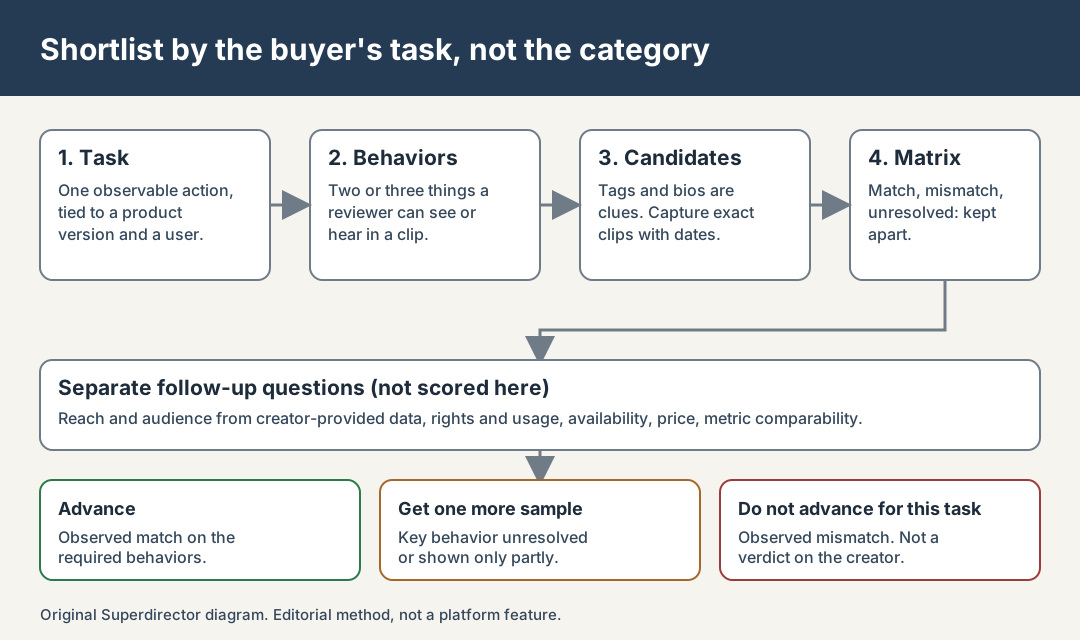
An original flow for shortlisting by task. Reach, rights and availability are follow-up questions, not part of the content-fit entries.
Original visual by Superdirector editorial team. Creation date not recorded.
Walk through a fictional example
Everything in this example is invented to show the method. "Parcelmark 2.4" is a fictional shipping-label app, and "Candidate A", "B" and "C" are fictional creators. No clip, number or outcome here exists. The buyer task, from a made-up support note, is: *a small shop owner imports an orders spreadsheet, sees one row rejected, corrects it and prints 40 labels on a 4-by-6 roll.* The required behaviors are (1) shows importing a spreadsheet with at least one bad row, (2) shows the rejection message and the fix, and (3) shows the print step on a roll-style printer.
A broad search for "small business shipping tips" returns many creators. Candidate A posts weekly packing tips and has a tag that matches the category. In the invented clip, A talks about saving time on labels but never opens an import screen: behavior 1 is missing evidence, 2 is missing evidence and 3 is missing evidence. The category fits and the clip shows none of the task. The decision is not to advance on this clip, with a note to look for a second work only if A's other works plausibly cover it.
Candidate B has no shipping tag. Their invented clip is a back-office walkthrough in which they import a spreadsheet, hit a rejected row and correct a date format, then cut to the result. Behavior 1 is an observed match, behavior 2 is an observed match, and behavior 3 is missing evidence because the clip ends before printing. B advances to a second-sample request: "Do you have a work that shows the print step on a roll printer?" Candidate C shows the whole sequence, but on a fictional version 1.9 interface that no longer has the same import screen. That is an observed mismatch on product version for behaviors 1 and 2. C is not advanced for this task, which says nothing about C's quality. A later task on a different version could change the answer.
Notice what the exercise did. The broadest category match (A) produced the weakest evidence, a creator with no label (B) produced the most relevant, and an apparently perfect clip (C) was disqualified by a version fact the tag could not show. Because none of this is real, it demonstrates the reasoning and not a rate of how often such things happen.
Keep reach, rights and availability as separate questions
The matrix answers one question: does observed work address the task? It deliberately says nothing about whether the creator can reach enough of the right viewers, whether they are free, whether your price works or whether you may reuse their video. Give each of those its own column or its own later review so a strong content match cannot hide a missing answer, and a weak number cannot erase a good demonstration.
When you do reach for numbers, make sure they are comparable first. View, engaged-view and unique-viewer figures differ by platform and by who reports them, which is the subject of the metrics worksheet. If the creator supplies format-filtered analytics, record who supplied them and when. For account-level screening that spans many candidates, such as consistency and audience-quality signals, the vetting rubric is the later tool. Run it on the people who survive the task-fit review.
Also keep the creator's future content claims separate from their past demonstrations. A clip that matches the task does not verify what a sponsored sentence will say about your product. The product claims check belongs to the drafting stage, after the shortlist.
Write the shortlist note for each candidate
Close with a short note for every candidate you examined, including those you drop. Use three decisions: advance (the required behaviors are observed and no serious mismatch stands), get one more sample (a key behavior is unresolved, shown once, or partly shown), and do not advance for this task (an observed mismatch, or nothing relevant after reasonable looking). State the reason in one or two sentences that cite the work and date, and name the single piece of new evidence that would change the decision.
Then list the open follow-ups for each advancing candidate: audience and reach questions to ask the creator, rights and usage terms, availability and price. These are questions, not findings. If you later paste the shortlist into a platform's saved list, such as the shortlist feature TikTok's guide describes, the matrix note is what explains *why* each person is on it. A reviewer who inherits the list should be able to reopen each cited work, see the same dated observation and either agree or disagree with a stated reason.
One last caution on honesty. Do not turn a fictional or hypothetical row into evidence of how well creators like B perform, and do not publish a real comparison unless the buyer task is permissioned and any creator names are cleared or redacted. If you do not yet have a real task and at least two real inspectable works, use the blank card to practice on your own material and keep the output internal.