How-To Guide
How agencies verify a sponsored post’s creator account
Match a sponsored post to the creator account in the agreement. Record a dated receipt and classify the account link as verified, mismatch or unresolved.
By the Superdirector editorial team. Official platform sources reviewed October 28, 2026.
At a glance
How can an agency verify that a sponsored post came from the contracted creator account?
Save the exact contracted platform account first. Open the live post, record its URL and post ID, follow or read its platform author, and compare that account with the saved account using an account/channel ID where genuinely available or a dated profile-path observation. Note the method, time, viewer context and any coauthor rule. Classify the account match as verified, mismatch or unresolved. A screenshot or familiar display name alone is not an account-bound publication receipt.
- Compare the exact platform post with the account frozen in the agreement.
- Name the observation method, time and viewer context.
- Leave a screenshot-only or role-ambiguous match unresolved.
Direct answer
Direct answer. Save the platform account named in the agreement before publication. When the creator sends a post link, open the *live post*, record its exact URL and post ID, and compare the post's publishing account with that saved account. Use account or channel IDs when the platform and authorized access expose them; otherwise record precisely how the visible author and profile were matched. Save the observation time and viewer context. A screenshot, a tag, a familiar display name, a brand repost, or a post appearing on a collaborator's profile does not by itself establish that the contracted account published it. If the connection cannot be established, mark the account match unresolved, not delivered or failed.
The check answers a narrow question: *which platform account is attached to this post at the time we observed it?* It does not establish who controlled the account, whether the creator met every contract term, whether a disclosure is adequate, or whether the post drove a sale. A later edit, deletion, privacy change, or platform reassignment can change what a reviewer sees. Keep the dated receipt rather than treating a current page as a permanent record.
Freeze the account the agreement actually names
Before anyone sends a post link, record the platform, the agreed creator profile URL, the handle as it appeared at agreement time, and a platform account or channel ID if your authorized workflow exposes one. Save the contract or accepted brief reference and the agreed posting surface: for example, the creator's own TikTok profile, a YouTube channel, or an Instagram Reel under an agreed account. State whether a coauthored Instagram Collab post or a brand repost would satisfy the deal. Do not silently treat those as equivalent to a creator-origin post.
The display name is useful context but a weak join key. YouTube, for example, distinguishes its unique ID-based channel URL from a chosen handle URL; the handle can change. A saved youtube.com/channel/... identity gives the reviewer a better account anchor than a name or current @handle alone. YouTube's channel-URL guide and channel-ID guide describe those fields. For other platforms, record only IDs the account owner or an authorized platform integration actually supplies. Do not guess an internal ID from the text of a public URL.
If the agreement only says “post on your account” and names no profile, resolve that missing identity with the deal owner before calling any later post a match. A creator can legitimately operate multiple accounts, and a manager can discuss a campaign without deciding which account will publish. Account selection belongs in the agreed deliverable record. A later authorized change should have its own date and evidence; it should not rewrite the original account field.
Use the strongest account link each platform permits
YouTube. For a YouTube video, the Data API video resource exposes snippet.channelId, the channel the video was uploaded to, and Videos: list can retrieve that snippet for an exact video ID. Compare that channel ID with the contracted channel's saved ID-based URL or owner-supplied ID. This is stronger than matching channel titles. Google's resource documentation says channelId can change in special cases such as reassignment to a topic or artist channel; date the readback and investigate a later mismatch rather than claiming IDs can never change. An ordinary reader without API access can open the video, follow its channel link and compare the linked channel, but should label that as a visual/profile match rather than an ID readback.
TikTok. A public TikTok post page can show the current author account, so a reviewer can follow its author link and compare the profile against the contract anchor. A stronger account-bound check is available *only if the creator authorized an approved integration*: TikTok's Display API reads a consenting user's profile and public videos, and its v2 video-query endpoint verifies whether specified video IDs belong to that authorized user. The setup guide requires developer-product approval and granted scopes. TikTok's current Get User Info field table says basic scope returns an app-scoped open_id and display name, while username and profile_deep_link require the additional user.info.profile scope. To bind the consenting account to the contract, compare one of those granted public-profile fields with the contracted profile, or use an open_id that was already verified against it at agreement time; a display-name match alone is unresolved. Then query the exact video ID under the same authorization. Without that first join, a positive query only ties the video to whoever consented. This is not a public lookup for arbitrary creators. If your team has no such connection, do not claim an API match. A Spark Ad authorization or ad preview is a separate paid-use record, not a substitute for observing the promised public post.
Instagram. Meta says accepted Collab posts and Reels can appear on each collaborator's profile grid and reach their audiences. Therefore, “I saw it on the creator's grid” does not always prove that the creator account originated the post. Inspect the post's displayed account relationship and compare it with the agreement's rule for sole publication versus coauthorship. If the deal specifically requires the creator to originate the post and the public interface cannot establish that role, request a permitted account-side publication record or leave the origin question unresolved. Do not invent a public Instagram API field or treat a paid-partnership label as an origin receipt.
These are methods, not an assertion that Superdirector has a connected account or can read these APIs for a particular campaign. A direct public observation and a creator-authorized API readback have different strengths. Record which one was actually used.
Make one dated account-bound publication receipt
The blank receipt worksheet and CSV header prompt for the minimum join. Store any completed copy in the campaign's private system; the public files are blank. A useful receipt contains:
- Contract anchor: agreement reference, platform, contracted profile URL, handle at agreement, account/channel ID if actually known, agreed surface and coauthor rule.
- Live post: supplied URL, final URL, exact post ID or shortcode, author/coauthor profile reached from the post, and visibility in the declared viewer context.
- Observation: checked-at time with time zone, method (public profile path, platform metadata, or authorized owner readback), source or capture reference, and reviewer.
- Decision: verified same account, observed different account, or unresolved, with a reason and next check. Record content approval, disclosure, usage rights and paid delivery elsewhere; they are different decisions.
The account-to-post diagram shows the join. It is an editorial decision aid, not a platform-issued certificate.
Use verified only when the exact post and its account relationship match the agreed account role (sole publisher or permitted coauthor) under the evidence method you recorded. Use mismatch when a live post is demonstrably attached to a different account and no agreed coauthor or account change explains it. Use unresolved when the link is inaccessible, the profile changed without a reconciled identity, the only proof is a screenshot, or the platform view cannot distinguish the role the contract requires. “Unresolved” is a request for better evidence; it is not a fraud accusation. Even a verified account match leaves content, timing, disclosure and rights checks open.
When enlarged, scroll horizontally to read the diagram.
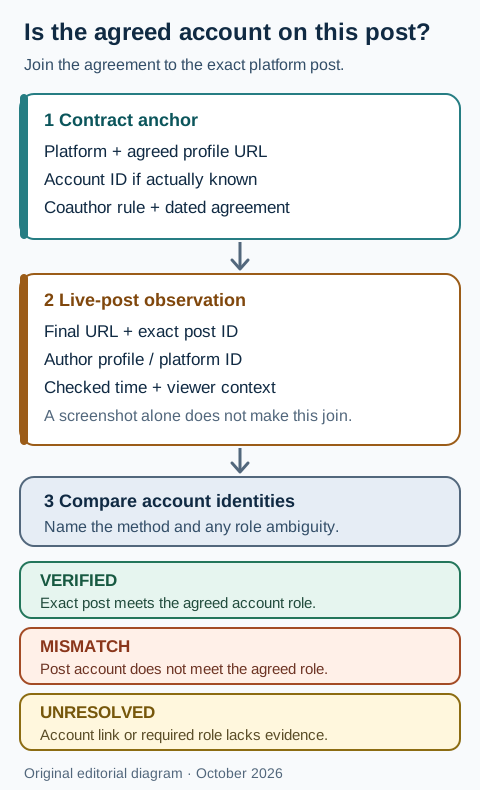
Original account-to-post proof map. Date the platform observation and state which identity relation was actually checked.
Original visual by Superdirector editorial team. Creation date not recorded.
Handle the cases that make a screenshot misleading
Consider three hypothetical decision patterns, with no real account or campaign data:
- A brand reposts the creator's approved file on the brand profile. The file may be correct, but the post's publisher is the brand. If the agreement required the creator profile, this is an account mismatch until the contracted post exists or the deal owner records a different agreed route.
- A creator changes their handle after agreement. A different
@handleis a reason to investigate, not automatic proof of a different account. On YouTube, compare the video-associated channel ID with the saved channel ID. On a platform without that readback, seek account-side evidence or a dated, authorized account change; otherwise leave the match unresolved. - An Instagram Collab appears on both the brand and creator grids. Meta's product design permits that appearance. If the deal allowed a coauthored post, check the exact agreed role and live account labels. If it required creator-origin publication and the available view cannot identify the origin, keep that point unresolved even though the post is visible on the creator grid.
Do not replace the receipt when a post is edited, deleted, made private, or reposted. Add a new dated observation tied to the same or a new post ID. At the client-report cutoff, re-open the exact URL and state its current status separately from the earlier observation. The client social media report guide asks for actual publication links and agreed versus published units; this receipt is the evidence that should support one such row. The crop review guide covers whether the selected creative remains legible; it does not establish who published it.
What to say in the client report
“The exact post at [URL and ID] was reachable by [observation time and time zone] in [viewer context]. Public visibility was [checked result]. Its platform author/profile was compared with the contracted [account URL/ID] using [method and source]. Account-to-post status: [verified / mismatch / unresolved]. The exact first-publication time, continuing visibility, content acceptance and paid delivery are separate checks.”
Replace the brackets with a real private receipt. Do not copy a creator's credentials, access tokens, private agreement terms or customer identifiers into the public worksheet. This guide does not supply a verified customer case or campaign result.
Source and scope note
The platform-specific statements above come from official YouTube channel URL, YouTube video resource, TikTok Display API, TikTok authorized video query, and Meta Collabs documentation, checked October 28, 2026. The receipt fields and three-way decision are our editorial method. No actual creator post, account connection, search volume, delivery outcome or performance result was measured for this article.
Frequently asked questions
How can an agency verify that a sponsored post came from the contracted creator account?
Is a creator-supplied screenshot enough to count the post delivered?
What if the creator changed their handle after the agreement?
channelId are one example. When an equivalent readback is unavailable, seek a dated authorized account-change record and leave the identity link unresolved until it is supported. Do not silently replace the agreement's account.