How-To Guide
How to combine creator cash, product cost and ad spend into one campaign cost
Build a spend ledger by category and status, add the ad platform's spend as one line, then divide by one defined outcome. Components first, ratio last.
By the Superdirector editorial team. TikTok and Google Ads help pages reviewed October 30, 2026.
At a glance
How should a team combine creator cash, product cost and paid media when reporting campaign cost?
Build a ledger of actual spend from your own invoices, receipts and agreements: creator cash, product and shipping, commission, usage rights and other external costs. Mark each line paid, owed or estimated and count only paid or owed lines with a document. Add the ad platform’s spend as one line, matched to an invoice or payment. Divide the total by one defined outcome in one counting window. Print the components first, then the total and the ratio, and withhold the ratio if any line is missing or the currency is mixed.
- Count actual spend by category, never an estimated media value.
- A platform’s own spend figure is one ledger line, not the whole cost.
- Print components before the ratio, and withhold the ratio when a line is missing.
Direct answer
Short answer: do not take the campaign cost from an ad dashboard. Build it from your own ledger in five moves. List every cost line from your invoices, receipts and agreements. Give each line a status of paid, owed or estimated. Add the ad platform’s spend as one line among the others. Define one outcome and the window it is counted in. Then print the components first, then the total, then the ratio of total actual spend to the outcome count, and hold the ratio back if a line is missing or the currency is mixed.
This is for an agency or in-house marketer who has to report one cost number to a client or a manager after a creator campaign that mixed fees, a sent product and some paid promotion of the posts. The decision is narrow: which amounts enter the numerator, and when you may print a ratio at all. It does not choose the outcome, set a fee, judge whether the result was good or say what any of it is worth. Those questions have their own pages, listed in the boundary section.
The reason to insist on actual spend is that a single blended number hides which part moved. A ledger with statuses lets a reader see the parts. The blank cost components card, the CSV ledger and the cost map keep them in one place.
List every cost line from your own ledger
Open the records you hold, not the ones a platform holds, and write one line per payment or obligation. Each line carries a category, the payee, the document it comes from, the amount in the currency written on that document and the campaign it belongs to. A line without a document is a note, not a ledger line, so mark it as a note until you find the paper behind it.
Use a small, fixed set of categories so two people sort the same item the same way. Creator cash is what the agreement says the creator is paid in money; if the agreement names a production fee and a posting fee, keep them as separate lines, as in the production and posting fee ledger. Product and shipping is what you spent to send the item, covered below. Commission is what you paid or owe on sales the creator’s link or code brought in; a gifted product and a commission are different components with different triggers, as the gift and commission page sets out. Usage rights is a fee charged for letting you run the creator’s post as an ad, and only if the agreement prices it apart from the creator’s other fees. Other external invoices cover anything else a third party billed you for this campaign, such as an agency charge or a courier.
A creator quote that bundles several things into one total should be opened before it goes in the ledger. If the bundle states its parts, use the parts. If it does not, enter the bundle as one line and say so, and do not invent a split. The bundle quote comparison explains how to open one without dividing it blindly.
For the product line, write the basis next to the amount. It might be the purchase invoice for the units you sent, a landed cost your finance team has stated, or the outbound shipping receipt. State which. If your client has agreed to report the product at retail price, that is a different basis and the report should say so.
Keep the reporting currency to one. If a document is in another currency, record the amount as written and the conversion you used, with where you took the rate from and the date. If you cannot say where the rate came from, leave the line in its original currency and mark the total as mixed.
Mark each line paid, owed or estimated
Give each line one of three statuses and a status date with its time zone. Paid means money has left, and you hold a receipt or payment record. Owed means you have an invoice, or an agreement clause whose trigger has happened, but you have not yet paid. Estimated means you expect to pay an amount you have not yet been billed for, or the amount rests on a quote you have not accepted.
Only paid and owed lines with a document enter the total. Estimated lines stay in the ledger, shown in their own labelled column, and appear on the report beside the total instead of inside it. This is the rule that keeps the figure honest when a campaign is still running.
Be strict about what is not a cost line at all. An estimated media value, meaning a guess at what comparable exposure might have cost to buy, is not money you spent. A quote you declined is not a cost. A price you expect a creator to ask for next time is not a cost of this campaign. If the client wants the estimated media value on the page, put it on its own line labelled as an estimate, with its method and source, and keep it out of the total and out of the ratio. This page does not say how to compute such an estimate, and we are not endorsing one.
Watch for lines that change status after the report is written. A commission is the usual example, because it is owed only as sales arrive and may be reversed if your agreement says returned orders do not count. Date the report, state which lines were estimated on that date, and plan a re-read. If a creator’s usage term is still running, the rights line may also continue; see the paid usage term page for what to write down before the term starts.
Add ad platform spend from its own report
If you promoted creator posts as ads, the platform’s spend is one line in the ledger, and it is the one line where the platform’s report is the natural source. Name the report, the date range, the currency shown and the date and time you read it. Then match it to something you can hold: an invoice, a statement or a payment record. A dashboard figure you cannot match to a payment is an observation, and it should be marked that way.
Read what the platform says its figure covers. TikTok’s basic metrics and definitions page, last updated October 2025, defines cost as total ad spend, defines cost per conversion as the average amount spent per conversion, and defines conversions as the number of times an ad resulted in the selected optimization event. Google Ads Help, on understanding conversion tracking data, says cost per conversion is calculated by dividing total cost by the Conversions column, applies only to eligible interactions such as ad clicks or video ad views, and says the primary conversion columns are based on the time of the click, not the time of the conversion.
Notice what those definitions describe: the spend and conversions inside that ad account. None of the passages we read names a creator’s fee, a sent product or shipping, and we make no claim about what a platform does or does not include beyond the wording above. That is the whole reason the ledger exists. A platform’s cost per conversion can be accurate as defined and still be a fraction of what the campaign cost you. Your report should say plainly that the platform figure is the paid media line.
Meta’s Business Help Center has pages named “Amount spent” and “Cost per result”. We could not load either page while preparing this article, so we make no statement about their wording. If you run Meta ads, read both yourself, then record the page name and the date you read it on the card, as you would for any platform.
Be careful with promoted creator posts. TikTok’s Spark Ads FAQ, updated June 2026, says Spark Ads publish ads using organic posts made by other creators with their authorization. The page we read did not address what an advertiser pays the creator for that authorization. Whatever you agreed with the creator belongs in your creator cash or usage rights line, not in the platform line, and the organic-to-paid agreement page covers what to settle first. For separating a post’s organic and paid delivery, use the organic and paid results page; this page deals with money, not delivery.
When enlarged, scroll horizontally to read the diagram.
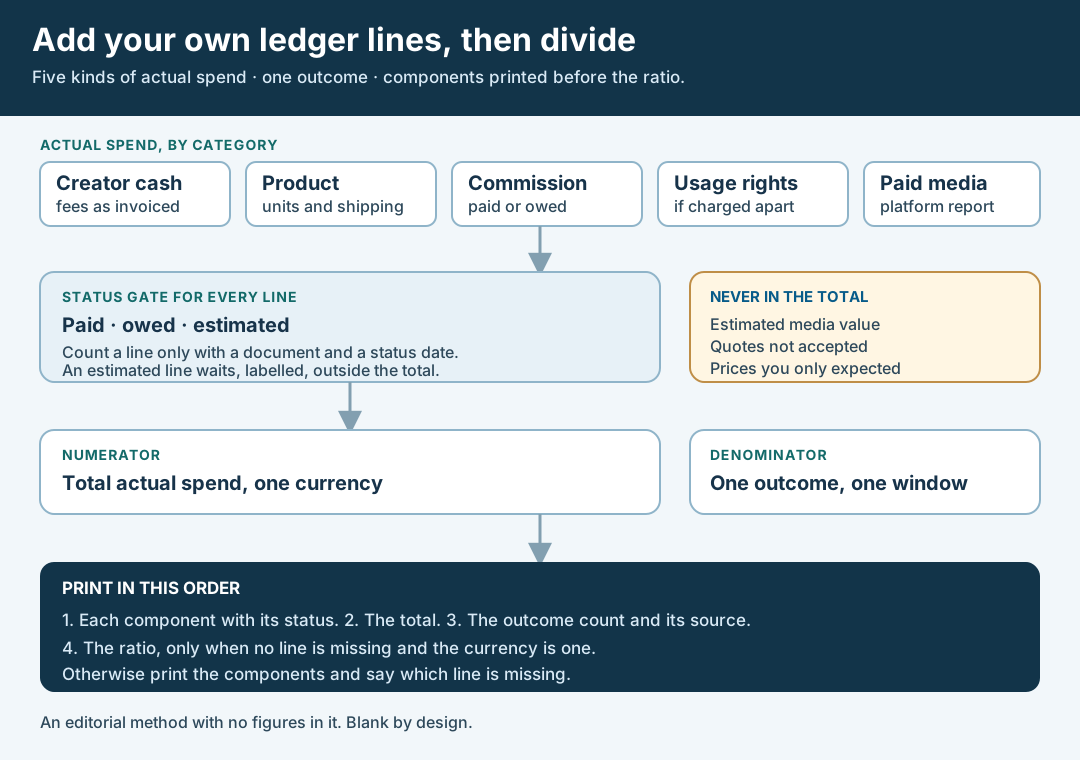
An original editorial map. Components are printed before the ratio, and estimates stay outside the total.
Original visual by Superdirector editorial team. Creation date not recorded.
Name one outcome and its counting window
A ratio needs a denominator someone else could check. Write the outcome as something a person did, name the system of record that counts it, say what does not count, and fix the start and end dates of the window. The conversion event page shows how to write that definition before the first post, and the observation window page shows how to set the dates. This page only needs you to have both done.
Read the count once, from that system, on a stated date, and write the date on the card. Do not combine counts from the ad platform, a coupon report and a link tracker by adding them, because one person can appear in all three. The one-order-once page handles that problem. If the count is still moving, say that the window is open, and expect the ratio to change when you re-read it.
Check that the spend and the outcome cover the same period and the same campaign. Fees paid before the first post and product sent weeks earlier belong to the campaign even though the outcome window starts later, so state the spend period separately from the outcome window. A reader should never have to guess whether the ledger includes money that was spent before the window opened.
Use one outcome per ratio. If the campaign had two goals, such as sign-ups and purchases, print two ratios from the same total and name both denominators. Dividing the same spend by two different outcomes is fine; dividing by a sum of two different outcomes is not, because the result describes no action a person took.
Walk through a fictional report
Fictional exercise: no real brand, creator, campaign, amount or result was inspected, and the letters stand for amounts you would fill in. A made-up brand, Brand A, ran one campaign with Creator Q. The ledger holds a creator cash line, amount A, from a paid invoice; a product line, amount B, from the purchase invoice for the sent unit, with its basis written as “purchase invoice”; a shipping line, amount C, from a courier receipt; a commission line, amount D, owed but not yet paid; and a platform line, amount E, read from the ad report on a stated date and matched to a card statement.
A quote for a second video, amount F, was never accepted, and a colleague’s note says the post “got about as much exposure as an ad that would cost G.” The reviewer puts F in the ledger as an estimated line outside the total, and puts G on a separate, labelled estimate line, also outside. The total actual spend is A + B + C + D + E, with D marked owed. The outcome is a defined action recorded in the brand’s own order system within a fixed window, and the count is N, read on a stated date.
The reviewer prints the five components with their statuses, then the total, then N and its source, and last the ratio (A + B + C + D + E) ÷ N. Because D can still change, the report states the date and says D is owed. Had the courier receipt been missing, the reviewer would have printed the components and named C as the missing line without printing a ratio. The exercise predicts nothing about any real campaign.
Print components first, then the ratio
Lay out the report in a fixed order. First, each component with its category, status and status date. Second, the total actual spend in one currency. Third, the outcome count, its definition, its system of record and the date you read it. Fourth, the ratio, written as total divided by count, with the two numbers beside it. Fifth, anything outside the total: estimated lines, unaccepted quotes and any estimated media value, each labelled.
Print the ratio only when four conditions hold. Every line the agreements say should exist has a document. The currency is one. The outcome is defined and counted from one system. And the spend period and outcome window are both written down. If any condition fails, print the components alone and say which one failed and who will fix it. A report that says “ratio withheld, shipping receipt missing” is more useful to a client than a ratio that quietly leaves shipping out.
Where the outcome count is zero, there is no ratio to print, because dividing by zero describes nothing. Print the total and the zero, and let the reader draw the obvious conclusion about the campaign without a number that implies a result.
Close by dating the report and saying when it will be re-read. If the ratio disappoints, the next test page shows how to check the measurement before blaming the creator. The cost report is the record of what was spent; it is not an argument about why.
What this page does not decide
This method builds a cost number from actual spend and decides when it may be printed. It does not set a fee, judge a quote, define the outcome, value the exposure or tell you whether a ratio is good. It is also not accounting, tax or legal advice: how an expense, inventory or a commission is booked is for your finance team and your adviser, and what counts as a cost under an agreement is for the agreement.
It differs from the closest existing pages. The bundle quote comparison opens one creator’s quote into lines before you decide anything; this page begins after the money has moved and combines categories into one report. The production and posting fee ledger records two creator fees against a signed agreement, which is one category on this page’s ledger. The gift and commission page separates two forms of compensation by trigger and proof, whereas this page costs them. The organic and paid results page separates delivery, not money, and the conversion event page defines the denominator that this page only consumes.
Nothing here measures what a creator campaign should cost, what a typical ratio is, or how product cost compares with fees. Those numbers are not available to us and are not claimed. We also did not verify Meta’s metric definitions, and we make no statement about how any platform bills for creator-authorized ads. The page is an editorial method for keeping actual spend by category, its status and one defined outcome apart, so every number in a cost report can be traced to a document.