How-To Guide
Record a creator’s production fee separately from the posting fee
Build a fee ledger that ties the production fee and the posting fee to separate clauses, triggers, proofs and payments from the signed agreement.
By the Superdirector editorial team. FTC endorsement rule and TikTok One help pages reviewed October 30, 2026.
At a glance
How should a brand record a creator’s production fee separately from a posting fee?
Work from the executed agreement. Copy the sentences for what the creator must make and what they must publish, and record each amount as written, or mark it as one total or silent. Give each fee line its own trigger event in the agreement’s words, one openable proof for that trigger, and its own payment record with a bank or provider reference. Keep owed, approved to pay and paid as separate states. Where only one obligation is met, quote the clause or record that the agreement is silent and ask the deal owner to decide. Never split a single total, and keep rates, rights and tax questions out of the ledger.
- One line per obligation, each with a quoted trigger and its own proof.
- Owed, approved and paid are three states, not one checkbox.
- If the agreement is silent, record the gap and ask the owner; do not invent a rule.
Direct answer
Short answer: when one agreement pays a creator for both making a video and putting it on their account, record two fee lines, not one. Give each line its own amount as written in the signed agreement, its own trigger event (what must happen before it is owed), its own proof and its own payment record. Call the first the production fee and the second the posting fee only if that is how your agreement is organised; if the agreement uses one lump sum, write “one fee, not split” instead of inventing a split.
This is for a brand marketer or agency coordinator who holds an executed creator agreement and must keep the books honest. The decision is narrow: which obligation does each payment belong to, and what proves that obligation was met? It does not decide whether a fee is reasonable, what a creator should charge, or who owns the video. No market rate appears on this page, and none is implied.
The reason to separate the lines is practical. A creator can deliver an approved video and then never post it, or post a version that was not the approved one. If your ledger holds a single amount, nobody can say which half was met. Use the fee-components ledger card, the blank CSV register and the ledger map. All three are blank or fictional teaching aids; none shows a real creator, brand or payment.
Quote the two obligations from the signed agreement
Start from the executed agreement and any signed amendments, not from the quote, the email thread or a summary. Find the sentences that describe the creator’s work and copy them word for word into two columns. In the first column put what the creator must make: the video or other asset, its format and length, the required elements, the number of revision rounds and the delivery date. In the second put what the creator must publish: the account, the platform, the date or window, how long the post stays up and any tag, link or label the creator must include.
Then copy the money sentences beside them. Record every amount as written, in the stated currency, and say whether the agreement ties it to a specific obligation. Three outcomes are common and each gets a different note. The agreement may name two amounts, one per obligation. It may name one total and describe both obligations. Or it may name amounts for some things and leave others silent. Mark each case plainly: stated per obligation, one total or silent. Do not divide a single total to create two numbers. If you need a labelled working split, the bundle-quote guide explains how to keep an allocation visibly yours; here, the ledger should hold only what the signed words support.
Keep the boundary with other costs. Fees for the agency’s own work belong in a separate column, as the agency work versus creator deliverables guide describes. Rights to reuse the video, such as boosting it as an ad, are a third question, and the paid-use agreement guide covers it. If the agreement bundles a rights fee into either line, write that down as a note on the line; do not move it silently.
Finally, record the document identity: file name, version, date signed, who signed for each side, and where the executed copy is stored. When a payment is questioned months later, this is the page you open first, so it should be findable by someone who was not in the original thread.
Give each fee its own trigger event
A fee is only meaningful with a condition attached. For each line, write the event that makes it payable, using the agreement’s own words. A production line commonly depends on delivery or acceptance of the finished asset, while a posting line commonly depends on publication. Those are examples of what to look for, not a standard to impose: read what your agreement actually says, and where it says nothing, record trigger not stated.
Some platforms show why the distinction is worth the care. TikTok One’s help article on creating a creator marketing project (last updated March 2026, as shown on the page) says that after the creator accepts the invitation the advertiser clicks Pay now, that only after payment can the creator begin creating the video, that the platform collects and holds the payment, and that it is paid out after the advertiser’s approval of the video. TikTok One: create a Creator marketing project. The same page also says that after the video is published, payments held by the platform are paid out to the creator. The page does not explain how those two release events fit together, so a team that relies on it has to read the project’s own terms to know which applies.
That example supports one narrow point: a single deal can name several distinct events, such as funding, approval and publication, and a ledger should not blur them. It does not say that TikTok One has a “production fee” and a “posting fee”, that other platforms work the same way, or that your agreement follows this flow. A direct deal outside any platform is governed by its own signed words.
Write the trigger so a stranger could test it. “On delivery” is vague; “when the creator sends the final file and the brand confirms in writing that it meets the brief” can be checked. If the trigger depends on a person’s judgment, name who decides. If it depends on a date, state the time zone. If two readings are honest, do not choose one; record both and send the question to the deal owner, in the same way a first-cut review treats a gap in a brief.
Attach one proof to each trigger
Every trigger needs a piece of evidence you can open, because a payment justified only by memory cannot be audited. Use a different proof for each line, since each trigger is a different fact. The table shows examples of what a team might keep; adjust it to your agreement.
| Line | Trigger written in the agreement | Proof to attach | What the proof does not show |
|---|---|---|---|
| Production fee | Delivery or acceptance of the asset | The delivered file name and version, the date received and the written acceptance message or approval record | That the post exists, or that it matches the accepted file |
| Posting fee | Publication on the named account | The live post address, the capture date and time with time zone, and the account it appears on | That the accepted version was posted, unless you compared them |
| Either line | Any condition the agreement adds, such as a hold period | The clause, the date the condition ended and who confirmed it | Anything not written in the clause |
| Neither | Silent or ambiguous trigger | Both readings and the clause they hinge on | A decision; the deal owner must make it |
Notice that the two proofs can disagree. An accepted file and a live post are separate facts, so it is possible to hold proof for the production line and none for the posting line. That is exactly the situation the ledger exists to show. For the posting proof, the account-to-post verification guide shows how to confirm that a public post is on the contracted account, and the disclosure caption and video guide covers how to check what a live post says about the paid relationship.
Be careful about screenshots of dashboards you do not own, and about anything private to the creator. Record only what you were entitled to see, and keep signed documents and payment details in your own secure workspace. A capture is evidence of what appeared at that time, not of what the post looked like earlier or later.
When enlarged, scroll horizontally to read the diagram.
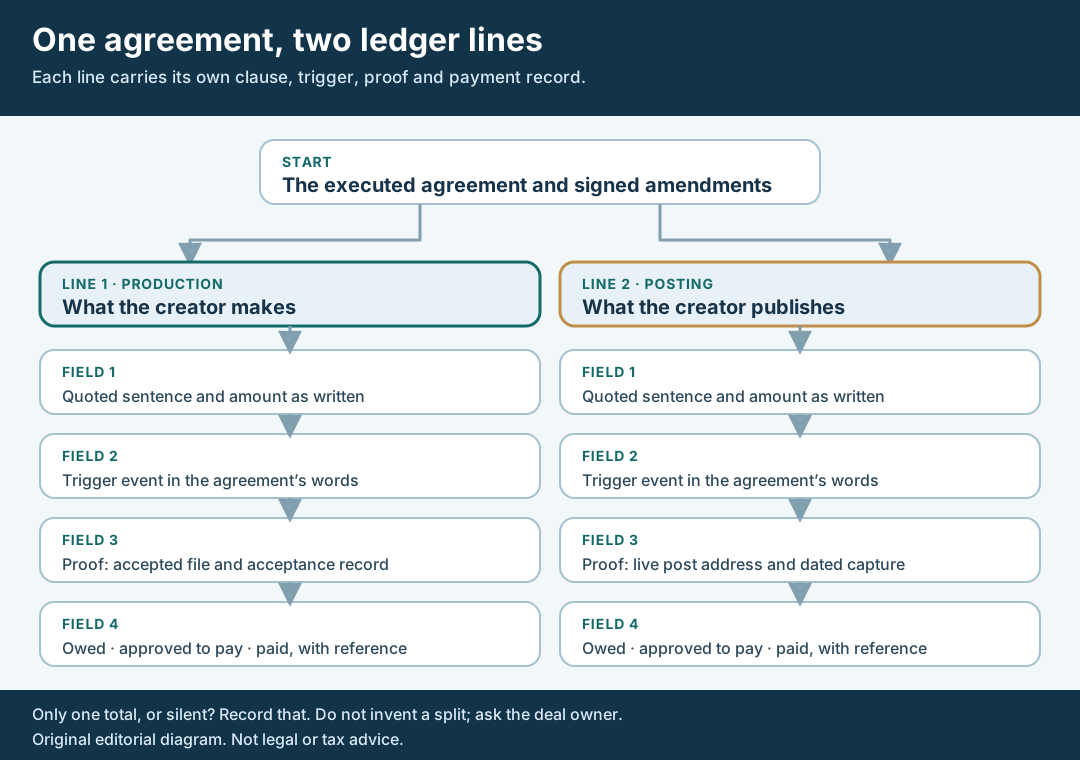
An original editorial ledger map. Each fee line carries its own clause, trigger, proof and payment record.
Original visual by Superdirector editorial team. Creation date not recorded.
Record each payment against its own line
Now record the money. For each payment, note the line it settles, the amount and currency, the date sent, the method, the payer entity, the reference on your own payment record and the person who approved it. Add the remittance or receipt reference that your bank or payment provider produced, not just your intention to pay. If the creator sent an invoice, store its number and date, and note which line it claims; an invoice that mixes both lines should be recorded as a claim for each, with the amounts the agreement supports.
Keep three states apart for every line: owed (the trigger proof exists), approved to pay (a named person has accepted the proof) and paid (a payment record exists). Teams often collapse these into a single “paid” checkbox, which hides whether a payment preceded its proof. If your agreement requires payment before work starts, as some platform flows do, record that as the stated trigger for that payment and keep it distinct from the later events. TikTok One’s help page describes upfront payment for that flow, but only as that platform’s mechanism.
The FTC’s endorsement rule matters here for one reason. 16 CFR 255.5 says material connections can include monetary payment or free or discounted products, and gives an example of a paid social media post that should disclose the arrangement. FTC Disclosures 101 for Social Media Influencers says the same about a brand paying an influencer. So a payment on either line is a fact that your disclosure check should know about. Keep the ledger entry and the disclosure review in step. This page does not say which fee triggers a disclosure duty or how a disclosure should read; read the sources and send legal or tax questions, including how payments are reported, to qualified advisers.
Write what happens when only one obligation is met
The reason to keep two lines becomes concrete in the cases where one is met and the other is not. Before any dispute, write down what your agreement says for each case. Use one row per case and quote the clause. If it says nothing, write silent and ask the deal owner to decide, in writing, before money moves.
| Case | Questions to answer from the agreement | Ledger entry |
|---|---|---|
| Asset accepted, not posted by the stated date | Is the posting fee owed, held or void? Is there a cure period? Who decides? | Production line proof present; posting line status and the clause quoted |
| Posted, but not the accepted version | Which version was posted, and does the agreement treat that as met? | Both file versions side by side; owner decision |
| Asset delivered, not yet accepted | Is the production fee owed on delivery or on acceptance? How many revision rounds remain? | Trigger text; review round count |
| Post removed or edited later | Does the agreement set a minimum time online? Who confirms it? | Capture history; clause; owner decision |
| Deal cancelled midway | Does the agreement state amounts by stage? | Stage reached with proof; clause quoted |
A platform’s published cancellation terms show how explicit a stage-based rule can be. TikTok One’s cancellation article (last updated February 2026, as shown on the page) says that for Creator Projects, an advertiser who cancels after an Order is agreed but before content is submitted receives a 90% refund, one who cancels after content is submitted but before final approval can cancel for a 50% refund of the total fee, and that once content is delivered and approved full payment is required. Advertiser Cancellation Process for Collaborations in TikTok One. Those are that platform’s terms for its own orders. They are not a norm for direct creator agreements, and you should not copy the percentages into your ledger. The useful lesson is that the rule was written by stage, so the ledger can follow it.
When the agreement is silent, avoid writing a convenient rule into the ledger. An honest entry reads “agreement silent on posting after accepted delivery; owner decision requested on this date.” The record then shows a gap, not a verdict, and the creator is not marked down for a term nobody wrote.
Walk through a fictional two-line agreement
Fictional exercise: no real brand, creator, agreement or payment was inspected, and the amounts are blank placeholders. Brand A signs an agreement with Creator Q for one vertical video. The agreement names an amount [X] for making the video, payable when Brand A accepts the final file in writing, and an amount [Y] for publishing it on Creator Q’s named account, payable once the post is live. It also says the video must remain online for a stated number of days.
Brand A’s coordinator opens the ledger. Under production, the quoted trigger is written acceptance; the proof is the final file name, the date received and the accepted message. Under posting, the quoted trigger is the live post, and the proof is the post address plus a capture with date, time and time zone. Brand A pays [X] after the acceptance message exists and records the bank reference on the production line. The posting line stays at “owed: no proof yet.”
Suppose the coordinator then finds that the post went live but uses an earlier cut than the one Brand A accepted. The posting proof exists, but the posting trigger asked for publication of the accepted video. The coordinator does not decide alone. The ledger entry reads “posted; version differs from accepted file; agreement text quoted; owner decision requested,” and [Y] is not recorded as paid until the owner answers. If the agreement had said only “post the video,” the entry would read “silent on which version” and go to the owner the same way. Nothing here predicts how a real creator would respond or what any post would earn.
What this page does not decide
This page records two obligations and their payments. It does not replace the checks beside it. Comparing a bundle quote helps before signing, when you are weighing a total against separate videos. Reviewing the first cut decides whether a delivered asset meets the agreed deliverable. Paid-use agreement covers the right to run the video as an ad, which is neither fee line unless your agreement says so.
It also does not tell you what a production fee or a posting fee should be, whether splitting a fee is customary, or how common any trigger is. We have no benchmark data and make no claim about rates. It is not legal or tax advice: whether a payment is correct under an agreement, how it is reported or taxed, and whether a clause is enforceable are questions for counsel and your finance team.
The method asks for one discipline: every amount in the ledger is tied to a quoted sentence, a trigger you can test, a proof you can open and a payment record you can find. Where any of the four is missing, the entry says so.