How-To Guide
How to separate a gifted product from affiliate commission in a creator offer
Split a creator offer into a gifted product and an affiliate commission, each with its own trigger, proof and disclosure wording, in a blank components table.
By the Superdirector editorial team. FTC pages reviewed October 30, 2026.
At a glance
How should a team separate a gifted product from affiliate commission in a creator offer?
Treat them as two components in a table, not one blended perk. For each, write what the creator receives, the clause it comes from, the trigger that gives or earns it, who decides, the proof you keep, what the creator keeps if there is no post or no sale, and its own disclosure wording. The gift is in kind and does not depend on a sale. The commission is a payment that depends on a qualifying sale under the program terms. Then check the live post against both lines, because the FTC’s Q&A page says that saying only that you got a product for free suggests you got nothing else.
- Make two rows: the gift and the commission, each with its own source clause.
- Give each row a trigger, a decider and a proof, so shipping never counts as a sale.
- Agree disclosure wording per component and check the live post against both.
Direct answer
Short answer: write the creator offer as a table of components, and put the gifted product and the affiliate commission on separate rows. For each row record what the creator receives, the clause it comes from, the trigger that gives or earns it, who decides the trigger is met, the proof you keep, what the creator keeps if there is no post or no sale, and the disclosure wording agreed for that row. The gift is value in kind that is handed over whether or not anyone buys. The commission is a payment that exists only if a qualifying sale happens under the program’s written terms. They are two sources of value with two sets of obligations, and blending them into one “perk” is how teams lose track of what was promised.
This is for an agency or brand marketer about to send a creator an offer that includes both a product and a link or code that earns commission. The decision is narrow: how to keep the two components apart on paper, from the offer through the live post. It does not set a commission rate, value a product, choose a flat fee or decide what any disclosure must say. Those belong to your program, your finance lead and counsel, and the boundary section lists the pages that sit next to this one.
Use the blank components card, the CSV register and the component map to keep the two rows apart. Everything here is a method. It contains no sample rate, no sample product value and no result from a real campaign.
Split the offer into separate components
Start with the offer as it was actually written or said, and list everything of value the creator is to receive. Most offers that mix a product and a link have at least two items, and sometimes more. Give each item its own row and its own name. A row named “perks” hides two different things, so name the rows after what they are: “gifted product” and “affiliate commission”. If something else is promised, such as a flat fee for the post, add it as a third row and keep it apart too.
For each row, write what the creator receives in plain words, and quote the clause from the agreement or the program terms that creates it. For the gift, that is the product, the quantity and the version you named. For the commission, that is the program’s own statement of what earns a payment, copied from its terms rather than summarized. If a row has no source clause, write “no clause” and treat it as an open question for the deal owner, not as something the team can assume.
| Question for each row | Gifted product | Affiliate commission |
|---|---|---|
| Kind of value | In kind: the product itself | A payment, contingent on a qualifying sale |
| Depends on a sale? | No; given whether or not anyone buys | Yes; none without a qualifying sale |
| Source to quote | The clause naming the product, quantity and version | The program’s written terms for what earns a payment |
| What you can know at the time | Exactly what was sent | Nothing yet; it depends on later orders |
| Typical open question | Does the creator keep it if they do not post? | What counts as a qualifying order? |
The last row of the table is deliberately a question, not an answer. This page does not know your terms. If you are still deciding whether to send product at all, the unsolicited sample request guide covers that decision, and the shipping address guide covers asking for an address only for a real shipment.
Give each component its own trigger and proof
A trigger is the event that makes a row real. Write one per row, and make sure the two are different events. The gift’s trigger is usually that the product was sent or that the creator confirmed receipt. The commission’s trigger is a qualifying sale through the creator’s link or code, as your program defines qualifying. If both rows share one trigger, such as “when the post goes live”, you have probably merged them again.
Next to each trigger, write who decides it has happened and what proof you keep. For the gift, the decider might be the person who ships and the proof a carrier or receipt record you hold. For the commission, the decider is the program’s own rules, and the proof is the program’s order or payout report, not the creator’s screenshot and not your guess from site traffic. The sale-side record is where the coupon code and tagged-link reconciliation guide picks up when a code and a link both claim an order. For the same two-obligation discipline applied to fees, see the production fee and posting fee ledger.
Then write what the creator keeps if the trigger never comes. If the creator posts and no one buys, the gift row is unaffected and the commission row has nothing to pay. If the creator does not post at all, the agreement may or may not say what happens to the gift. Do not fill that gap with a guess. Write the sentence from the signed terms, or write “not stated” and ask the deal owner before the offer goes out. The component map shows the two lanes side by side so that a reviewer can see at a glance that one is conditional and one is not.
When enlarged, scroll horizontally to read the diagram.
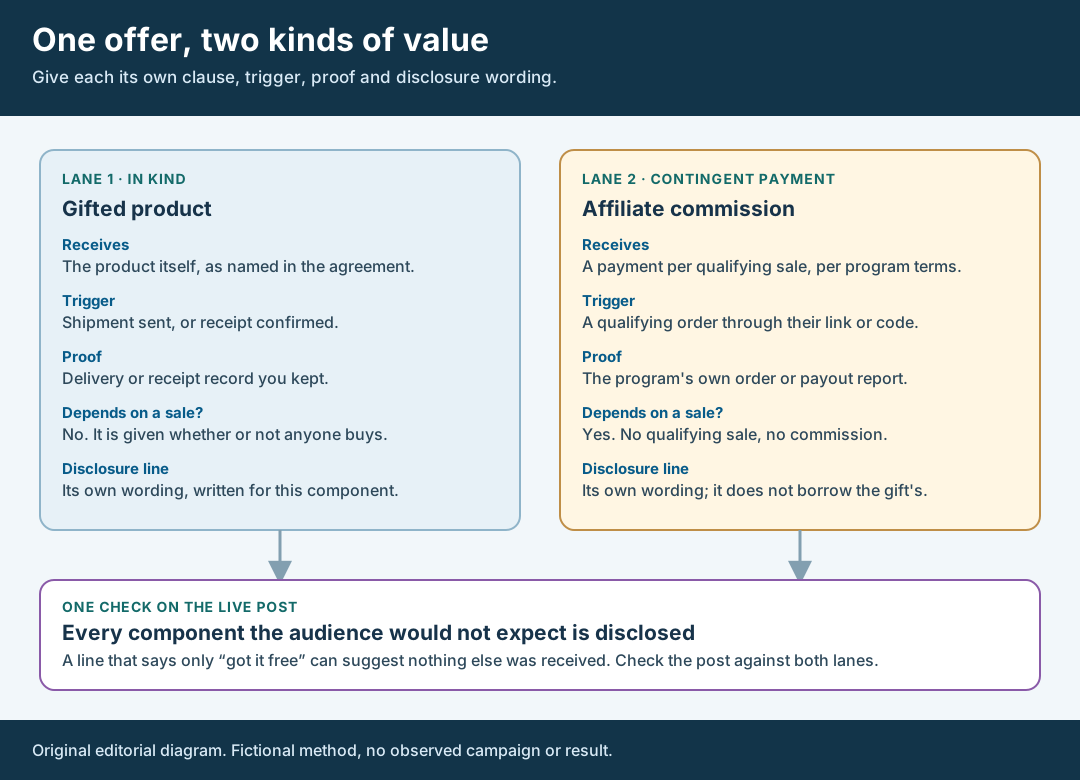
An original editorial map. The gift is in kind and unconditional; the commission is conditional on a qualifying sale. Each has its own disclosure line.
Original visual by Superdirector editorial team. Creation date not recorded.
Write the offer to the creator in two parts
The offer the creator reads should mirror the table. Put the gift in one paragraph: what is being sent, that it is given on the terms in the agreement, and what is expected in return, if anything. Put the commission in a second paragraph: how the creator’s link or code works, what earns a payment according to the program terms, and where those terms live. Link or attach the terms instead of paraphrasing them. A paraphrase becomes your promise, and a creator who reads “you earn on every sale” will hold you to it.
Keep the sentence about what is not promised in the commission paragraph. A link or a code does not guarantee that any sale will happen, and the offer should not imply otherwise. Say so in the same plain voice as the rest, and do not attach a number you cannot support. This page does not suggest one; a rate belongs to your program terms.
If the creator has asked about money before scope, or answers with a counter, the budget reply guide and the bundle quote comparison cover that exchange. Here the point is only that whatever you agree, each component keeps its own paragraph in the written record, and the creator can answer each one separately. A creator who is happy with the gift and unsure about the link should be able to say so without the thread collapsing into a single yes or no.
Attach disclosure wording to each component
Each component can create a connection the audience would not expect, so each needs its own disclosure line. Under the FTC’s endorsement rule on material connections, a connection that might materially affect the weight or credibility of an endorsement, and that the audience does not reasonably expect, must be disclosed clearly and conspicuously, and the rule’s text counts monetary payment and the provision of free or discounted products among the connections that can matter. Its examples include a blogger who receives a portion of a sale through affiliate links, and reviewers given a free product plus a payment for posting. The rule’s text is the source; this page only organizes your paperwork around it.
The FTC’s question-and-answer page makes the practical point that matters for a two-row offer: saying only that you got a product for free suggests you did not get anything else. The same page says that “Gifted by” a brand name should be sufficient when all the creator received is a free product. Read together, those two statements mean a gift-only line fits a gift-only deal. If the creator also earns commission, the gift line alone is incomplete, and the commission needs wording of its own. One example in the rule makes a related point: it says that disclosing only that an app was free would be inadequate when the reviewer also received a cash payment.
On commission wording, the same Q&A page says consumers might not understand that “affiliate link” means the person placing the link is paid for purchases made through it, says “paid link” placed right next to an affiliate link should be an adequate disclosure of the link’s nature, and says “commissionable link” is probably not a clear disclosure. It also says the same guidance applies to affiliate links in tweets and on other people’s websites. Treat those as the FTC’s statements on those phrases, not as a wording you must copy. Your counsel decides the final line.
Where the disclosure sits matters as much as what it says. The FTC’s influencer guide says the disclosure should be placed with the endorsement message itself, and that in a video it should be in the video and not only in the description. FTC Disclosures 101 for Social Media Influencers. Write the agreed wording and its location on the card for each row, then use the disclosure check for caption and video on the live post. That page judges placement. This one only makes sure each component has a line to judge.
A brand cannot hand this off. The FTC’s Q&A page says that for influencers who only get free products, sending training material is important but insufficient, and that the brand should ask them to disclose the gift clearly and conspicuously in any resulting posts. It also says a company remains responsible for what an outside company does on its behalf. Putting the requested wording in the offer, per component, is part of how you ask.
Log a change to either component on its own
Terms move. A product version is swapped, a second unit is added, or the program changes what earns a payment. When that happens, record which component changed, the new terms, the written agreement that changed them and the date. Leave the other component’s row alone. If the gift is replaced, the commission row should not need to be touched, and if the commission changes, the gift row should not either. A single “updated terms” note cannot show which half moved.
Check the disclosure line whenever a component changes. A creator who was told the deal was a gift and is later given commission terms has a new connection to disclose, and the post that is already live may need the second line. Ask the creator the question rather than assuming, keep the answer as written, and re-run the live-post check on that row. If the change reaches a product statement, route the statement through verifying creator product claims, and if the product itself changed, use versioned product facts.
Keep the whole set together: the offer, the signed terms, the filled table, the proof for each trigger, the live-post check and every change record. How long to keep it is not stated here, because the sources we read gave no period. Set it from your agreement, your records policy and counsel.
Walk through a fictional offer
Fictional exercise: no real brand, creator, program or result was inspected. A made-up brand, Brand A, plans to send Creator Q one unit of Item X and give Creator Q a tracking link under its affiliate program. Brand A’s first draft says only: “You’ll get Item X and can earn on sales.” The reviewer opens the blank card and splits the draft into two rows.
Row 1, gifted product: one unit of Item X, version as named in the agreement; trigger, shipment sent and receipt confirmed; decider, the person who ships; proof, the shipping record and Creator Q’s confirmation; depends on a sale, no; if no post, “not stated”, flagged for the deal owner. Row 2, affiliate commission: a payment per qualifying order through Creator Q’s link, quoted from the program terms; trigger, a qualifying order as the program defines it; decider, the program’s rules; proof, the program’s order report; depends on a sale, yes; if no sale, nothing is earned.
The reviewer then sees two problems the blended sentence hid. The draft says nothing about whether Creator Q keeps Item X without posting, and it offers no disclosure wording for either row. The reviewer writes a separate proposed line for the gift and for the commission, marks both as pending counsel’s review, and splits the offer email into two paragraphs. After the post is live, the reviewer checks it against both lines. The scenario predicts nothing about any real creator, product or program.
What this page does not decide
This method keeps two sources of value apart in an offer. It does not set a commission rate, value a gifted product, say how either should be treated for accounting or tax, or decide what a disclosure must say. Those are for your program terms, your finance lead and counsel. We quote the FTC’s own pages above and make no claim beyond them.
How this differs from the closest pages. The production fee and posting fee ledger separates two cash obligations by clause, trigger and payment. This page separates a gift in kind from a commission that depends on a sale, and carries the disclosure line for each. The unsolicited sample request guide decides whether to send a product at all. This page starts after that decision. The disclosure check judges placement on the live post, and the coupon and link reconciliation guide decides which signal gets credit for an order. This page only records the two components that precede both.
We did not read any affiliate network’s or platform’s program terms for this article, so nothing here states how a given program defines a qualifying sale, handles returns or pays out. Nothing here measures how often offers mix a gift with commission, or how that mix affects results. Those numbers are not available to us and are not claimed. The page is an editorial method for writing the offer so that each claim about what a creator receives rests on its own clause.