How-To Guide
How to choose a paid usage term before you negotiate a creator fee
Turn the paid run you plan into dated scenarios, compare each with a candidate usage term, then ask creators to quote against them. Not legal advice.
By the Superdirector editorial team. Copyright Office, U.S. Code and TikTok pages reviewed October 30, 2026.
At a glance
How should a team choose a paid usage term before negotiating a creator fee?
Choose the term from your own paid plan, not from the creator’s first number. Write the planned run as dates, add each delay, extension or early stop you can name as a scenario, count the calendar days each scenario needs including the days to switch the ad off, and compare that with a candidate term. Keep the contract term and the platform’s permission period as separate clocks. Then ask the creator to quote at two or three terms and for the extension on its own line. Counsel writes the legal terms.
- Count days per scenario: first day to last day, plus wind-down.
- Treat the contract term and the platform permission as two clocks.
- Ask for quotes at several terms and an extension option, and hand counsel the matrix.
Direct answer
Short answer: pick the usage term from your own paid plan, before you talk about the fee. Write down the dates you intend to run the creator’s asset in paid media. Then add the scenarios you can name: a launch that slips, a test you might extend, a campaign that stops early. For each, count the calendar days the asset would be live, plus the days it takes to switch it off. The longest scenario you can honestly describe is the term you need to ask about. A shorter term leaves a gap you will have to close later, and a longer one asks for days you have no plan to use.
This is for an agency or brand marketer who has an asset in mind for paid use and is about to hear a number from a creator or manager. The decision is narrow: which term to put in front of the creator, and why. It does not decide the fee, which channels or territories are covered, who owns the video, or what the contract should say. The legal wording belongs to counsel, and this page only gives counsel a clear statement of what you need.
The order matters. If the creator names a term first, you are choosing between their options without knowing what you need, and a convenient number can stand in for a plan. Writing the scenarios first gives you a reason for each term you ask for. Use the blank term-scenario card, the CSV register and the term-scenario map to keep the work in one place.
Write the planned paid run as dates
Start with one asset and one paid placement. Name the asset by file and version, and name where it would run, such as one platform’s ad format. A term for “the creator’s content” in general is too vague to count. If you plan several assets or placements, give each its own card, because they can start and stop on different days. How to list assets one by one is covered in the per-asset rights record guide.
Then write four dates and one count. The first day the asset would run in paid media. The last day you expect it to run. The time zone for both. And the wind-down: how many days after the last run you need to pause the ad, remove it and confirm it is off. Calendar days needed for the plain plan is the span from the first day to the last day, plus the wind-down. Write the arithmetic out on the card so a colleague can check it.
Be strict about the source of each date. A date from the media plan, a launch calendar or a client email is a dated fact you can cite. A date you hope for is a wish. Write who set it and from which document. If the paid start depends on the creator’s organic post date, use the separate paid-start clock described in the two-clock guide rather than assuming they match. When the paid use was not part of the original deal at all, settle that first with the organic-to-paid guide.
One more check belongs here, not later: rights in parts of the asset can differ. Music in particular may need its own look, as the paid music recheck explains. If part of the asset might be pulled, note it, because it changes which days are usable.
Add the slips and extensions you can name
A plan is one scenario. A term has to survive more than one. Add a scenario only when someone on your side can say what would have to happen and point to why it is plausible. Typical rows are: the start slips because approval or a product date moves; a test runs longer because you decided to keep a version going; the run stops early; or a second flight is added later with the same asset. Each row gets a name, a reason, a source and its own first and last day.
Count each row the same way: first day to last day, plus the wind-down, in calendar days. Then put the candidate term beside it. Gap = term minus days needed. A negative gap means the term would end before the run does, and you would need an extension or a new agreement mid-flight. A large positive gap means the term is longer than any scenario you described. Neither is automatically wrong. The point is that the choice is now visible: you are accepting a known gap, not discovering it after launch.
| Scenario | What would have to happen | Days needed | Question it raises for the term |
|---|---|---|---|
| Plan holds | The run goes as written in the media plan | First to last day, plus wind-down | Does the candidate term cover this with no gap? |
| Start slips | A named dependency moves the first day later | Same length, later start | Does the term start on signing or on the first paid day? |
| Test extended | A version is kept running past the planned last day | Longer span from the same start | Is an extension option priced and written down? |
| Stopped early | The run ends before the planned last day | Shorter span | Is anything owed for the unused days, or nothing? |
| Second flight | The same asset returns later in a new flight | A new span after a pause | Does one term cover both flights or is a new one needed? |
Do not invent scenarios to look thorough. Five rows with no source behind them tell you less than two with a named reason. If you cannot describe why a run would be extended, write that you cannot, and let the extension option stay a question for the creator rather than a guess. The map shows the same rows as bars on one calendar, so a bar that crosses the candidate term line is easy to see.
Notice what this method avoids saying. It does not say how long a term usually is, and it does not rank scenarios by likelihood. We did not find a source that gives a standard paid usage length, so no number appears here. The only numbers on your card are the ones you counted from your own dates.
When enlarged, scroll horizontally to read the diagram.
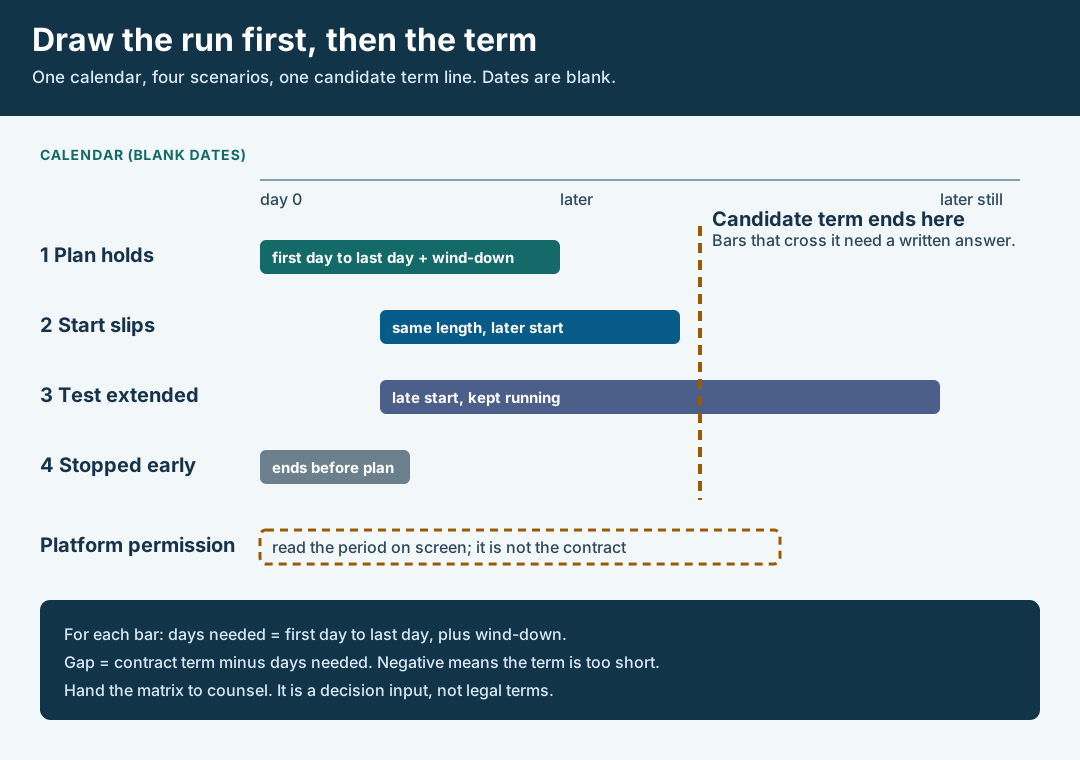
An original editorial map. Count the days each scenario needs, then compare them with a candidate term.
Original visual by Superdirector editorial team. Creation date not recorded.
Keep the contract term apart from platform permission
Two different things can end a paid run, and they run on separate clocks. The contract term is what the signed words allow you to do with the asset and for how long. The platform permission is a setting that lets an ad use the creator’s post on that platform. A run needs both to be in force on every day it is live. If either ends first, the ad is at risk even though the other still looks fine.
On TikTok, the Spark Ads guide in the Business Help Center describes creators generating a code in the app and the advertiser authorizing it in Ads Manager. It says there is an authorization period to review beneath each post, and that a video code can be deleted only when all the ads using that video are deleted. TikTok Spark Ads creation guide. That page does not state how long the period lasts or what happens when it ends, so this article makes no claim about either. Read the period on your own screen, write down what you saw and the date you read it, and ask the creator or the platform’s current help if anything is unclear. TikTok’s developer documentation also has pages on getting authorization from creators and managing post ad authorization; we could not read their text, so we do not rely on them.
For Meta, the Business Help Center has a page named About Partnership Ad Permissions. We could not load its text while preparing this article, so we say nothing about how its permissions are granted, how long they last or whether they can be withdrawn. Check it directly, and record on the card what you read and when.
Use the card to put the two clocks side by side for every scenario. Write the contract term in the signed words, quote them and do not paraphrase. Write the platform period you saw. Then ask, for each scenario, whether both cover the last day. If the platform period is shorter than your longest scenario, that is a task for the creator or account owner, and it can change the term you ask for. If it is longer than the contract, the contract is the limit. The clocks are different, and only counsel can say how they interact in your agreement.
Ask the creator to quote against your scenarios
Now bring the creator in. Describe the asset and the placement, then ask for the fee at two or three terms you chose from the matrix, and for the cost of an extension as its own line. Do not name the term you hope for and ask whether it is acceptable. Do not offer your budget first. Ask the creator to state what each term costs and what an extension would cost, and say that you are comparing options. If the creator or manager wants to propose a different term, welcome that, and add it as another row.
Keep each reply as received, with the date and the term it was quoted at. Do not average the quotes, do not convert a bundled number into a per-term price yourself and do not infer a pattern from two points. If the creator sends one bundled amount that covers production, posting and usage, split it only by the creator’s own lines, as the bundle quote guide describes. Where the production and posting fees are already stated, keep them in their own lines, following the fee ledger guide. A usage line should not absorb them.
If a creator will not quote against more than one term, record that too. It changes the decision: you then have one term and a gap list, and the extension question stays open. If the term you need is not available, write that down, and let the owner choose between a different plan and a different creator. A past partnership’s outcome can inform the choice but should not set the term, which is why the renewal guide treats a repeat deal as new terms.
Walk through a fictional matrix
Fictional exercise: no real brand, creator, fee or result was inspected. A made-up brand, Brand A, wants to run one video from Creator Q as a paid ad in one placement. The media plan gives a first paid day and a last day 14 days later, and the team allows 2 days to switch the ad off. Plan holds: 14 days from first to last, plus 2, so 16 days needed. Brand A’s approver says the start could slip a week if a product page is not ready: same length, later start, 16 days but beginning later. The team may keep the better version running for 14 more days: 28 plus 2, so 30 days needed. Stopped early: if the ad is paused on day 5, 7 days needed.
Brand A compares a candidate term of 20 days. Plan holds has a gap of 4. Test extended has a gap of negative 10: the term would end 10 days before the run. Brand A now sees the choice. It can ask Creator Q to quote at 20 days, at 30 days and for a 14-day extension as a separate line, and it can plan to accept the 20-day gap or not. It does not yet know any fee, because none has been quoted. All numbers here are made up to show the arithmetic, and the example suggests nothing about any real term.
Brand A also writes down the platform permission period it sees on screen, with the date it read it, and notes that the period must cover the 30-day scenario if that scenario is kept. The matrix then goes to counsel with two open questions: whether the term starts on signing or on the first paid day, and how an extension should be written.
Hand counsel the matrix and the open questions
Give counsel the filled card, not a conclusion. They should see the asset and placement, each scenario with its source, the days needed, the candidate terms, the gaps, the platform period you read and the creator’s quotes as received. Add a short list of questions you could not settle, such as when the term starts, whether an extension is an option or a commitment, and what happens to an ad still running when the term ends. Counsel decides the wording; your job is to state the need and the facts clearly.
Two points from U.S. Copyright Office guidance explain why ownership questions go to counsel and not into a term decision. Circular 1 says a transfer of copyright ownership generally must be made in writing and signed by the owner of the rights conveyed or the owner’s authorized agent, and that transferring a right on a nonexclusive basis does not require a written agreement. Copyright Basics, Circular 1. The statute states the signed-writing rule for transfers in 17 U.S.C. § 204(a). Neither tells you what term to choose, and neither says what your agreement means.
Circular 30 adds that a specially commissioned work is a work made for hire only if it falls within one of nine listed categories, the parties agree in a written agreement that it is a work made for hire and all parties sign; if any requirement is missing, it is not a work made for hire. Works Made for Hire, Circular 30. Whether a creator’s video fits any of that is not something this page can judge. Keep the matrix, the quotes and the questions together, and record who made the final choice and on which date.
What this page does not decide
This method produces a decision input: a dated list of the days you might need and the gaps against candidate terms. It does not tell you which term to buy, what a term should cost, or what an agreement should say. It also does not claim that any term length is normal, because we found no source we could cite for one.
It is close to three existing pages and differs from each. The per-asset rights record starts from signed words and records what they allow for each asset; this page starts earlier, from your plan, before there are words to record. The organic-to-paid guide decides whether a boost needs a new scope; this page assumes paid use is wanted and asks how long. The bundle quote guide opens a quote that has already arrived; this page decides what to ask for before it does.
Other limits are plain. We did not read the length or the end-of-period behavior of TikTok’s authorization period, nor Meta’s partnership ad permission page or TikTok’s developer authorization pages, so we say nothing about them beyond what is quoted above. We give no fee, rate, benchmark or result, and the fictional example predicts nothing. Channels, territory, exclusivity, edits and ownership are separate decisions. If a point turns on law or on the meaning of your agreement, send it to counsel.