How-To Guide
Turn a disappointing creator campaign into one test you can actually lose
After a creator campaign underdelivers, check the measurement, list rival causes, change one thing and write the read before launch, on a blank worksheet.
By the Superdirector editorial team. Google Analytics Help pages reviewed October 30, 2026.
At a glance
How do you turn a disappointing creator campaign into a next test?
Record the result as observed, with its source and date. Check whether the measurement can be trusted before explaining anything, because a broken count cannot support a test. List rival explanations and what each would predict, then pick one hypothesis and change one thing while writing down everything held constant. Before launch, write the metric, the window and the read date, plus what result would support the hypothesis, what would contradict it and what would be inconclusive. Freeze that page so the outcome cannot be reinterpreted later.
- Check the measurement before you explain the miss.
- One hypothesis, one change, everything else held constant.
- Write supporting, contradicting and inconclusive results before launch.
Direct answer
Short answer: do not write a lessons-learned list. Write one test you can lose. Record the disappointing result as observed, check that the measurement behind it can be trusted, list the rival explanations and what each would predict, choose one hypothesis and change one thing, and write down before launch what result would support it, what would contradict it and what would be inconclusive. Freeze that page. When the read date arrives, compare the data to the page you froze rather than to your memory of it.
This is for an agency or brand marketer whose creator campaign underdelivered against its stated goal and who must decide what to try next. The decision is narrow: what single, readable test follows this result. It does not decide whether to renew the creator, whether the channel is worth the budget, or why this particular campaign missed. A single campaign rarely settles why. A good next test makes the next answer smaller and clearer.
Generic lessons fail for a simple reason: “the hook was weak” and “the audience was wrong” can both be told about almost any result, so neither can be shown wrong. A hypothesis that names a change, a metric and a window can be shown wrong. Use the blank next-test worksheet, the CSV register and the decision map. All three are blank or fictional teaching aids, and none represents a real campaign, creator or result.
Record the result exactly as observed
Start with what was seen, not why. Write the number or fact, the post or posts it refers to, the date range, where it was read, who read it and when. Add the goal as it was written before launch, with its date. If nobody wrote the goal down, record “not written” and treat that as part of the finding; a goal reconstructed after a disappointing result tends to drift toward whatever the result was.
Keep three things apart on the page: the result (“fewer sign-ups were recorded than the goal”), the source (the report, with its date), and any interpretation (“because the creator’s audience was wrong”). Only the first two belong in this step. Park the interpretation in a separate line so it can be tested later instead of being absorbed into the record. If the goal has a deadline, note whether the read date falls inside it; a result read too early is a different fact from a result read at the end.
Also record what you do not know. Unknown reach on a post, a platform total you could not split, a creator who did not share an export: each is a blank on the page, not a zero. Blanks matter because they decide, in the next step, whether the result can support a test at all. The observation window guide covers fixing report dates before launch, which makes this step easier next time.
Check the measurement before explaining the miss
A test is only as readable as the count behind it. Before you theorize, ask whether the disappointing number could be a recording or reading problem. Mark the measurement trusted (you have evidence the path was captured), not trusted (you found a break) or unknown (you cannot tell). Write the evidence beside the mark. If it is not trusted, stop: repair the measurement first, because a new test on a broken count will be unreadable in the same way.
Three documented behaviors are worth checking if you used Google Analytics 4. First, Google says many reports and explorations can take 24 to 48 hours to process data, so a number read the morning after a post may simply be incomplete. Google Analytics Help: Data freshness. Second, Google says marking an event as a key event affects reports from the time of creation and does not change historic data, so an event marked after launch cannot be counted backward. Google Analytics Help: Mark events as key events. Third, Google says changes to the key event lookback window apply going forward, and that the window also applies to session attribution. Google Analytics Help: Advertising and attribution.
Read those as prompts for your own records, not as a diagnosis. Did anyone change a setting mid-campaign? When was the event marked? How long after the post was the report read? These are questions about your property, and only your settings history and report dates can answer them. Nothing here tells you your count was wrong. It tells you what to rule out before you spend a test on it.
If the doubt is specifically that a video had views but few visits, do not solve it here. Follow the views without qualified visits diagnostic to find where the path broke, then return with a trusted count. This page begins after that question is settled or consciously set aside as unknown.
List rival explanations and what each predicts
Now list the explanations that could account for the result, including ones you dislike. For each, write what it predicts if it is true, what evidence you already hold, what is missing, and whether a single change could separate it from the others. An explanation that predicts nothing different from its rivals cannot be tested, and should not be chosen.
| Candidate explanation | What it would predict | Evidence in hand | Evidence missing | Separable by one change? |
|---|---|---|---|---|
| Ask unclear | Viewers who reach the destination do the intended action at a similar rate to other sources, but fewer reach it | The spoken or on-screen words of the ask, verbatim | Whether viewers understood the next step | Yes: change only the wording of the ask |
| Audience mismatch | Different creators would reach people who act at a different rate | The creator’s public posts, as observed | Audience facts the creator has not shared | Only by changing the creator, which changes everything else too |
| Destination mismatch | Arrivals leave at the first screen regardless of creator | The page as it appeared, with its date | What arrivals expected to see | Yes: change only the first screen |
| Timing or window | The result looks different when read after more time | Read date and the stated window | Delayed actions not yet recorded | Yes: re-read at a longer pre-stated window |
| Measurement gap | Some real actions never reached the report | Settings history and the checks in the previous step | A direct count from another source | Not a test; fix it first |
Notice what the last column does. It stops you from choosing the explanation that feels most true and pushes you toward the one you can separate with a single change. “The audience was wrong” may be the most plausible cause and the least testable, because testing it means changing the creator, the post and probably the message at once. A less glamorous cause that one edit can confirm or rule out is usually the better next test.
Keep the rejected candidates on the page with their reason. They are not wrong; they are not testable now, and a later campaign may be able to test them. Do not delete them, and do not let the team treat the chosen one as the established cause. The page records a choice about what to examine next, not a finding about what happened.
When enlarged, scroll horizontally to read the diagram.
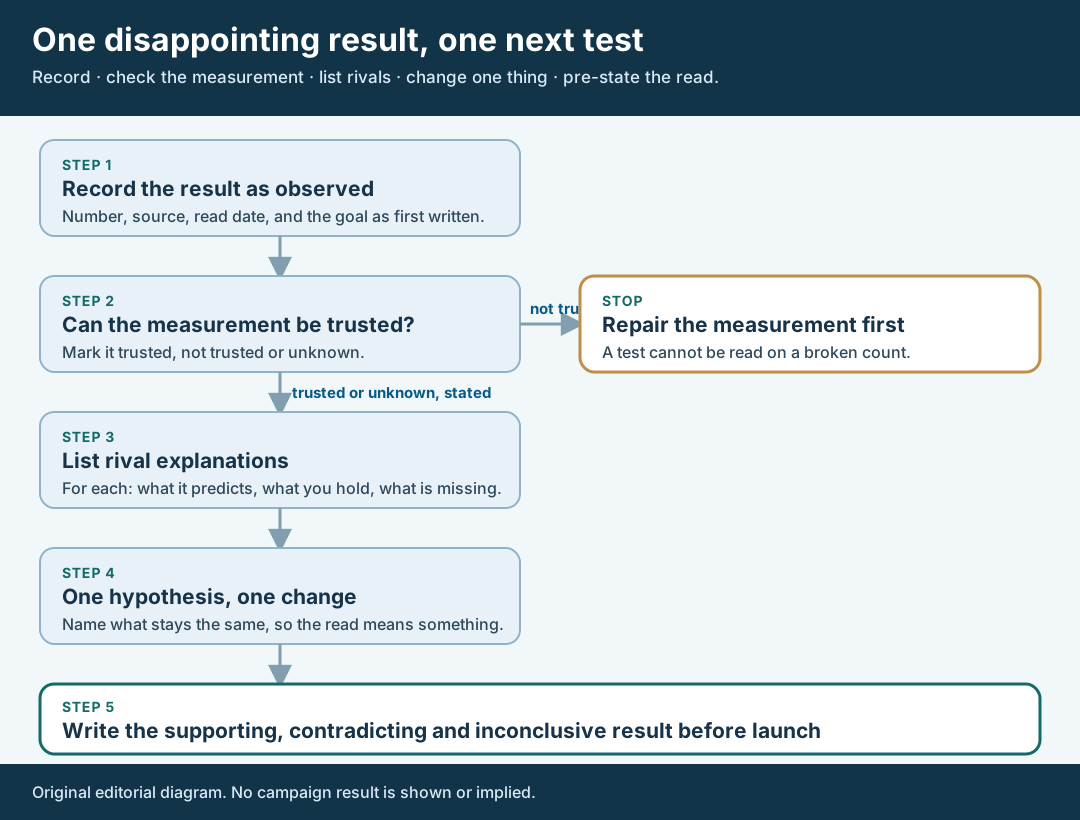
An original editorial decision map. A test is only readable if the measurement holds and the read is written first.
Original visual by Superdirector editorial team. Creation date not recorded.
Choose one hypothesis and change one thing
Write the hypothesis in one sentence of this shape: If we change (A) to (B) and hold the rest the same, then (metric) will (move in a stated direction) by (read date). Every blank must be filled with something observable. “Improve the message” is not a change; “replace the closing line with a request to do one named action” is. “Better engagement” is not a metric; a named count from a named source is.
Then write the held-constant list: creator or creators, offer, destination, posting window, measurement settings and the goal itself. This list is what makes the read mean something. If you cannot hold the creator constant, because the next test uses a different person, say so and treat the result as comparing two changes, not one. You may still run it, but you must not claim that the single edit explains the difference.
Be honest about what one small run can show. A single post pair, or a handful of arrivals, can be moved by chance, by a creator’s mood on a given day or by the date it landed. The worksheet does not turn that into proof. It gives you a structured, repeatable question: if the supported result appears again under the same conditions, the explanation gains weight; if it does not, it loses it. Plan the repeat before you start, not after a pleasing outcome.
Check the change against the agreement as well. Altering what a creator says or shows may need their consent, a revised brief or a new review of the cut. The first-cut review guide covers that review, and a post that mentions or endorses the brand still needs a clear disclosure of the paid relationship. Keep the change within what the creator has agreed to, or agree it first.
Write the read before the test launches
This step is what makes the test falsifiable. Before launch, write: the metric and its source, the window, the read date and time zone, and the owner who will take the reading. Then write three results in advance. A supporting result, which would make you more confident in the hypothesis. A contradicting result, which would make you less. And an inconclusive result, which includes “the data was not available by the read date.”
Beside each, write what you will do. If supported, you might repeat once under the same conditions before widening. If contradicted, you drop that explanation and move to the next separable one on the list. If inconclusive, you extend the window once, by a length you state now, or you record “no read” and do not call it a win or a loss. Deciding the action in advance protects you from a common habit: stretching the interpretation until the result seems to fit.
Your team sets any numeric threshold, from its own goal and costs. This page offers no benchmark, because none can be supplied honestly without your data. If you cannot say in advance what number would contradict the hypothesis, the hypothesis is not yet falsifiable; rewrite it until you can. When the page is complete, record the time it was frozen, ideally by saving a dated copy, and record the actual reading on a new line after the read date, never over the plan.
A note on tracking: if the test depends on an event that must be marked or configured, do that before launch. Because marking a key event does not change historic data and can take up to 24 hours to appear in standard reports, according to the Google page cited above, an event set up late can leave the first stretch of your window uncounted. Put the setup date in the worksheet so the read can account for it.
Walk through a fictional disappointing campaign
Fictional exercise: no real brand, creator, campaign or result was inspected. A made-up brand, Brand A, asked Creator Q for one video that sends viewers to a sign-up page. The goal, written before launch, was a stated number of sign-ups in a stated window. At the read date, the report showed fewer sign-ups than the goal. The result line reads: “fewer sign-ups recorded than the written goal, read on the read date from the report named in the worksheet.” No number is invented here because none is needed to teach the method.
Measurement check: the event was marked as a key event after the video went live, and the report was read the morning after the last day of the window. Both are documented reasons for incomplete counts, so the state is unknown, and the team re-reads at a later pre-stated date before testing anything. Suppose that re-read still shows the shortfall. The team lists five candidate explanations as in the table above and notes that audience mismatch cannot be separated without changing the creator.
They choose ask unclear because a single edit separates it. The hypothesis: “If Creator Q’s closing line changes from a general invitation to a request for one named action, and the destination, offer, window and measurement settings stay the same, then the sign-up count from that post will exceed the pre-stated number by the read date.” The pre-stated results: supported if the count meets the number, contradicted if it is below the number with the event verified before launch, inconclusive if the report is unavailable or the event was not verified. The matching actions are written beside each.
Suppose the test is contradicted. Brand A records that the wording of the ask is not, under these conditions, what limited the count, and moves to the next separable candidate: the destination’s first screen. It does not conclude that the creator failed, or that the channel does not work. The scenario predicts nothing about any real creator and carries no performance claim.
What this page does not decide
This method turns one result into one test. It does not choose the goal in the first place; the one client decision guide and the measurable objective guide cover that. It does not diagnose a path that broke between a view and a visit, which the views diagnostic handles. And it does not check the destination itself before a post, which the destination rehearsal guide does.
It also leaves out the commercial question of whether to work with a creator again. That depends on cost, rights, availability and evidence this worksheet does not collect. A next test is a way to learn one thing cheaply; it is not a verdict on anyone.
Nothing here measures how often teams find their cause, how many tests a campaign needs or how well any structure predicts results. Those figures are not available to us and are not claimed. The page is an editorial method for keeping results, measurement, explanations and decisions apart, and it asks one thing of a test: that you can say in advance how it could fail.