How-To Guide
How does influencer marketing on Amazon work for brands?
How Amazon's Influencer Program, Creator Connections and Amazon Attribution fit together for brands: who pays creators, what they earn, how to measure it.
By the Superdirector editorial team. Amazon program pages read November 6, 2026.
At a glance
How does influencer marketing on Amazon work for brands?
Through three Amazon programs. Influencer Program creators earn Amazon's standard category commission, paid by Amazon, on sales from their storefront or links. Brands that want to pay creators more use Creator Connections (bonus commissions, traffic payments or flat fees). Brands measure creator posts that start on social media with free Amazon Attribution tags.
- A $40 Kitchen sale earns a creator $1.80 at 4.5%; the same sale in Grocery earns $0.40.
- Give every creator their own Attribution tag to see results by creator.
- Disclosure: "#ad" or "(paid link)" plus Amazon's Associate statement.
The short answer
Influencer marketing on Amazon runs through three separate programs, and only one of them costs the brand anything directly. Creators in the Amazon Influencer Program get a storefront and earn Amazon's standard commission on sales they refer, which Amazon pays, at a rate set by product category. A brand that wants to pay creators on top of that uses Creator Connections, where brands selling on Amazon offer bonus commissions, traffic payments or flat fees for sponsored content. And to see what creator posts on Instagram, TikTok or YouTube did for sales on Amazon, a brand adds Amazon Attribution tags, which are free.
So the brand's work is: choose whether to fund creators beyond the standard commission, tag every off-Amazon link so the sales are measured, and make sure creators disclose. The rest of this page shows each step with Amazon's own pages.
How this page was made: we read Amazon's public program pages on November 6, 2026 and quote only those. Amazon's brand-facing Creator Connections help pages did not load for us, so setup details that appear only in seller forums or third-party guides are left out. We publish Superdirector, which helps brands find and screen creators; it is not part of any Amazon program.
Know which money comes from Amazon and which from you
| Program | Who joins | Who pays the creator | What the brand does |
|---|---|---|---|
| Amazon Influencer Program | Creators approved through one of their social accounts (TikTok, Instagram, YouTube, Pinterest or Facebook) | Amazon, at its standard category commission | Nothing required; your products can appear in creator storefronts and videos |
| Creator Connections | Creators and brands sold on Amazon | The brand, as bonus commission, traffic payments or flat fees | Offers a paid campaign to creators |
| Amazon Attribution | Brand Registry sellers, vendors, KDP authors and agencies | Nobody; it is a free measurement tool | Tags its own off-Amazon links, including influencer campaigns |
The Influencer Program help page describes the creator side: a page on Amazon with the vanity address amazon.com/shop/handle, and payment for purchases made through it in a similar fashion to the Amazon Associates program. The commission statement is explicit that Amazon is the payer: "We will pay Standard Commission Income" on qualifying purchases.
Amazon's own explainer adds that Amazon looks at an applicant's follower count, engagement rate and the quality of their content, and that the program launched in 2017 and is now available in more than 20 countries. A creator who already promotes your product may therefore be earning from it without any agreement with you.
Work out what a creator earns on your product
The standard commission depends on the product's category, not on the brand. Here is one $40.00 sale in five category groups, using the rates in Amazon's US Associates commission table.
| Category | Standard rate | Creator earns on a $40.00 sale |
|---|---|---|
| Luxury Beauty | 10% | $4.00 |
| Kitchen | 4.5% | $1.80 |
| Beauty, Home, Toys, Pets, Sports | 3% | $1.20 |
| Grocery, Health & Personal Care | 1% | $0.40 |
| All other categories | 4% | $1.60 |
This is why a creator may ask a grocery or personal care brand for a bonus: at 1%, a $40 sale pays them $0.40. Amazon notes that the creator also earns on other items the shopper buys after following their link. The limit is the session: under the commission statement, it ends after 24 hours, when the customer orders a non-digital product, or when they click another Associate's link, whichever comes first. Items added to the cart during that session still count if the order is completed within 89 days.
The calculator in the planning sheet repeats this for your own price and category.
When enlarged, scroll horizontally to read the diagram.
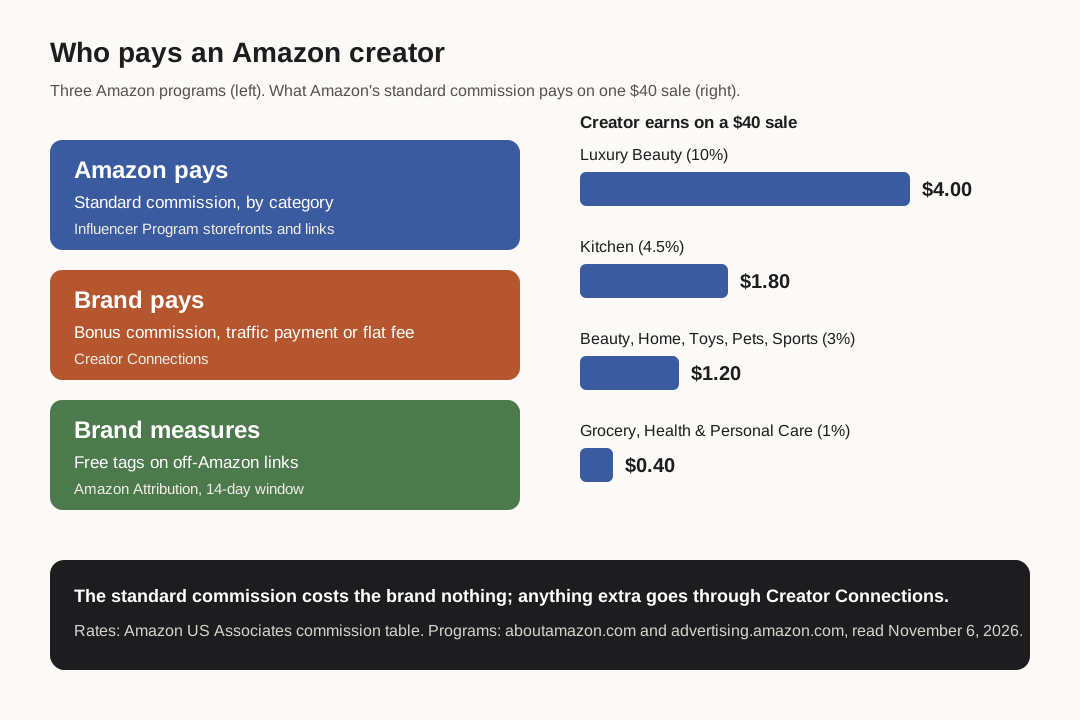
Worked example with a $40 sale. Rates from Amazon's US Associates commission table, read November 6, 2026.
Illustrative worked example by Superdirector editorial team. Creation date not recorded.
Fund creators through Creator Connections
Creator Connections is the brand-funded part. Amazon calls it a marketplace linking creators with brands whose products are on Amazon. A creator can be paid in three ways there: a bonus commission on sales, a payment for clicks sent to a brand's sponsored products, or a flat fee for a sponsored social post the brand may then license for its ads.
The program is changing as it expands. At its India event, Amazon Ads said Creator Connections there would automatically connect Sponsored Products campaigns with creators from the Influencer Program. Amazon Ads' creator guide puts the pool at more than one million Amazon creators, and says brands can later reconnect with audiences who visited influencer storefronts.
What we could not confirm from an official page: the minimum budget, the default commission, which sellers are eligible, and how campaign dates work. Those figures circulate in seller forums and agency blogs. Check them inside your own Seller Central or Amazon Ads account before you plan a budget around them.
Measure creator posts that start off Amazon
Most influencer work starts on Instagram, TikTok or YouTube and ends on an Amazon product page. Amazon Attribution is how a brand sees that path. Amazon lists affiliate and influencer campaigns among the non-Amazon channels it measures, and the tool is free for eligible accounts.
- Confirm you are eligible: professional sellers enrolled in Brand Registry, vendors, KDP authors, or an agency working for one. Amazon lists the US, Canada, Mexico, the UK, Germany, Spain, France, Italy and the Netherlands.
- Add the products you want to measure, then generate tags. Amazon's own example is one tag per marketing tactic, so make one per creator or per post if you want results by creator.
- Give each creator their own tagged link instead of a plain product link.
- Read the results after the 14-day attribution window: clicks and detail page views, then add-to-cart, purchases, units sold, product sales and new-to-brand.
- Check brand halo sales too: Amazon's product report includes brand halo products, meaning other products within the same brand.
The Brand Registry page also lists Brand Referral Bonus, which earns credits from non-Amazon marketing. Amazon's page did not show its rates when we read it, so check them in Seller Central. For tagging links outside Amazon, see our guide to UTM tracking for influencer campaigns.
Keep disclosures and reporting straight
- Disclosure: Amazon's disclosure help page says a creator's link-level disclosure can be as simple as "(paid link)", "#ad" or "#CommissionsEarned", and the statement "As an Amazon Associate I earn from qualifying purchases" must be associated with their social account. If you also pay the creator through Creator Connections, agree in the brief how they will label the post as sponsored.
- Where sales show up for the creator: in Associates Central, traffic sent to a product page is "off Amazon" and traffic to the storefront is "on Amazon". Creators can also split results with tracking IDs. Ask a creator for the report that matches the link they used.
- Reusing content: Amazon says videos in a creator's storefront are eligible to show on product pages, in search and on the homepage, and its leading creators may choose to join Creator Ads. Amazon Ads' Social Overlay reuses vertical creator content in Amazon ad formats. If you license a creator's video, agree the usage in writing.
For the brief itself, our influencer posting guidelines cover disclosure wording and approvals.