How-To Guide
What should one UGC video cost, and what is inside that price?
Published UGC prices disagree by several times. Read a quote as five lines, price rights by run dates, and compare quotes on cost per accepted video.
By the Superdirector editorial team. Vendor guides, FTC, TikTok and Meta pages read October 31, 2026.
At a glance
How much should I pay per UGC video, and what should the price include?
No single number is safe to quote: vendor guides put the same beginner tier anywhere from $50 to $400 per video or piece and none states a research method. Instead of matching a benchmark, ask each creator for five separate lines: the base video as specified, the usage rights for the dates you will run, any ads run through the creator’s handle, process extras such as extra revisions, rush, raw footage and extra hooks, and your own product and shipping. Add them, divide by the videos you will accept, and compare quotes on that cost per accepted video.
- A tier label such as “beginner” is not a benchmark; the sources we read give it ranges that barely overlap.
- Write the paid run as dates, then ask whether usage and handle-based ads are priced separately or together.
- The base price is where quotes differ most: one guide says it often includes a 6 to 12 month license, another says three months on one platform.
Direct answer
Short answer: do not look for one “UGC price per video.” Ask each creator to quote five lines and add them yourself: the base video as you specified it, the rights for the dates you will run it, ads run through the creator’s handle if you plan them, process extras such as extra revisions, rush, raw footage or extra hook versions, and your own product and shipping. Then divide the total by the videos you will actually accept. That figure, the cost per accepted video, is the only one you can fairly set beside another creator’s quote.
This is for a brand or in-house marketer who has a quote in hand, or has to write a budget, for a video the brand will post or run as an ad itself. The reason not to lean on a market benchmark is in the next section: the published ranges disagree by several times, none of the ones we read states how its figures were gathered, and they do not even agree on what the base price includes. A benchmark can tell you that a quote is odd. It cannot tell you what yours should be.
This page does not tell you what any creator will accept, and it makes no claim about the market’s true average. It shows how to turn a vague quote into lines you can question, and uses the vendor percentages only as labelled arithmetic. Use the original five-line quote diagram and the blank quote comparison sheet to hold the quotes; the sheet contains no creator, fee or result.
Why published UGC price ranges cannot set your number
Search for a UGC price and you will find tidy tier tables. We read three vendor guides dated 2025 and 2026. They are marketing content, not surveys, and they differ on the same tier.
| Source (date shown on page) | Entry or beginner | Middle | Established | Method stated |
|---|---|---|---|---|
| JoinBrands (Aug 15, 2026) | $150–$400 per piece | $400–$1,000 | $1,000–$3,000+ | None cited |
| Webtonic (updated Oct 9, 2026) | $50–$150 | $150–$500 | $500–$1,000+ | None of its own; cites other vendors’ analyses |
| Influee (page dated Apr 18, 2025) | Not tiered: single-video average $150–$212, median about $175 | No data source or sample named |
Read the first column of numbers again. The same “beginner” label spans $50 to $400, an eightfold gap, and the two guides’ middle tiers overlap only between $400 and $500. That spread is not a market fact you can average. It tells you the labels are chosen by whoever writes the guide. JoinBrands also gives ranges by content type, such as $250–$1,200 for a 30 to 60 second unboxing and $400–$2,000 for a 60 to 90 second testimonial, and again names no source for them, so we treat them as an illustration of how much the job itself moves the price and not as a rate.
The sharper disagreement is about what the base price buys. Webtonic says a standard organic use, website display, email and a 6 to 12 month license are often included. JoinBrands lists limited usage (one platform, about three months) at the base rate and, separately, non-commercial use at the base rate, with commercial use such as paid ads at plus 20% to 50%. A creator quoting “$200” under one of those assumptions and a brand reading it under the other are not talking about the same product. We also could not load Collabstr’s UGC pages, which returned an access error, so we make no claim from them. Use a guide as a rough check on whether a quote is wildly out of line, and let the quotes you collect on one spec set your budget.
When enlarged, scroll horizontally to read the diagram.
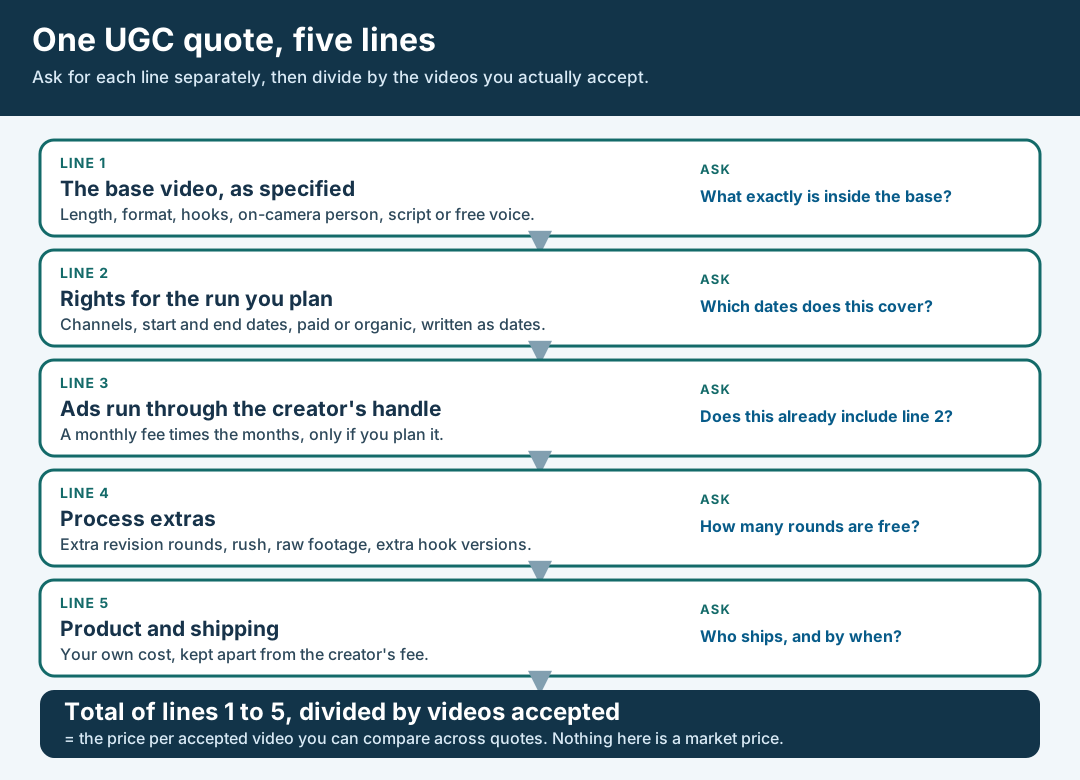
An original editorial diagram. It shows the lines to ask for, not a market price.
Original visual by Superdirector editorial team. Creation date not recorded.
Write the video spec before you ask for a number
A creator can only quote what you describe. Before any message goes out, write one spec that every creator receives: the platform and length, the number of hook versions, who is on camera, whether you supply the script or the creator writes their own, whether the creator receives product and when, and what proof the video must show. The more of that the brief leaves open, the more the quote has to cover with padding.
This is where a planning tool earns its place, and where it stops. Superdirector’s UGC campaign planning flow helps you prepare the brief from your product context and selected references: audience, proof moment, hook, script beats, shot requirements, deliverables and usage expectations. Those are the same fields that drive the price lines below. It is not a UGC marketplace or a creator payment platform, and it does not know what any creator charges, so the quotes still come from creators. The UGC creator brief template shows the fields on a worked fictional brief.
Then send the same spec to at least three creators and ask each for the five lines in writing. If a creator asks your budget first, the reply guide covers what to say before a figure leaves your team. For a creator who will post on their own audience, as opposed to handing you a video to use, the influencer rate method is the better fit.
Ask what the base price already includes
Ask for the base in writing, and ask four things about it. Usage: which channels, and for how long? Revisions: how many rounds are free? Both JoinBrands and Webtonic say one to two rounds are usually included, and price extra rounds differently, at $50 to $200 and $25 to $75 respectively. Delivery: which files, with or without captions or music? Raw footage: is it included or a separate line? The raw-footage guide explains why it is a different deliverable from the finished cut, and the revision-round guide covers agreeing the number of rounds before production.
Write each answer next to the clause or message it came from. A verbal “that’s all included” is not something you can compare later. If the creator’s own quote bundles several of these into one number, ask for it opened into lines; the bundle-quote guide shows how to do that without inventing an allocation.
Price the rights for the dates you plan to run
Rights are usually the biggest swing in a UGC price, so state your plan as dates, not as a vague “paid use.” Write the first day the video would run as an ad, the last day, and the channels. The paid usage term guide walks through turning a plan into scenarios, including the slips you can name, before you ask any creator to quote against them.
The guides we read price this as a percentage of the base, and they differ. For paid-ad usage, JoinBrands adds 20% to 50%, and Webtonic and Influee both say 30% to 50%. For perpetual rights JoinBrands says 50% to 100% and Webtonic says 100% to 150%. Treat those as opening positions to question, not rates. For ads run through the creator’s handle, often called whitelisting, Xolo defines it as the brand running paid ads through the creator’s personal account instead of its own, and gives the formula total = content fee + (monthly whitelisting fee × months), with the monthly fee at 30% to 100% or more of the content fee. Webtonic gives the same 30% to 100% a month, and Influee says 30% a month. Xolo cites no external source for its rates.
None of the guides we read says whether a whitelisting fee already contains the paid-usage right, so ask. If both appear on a quote, check that you are not paying twice for the same ads. Also keep the contract and the platform apart, because each has its own clock. TikTok’s Content Suite page says Spark Ads authorization requests default to 365 days and can be obtained by video request, account authorization or an off-platform arrangement. TikTok: Content Suite and Spark Ads. Meta’s developer documentation describes account-level partnership-ad permission as a request from the brand that the creator accepts in the Instagram app, with statuses such as approved, pending and revoked, and the page says nothing about how long a permission lasts. Meta: account-level permissioning for partnership ads. A 30-day contract term and a 365-day platform authorization are different things, and the Spark authorization log and guide to stopping creator ads before the term ends show how to track both. Record the grant itself with the asset rights guide or the usage rights checklist.
Add process extras and read the bundle discount
The fourth line collects the things that change how much work the creator does. The guides name raw footage (Webtonic and Influee: 30% to 50% of the base), rush delivery (JoinBrands and Webtonic: 25% to 50%), extra revision rounds (see above) and extra hook or call-to-action versions (Webtonic: $50 or more per variation). Add a line only for what you will use. A rush fee you could avoid by planning a week earlier is the cheapest saving on the page.
Bundles lower the per-video price, but not by a number anyone can promise. Influee gives tiers from 5% to 10% off for two videos to 15% to 25% off for five or more, and an example of $810 for five videos at $200 instead of $1,000. JoinBrands says ten videos over three months usually earn 10% to 15% off, and Webtonic says 10% to 25%. Three questions decide whether a bundle is a bargain: does the discount apply only to the base or also to the rights and extras, must you accept every video, and what happens to the unused videos if the first cuts miss the brief.
Walk through a fictional quote
Fictional exercise: no real brand, creator, fee or result was inspected. Suppose a brand receives a headline of $200 for one 30 second video. The table applies the ranges the guides cite above to that made-up base, to show how far the same headline moves. It is arithmetic on vendor percentages that disagree with each other, not a market observation.
| What the brand adds | Range cited | On a $200 base | Running total |
|---|---|---|---|
| Organic use only | — | $0 | $200 |
| 90 days of paid-ad usage | +20% to +50% (JoinBrands, Webtonic, Influee) | +$40 to +$100 | $240 to $300 |
| Ads through the creator’s handle, 2 months | 30% to 100% of the base per month | +$120 to +$400 | $360 to $700 |
| Raw footage, one extra revision round, rush | +30% to +50%, $25 to $200, +25% to +50% | +$135 to +$400 | $495 to $1,100 |
The same $200 headline therefore describes anything from $200 to $1,100 depending on what the brand needs, and the top row is the only one that needs no rights conversation. Webtonic says true cost often rises 30% to 100% once usage and add-ons are included; the third and fourth rows land 80% to 250% and 147% to 450% above the headline, so a quote can sit well outside that rule of thumb. The point of the exercise is not the totals. It is that none of the lines can be added to a number you cannot see inside.
Now compare two fictional quotes in the creators’ own words for one video. Quote P is $320, said to include 90 days of paid use, two revisions and raw footage. Quote Q is $180 for the video with 30 days of organic use, then $70 for 90 days of paid use and $50 for raw footage, with one revision included. Opened into lines, Q totals $300 and P totals $320, and the difference is a question to ask, not a verdict: does Q’s single included revision matter to your review process?
Compare quotes on cost per accepted video
Put each creator’s lines in the same sheet: amount, what it covers, and the clause or message it came from. Add your own product and shipping as a fifth line, kept apart from the creator’s fee so a free-product swap does not hide inside a cash number. Then compute total ÷ videos accepted. A $150 quote whose first cut fails your review and needs a $75 extra round and a reshoot costs more per accepted video than a $200 quote that passes the first time. If you do not yet know which will pass, say so on the sheet and rank on lines, not on the total.
Two checks keep the sheet honest. First, cut-off dates: for every rights line, can you read the end date without doing arithmetic? Second, the line you cannot source. If a number came from a call, write “verbal” and ask for it in writing before you decide. A quote you could not defend to a colleague is not yet a quote. When a per-video price looks high, Billo alternatives for UGC videos compares what each platform charges for.
What a price does not cover
A price does not discharge your own responsibilities. The FTC’s endorsement Q&A says that when a person is paid or given a free product to promote it, that connection is something viewers should be told, and that a company is ultimately responsible for what others do on its behalf, including training and monitoring the people who promote for it. For short-lived posts such as Stories that are hard to monitor, it suggests requiring that paid posts are not made without your advance approval. FTC Endorsement Guides: What People Are Asking. Put the disclosure wording and the approval step in the brief, and check them when the first cut arrives. The disclosure review guide shows how. This is not legal advice.
A price also does not settle who owns the video. The guides use words such as buyout and perpetual rights loosely, and we could not load the U.S. Copyright Office’s page on works made for hire, so this page says nothing about ownership. Whether a quote grants a license or transfers ownership is a contract question for counsel, and the words in the signed agreement, not the headline price, decide it.
How this differs from nearby pages
This page answers the first price question: what to ask for and how to read a UGC quote before you pick a creator. It does not replace the influencer fee method, which values a creator posting to their own audience, or the rate card template. The bundle-quote guide opens one creator’s bundled quote after you have it, and the production and posting fee ledger records fees against a signed agreement. Here those are later steps.
We could not load Collabstr’s UGC price pages or the U.S. Copyright Office circular, and Meta’s page does not state how long a partnership-ad permission lasts, so we say nothing from them. Every percentage above is vendor guidance, several from sources that cite nothing, and none measures how often a quote lands in any band. We make no claim about AI-generated video prices, tax treatment of creator payments or international rates.