How-To Guide
How to reply when a creator asks for your budget before the deliverable is clear
Write the scope in six lines, check for a refused line and an approved figure, then pick one of four replies before any number leaves your team.
By the Superdirector editorial team. FTC and TikTok One pages reviewed October 30, 2026.
At a glance
How should an agency answer a creator who asks for the budget before the deliverable is clear?
Answer with the scope, not a number. Write the scope in six lines: deliverable and count, platform and format, rights, timing and revisions, disclosure and approval, and payment terms. Then ask three questions. Can the scope be written without gaps? Does the creator’s message already refuse a line you require? Has someone with authority approved a figure for this scope in writing? Those answers select one of four replies: ask scope questions, send the scope sheet and ask for a line-by-line quote, state the approved figure with the lines it covers, or close politely and name the blocking line.
- A number with no scope behind it cannot be compared with the next quote.
- State a figure only if it is approved in writing, and say which lines it covers.
- Log the message, your reply as sent, their answer and a follow-up date.
Direct answer
Short answer: when a creator asks “what is your budget?” before the deliverable is clear, reply with the scope, not a number. Write the scope as six lines: the deliverable and its count, the platform and format, the rights you want, the timing and revisions, the disclosure and approval steps, and the payment terms. Then ask three questions. Can the scope be written without gaps? Does the creator’s message already refuse a line you require? Is a figure for this exact scope approved in writing by someone with authority? Those answers choose one of four replies: A, ask scope questions and name no number; B, send the scope sheet and ask the creator to quote it line by line; C, state the approved figure together with the lines it covers; or D, thank them and close, naming the line that blocks the work.
This is for an agency or brand marketer who has just received a short, direct question from a creator or a creator’s representative and has not yet defined what the work is. The decision is narrow: what to send back first, and what must be true before any figure is stated. It does not decide what the work is worth, whether to hire the creator, or whether their quote is fair. Those belong to other pages, listed in the boundary section below.
The reason to order the reply this way is comparability. A figure with no scope behind it cannot be set beside the next quote, because nobody can say whether two numbers price the same work. If you later want to open a creator’s bundle price into its parts, you need the scope you originally sent. This page does not claim that withholding a number wins better terms, and it offers no figure of what creators charge. We have no data on either and make no claim about them. Use the blank budget-reply card, the CSV register and the decision tree as you work.
Read what the creator actually asked
Paste the message into your record exactly as written, with the date, time and time zone you received it and the platform it arrived on. A paraphrase becomes your reading of it. Then mark what it asks. Three readings are common and each calls for a different reply. The message may ask for a number (“what is the budget?”), for a range, or for a sense of fit with no number requested (“is this paid?”). A fourth reading, cannot tell, is allowed and often right for short messages.
Note who wrote. A message from the creator’s own account reads differently from one signed by a manager or an agent, and a message from an address you cannot tie to the account is a third case. If the writer’s authority is unclear, do not discuss figures yet. Confirm it first with the manager authority check, because a figure given to someone who cannot speak for the creator is a figure given to nobody.
Write down, too, what the message does not say. It may name no deliverable, no platform, no date and no usage. That list of absences is your scope-question list for Reply A. The aim is to separate what they said from what you assume.
Write the scope in six lines
Write the scope as lines a creator could quote against. Each line should be short and checkable. Where you do not know, write unknown. A scope with honest gaps is more useful than one with confident guesses, because the gaps are the questions you need to ask.
| Line | What to write | Why a quote depends on it | Check against |
|---|---|---|---|
| 1. Deliverable and count | What is made, how many, and what counts as done | A creator cannot price work whose size is open | Agency and creator scope table |
| 2. Platform and format | Where it posts and in what shape | Different formats are different work | Your brief and the platform’s own requirements |
| 3. Rights | Channel, term and territory for any reuse | Reuse beyond the original post is a separate term | Asset rights by channel and term |
| 4. Timing and revisions | Draft date, post window, number of change rounds | Open-ended revisions are open-ended work | Your calendar and the brief |
| 5. Disclosure and approval | What must be disclosed, where, and who approves before posting | Both are work the creator must plan for | Disclosure check |
| 6. Payment terms | When payment is due and what triggers it, or “not yet decided” | Timing affects whether a creator can accept | Production and posting fee ledger |
Two of these lines are not optional extras. The FTC’s influencer guide, dated November 2019, says a person should disclose a financial relationship with a brand, which it describes as including the brand paying them or giving them free or discounted products. It also says that for a video, the disclosure should be in the video and not only in the description. FTC Disclosures 101 for Social Media Influencers. That is a requirement on the work itself, so it belongs in the scope before a price is discussed, not after.
The FTC’s Endorsement Guides question-and-answer page says a company that hands this work to an agency is not relieved of its responsibility, and that reasonable programs include explaining what endorsers can and cannot say and instructing them on disclosure. It adds that reviewing posts before they go live is much easier than searching for them afterwards. FTC Endorsement Guides: What People Are Asking. They are the reason line 5 exists: a creator who is asked to follow guidance and wait for approval is doing more than posting, and a quote should be able to account for it.
Put a status on each line when you finish: written (a clear sentence a creator can quote), partial (some of it is known) or unknown. The count of unknown lines drives the first question in the next step.
When enlarged, scroll horizontally to read the diagram.
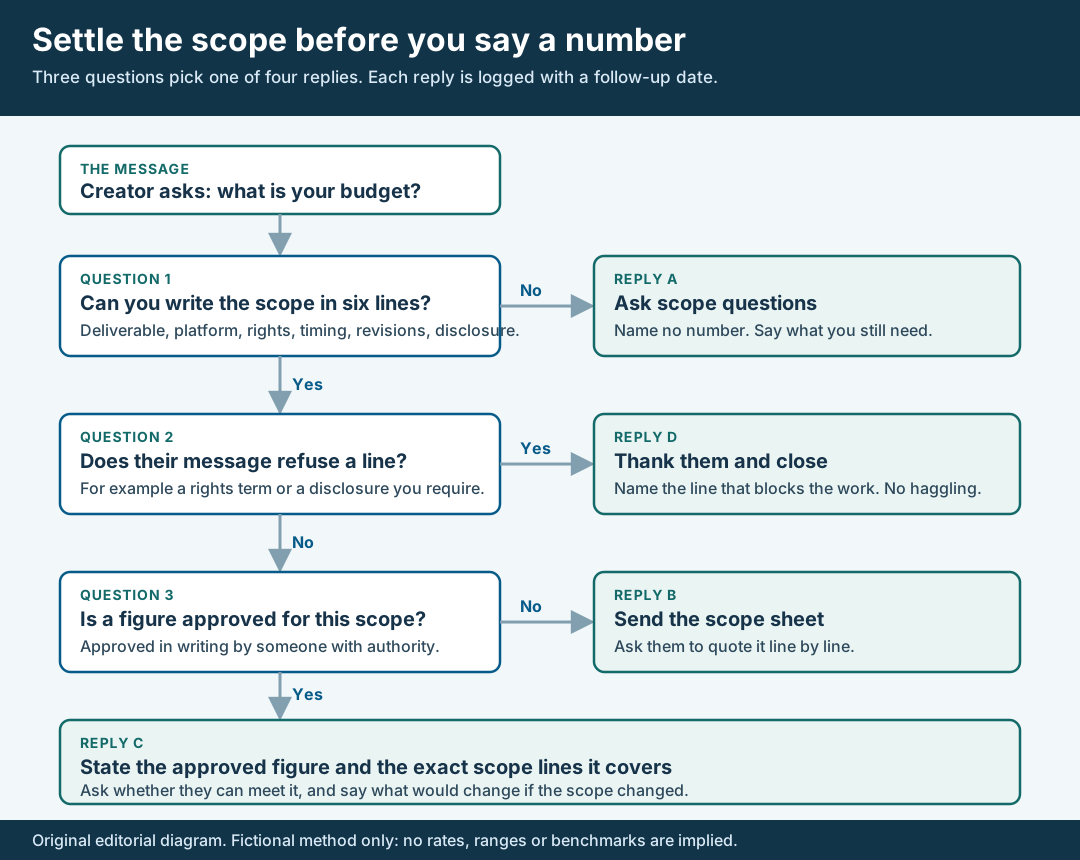
An original editorial decision tree. Settle the scope before you say a number.
Original visual by Superdirector editorial team. Creation date not recorded.
Pick one of four replies
Each reply is short, written in your own voice and sent once. Fill the brackets from your card. Do not add a figure to A, B or D.
| Reply | Send when | It says | It leaves out |
|---|---|---|---|
| A. Scope questions | Any of lines 1 to 5 is unknown | Thanks, here is what the work is so far, and here are the [two or three] things we still need to settle before we can discuss money | Any number or range |
| B. Scope sheet, quote requested | Lines 1 to 5 are written and no figure is approved | Here is the scope in six lines. Could you quote it line by line, and tell us what you would change? | Any number or range |
| C. Approved figure with its lines | Lines are written and a figure is approved in writing | For this scope, which covers [lines], we can offer [approved figure]. Can you meet that, and what would change if the scope changed? | Anything above the approved figure |
| D. Thank and close | The message refuses a line you require and you will not change it | Thank you for being direct. We cannot change [line], so this is not the right fit for this project | Pressure, a counter, or a figure |
A few details make these replies work. In Reply B, ask for the quote per line or per group of lines, and ask the creator to say what they would change. That keeps their price tied to your scope and shows you which line is driving it. If they return a single bundle price, open it with the bundle quote comparison. In Reply C, never state the figure without the lines. A figure with no lines invites the same ambiguity you set out to avoid.
Log the exchange and set the follow-up
Record the exchange the same day. One row in the register should hold the creator’s message as written, what it asked for, the six scope lines with their status, the answers to the three questions, the reply you chose, the reply as sent with its date and time zone, the creator’s answer as written, and the next follow-up date and owner. If you used Reply C, record who approved the figure and when, so that the authority behind the number is findable later.
Set the follow-up date before you close the row. If the creator does not answer, note the date you asked and the date you chased. Do not treat silence as agreement, and do not treat it as refusal.
When a quote arrives, compare it with the scope you sent, not with the scope you remember. If the creator changed a line, mark the change and ask whether the price moved with it. If it omits a line, ask whether it is included. When the scope changes in your own team, update the sheet as a new dated version rather than editing the old one, as described in the brief change impact guide.
Walk through a fictional exchange
Fictional exercise: no real brand, creator, campaign, rate or result was inspected. A made-up agency, Agency X, represents a made-up brand, Brand A, with a made-up note-taking app. Creator Q replies to a first email with one line: “What’s your budget for this?” The agency pastes it into the register. It asks for a number, the writer is Creator Q’s own account, and the message names no deliverable, platform, date or usage.
The agency writes its six lines. Deliverable: one short video demonstrating one task in the app. Platform: unknown, since Brand A has not chosen between two. Rights: unknown, because the client has not decided whether it wants to reuse the video. Timing: a draft and a post window, one round of changes. Disclosure and approval: a disclosure in the video itself and approval of the draft before posting. Payment terms: not yet decided. Lines 2 and 3 are unknown, so Question 1 is answered no.
Agency X sends Reply A. It thanks Creator Q, says the work is one short video showing one task, and says two things must be settled before money is discussed: where the video will post and whether the brand wants to reuse it, and for how long and where. It promises the full scope by a date it has checked with the client, and states no number. Creator Q answers that the video should post on the first platform and that reuse would need to be discussed. The agency records both as the creator’s words.
Brand A decides on the platform and on no reuse. Lines 1 to 5 are now written. Creator Q’s answer refuses nothing, so Question 2 is no. The client has not approved a figure, so Question 3 is no. Agency X sends Reply B: the scope sheet, a request to quote each line, and an invitation to say what Creator Q would change. When a quote arrives, the agency compares it line by line with the sheet it sent. The scenario predicts nothing about any real creator, price or response.
What this page does not decide
This page covers the reply that comes before a number is exchanged. It does not set a price, judge a quote or say how much to offer. It contains no rates, ranges or market benchmarks, and no data on how creators respond to different openings. Where a point turns on tax treatment, contract wording or law, take it to your own advisers.
It differs from the closest existing pages. The bundle quote comparison starts after the creator has sent a bundle price and opens it into lines. This page starts before any price exists and decides what to send and what must be true before you state one. The agency and creator scope table assigns each work item to the agency or the creator once a deal is being shaped, whereas this page uses a six-line scope only to answer a first message. The production and posting fee ledger records fees against a signed agreement. The manager authority check decides whether the writer can speak for the creator, which you should settle first if it is in doubt.
We did not verify how any platform other than TikTok One handles price negotiation, and we make no statement about them. No source we read says how often creators ask for a budget first, so no such number appears. The page is an editorial method: it keeps the scope, the authority behind a figure and the creator’s words apart, so that each claim in a negotiation rests on its own record.