How-To Guide
Record channel, term and territory for each creator asset’s usage rights
Give each creator asset its own row for channel, term and territory, copied from the signed words, so a planned use is covered or a written question.
By the Superdirector editorial team. U.S. Copyright Office, Cornell LII, TikTok and Meta developer sources reviewed October 30, 2026.
At a glance
How should a team record channel, term and territory for each creator asset?
Give each asset its own row and copy the signed clause beside it exactly as written. Fill four cells from the words: channel, term with its start and end triggers, territory and allowed edits. Write SILENT where the clause says nothing instead of assuming. Mark a planned use covered only when every cell it needs holds the clause’s words; otherwise ask the creator in writing, or counsel if it turns on law. Keep any platform permission in a separate record with its own end date.
- One row per exact asset, with the clause quoted as written.
- Fill channel, term, territory and edits separately; mark silence as SILENT.
- A platform permission has its own end date and does not widen the agreement.
Direct answer
Short answer: give every creator asset its own row, and fill four cells from the signed words: the channels the clause names, the term with its start trigger and end trigger, the territory, and the edits it allows. Copy the words exactly. Where the clause says nothing, write SILENT in the cell instead of filling in what seems normal. A planned use is covered only when every cell that use needs holds the clause’s own words. If any needed cell is silent, the use becomes a written question to the creator, or to counsel if it turns on law.
This is for an agency or brand marketer who holds a creator agreement and an inventory of files, and who is about to decide where each file may run. The decision is narrow: for this exact asset and this planned use, which words on the page cover it, and which cells are still questions? It does not decide what a fair price for those rights is, whether an agreement is enforceable, or whether a paid ad will work. It also gives no legal advice; where it states what a law says, it quotes the source and tells you where to read it.
The reason to use rows instead of one general “usage rights” line is that one agreement can treat its files differently. A signed final video, the raw clips behind it and a still pulled from it may each be granted, limited or not mentioned in different words. A single checklist tick for “usage rights agreed” hides that. Use the blank asset rights card, the CSV register and the row map. All three are blank or fictional teaching aids, and none represents a real agreement, creator or campaign.
List each asset as its own row
Start from the files you actually hold or expect to receive, not from the deal summary. Write one row per exact file or link, with its version: the final video, each cutdown if the creator delivered several, the raw footage if it was handed over, still images, a voice-over track, captions or a thumbnail. Two files that look like “the same video” in conversation are two rows if they are two different deliverables in the agreement or two different files on disk.
Give each row a short ID you will reuse everywhere, such as A1, A2, A3. The ID travels into the ad request, the trafficking sheet and any later question to the creator, so the answer to “may we run A2 there?” can be traced to one row.
Also record who made each file’s contents. A creator’s final video may contain a licensed music track, a brand’s product footage, another person’s face or a stock clip. The music paid-reuse guide covers the audio layer in depth; here, simply add a note in the row for each non-creator element you can see, so the rights question for that element is not silently answered by the creator’s clause.
Quote the grant beside every asset
Next to each row, paste the clause that mentions it, exactly as written, with the agreement version and signed date. Do not paraphrase. A paraphrase quietly becomes your reading of the agreement, and the matrix then records your reading as if it were the creator’s grant. If no clause mentions the asset, paste nothing and write “no clause names this asset”.
Then record the verb the clause uses. U.S. copyright law lists separate exclusive rights, and 17 U.S.C. § 106 says the owner has, subject to the limits in §§ 107 to 122, the exclusive rights “to do and to authorize” them: to reproduce the work, to prepare derivative works, to distribute copies to the public, and, for the kinds of work the section lists, to perform it publicly and to display it publicly. The Copyright Office’s What is copyright? page describes the same rights and says an owner can authorize others to exercise them, and that someone who does not own a work may be able to use it by buying or licensing it or seeking permission another way. You do not need to sort a clause into a legal category to use this. You only need a column that says which kind of act the clause allows: posting a file as it is, cutting it down, running it as an ad, showing it on a site. When the clause uses a verb that fits none of those, write the verb down as it is.
Record who may use it, too. A clause may name the brand, the brand’s agency, the brand’s other companies or a client of the agency. If the agreement says “the brand” and your plan is for an agency to run the asset from the agency’s own ad account, that is a question for the row, not an assumption. Likewise record whether the clause says the grant is exclusive. 17 U.S.C. § 101 defines a transfer of copyright ownership to include an exclusive license, “whether or not it is limited in time or place of effect,” and to exclude a nonexclusive license, and 17 U.S.C. § 204 says a transfer other than by operation of law is not valid unless an instrument of conveyance, or a note or memorandum of the transfer, is in writing and signed by the owner or the owner’s authorized agent. Those texts are why the signed words matter. They do not tell you whether a given grant is exclusive, nonexclusive or a transfer; that classification is a question for counsel, and your row only needs to show what the clause says about exclusivity.
Record channel, term and territory as written
These are the three cells the matrix is named for. Fill each one with the clause’s words, and fill them separately, because a clause can be specific about one and silent about the others.
| Cell | What to copy | What to record when the clause is not specific | Fictional wording, for practice |
|---|---|---|---|
| Channel | Each account, platform, placement or medium the clause names | The channels the clause does not name, listed in the “not named” column, not guessed from the named ones | “the brand’s own social accounts and website” |
| Term | The start trigger and the end trigger, each as written | If either trigger is missing or depends on an event, write what the event is and who decides it | “for a period following first posting”, with the length missing |
| Territory | The places the clause names, in its own words | If none is named, write SILENT; do not write “worldwide” or the creator’s country | “within the brand’s markets”, with no list attached |
| Edits | Cutdowns, captions, crops, overlays or other changes the clause allows | If none are named, write SILENT; a different length or crop is a different question | “minor edits for platform fit”, with no definition |
For term, write down two dates when you can: the date the term starts and the date it ends, each with the trigger that fixed it. If the start is “first posting,” the date is whatever your verified posting record says, which is its own check; the two-clock guide shows why a creator’s post and an ad launch are separate events. If the clause gives a term length but no trigger, you have a length with no calendar, and the row should say so.
For channel, record both what is named and what is not. If the clause lists the brand’s own accounts, a paid placement on those accounts and a placement from the creator’s handle are not obviously the same thing; keep each as its own planned use and test it against the words.
When enlarged, scroll horizontally to read the diagram.
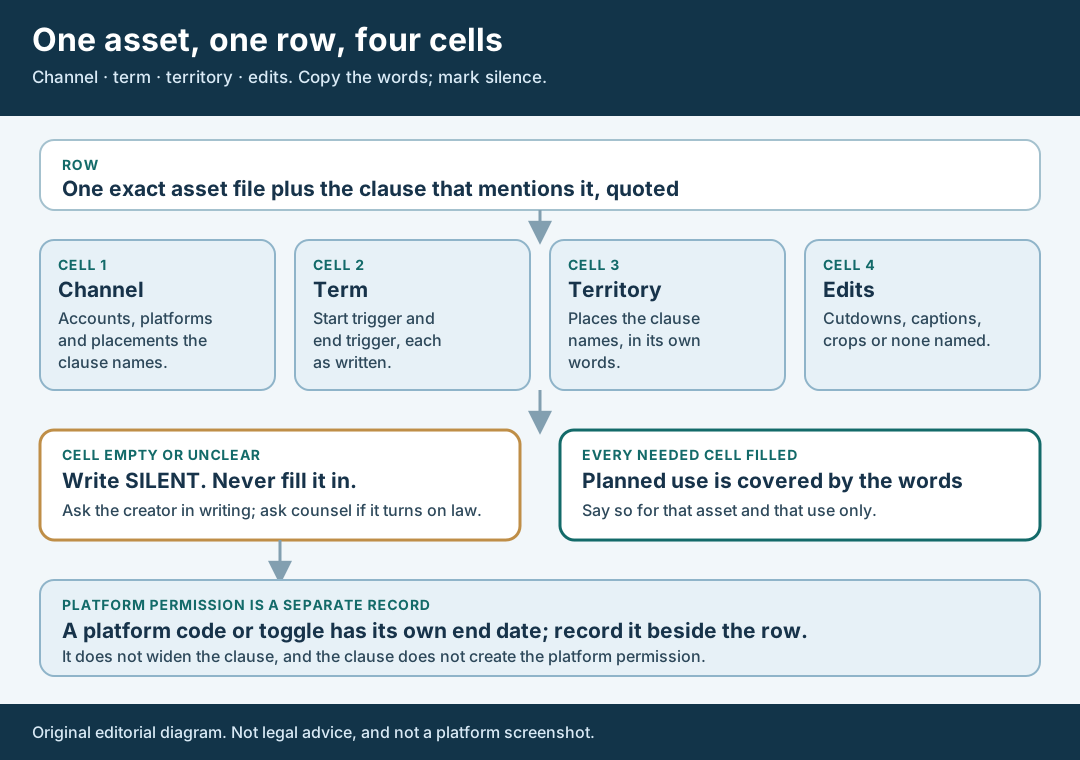
An original editorial row map. A planned use is covered only when every cell it needs holds the clause’s words.
Original visual by Superdirector editorial team. Creation date not recorded.
Mark what the words leave silent
Once the cells are filled, read each row for silence. A silent cell is not a small defect to smooth over. It is the part of the decision that the signed words do not make, and the matrix exists to make that visible before a file is scheduled.
Use three marks and no others. Covered means every cell the planned use needs holds the clause’s own words and they say yes. Not covered means a cell holds words that say no, such as a different channel list or a term that has ended. Ask means at least one needed cell is silent or can be read two honest ways. Do not create a fourth mark such as “probably fine.” That mark is how an inference ends up recorded as an agreement.
For each ask, write the question in a form the creator can answer in a sentence, and record the date sent and the written answer when it arrives. A good question names the asset ID, the planned use and the single missing cell: “For A1, may Brand A run the video as a paid ad on the channels listed here, and for what end date?” A weak question is “are we okay to use your video?” because the answer cannot be pasted into a cell. When the answer arrives in writing, record whether it is an accepted change to the agreement or only a message, and keep that distinction visible.
Where a question turns on law, such as whether a grant is exclusive or what a term clause means, write “counsel review” and the date in the row. The matrix does not decide it.
Keep platform permissions in a separate record
Most paid creator content runs through a platform permission as well as a signed agreement, and the two do different jobs. The agreement states what the brand and creator agreed. A platform permission is the mechanism that lets a particular ad system use a particular post or handle. Record the platform permission beside the row, with its own end date, and never let one stand in for the other.
TikTok’s own help pages show why the end dates need their own column. Its Smart+ Spark Ads guide tells advertisers to select the authorization duration (7, 30, 60, or 365 days) when authorizing a creator’s video, and its error-notification page lists an authorization-expired error whose suggested fix is to contact the creator to extend the authorization. The same page lists an error for an authorization that ends before the ad’s end time and suggests contacting the creator to adjust it. In plain terms: the platform permission has a duration chosen at the time, and an ad that is scheduled to run past it will meet an error. That date can differ from the term in the agreement, in either direction.
So record both clocks in each row: the term the clause gives, and the end date of the platform permission. If the platform permission ends earlier than the contract term, the ad needs a renewed permission to run to the contract’s end. If the platform permission ends later than the contract term, the row’s term still governs what the agreement covers, and the longer permission is not evidence of a longer grant. TikTok’s Spark Ads page also notes that a video must be un-authorized as a Spark Ad before it can be deleted from the organic account, which is a practical reason to log the permission even after a campaign ends.
Meta’s documentation shows a similar split in its own words. Its partnership-ads developer page says that with accepted account-level permission an advertiser can create partnership ads from a creator’s handle without a pre-existing post. Meta’s Help Center article “About partnership ad permissions” is cited by name only: we could not open its text and do not state what it says. Read it before you rely on it. The practical point for the matrix stands without it: an account-level permission to run ads from a handle is a platform setting, and your row for each asset should still hold the clause that covers that asset’s use.
What the sources say and do not say
The statements above rest on a short list of sources, each with a limit. The Cornell pages for 17 U.S.C. § 106, § 101 and § 204 support only the quoted statements: the listed exclusive rights and the owner’s right to authorize them, the definition of a transfer with its time-or-place wording and nonexclusive-license exclusion, and the signed-writing requirement. The Copyright Office’s What is copyright? page supports the general statement that owners can authorize others. TikTok’s pages support the stated durations, the expiry and end-time errors and the un-authorize-before-delete note; Meta’s developer page supports one sentence about account-level permission. None says what any particular agreement means. No figure on how often cells go silent, usual term lengths or rights cost is claimed.
Walk through a fictional asset list
Fictional exercise: no real brand, creator, agreement or result was inspected. A made-up brand, Brand A, signed an agreement with Creator Q. The agreement is itemised: A1 is one final vertical video, A2 is the raw clips behind it and A3 is one still image. Brand A wants to run A1 as a paid ad for a stated stretch, post A3 on its website and re-cut A2 into a longer film.
Row A1. The made-up clause reads: “The brand may post the video on the brand’s own social accounts and website for a period following first posting.” Channel: the brand’s own social accounts and website, as written; paid placement not named. Term: start is first posting, end is missing. Territory: SILENT. Edits: SILENT. Planned use, a paid ad: the channel cell does not name paid placement, the end cell is empty and territory is silent, so the mark is Ask. The question: “For A1, may Brand A run the video as a paid ad on the channels listed, in which places, and until what end date?”
Row A3. The made-up clause says nothing about stills. The row holds “no clause names this asset,” every cell reads SILENT, and the planned website use is marked Ask, even though the video clause names the website for A1. A still is a different file, and the matrix does not stretch one row’s words over another.
Row A2. The agreement lists the raw clips as “delivered for the brand’s archive.” The planned re-cut is a use the words do not mention. The edit cell is SILENT, and the mark is Ask, with counsel review noted because the question is whether archiving and editing are the same permission. After the creator answers A1 in writing with an end date and a channel list, only the A1 row is updated, and the TikTok permission, if used, gets its own end date recorded beside it. The scenario predicts nothing about how a real creator would answer and carries no performance claim.
What this page does not decide
This method records what a signed agreement says about each asset. It does not replace the checks next to it. How to write the brief is covered by the UGC content brief guide. Whether the cut met what was agreed is the first-cut review guide. Whether a product claim in the video is supported is the creator product claims guide.
A filled matrix is evidence of what the words say. It is not a statement that a use is lawful, that a platform will accept it or that the creator agrees with your reading. When a row ends in Ask or counsel review, the use waits.