How-To Guide
When raw creator footage should be its own deliverable, with its own permission and price line
Map every asset a creator shoot produces, name the job raw footage would do, and split copy, permission and price into separate lines before you quote.
By the Superdirector editorial team. U.S. Copyright Office and Copyright Act pages reviewed October 30, 2026.
At a glance
When should raw creator footage be a separately priced deliverable?
Make raw footage its own line only when you can name a job for it that the final video and cutdowns cannot do. Then answer three questions separately for it: whether you receive a copy, what uses the agreement permits, and what, if anything, it costs. The creator, not a benchmark, supplies the price, and a file handed over carries no right to re-edit it unless the signed words say so. An asset with no named job is not requested.
- List every asset the shoot makes, then name a job for each raw asset or drop it.
- Keep copy, permission and price as three separate answers on three separate cells.
- Record the creator’s reply as written and never treat silence as agreement.
Direct answer
Short answer: make raw footage a separate line only when it passes three tests. First, you can name a job for it that the finished video and its cutdowns cannot do. Second, handing it over or letting you use it plausibly means extra work or a trade-off for the creator, which only the creator can describe. Third, the agreement can state its permission in words of its own. If it fails the first test, do not ask for it. If it passes, give it its own row and answer three questions separately: do we receive a copy, what may we do with it, and what does it cost?
This is for an agency or brand buyer who is drafting a creator brief, reviewing a quote or answering a line in a creator’s reply that mentions “raw files.” The decision is narrow: raw footage is included in a named line, priced as its own line, or not requested. It does not set a price, and it contains no rate, range or market figure, because we have none that we can support. The creator’s own quote is the only price this page treats as real.
The reason to split the questions is that a file and a right are different things. Having the clips on your drive tells you nothing about whether you may re-cut them into a new video, run them in a different place or give them to another vendor. Use the blank raw footage card, the CSV register and the asset-deliverable map to keep one row per asset.
List every asset the shoot produces
Most briefs name one deliverable, “a 30-second video,” while the shoot produces many more files. Start from the shoot, not the deal summary. Write one row for each asset that exists or will exist, whether or not the agreement mentions it. A row for something nobody has asked for yet is useful, because a blank on the card is a question you can ask, and a blank in your head is a surprise later.
| Asset | What it is | Who holds it first | Often confused with |
|---|---|---|---|
| Final video | The cut the creator posts or delivers | Creator, then the platform | The raw clips it was built from |
| Cutdowns and alternates | Other lengths or aspect ratios of the final | Creator | New footage; they are edits of the final |
| Raw clips | Unedited takes as recorded | Creator’s device or storage | A backup of the final |
| Outtakes and selects | Takes the creator chose not to use, or a short list of preferred ones | Creator | All raw clips |
| Audio | Voice-over, room sound, any music or sound effects used | Creator, and for music possibly someone else | The video file |
| Stills and cover frames | Images pulled from the footage or shot separately | Creator | Rights to the video |
Also record what appears inside each asset that the creator may not control: other people on camera, background music, another brand’s product, a screen showing someone else’s software. Raw footage tends to contain more of this than a final cut, because the final was edited by someone who chose what to leave out. If a clip contains music, the music paid-reuse guide explains why the recheck belongs to the specific file. If a clip shows a product screen, the outdated product UI guide covers what to watch for.
Keep one row per exact file or clip group, with a version or date if the files can change. “Footage” is not a row. “All unedited camera clips from the demo shoot, as recorded” is a row. The asset rights guide uses the same one-row-per-file habit for channel, term and territory; this page starts earlier, with whether the row should exist at all.
Name the job each raw asset would do
For each raw row, write one sentence: “We would use this to ___, which the final video and its cutdowns cannot do because ___.” If you cannot finish the sentence, the asset has no job and the row’s decision is not requested. This is the step that keeps the list short. It also protects the relationship, because a request that names its purpose is easier to answer, and to price honestly, than a request for “everything.”
Jobs that can pass the test are specific. One is replacing a moment after the product changes, where a cleaner take would avoid asking for a reshoot. Another is making a different cut for a placement the final does not fit; the crop review guide is the way to find out whether an extra cutdown already solves it. Another is pulling a still for a use the agreement names. A job that fails the test is vague: “for the archive,” “in case we need it,” “because the other agency asked.” These are not jobs. They are worries, and a worry is better handled by asking one targeted question than by requesting every file.
Then ask whether a cheaper asset does the same job. A job that needs “the moment the creator holds the product” might be met by one clean take or a still, not the whole shoot. A job that needs “a version without the caption bar” might be met by a cutdown without the bar. Write the narrower asset on the card next to the raw one, because the creator can only quote what you ask for, and a narrower ask may be both easier to give and easier to permit.
Split copy, permission and price
For every asset that has a job, answer three questions in three separate cells. Collapsing them is the usual mistake. A quote that says “raw footage included” may mean the creator will send files, or that you may re-edit them, or that the fee already covers both, and the words alone do not tell you which. The map shows the three questions side by side.
| Question | What you are really asking | Where the answer must live |
|---|---|---|
| Copy | Which exact files will the creator send, in what format, by when | A delivery line naming the files and the date |
| Permission | Which uses the creator allows, in the agreement’s own words, including re-editing | A permission clause tied to the asset row |
| Price | Whether the fee covers it, or the creator quotes it as a line of its own | A price line the creator wrote, not one you estimated |
Copy is not permission. The Copyright Act states that ownership of a copyright is distinct from ownership of any material object in which the work is embodied, and that transferring the object does not by itself convey rights in the work. 17 U.S.C. § 202. The Copyright Office makes the same point in its basics circular: mere ownership of a copy does not give the owner the ownership of the copyright in the work. Copyright Basics, Circular 1. For a buyer, the practical reading is plain: receiving a file answers the copy question and nothing else.
Permission needs its own words. The statute lists, among a copyright owner’s exclusive rights, making copies of a work and preparing derivative works based on it. 17 U.S.C. § 106. We do not give legal advice, and we draw only the editorial conclusion: re-editing clips into a new video, copying them to another party or running them somewhere new are the kinds of use worth naming in the agreement rather than assuming. The same Act says a transfer of copyright ownership, other than by operation of law, is not valid unless an instrument of conveyance, or a note or memorandum of the transfer, is in writing and signed by the owner of the rights conveyed or the owner’s authorized agent. 17 U.S.C. § 204. The Copyright Office adds that transferring a right on a nonexclusive basis does not require a written agreement (Circular 1, above). Whether a given permission is exclusive or nonexclusive, and what that means for you, is a question for counsel. The editorial rule we suggest is simpler: put the permission in writing either way, so the record shows what both sides understood.
“Work made for hire” is not a shortcut. A buyer who wants clean ownership sometimes asks for that wording. The Copyright Office’s circular says a specially ordered or commissioned work is made for hire only if it meets four criteria: it falls within one of nine listed categories, there is a written agreement, the agreement expressly says the work is to be considered made for hire, and all parties sign it. If any requirement fails, it says, the work is not made for hire. Works Made for Hire, Circular 30. Whether raw clips would qualify is not something this page decides, so do not rely on a label to answer the permission cell. State the uses you need as well.
Price is the creator’s to say. Leave the cell empty until the creator answers. Reasons it might be extra could include time to select and export clips, the need to remove or flag material belonging to others, or the creator planning to reuse the same takes. Those are questions to ask, not facts we are asserting about any creator. If the quote is a bundle, ask for raw footage to be shown as its own line first; the bundle quote guide explains how to open a bundle without inventing the split.
When enlarged, scroll horizontally to read the diagram.
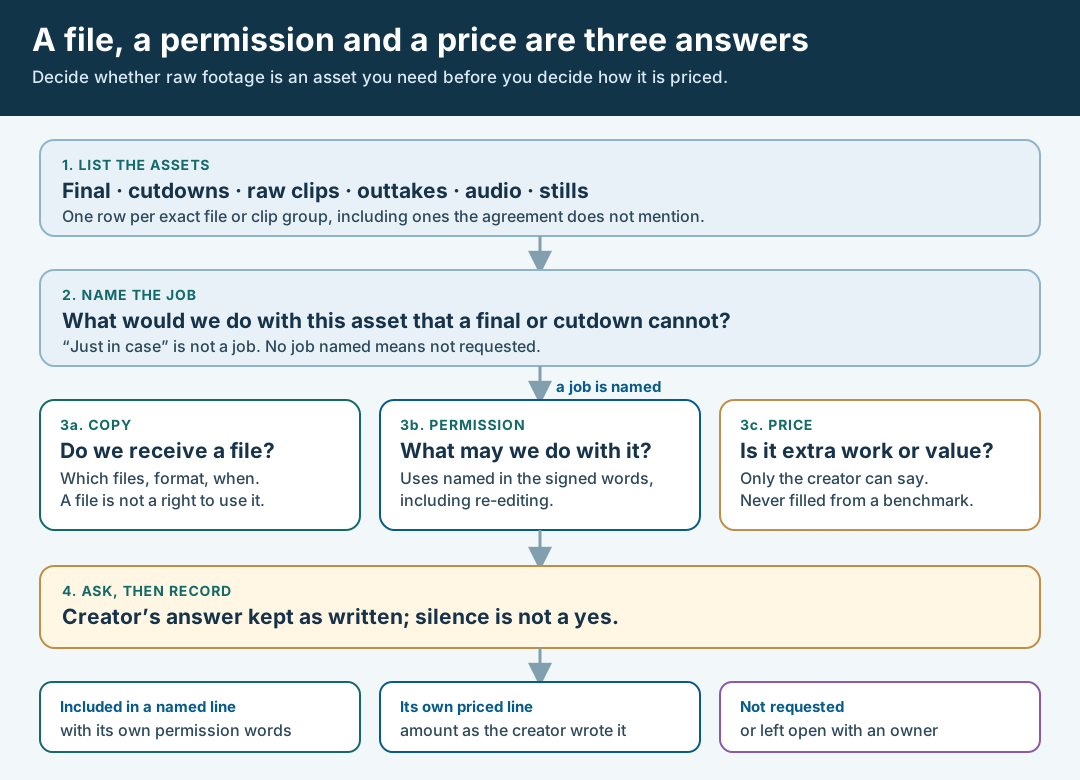
An original editorial map. A file, a permission and a price are three separate answers.
Original visual by Superdirector editorial team. Creation date not recorded.
Ask the creator before you assume a price
Put the job and the three questions to the creator in plain words. A workable message names one asset, the job, and then asks three things. First, “Can you send these files, and in what format and by when?” Second, “Which of these uses are you comfortable permitting?” followed by the uses you wrote down. Third, “Is this included in the fee we discussed, or would you quote it separately?” Attach the card row so the creator sees the same words you do.
Expect four kinds of answer, and record each as written: it is included, here is a separate quote, a narrower version is possible, or no. Date the reply with its time zone. Do not paraphrase a quote into your own shorthand, because the wording often carries a limit, such as which clips or for how long. If the creator names a condition, write the condition into the permission cell. If the creator does not reply, record when you asked and that no reply was received. Silence is not a yes, and an unanswered question should remain open on the card with an owner.
If the creator accepts the concept but declines this one item, that is a partial acceptance, and the partial acceptance guide covers keeping the rest of the deal moving. Declining raw footage does not have to end the conversation. Return to the job sentence and ask whether a narrower asset would do it.
Write the line and mark what stays open
Close each row with one decision: included in a named line, its own priced line, or not requested. A fourth state, open, is allowed only with an owner and a date for the question. Then write the decision into the agreement or the accepted brief, with an asset ID that matches the card. The line should show four things: the exact files, the delivery date, the uses permitted in the agreement’s words, and the price as the creator wrote it, or a statement that the fee covers it and which line it sits in.
Check that the three cells agree with one another. A row that says the files are delivered, the permission is blank and the price is “included” is incomplete, not settled. A row that says “included in line A1” should point to a line that actually mentions the asset. If the creator’s fee for the main deliverable is the same fee in your records and in theirs, the fee ledger guide shows how to tie each amount to a clause and a payment, so a raw footage line does not hide inside another line.
Keep the whole file together: the card, the creator’s replies as written, the agreement clause numbers and the signature record. If you later want a use you did not write down, treat it as a new row and a new question, not as something the earlier wording implies. This page does not state how long records should be kept; set that from your agreement and your own records policy.
Walk through a fictional map
Fictional exercise: no real brand, creator, agreement, price or result was inspected. A made-up brand, Brand A, hires Creator Q for one demonstration video. The brief names only the final video. The buyer lists four rows: A1 the final video, A2 one square cutdown, A3 all unedited camera clips and A4 the voice-over audio on its own.
For A3, the buyer first tries to write the job sentence: “We would use this to remake the opening if the product label changes before launch.” That is a real job, but the buyer then asks whether a narrower asset does it, and writes “one clean take of the opening, no on-screen text” next to the row. For A4 the buyer cannot finish the sentence, so the decision is not requested. For A2 the job is a placement the final does not fit, and the crop review confirms the need, so it goes into the delivery line.
The buyer sends Creator Q the narrower ask for A3 with the three questions. Suppose the reply, kept as written, says Q can send the opening takes and would like to quote re-editing separately. That is Q’s statement, so the buyer records it verbatim, leaves the price cell empty until a quote arrives, and writes the permission cell as “the opening takes may be re-edited only into the replacement opening” pending Q’s agreement. The decision for A3 is open, owned by the account lead, with a date. Nothing in this scenario implies what any real creator would say or charge.
What this page does not decide
This page decides whether a raw asset deserves a line of its own and how to keep that line honest. It does not set a price, judge whether a fee is fair, or say what a given agreement means. Those belong to the creator’s quote and to counsel. Nothing here is a market benchmark: we did not find a source we could support for a typical price of raw footage, so none is given. We also did not read any platform’s terms about who may use clips posted on that platform, and we claim nothing about them.
It differs from the closest existing pages in the question it answers. The asset rights guide records channel, term and territory for every file you already hold; this page comes first and asks whether the raw file should be requested, and in what lines. The fee ledger guide ties production and posting amounts to clauses and payments; this page decides whether one more asset needs its own amount. The bundle quote guide opens a quote into lines; this page supplies the asset question you ask before you open it. The scope table guide assigns work between agency and creator; this page covers one asset inside that table.
Two neighbours are also separate. Paying to boost a creator’s post is covered in the paid-use agreement guide, and it concerns the post, not the raw clips. How files are named, sent and stored once you have agreed to receive them is a delivery question this page does not cover. If a point turns on the law or on the meaning of your agreement, send it to counsel instead of settling it in a message thread.