How-To Guide
What revision scope to settle with a creator before production starts
Define what one revision round is, what it covers, how a request cites the brief, the turnaround on each side and what happens when the rounds run out.
By the Superdirector editorial team. FTC and TikTok One pages reviewed October 30, 2026.
At a glance
What revision scope should a team settle with a creator before production begins?
Settle five things in writing before the creator starts: what counts as one round, what a round covers and excludes, that every change request quotes an agreed brief line, how many days each side has to respond, and what happens when the last round is used. A revision is a change to agreed work. A request for something the brief never held is a scope change, a fix an outside rule requires is recorded as required, and a preference with no agreed line needs a named person’s written decision. None of this fixes a number of rounds; that is a term you set.
- Define the round as one consolidated request answered by one returned file version.
- Sort each request into revision, scope change, required fix or preference by the brief line it cites.
- Write the clock for both sides and the outcome when the rounds are used up.
Direct answer
Short answer: before a creator starts producing, settle five terms in writing. First, what one round is: who sends the request, how requests are bundled and which returned file ends the round. Second, what a round covers and what it does not. Third, that every change request quotes the agreed brief line it points to. Fourth, the clock for each side: how many days the creator has to return a file and how many days you have to review it. Fifth, what happens when the last round is used: accept the file, buy an extra round on agreed terms, or stop.
This is for an agency or brand marketer who has a brief and a fee agreed in principle and is about to let a creator begin. The decision is narrow: which changes count as a revision to agreed work, and how that is counted. It is not a method for deciding whether you like a cut, and it does not tell you how many rounds to offer, because we have no verified benchmark for that and invent none. The pages that sort feedback after delivery and fix the approved file sit beside this one and are listed in the boundary section.
The reason to settle this early is that the platform tools and the brief can change underneath you. In TikTok One, for example, the page for creator content at scale says the brief can be edited only until creators have started producing videos (TikTok One: creator content at scale). That is one tool’s rule, not a rule for every deal, but it shows how a terms-first sequence works: the cheap moment to agree what counts is before production. Use the blank revision-boundary card, the CSV register and the sorting map to keep the terms and the tally in one place.
Name the unit that counts as one round
A phrase like “two rounds of revisions” hides at least four choices. Write the answer to each on the card before the creator starts. Who may ask: name the one person whose request starts a round, not a team, so two reviewers cannot start two rounds. How requests are bundled: is one round a single consolidated list, or does every separate message count? What ends a round: one workable choice is the creator returning one new file version that you log with a version label and a time. What the count attaches to: each video, or the whole set of deliverables.
Write the definition as a sentence a stranger could apply: “One round is one consolidated list of change requests from the named reviewer, answered by one returned file version.” If your agreement already has wording, quote it exactly and do not paraphrase. If it says only “two revisions,” write “round not defined” and settle the definition now. A count with no unit leaves room for a later disagreement about whether the rounds are already used, and that argument is then about wording, not the video.
Platform tools give a round natural edges, but not a limit. The TikTok One page on completing deliverables says the advertiser or TikTok might request edits, that the creator can see the requested changes and upload a new video, and that after a new upload the video again goes through brand and platform review (TikTok One: complete deliverables). So a request and a new upload bracket a round in that tool. The pages we read do not state how many edit requests are allowed, so the number is yours to write down. They also describe one tool; we did not read the equivalent steps for other platforms and make no statement about them.
List what a round covers and what it does not
The most useful thing a revision clause can do is separate kinds of change, because they have different owners and different costs. The map and the table below give four bins. These bins are our editorial method for keeping a record, not a legal classification and not a platform feature. The “usually” column is a starting position to confirm in your own agreement.
| Bin | Fictional example | Usually counts as a round? | The term to write down |
|---|---|---|---|
| A. Revision to agreed work | The brief line asks the video to show exporting a file; the cut shows importing | Yes, round number recorded | Does a miss against a stated brief line use a round, or is it a defect fix outside the count? |
| B. Scope change | “Add a second scene about the plan tiers” when the brief never mentioned tiers | No. Handled apart as a change to the agreement | Who prices and dates an addition, and in what form is it agreed? |
| C. Required by an outside rule or the platform | A disclosure position or a claim must change before posting | A named person decides and records it | Does a required fix use a round, and who pays for the extra work? |
| D. Preference with no agreed line | “It feels a bit flat” | Only if a named person decides in writing to act on it | Is there any preference round at all, and who may call it? |
Two clarifications keep the table honest. First, a request for another video is not a revision unless your agreement says it is. The TikTok One creator-content-at-scale page treats them as separate actions: you can request edits on a specific video, and you can ask the creator to make another video for the same project once the earlier video has passed platform review (TikTok One: creator content at scale). Second, a change caused by your own late product or brief change is not the creator’s miss; the brief-change impact guide covers amending a brief and keeping a dated, versioned record of what was sent.
For bin C, keep the facts straight and the money question separate. The FTC’s question-and-answer page says a company is ultimately responsible for what others do on its behalf, and that delegating part of a promotional program to an outside company does not relieve it of responsibility under the FTC Act (FTC Endorsement Guides: What People Are Asking). The FTC’s influencer guide, dated November 2019, separately tells influencers it is their responsibility to make disclosures (FTC Disclosures 101 for Social Media Influencers). Neither page says whether a required fix uses up a revision round. That is a commercial term, so write it down rather than argue it later. Whether a given disclosure or claim is adequate is for counsel and for the specific checks linked in the boundary section.
When enlarged, scroll horizontally to read the diagram.
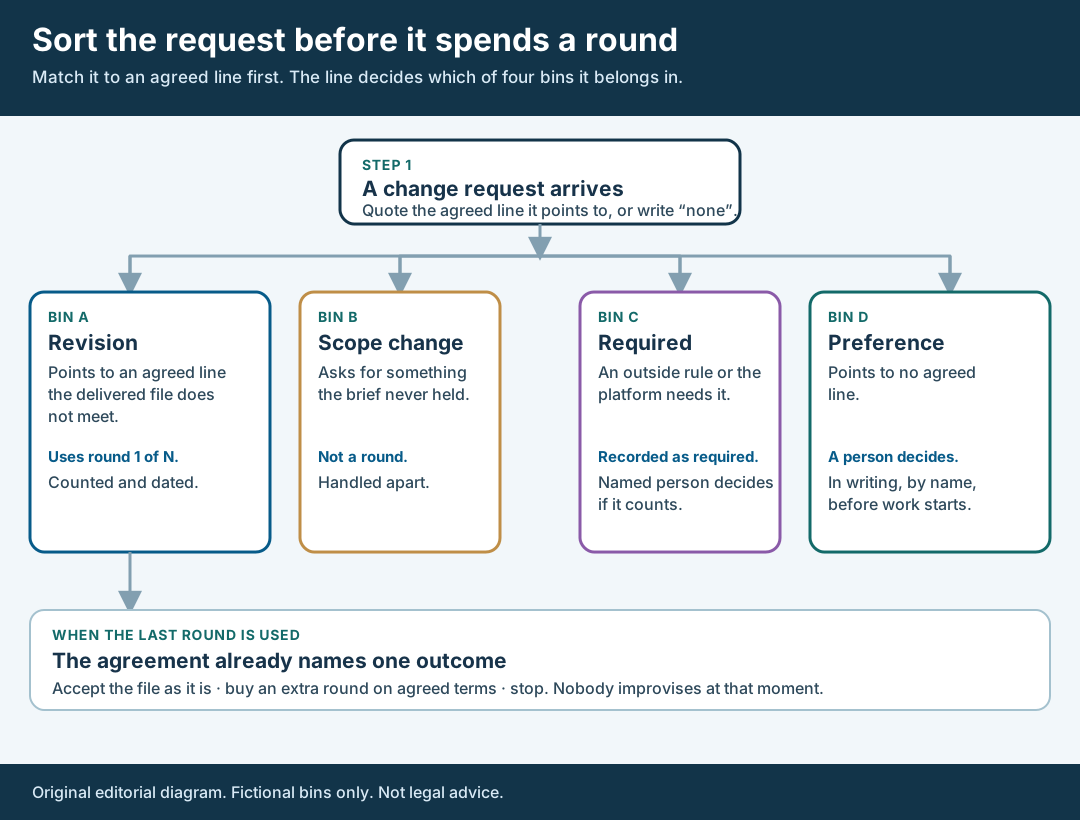
An original editorial map. The brief line a request cites decides which bin it belongs in.
Original visual by Superdirector editorial team. Creation date not recorded.
Tie every change request to an agreed line
A change request is the point where a round either starts or does not. Require each request to carry three things: the agreed brief line it points to, quoted; what the delivered file shows at that point, with a timestamp; and the change requested. A request in this shape can be sorted into a bin in minutes. A request that cites no line is not yet a revision: reply with a question, “Which agreed line does this point to?”, and do not start the clock. That is a neutral question, not a refusal, and it is also kind to the creator, who is spared guessing what a vague comment means.
Put the consolidation duty on your side. If three people at the brand have notes, one named person resolves conflicts and sends one list, because contradictory comments from several reviewers are a fast way to spend a round and still not satisfy anyone. The card’s block C records each request with who sent it, when it was received, the line cited, the bin and whether it counts. If a request arrives in a platform tool, copy the tool’s wording and time into the block rather than summarizing it.
Review before posting, and say so in the agreement. The FTC’s question-and-answer page says it is much easier to review posts before they are posted than to search for them afterwards (FTC Endorsement Guides: What People Are Asking). That supports building the review step, and therefore the rounds, into the schedule before the post date, not as a scramble after it. Sorting a pile of comments by obligation, legal gate, brief gap or preference is the job of the first-cut review guide; the card here is the agreement that review runs inside.
Set the clock for each side of a round
A round that has no clock can stretch indefinitely in either direction. Write two numbers: the days the creator has to return a new file after a request, and the days you have to review a returned file. Do not borrow a number from this page, because we state none. Use days that fit the posting date and the creator’s own schedule, and record the time zone for every timestamp so “within two days” has one meaning.
Then write what a missed clock does. If you review late, does the delivery or posting window move? If the creator returns late, does the round still count? And what does silence mean: is a returned file treated as approved if nobody answers, or does it stay open? Your agreement may say nothing on this, and a platform tool may not answer it for you. If yours is silent, write “not stated” and ask for the missing term before production starts. Do not assume that silence is approval; make it a written yes.
Also pin the last date a change may be requested. A late request after the posting date has been set can disrupt the schedule, so the cutoff belongs in the agreement with the other limits. Keep the clock terms and the round count on the same card so one glance shows how many rounds are used, how many remain and which days each side owes.
Walk through a fictional agreement
Suppose Brand Q hires Creator R for one 30-second video. The fictional agreement says: “Up to two rounds. One round is one consolidated list from Alex, the brand lead, answered by one returned file version.” It says required fixes do not count, and that an addition outside the brief is a scope change. It states no days, so the card records both clocks as “not stated” and the team agrees them in writing before production starts.
The first cut arrives. Alex sends one list with four items. The first quotes brief line 4, which asks for a clip showing exporting, and notes that the cut at 0:12 shows importing: bin A, round 1. The second asks for a new scene about pricing, which the brief never held: bin B, a scope change handled apart and not counted. The third is a disclosure position the brand’s adviser wants moved: bin C, recorded as required, with the agreement’s own wording that it does not count. The fourth says “it feels a bit flat” and cites no line: bin D, so Alex decides in writing to leave it.
Creator R returns version 2 and the tally reads 1 of 2 used. If a second round is spent, the agreement’s named outcome applies and nobody has to improvise. The scenario is invented to show the sorting and predicts nothing about any real creator, fee or result.
Write what happens after the last round
Decide the ending before you need it. When the last round is used and a gap remains, there are three outcomes: accept the file as it is, buy an extra round on agreed terms, or stop. Write which one applies by default and who may choose another. For an extra round, quote the terms from the agreement or attach a short written addition; do not invent a price on this page or in the thread. For stopping, say what happens to the fee and the files, and keep that in the fee record described in the production and posting fee guide.
Record the end state the same way as every other step: the round count, the version returned, who decided, the date and where the written confirmation is. A short file that shows each request, its bin and its outcome is also your best answer if the two sides later disagree about what was asked. When you reach approval, pin exactly which file was approved using the approved-cut receipt guide, so that the last returned version and the approved version cannot be confused.
If the creator declines one of the changes you requested, that is a different situation from running out of rounds; see the partial acceptance guide. Keep the card, the register and the written confirmations together for every deliverable, and fill the card in again when the deliverable changes.
What this page does not decide
This page settles the terms and the tally for revision rounds. It does not decide whether a particular change is lawful, whether a creator breached an agreement, or whether a disclosure is sufficient. Those points belong with counsel and with the specific checks. It also does not set how many rounds to offer or what an extra round should cost, and nothing here is a benchmark.
How it differs from the closest existing pages. The first-cut review guide sorts the comments on a delivered cut into obligation, legal gate, brief gap or preference; this page is the agreement written before production that decides what a round is and how many remain. The approved-cut receipt guide fingerprints the file that was approved; this page counts the rounds before that approval. The brief-change impact guide amends an approved brief after a product change; here a scope change is only one bin. The production and posting fee guide separates fees; this page does not set or split any fee. The agency and creator scope table assigns who owns each work item; this page counts only changes to agreed creator work.
The platform statements come from two TikTok One help pages, marked as last updated in October 2025 and March 2026, and two FTC pages read on October 30, 2026. We could not load the revision pages of two third-party influencer platforms, so we cite no claim from them. We did not read the equivalent steps for Instagram or YouTube, so we make no statement about them. We hold no first-party revision history from real campaigns, so the card is blank and the example is fictional.