How-To Guide
When to stop renewing a creator who keeps missing agreed deliverables
Log each agreed unit with its due date, outcome and cause, count the pattern across agreements, then renew, tighten, run one unit or end.
By the Superdirector editorial team. FTC page reviewed October 30, 2026.
At a glance
When should a brand stop renewing a creator who repeatedly misses agreed deliverables?
Stop when your own dated ledger shows a repeat of the same kind that you can assign to the creator, and your rule, written before counting, says that is enough. Log one row per agreed unit with its signed due date, observed outcome, observed date and a cause: creator, brand dependency, outside event or unclear. Count units across every agreement, keep unclear rows apart and read the order in time. No source we found gives a normal miss rate, so the threshold is yours. Choose renew as is, tighter milestones, a one-unit probation or end.
- Count units, not agreements, against the due dates actually in force.
- Mark your own late sample or approval as a brand dependency, not a creator miss.
- Write the renewal rule and review date before reading the counts.
Direct answer
Short answer: stop renewing a creator for missed deliverables only when your own dated record shows a repeat that you can assign to the creator, and not before. Build a ledger with one row per agreed unit, the due date exactly as signed, what was observed and on which date, and who or what caused each miss. Then count units across every agreement, keep creator-caused and unclear rows apart, and compare the counts with a renewal rule you wrote before reading them. The rule picks one of four options: renew as is, renew with tighter milestones, run a one-unit probation, or end.
This is for an agency or brand marketer who has worked with one creator under two or more agreements and remembers several late or absent items. The decision is narrow: should the next agreement exist, and on what terms, given observed delivery? It is not a judgment of talent, honesty or audience, and it predicts nothing. We found no source giving a normal miss rate or a number of misses that justifies ending a relationship, so this page supplies none. The threshold is yours.
An impression like “they are always late” is easy to hold and hard to defend. It may blend a creator’s slips with a sample that shipped late and an approval that sat for a week. The blank record card, the CSV register and the decision map keep those apart. All three are blank, and the example below is fictional.
List every agreed deliverable with its due date
Start from the signed words, not from memory. For each agreement, write down its ID and signed date, then split it into units: one video, one draft for review, one file hand-off, one posted link. A bundle such as “three videos and a pinned comment” becomes four rows, because the question later is how many units arrived and when. Without that split, an agreement where three of four units arrived looks the same as one where none did.
Give every unit its due date exactly as the agreement states it, and say which kind of date it is: a draft date, a live-post date and a posting window are different promises. If the agreement states no date for a unit, write “no date stated”. A unit with no written date cannot be late in this record, and the fix belongs in the next agreement. Add every written amendment with its date and who agreed to it; “Friday works” counts only if both sides can show it.
Add the brand dependencies in front of each unit, from your own files: the date the sample was sent and received, the date your approval came back for a draft, and the date any brief change was sent. These decide in step three whether a miss is the creator’s. If your team never wrote them down, put “not on file”. The sample scheduling guide covers that clock, and the revision rounds guide covers revision limits.
Confirm that each posted unit is on the account the agreement names; the account-to-post proof guide shows how. A partly accepted unit is one row with its own outcome, and the partial acceptance guide covers that single case.
Record what happened to each unit on its date
For each row, write the outcome from what you can show, using one of four labels. On time means the unit arrived or went live by the due date in force. Late means it arrived after that date, and you record the number of days. Not delivered means no unit was received or published by the day you read the record, and you write that day. Replaced by written agreement means both sides agreed in writing to drop or swap it. Do not use a fifth label such as “mostly done”. If a unit is partly there, say in the row what is there and which label the agreement’s own wording supports.
Write the observed date and the evidence beside it: the post address and the date you saw it live, the delivery message, the hand-off record. “I think it was Tuesday” is a recollection; a capture with an address and a time is a record. If a unit is not yet due, write “not yet due” and leave it out of every count.
Mind the date you use for “on time”. A creator who delivers the draft on its due date but waits for your approval has met the draft date. If the post then goes live after the live-post date because approval was late, the outcome is still “late”, and the cause belongs to the next step. Keeping outcome and cause in separate columns lets one fact stay true while the explanation is argued. A single missed window has its own page, the missed launch window guide.
Keep the creator’s own account in the row. If you asked why a unit was late or absent, save the reply exactly as written with its date, labeled as their statement. If you did not ask, write “not asked” and ask before you decide. If they have not answered, write the date you asked and that no reply was received. Silence is a fact about the exchange, not an explanation of the miss.
Mark who or what caused each late or missing unit
Every row labeled late or not delivered gets one cause label and the evidence for it. Use four. Creator means the delay came from their own work or schedule, and nothing on your side stood in front of it. Brand dependency means something you owed arrived late or changed: the sample, the approval, the access, the brief. Outside event means a carrier, a platform outage or another third party, with something you can point to. Unclear means no record decides it. “Unclear” is a legitimate label and will be common. Using it keeps you from turning a gap in your own files into a finding about the creator.
The test for a brand dependency is mechanical. Take the date the dependency arrived, then ask whether the creator delivered within the time the agreement allowed after that date. If the sample arrived eight days after it was due to ship and the agreement gave the creator ten days from receipt, the unit was not late on the creator’s clock, even if it was late on the calendar. If the agreement states no clock after a dependency, mark the row unclear instead of inventing one. A changed brief is a new input to the creator, and the brief change guide explains how to put its date on file.
Be as strict with your own side as with theirs. A row where your approval took longer than the agreement gives you is a brand miss, and it belongs in the same ledger. It shows whether the agreement’s dates were realistic and keeps the conversation with the creator fair.
When enlarged, scroll horizontally to read the diagram.
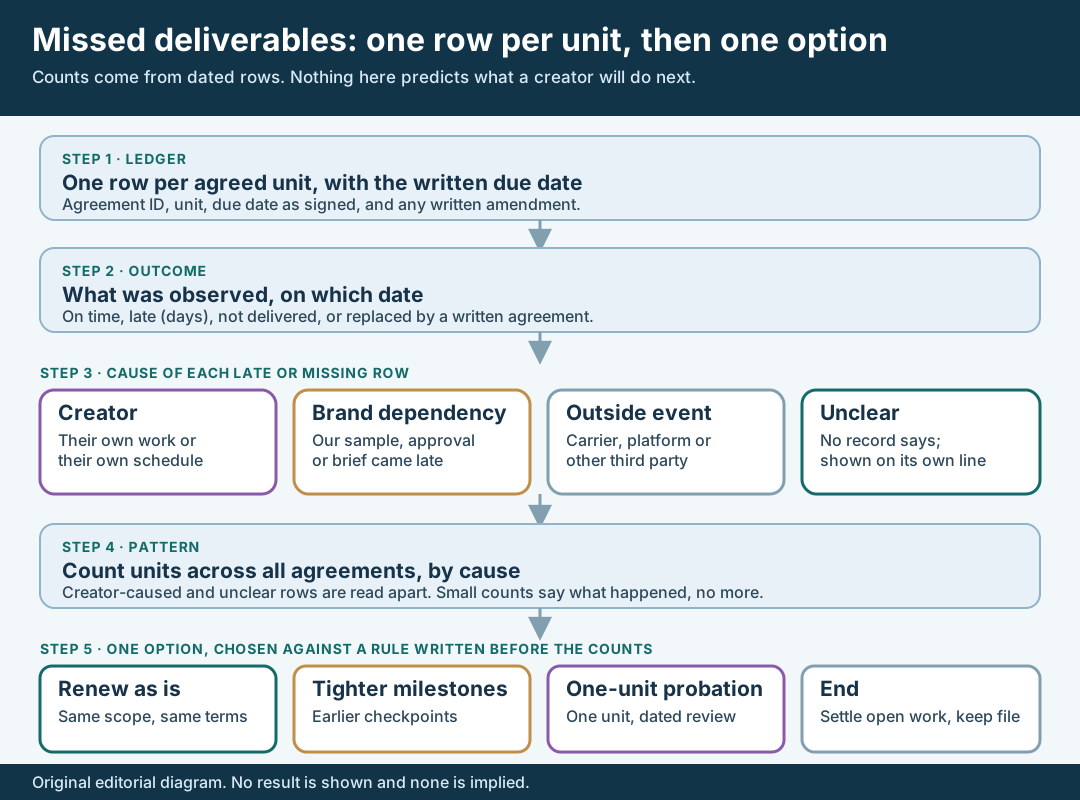
An original editorial map. Counts come from dated rows, and unclear rows are never folded into the creator’s side.
Original visual by Superdirector editorial team. Creation date not recorded.
Read the pattern across every agreement
Now count, but only after you have written your rule. Before reading any count, write one sentence that says which result would make you renew as is, tighten the terms, try one unit or end. Date it and keep it on the card. A rule written after the counts can be bent to fit a conclusion you already hold, and the dated sentence shows it was not. Fill the thresholds from your own economics, such as what a missed launch costs you, and not from an industry figure. We have none to offer.
Count units, not agreements, across the whole relationship. For each cause label, count the units that were due. Show on-time, late and not-delivered beside each cause. Keep the creator-caused row and the unclear row apart and never fold unclear into either side. The table shows the reading frame. It is an editorial aid for naming what the record supports and is not a scoring formula.
| Count to take | What it can support | What it cannot support |
|---|---|---|
| Units due, on time vs late vs not delivered | How many agreed units came on the dates in force, per outcome | Why any of them were late |
| Creator-caused rows only | Whether the record shows a repeat that sits with the creator, and whether it is the same kind each time | A prediction of the next agreement |
| Brand dependency rows | Whether your own inputs, not their work, drove the lateness | That the creator would have been on time |
| Unclear rows | How much of the record you cannot yet read, and what to file better next time | Blame or credit for either side |
| Days late among late units | Whether lateness is small and steady or large and sporadic | A reason, or an average worth quoting without the counts |
| Order in time | Whether misses are clustered early, recent or spread out across agreements | Cause, since later agreements may have changed in scope |
Read the order in time before the totals. Three misses in a first agreement and none in the next two is a different story from the reverse, even with equal totals. Check whether the agreements differ in size, format or dates, then check the kind of any repeat: the same unit type, or the same step, such as drafts always on time and posts always late. A repeat of one kind says more about what to change than a bare count.
Be honest about size. With only a handful of units, the counts tell you what happened in those cases and little else, so say that on the card. When the creator-caused count is small and the unclear count is large, the right next step may be to improve the file and ask the creator. When results rather than delivery are mixed, see the mixed-results renewal guide, which reads reach and outcomes and not delivery dates.
Pick one option and write the new terms
Choose exactly one of four options, using the rule you wrote and the rows you can cite. Renew as is fits creator-caused misses that are absent or isolated. Renew with tighter milestones fits a creator pattern concentrated in one step, where an earlier checkpoint can be added without raising the whole cost. One-unit probation fits a creator-caused repeat or a large unclear share where you still want the relationship: one unit, with its date and dependencies written down, and a review date. End fits a creator-caused repeat that your rule says is enough, after the creator has had a chance to answer. These options are an editorial framework, not validated thresholds, and no row is an automatic answer.
Whatever you choose, write the terms as new. A renewal is a new agreement, so state its due dates, what counts as delivered (a draft received, a draft accepted or a post live), who confirms it and when, how long you will take to approve, and when your inputs are due. Putting your own dependency dates in the document is the single change most likely to make the next ledger readable. Any remedy for a missed date, a change to payment timing or a right to terminate is a contract question, and this page does not draft one. Send those clauses to counsel.
Say the reason to the creator before the decision is final, and attach the rows: “Of four units, one is marked late on your side, one late on ours and one unclear. Is anything missing?” That lets them correct your record, and a corrected record is better evidence. If you ended a creator and new evidence appears, the decline re-evaluation guide describes how to reopen the question.
If you do renew, keep monitoring in view. The FTC’s Endorsement Guides question-and-answer page says advertisers should train and monitor members of their network, that there is no one-size-fits-all standard for how often, and that if regular monitoring is too much, you should probably switch to pre-approval of posts. FTC Endorsement Guides: What People Are Asking. The page does not tie lateness to monitoring, so choose a cadence you can keep and write it on the card.
Finally set the review date and name who will read the ledger again. A probation that nobody reads at its end is just a renewal.
Walk through a fictional ledger
Fictional exercise: no real brand, creator, campaign or result was inspected. A made-up brand, Brand A, has worked with Creator Q under two agreements. Agreement 1 asked for one long video and agreement 2 asked for two short videos and a pinned comment. Before reading anything, Brand A wrote its rule: end if the creator-caused rows show a repeat of the same kind and the unclear rows are few; try one unit if the creator-caused rows are few but unclear rows are many.
| Unit | Due as signed | Outcome | Cause | Evidence the team wrote down |
|---|---|---|---|---|
| Agreement 1, long video | Day 30 | Late, 6 days | Creator | Sample received before day 5; no later change on file; creator’s reply: schedule slip |
| Agreement 2, short video 1 | Day 20 | On time | — | Post seen live on day 19 |
| Agreement 2, short video 2 | Day 20 | Late, 9 days | Brand dependency | Brand A’s approval returned 11 days after the draft; the agreement gave Brand A 3 days |
| Agreement 2, pinned comment | Day 21 | Not delivered | Unclear | No message either way; creator not yet asked |
Reading the table, Brand A has four units, one on time and three not. Only one miss is creator-caused, one is Brand A’s own approval delay, and one is unclear because nobody asked. The first branch of the rule needs a repeat of one kind from the creator, and the record shows a single row, so it does not fire. Brand A asks Creator Q about the pinned comment and records the reply as written. Until then, the sensible option under its own rule is a one-unit probation with the approval time written into the terms. The case predicts nothing about any real creator.
What this page does not decide
This record decides one thing: whether a creator’s observed delivery supports another agreement, and on which terms. It does not weigh reach, sales or content quality. The mixed-results renewal guide reads reach and qualified outcomes and does not examine delivery dates. This page reads delivery dates and not results. Use both when both questions are open, and keep their ledgers separate.
It also differs from three nearby pages. The incomplete deliverable report tells a client about one gap. The missed launch window guide revises one approved post after its date has passed. The partial acceptance guide settles one agreement’s missing unit. None decides, across several agreements, whether the relationship should continue. Picking who to approach belongs to the buyer task shortlist guide, and checking a creator’s format to the format repeatability guide.
Nothing here says how often creators miss deliverables, how many misses are normal, or how delivery relates to results; we found no sources for those numbers. The FTC page we cite supports only the narrow statement attributed to it. It does not tell you whether a miss is a breach, whether ending an agreement is permitted by its terms, or what a regulator would decide. Those points turn on law and your contract’s exact wording, and belong with counsel.