How-To Guide
How to schedule several creator demos with one product sample
Track one product sample through creator custody, transit and condition checks. Set demo and publication windows from evidence, with a plan for delays.
By the Superdirector editorial team. Official USPS and FTC sources reviewed October 29, 2026.
At a glance
How can a brand schedule several creator demonstrations when only one physical sample is available?
Confirm the exact reusable unit and agree on temporary custody terms. Put creators in a one-at-a-time chain with a receiving/condition check, hands-on window, raw-proof checkpoint and return or forward handoff for each. Use route-specific carrier estimates only for provisional blocks; move the next filming window after actual usable receipt. Keep editing, approval and publication on a separate clock, with a reshoot path for the only unit.
- Confirm one reusable physical unit and its loan/return arrangement.
- Sequence creator access by acknowledged usable receipt and condition, not a label or estimate.
- Keep filming, draft review and public publication on a separate clock with a reshoot path.
Direct answer
Short answer: confirm that the single usable sample actually exists, give it one named custodian at a time, and sequence creators by *physical possession*, whatever the mailing labels or proposed post dates say. For each creator, reserve a receiving and condition check, a real hands-on demonstration window, an agreed transfer or return, and time for the next handoff. Treat carrier dates as estimates until the specific parcel is accepted and delivered; treat a delivery scan as a prompt to confirm the creator actually has a usable item. Keep the sample clock separate from the content clock: a creator may edit after sending the unit onward, but a reshoot may require it back. Publish only against the agreed deliverable and review window, and update promises when possession, condition or creative review changes.
This is a logistics and commitment problem, not a request for three identical briefs. The served three-creator laptop-stand guide assigns different buying questions to three demonstrations. It does not establish that three physical stands exist or calculate a one-unit custody route. The UGC brief guide sets the creative and deal scope; the outreach template distinguishes a no-obligation gift from a paid deliverable. We start from the point where the brand wants several hands-on demos from one actual reusable sample. Use the blank custody schedule, CSV, and custody timeline to keep those facts together. The assets are blank or illustrative; they carry no client inventory or creator address.
Draw one custody chain before naming post dates
Use a single row per possession or transit leg: brand → creator A → creator B → brand, or another route justified by location and schedule. The order should follow the creators' real availability and the item’s handling needs, not merely a desired posting order. A creator can often film first and publish later; the brand may choose to send the unit to a second creator while the first edits. That parallelism saves waiting only if the first creator has already captured the required raw proof and the reshoot risk is understood. Do not book two simultaneous hands-on slots for a unit that cannot be in both places.
The custody record needs an owner at every transition; for each handoff, write the current holder, next holder, item ID and condition, departure source, carrier or handoff method, private tracking reference, expected arrival range, actual carrier status, recipient acknowledgment, and next action. Keep personal shipping addresses and full tracking identifiers in the authorized campaign system, not a public worksheet. A sample should never sit in the plan as “with creator” when the only evidence is that a label was printed.
USPS's tracking-status explanation makes a useful example: “Shipping Label Created, USPS Awaiting Item” means USPS has not yet received the package. “Delivered” records a time and location, but USPS also tells recipients to look in nearby safe places if they cannot find it. Treat a label, carrier possession, delivery scan, and creator acknowledgment with condition as four different events. For another carrier, use that carrier's current status definitions and do not import USPS labels.
The custody timeline shows those transitions as checkpoints and puts draft and publication work on a separate lane. Its route is illustrative, not a forecast of a real parcel's speed.
When enlarged, scroll horizontally to read the diagram.
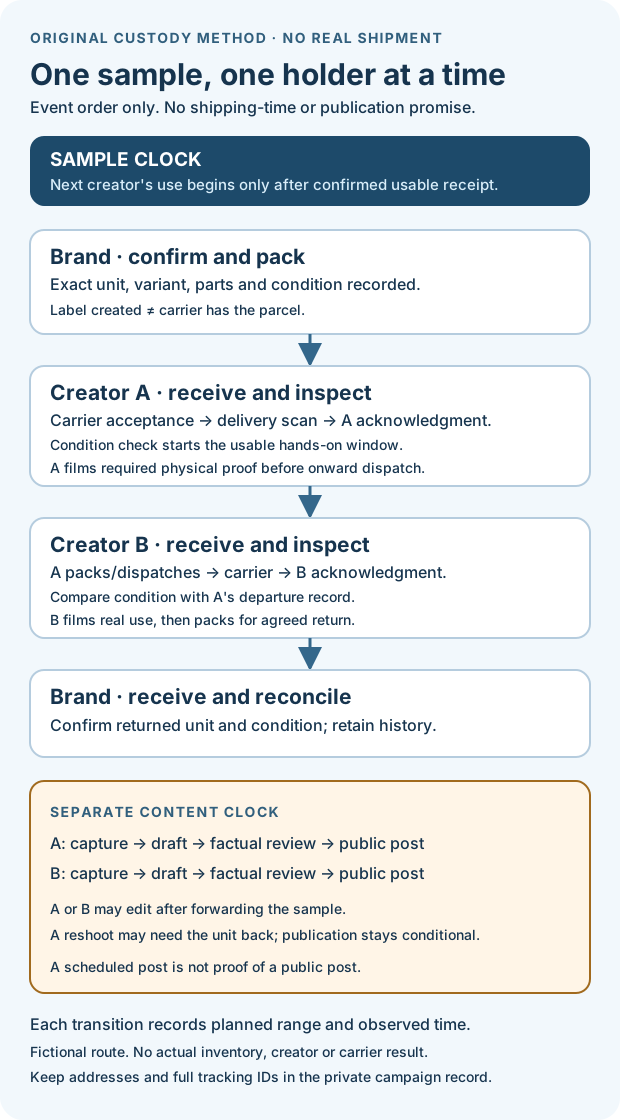
Original custody timeline. A label, carrier scan, creator receipt, filmed demo and public post are separate events; the drawing is not a shipping-speed scale.
Original visual by Superdirector editorial team. Created 2026-10-29.
Give each creator a usable window and a condition check
Ask each creator for a receiving window, a hands-on window, and a dispatch window. A vague “I can film next week” is not enough when the object must continue to another person. The receiving window needs time to locate the parcel, open it, inspect the unit and accessories, charge or set it up if relevant, and report damage before filming. In the hands-on window, the creator must be able to use the product long enough for the agreed claim, capture the required angles or task, and disclose any problem they encountered. The dispatch window opens only after the work that truly requires the unit is complete under the agreed scope.
At receipt, have the creator confirm the exact unit and supplied contents, note visible wear or damage, and record what the product can actually do in their setting. An ordinary dated acknowledgment and condition photos held privately may be enough; the schedule does not need a new asset system. The condition check protects both the creator and the next handoff: if A receives a scratched unit, B should not later be blamed for the scratch. Where B is meant to make a pristine close-up, the brand must decide whether the same used sample is suitable before making that promise.
At dispatch, record the packed condition, included parts and agreed handoff method. Confirm that the creator has completed the physical tasks in the brief, such as setup, fit, texture or demonstration shots. This does not mean the edited video is approved; a late edit may reveal a missing close-up, and the sample may then be with B. Keep a reasonable pickup or reshoot path in the schedule: reserve a later return opportunity, choose a narrower claim that the existing footage supports, or arrange a separate unit. Do not tell the creator to fake a pickup shot with a different model.
Treat transit as uncertain time, not ownership
For each leg, use the actual origin, destination, service, cutoff and carrier estimate supplied for that shipment. Do not assume a universal “two-day shipping” for every creator date. USPS's service-standards page explicitly says exceptions apply and delivery time is not guaranteed for the expected domestic times it displays. International customs, remote delivery, holidays, damaged labels, missed pickups and failed access can create different delays; investigate the actual route instead of inventing a standard buffer.
Write estimated, confirmed, and unknown in different cells. A printed label is preparation, and a carrier acceptance scan confirms the parcel has entered that carrier's network. An expected delivery date is a planning signal, while a delivery scan is an external event. The creator's own acknowledgment confirms usable possession. If the scan says delivered but the creator cannot locate the box, keep possession unconfirmed and work the carrier's documented resolution path; do not start their filming window merely because an automated dashboard turned green.
A simple scheduling formula is enough: the next creator's earliest *credible* hands-on start is after the previous creator's agreed physical work, pack and dispatch, actual transit, receiving and condition check. The carrier estimate can reserve a provisional calendar block, but the receiving acknowledgment moves it from provisional to usable. In a spreadsheet, keep a planned range and an actual time for each event; do not overwrite a missed promise with a later date. The blank schedule provides those separate fields. We do not recommend any hypothetical transit figure in this article as a service level.
Keep draft approval and publication on a separate clock
The content clock begins with what the creator agreed to deliver: raw clips, a draft edit, revision period, final accepted file, and their own public post if posting is included. Handing off the physical sample does not prove the video exists. A submitted draft does not prove the promised demo is accurate, and a scheduled post does not prove it was published. Keep each date and evidence source next to the custody record, so a client sees which delay is a parcel, a creative revision or a platform event.
Set publication windows from dependencies. For creator A, the earliest defensible public date may be after A has filmed, produced a draft, received factual review, made changes and confirmed a post slot. A can often do editing while B holds the sample. But if A's final cut needs a reshoot, the next available sample window may be after B's dispatch. Name that contingency, and do not promise A a fixed date that assumes a perfect first cut. Creator B's delivery window similarly depends on actual arrival and use, not A's planned ship date.
Avoid confusing the brand's desired launch order with sample order. If a campaign wants B to publish first, B need not necessarily hold the sample first; editing and approval may take different times. Still, do not claim B's demonstration is ready until B has physically used the unit and delivered the proof the brief requires. The post-versus-ad timeline covers a different later distinction: a creator's public post and any paid amplification are separate events. This page stops at the truthful one-sample production and publication plan.
When a due date is already in a signed agreement, moving a box does not silently change it. Tell the creator and client what happened, document a mutually accepted revision if the agreement permits, and keep the original date visible in the record. Do not retroactively mark a late delivery as on time. If the available unit makes the committed date impossible, the concrete options are a second unit, a different shot that does not require it, a changed publication agreement, or fewer creators. Calling a planned post “live” would misstate the campaign.
Decide what happens when the unit is late, damaged or unsuitable
Put one named decision owner on the schedule. If the first carrier leg is late, that person updates the next creator's provisional possession range and asks whether their real availability still fits. If A needs an extra day for a genuine demonstration, the owner checks B's availability before extending A's hold. If A reports damage, compare the receiving and dispatch condition evidence, determine whether the unit still supports the next planned claim, and tell B the truth. A worn sample can be acceptable for a durability or long-use demonstration, but it cannot be dressed up as unopened new stock.
If the product becomes unusable, do not ask a creator to endorse a function they did not experience. Change the creative assignment, use a replacement unit if one truly exists, or renegotiate the scope and dates. The FTC's disclosure and experience guidance says a creator cannot describe an experience with a product they have not tried. A brand-provided clip may illustrate a product when labeled honestly, but it does not convert B into a first-hand user of a unit B never received.
For a lost or unlocated parcel, preserve carrier status and the last acknowledged holder, then use the chosen carrier's claim or search process where applicable. Do not assume a carrier's insurance or proof-of-delivery service exists for this shipment; those depend on the selected service and purchase. The operational question for the client is simple: which creator can still film a real demonstration, with what unit, and which publication promises need to move? Your schedule should answer that without hiding the failed leg.
Fictional worked schedule for one reusable unit
Entirely fictional example. “Northline” is a made-up brand, the reusable desk accessory and creators A and B are invented, and all day numbers, carrier events and creative outcomes below are assumed for teaching. No Superdirector inventory, carrier tracking, creator agreement, physical condition, post or signup was observed. D0–D24 are arbitrary relative days, not typical shipping times or a carrier service claim.
The fictional brand confirms one sample, asset NL-01, with all parts present. A and B both agree to a temporary loan and separate hands-on demos; neither is promised a fresh unboxing. Initially, the owner reserves A's receiving window for D2–D4 based on a hypothetical route-specific estimate, A's filming for two days after *actual* usable receipt, and B's receiving window only as provisional. The team holds target publication windows A D17–D19 and B D22–D24, explicitly dependent on real filming, factual review and accepted files. These target windows are invented planning examples, not committed creator dates.
In the imagined trace, the brand creates a label on D0 and hands the packed unit to the carrier the same day. A acknowledges usable possession on D3 after inspecting the box and the included parts. Next, A films on D4–D5, sends the required raw demonstration proof on D6, and the owner confirms no physical pickup is needed before A dispatches the same unit on D7. Then B acknowledges usable possession on D10, films on D11–D12, and reports a cosmetic scuff that was already present in A's D7 dispatch photos. On D13 B sends the agreed raw proof and dispatches a return on D14. The brand receives the unit on D16. Each event is a separate fictional observation in the teaching example; no real carrier achieved that pace.
The content lane does not automatically follow the parcel lane. A's draft arrives on the invented D9, while B holds or awaits the sample; the owner checks whether A's footage already proves the assigned task. B's draft arrives on invented D17. Only after factual review and creator agreement do the parties confirm or revise the tentative public windows. If A's cut is missing an essential product action, A cannot simply reshoot on D10 while B has the only unit. The owner can use the returned unit after D16, narrow the claim if the existing footage supports it, or move A's publication. The failed proof is retained; the D17 target is not silently rewritten as a delivered post.
Now change one assumption: imagine A's second shipment is delayed and B does not acknowledge receipt until D13; B's D11–D12 filming block cannot happen. The owner moves B's filming and draft target, checks the creator's real availability, and revises the B D22–D24 publication proposal before it becomes a promise. This branch illustrates why an estimated delivery date reserves time but does not give the next creator possession. It is not a recommendation to add exactly three days of buffer to every shipment.
The original custody timeline uses this case's event order without drawing a shipping-speed scale. The blank schedule gives a separate row for each handoff and each creator's content checkpoint; the CSV is suitable for a private record. Their public copies contain no actual addresses, tracking IDs or contract terms.
Write a client-ready status without false certainty
Use a short status line per creator: “Sample NL-01 is [confirmed holder and condition] as of [timestamp and source]. Next physical event: [handoff/receipt with owner and estimated or confirmed range]. Creator [A/B] has [filmed / draft delivered / final accepted / public post verified], supported by [private receipt]. Agreed publication window: [date and time zone or not yet committed]. Risk and next decision: [specific issue and owner].” The brackets are a template; NL-01 is fictional.
Separate planned, observed, and agreed. A client may reasonably want a target week, but the team should say what must happen for it to hold. If the sample is in transit, state the carrier's estimate as such and the next check time. If a creator has the item but no confirmed shoot slot, say so. If the shoot is finished but the factual review is open, do not count the video as approved or posted. That small amount of precision protects the creator, the client and the schedule from the false comfort of a single green date.
Use the same schedule after each real transition instead of making a second tracker for packaging, a third for content and a fourth for publication. One sample, one custody history, and one adjacent content lane are enough. The brand's existing project or campaign record remains the authority; the downloadable card is a thinking aid. We do not claim that Superdirector tracks physical inventory or orders shipments for a customer.
Source and scope note
We checked these primary sources on 2026-10-29 UTC: USPS tracking status definitions for label, acceptance, delivered and locating a parcel; USPS service standards for estimated domestic delivery times with exceptions; and the FTC's Disclosures 101 for material connections, in-video disclosure and honest first-hand experience in U.S. endorsements. The custody chain, two clocks and Northline example are original editorial methods, not USPS or FTC procedures. We did not verify any real sample stock, carrier service, shipment duration, creator agreement, publication, account connection or keyword volume for this article.