How-To Guide
How to check whether a creator regularly makes the format you want to sponsor
Sample a creator’s dated public uploads against a written format definition, then count matches, dates and gaps to tell a habit from a one-off hit.
By the Superdirector editorial team. YouTube Help pages reviewed October 30, 2026.
At a glance
How should a sponsor check whether a creator regularly makes the proposed format?
Write the format as a definition of two to four checkable parts, fix a sample window and a repeat rule before looking, list every public upload in the window and mark each as match, near, no match or cannot tell. Then count matches, distinct dates with a match and the longest gap. Matches on several dates across the window point to a repeated format. A single match, or matches bunched in one stretch, point to a one-off until the creator shows more. Near and cannot tell are never counted as matches.
- Write the definition and the repeat rule before opening the channel.
- List every public upload in the window, not the best ones.
- Keep near and cannot tell out of the match count and ask one question if the pattern is unclear.
Direct answer
Short answer: do not judge whether a creator makes a format from their best clip. Write the format down as a definition, fix a sample window before you look, list every public upload in that window, mark each upload match, near or no match against the definition, and then read the pattern: how many matches, on how many different dates, and whether they sit in one stretch. A format that shows up on several dates across the window is repeated. A single hit, or a short run followed by nothing, is a one-off until the creator shows you more.
This is for a sponsor, agency or brand marketer who has a proposed format in mind, such as a short walkthrough or a longer review, and a creator whose strongest example looks right. The decision is narrow: does this creator regularly make this format, or did they make it once? It does not tell you whether the audience is right, whether the creator will perform, or what to pay. Those questions have their own pages, listed in the boundary section below.
The reason to sample on purpose is that a pitch deck, a media kit and a creator’s own pinned post all show a creator at their most flattering. A written sample window forces the ordinary weeks into view. Use the blank sampler card, the CSV register and the sampler map to keep the evidence in one place.
Write the proposed format as a checkable definition
Before you open a single channel, write the format as two to four parts that an upload either has or lacks. “Quick demo” is not checkable. “Vertical, under three minutes, one task shown on screen from start to finish, spoken by the creator” is. Each part should be something a reviewer can see or hear in the upload itself: orientation, length range, structure, who is speaking, what is on screen. Give the definition a version or a date so the sampler card shows which wording was used.
If the format is a YouTube Short, take the platform’s own wording into account rather than your own. YouTube’s Help page says that uploads with a square or vertical aspect ratio and up to three minutes in length are categorized as Shorts, for standard channels from October 15, 2024, and that uploads before that date remain long-form videos. Understand three-minute YouTube Shorts also gives a separate date for Official Artist Channels, so read the page for the channel type in front of you. Two things follow for your definition. First, a clip can be short and still not be a Short if it is wide. Second, an older vertical clip from before the cutoff is not filed as a Short, so it needs a note of its own rather than a silent match.
Keep the definition free of judgment words such as “engaging”, “authentic” or “high quality”. Those belong to a different review, the first-cut review against the brief, which happens after you have chosen a creator. Here you are only checking whether the creator has made the thing before.
Also write down what the format is not. If your proposal is a walkthrough and a creator’s reaction clips are not a substitute, say so on the card now. A definition that names its own exclusions is harder to bend when you are looking at a creator you already like.
Fix the sample window before you look
Choose the start date, end date and rule for the sample before you open the creator’s channel. A window can be a span of dates, such as the twelve weeks before the check, or a count of uploads, such as the most recent twelve. Pick the one that suits the creator’s pace: a date span suits a creator who posts every week, and a count suits one who posts rarely. Write which you chose and why on one line. This page does not set a window length or a count for you, and we did not find a source that does. Choose one you can finish for every creator on your list, so the comparison stays fair.
Then write your repeat rule in plain words, also before looking. For example: “at least this many matches, on at least this many different dates, with no single gap longer than this.” The numbers are yours, set from how often you need the format to appear to feel safe sponsoring it. We give none, because a threshold taken from nowhere would look more authoritative than it is. The point of writing it first is that you cannot move the bar after seeing the result.
Decide how you will treat gaps in the creator’s own posting. A creator who posted only four times in the window has a small sample, and four of four matches is a different statement from two of twelve. The card has a slot for the number of uploads found, so the denominator travels with the count.
Finally, decide who samples. If two people sample the same creator with the same definition and window and disagree on a mark, that disagreement is worth keeping on the card as a “near”, not smoothing over. Two reviewers should not need to talk before filling in the card.
List every public upload in the window
Now open the channel and list every public upload inside the window, in date order, before you mark any of them. Record the upload address, the upload date with its time zone, the orientation and length as displayed, and the date you viewed it. Do not skip an upload because its thumbnail looks off-topic: skipping is how a sample turns back into a highlight reel. Number the uploads from one, newest first, so the card shows the same order the channel does.
Know where you are looking. YouTube’s Help page for channel pages says a viewer can pick a video type from the tabs at the top of the page, and that the tabs shown vary by channel and the types of videos it produces. Find your way around YouTube channel pages lists Videos, Shorts and Live as examples. So a Shorts-only look can miss a long-form format, and a Videos-only look can miss a Shorts format. Record which tab or list each upload came from, and check every tab the channel shows that could hold your format.
A public list is a view of today, not of history. YouTube’s Help page on changing video settings lists settings a creator can edit after upload, including the title, the description, the thumbnail and the visibility. Change video settings does not describe what a viewer can see of earlier values. So a title or thumbnail you read now may not be what it was when the upload went out, and an upload that is no longer public will not be in your list at all. Write “public list as viewed on this date” on the card, and do not describe uploads you cannot see.
If the creator gives you extra uploads, such as unlisted examples or a list from their own records, keep them in a separate block marked “supplied by the creator”. They can be useful evidence, but they were chosen by the party who wants the deal, so they should not be mixed into the sample you drew yourself.
Mark each upload match, near or no match
Go through the uploads one at a time and test each against each part of the written definition, marking every part yes, no or cannot tell. Then give the upload one result. Use the same order every time and write a one-line reason that quotes what you saw, such as the length shown or what was on screen. The sampler map shows the slots and how the marks feed the read.
| Result | Use it when | Write beside it |
|---|---|---|
| Match | Every part of the definition is met by what you can see or hear | The part-by-part marks and the one-line reason |
| Near | All but one part is met, or a part is met only loosely | Which part was missed and by how much; do not round it up |
| No match | Two or more parts are missed, or the upload is a different format | Name the format you think it is, as a label, not a verdict |
| Cannot tell | The upload is unplayable, restricted, or the part cannot be checked from where you stand | What you could not check and why |
Keep near as its own result and keep it out of the match count. It is the most useful mark on the card, because a long list of near uploads says the creator is close to your format and has not made it. That may be fine, since a creator can adapt, but it is a different conversation from “they do this every week”. It is also the place where your own preference sneaks in. Writing down the missed part is what stops it.
Mark whether a sponsored or branded label is visible on each upload, but do not use it to rank. Sponsored uploads are fair evidence of format, since they show the creator has produced this format to a brief. They can also differ from organic uploads in structure, so the label lets you split the count later if you need to. The settings page lists a branded content setting among those a creator can change, so record what the label shows when you look, and say nothing about what it showed earlier.
If a part of the definition turns on the platform’s classification, such as whether an upload is a Short, use the platform’s own wording and the date rule above rather than your own guess from the thumbnail. Where you can’t check, mark it cannot tell.
When enlarged, scroll horizontally to read the diagram.
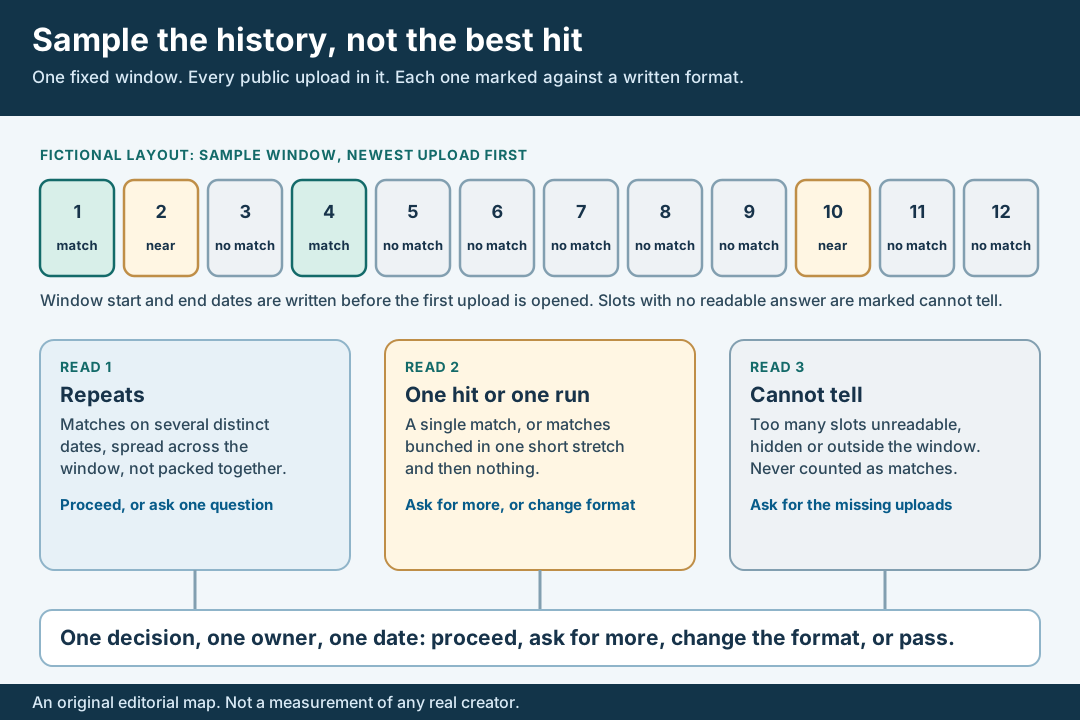
An original editorial map in a fictional layout. A format is repeated only when matches appear on several dates across the window.
Original visual by Superdirector editorial team. Creation date not recorded.
Walk through a fictional sample
Fictional exercise: no real brand, creator, channel or result was inspected. A made-up brand, Brand B, proposes this format: a vertical upload under three minutes, showing one task on screen from start to finish, spoken by the creator. Brand B writes the definition on the card with a date. For the exercise, its repeat rule is “at least three matches on three different dates, with no gap longer than the stretch in the window’s middle third”. That rule is invented for the example and is not a recommended threshold.
Brand B sets the window as the creator’s most recent twelve public uploads and then lists them. Creator R’s channel shows two tabs that could hold the format, so Brand B lists both and numbers the twelve uploads newest first. Brand B then marks them: two matches (numbers 3 and 4, posted on neighboring dates), two near (number 1, a wide clip under two minutes that fits every part except orientation, and number 10, a vertical clip with no on-screen task), eight no match, and none marked cannot tell. The sponsored label is visible on one of the two matches.
The read: two matches on two dates, both in one stretch, and no match in the eight uploads that followed. Under Brand B’s own rule that is not enough, and the near clips explain why: Creator R has made something close to the format, and made it twice in a row once. The decision is to ask, not to pass. Brand B asks Creator R for other uploads in the format, supplied and marked as supplied, and what the shorter run was made for. The scenario predicts nothing about any real creator.
Read the pattern and decide what to ask
Count three things from the marks: matches, distinct dates with a match, and the longest gap between matches. Then check whether all the matches sit in one stretch. Compare the counts with the rule you wrote before sampling and write the result in one line. Matches on several dates spread across the window read as repeated. A single match, or matches bunched together, read as a one-off or a short run. Many “cannot tell” marks mean the sample is not good enough to decide, and the honest read is “unknown”, not a match and not a miss.
Then choose one decision: proceed with the format, ask the creator for more evidence, change the proposed format to one the creator does make, or pass. Write who decided and on what date. If you ask, make it one question with the card attached: “Between these dates we found these uploads that fit the format. Are there others, and was the format a one-time brief or something you make regularly?” Save the answer as written. A creator who says it is new to them has given you useful information, and the next step is a smaller first test, not a reproach.
Last, note what the sample could not show. A public sample cannot show private analytics. YouTube’s Help page on content performance describes Studio reports with separate tabs, including All, Videos, Shorts, Live and Posts, reached by signing in to YouTube Studio. Understand your YouTube content performance also says that starting August 24, 2026, views are counted the moment a video starts to play across all formats. If you later compare views between formats or across that date, read the YouTube metrics worksheet first so that you are comparing like with like. Repeatability tells you whether the format exists in the creator’s history, and says nothing about how it performed.
How this differs from nearby pages
This method answers one question: has the creator made this format more than once, across a fixed window? The closest existing pages ask different ones. Decide if a viral post counts for creator fit decides whether one high-reach post is admissible evidence, and its artifact is a three-way admission call on that post. Here no single post is under test; the unit is the whole window of uploads. Shortlist creators by the buyer’s task starts from a buyer’s job and checks whether a creator’s work demonstrates it. Here the format is already chosen, and the question is how often it appears.
Compare YouTube creator metrics without mixing views is about whether view numbers are comparable. This page counts uploads, not views. The 100-point influencer vetting rubric scores broad account signals with weights. This page has no score and no weights, only marks against a written definition. Once you have chosen a creator, prove the sponsored post is on the right account.
Nothing here measures how often creators change formats, how many uploads make a fair sample, or whether a repeated format sells. Those numbers are not available to us and are not claimed. We checked YouTube’s Help pages only. We make no statement about other platforms, and the same method would need that platform’s own definitions. The page is an editorial method for separating a one-time hit from a habit, and it is not legal advice.