How-To Guide
When to reconsider a creator you declined once new evidence appears
Reopen a declined creator only when dated new evidence answers the original reason, and record it as a linked entry instead of editing the old decision.
By the Superdirector editorial team. TikTok One and ICO pages reviewed October 30, 2026.
At a glance
When should a previously declined creator be reconsidered?
Reconsider a declined creator when new, dated evidence answers the reason written on the original decision, not merely when the creator posts something impressive. Read the old entry as a frozen record, log the new evidence with its source and capture date, name the reason type and test whether the evidence answers it. Then add a new entry that names the one it supersedes. Never overwrite the old decision, so the history stays readable.
- Match the evidence to the original reason: a gap, a mismatch, a constraint or a record error.
- Add a new linked entry; leave the old decision as it was written.
- End with an outcome and a next review date or trigger.
Direct answer
Short answer: reconsider a declined creator when new, dated evidence answers the reason you wrote down, not whenever the creator posts something that looks good. To do that, keep one versioned record per decision. First, the original decline read as a frozen entry: date, decider, reason in the words used then, and the evidence cited. Second, each new item of evidence with its address, capture date, and what it shows and does not show. Third, a test of whether that evidence answers the original reason. Fourth, a new linked entry that says what you now decide and which entry it supersedes. The old entry is never edited.
This is for an agency or brand sourcer who has a screening record with past declines in it and has just seen something new about one of those creators: a fresh upload, a changed channel format, a new account, a correction to a fact. The decision is narrow: does this new evidence reopen an old decision, and how do you record the change without erasing what you decided before? It does not decide whether the creator is a good partner, what to pay or whether to contact them. Those have their own pages, listed in the boundary section.
A decline is a decision about a set of evidence on a date. When the evidence changes, the decision may change, but the earlier decision was still the one you made on what you had. Keeping both lets you answer “why did we pass in March, and why did we look again in June?” Use the blank reevaluation card, the CSV register and the reevaluation map with the steps below.
Read the original decline as a frozen record
Open the original entry and copy it as it stands. Record the decision ID, the date and time zone, who decided, the reason in the exact words used then, and the evidence cited, with addresses and capture dates. If the entry names a reopen condition, such as “look again after three more uploads in the format,” quote it. If it does not, write “none” rather than inventing one now. A condition you add afterwards is a new rule, and the record should say so.
Many old declines carry only a label, such as “not a fit.” That label is not a reason you can test. If the original entry has no usable reason, record that as the first fact: reason not written down. Then the only honest question is whether the new evidence is enough to run a fresh screening from the start, which is a different thing from reversing a decision whose basis you cannot read.
Treat the original as a statement of what was known and judged on that date. The ICO’s accuracy guidance says a record of an opinion must make clear that it is an opinion and, where appropriate, whose. ICO: Principle (d), accuracy. We cite the ICO as one published example of record-keeping guidance when personal data is involved. It is not advice on your obligations, and other places differ. Whatever rules apply, a decline recorded as “our reviewer judged the work off-topic on this date” is easier to revisit than one recorded as a bare fact about the creator.
Log the new evidence with its source and date
Log each new item separately, as you would a first-time screening item. Save its address or document name, the capture date and time zone, who captured it, and the format if it is a video or post. Then write two short lines: what it shows, in terms of what a reviewer can see or hear, and what it does not show. A public upload shows only what is visible in it. It does not show the audience, availability, rights or results, so say so each time.
Record whether the item is dated after the original decision. That is not a formality. Evidence that existed before the decline and was simply missed belongs to a different explanation, a review gap or a record error, from evidence that appeared afterwards. Mark it yes, no or unknown, and leave unknown as unknown. If you cannot date it, say what you could not date.
Where the new evidence comes from a discovery tool, keep the source honest. TikTok One’s creator discovery guide, last updated June 2026, describes searching by keyword, filtering by creator details, audience details and performance metrics, adding a creator to a shortlist, and watching a creator’s recent organic and sponsored videos to judge style, quality and fit. TikTok One: find creators. That describes how to find and review a creator. It does not mention reconsidering creators or recording rejections. The reevaluation method here is our editorial method, not a TikTok feature or recommendation.
Test the evidence against the original reason
Now name the reason type from the original entry. We use four, an editorial sorting rather than a standard. An evidence gap means you could not tell, for example too few dated works to judge. An observed mismatch means you saw the work and it did not fit the task. A constraint means something outside the creator’s content stopped you, such as a rights question, a conflicting sponsor, a timing limit or your own pause. A record error means the decline rested on a wrong account, a misread fact or a mixed-up creator. Then ask one question: does this evidence answer that reason? Write one of four results: yes, partly, no or contradicts.
| Original reason type | What can answer it | What cannot answer it | Typical result for a single new item |
|---|---|---|---|
| Evidence gap | New dated works that supply the missing piece, such as more uploads or a clearer example of the task | A single piece of evidence that is as thin as the original | Often yes or partly; reopen if the gap is now filled |
| Observed mismatch | A changed pattern across several recent works, with dates, in the thing that did not fit | One standout post beside a pattern you already saw | Often partly; look at more works before changing the decision |
| Constraint | A change to the constraint itself, such as a lapsed conflict or a new rights position | Anything the creator posts, because their content was never the issue | No; ask whether the constraint changed, which is a separate question |
| Record error | A correct source for the right account or fact, with a note on what was wrong | More content from the creator | Correct the record; then screen the right creator on the right evidence |
| Not written down | Nothing yet, because there is no reason to test against | Treating the new item as proof the old decision was wrong | Start a fresh screening instead of a reversal |
Notice what the table refuses to do. It does not say new evidence overrides an old decline, and it does not treat a creator’s later success as a reason by itself. A decline for an observed mismatch is a judgment about a pattern. To test a changed pattern, count dated works against a written definition as in the format repeatability check. To test whether one prominent post belongs in the assessment at all, use the viral post admission call.
A partly result is a legitimate answer. It usually means the evidence moves one part of the reason and leaves another. Record which part. If the original reason had two clauses, mark each separately, because reopening on half a reason is a choice you should be able to see on the page.
When enlarged, scroll horizontally to read the diagram.
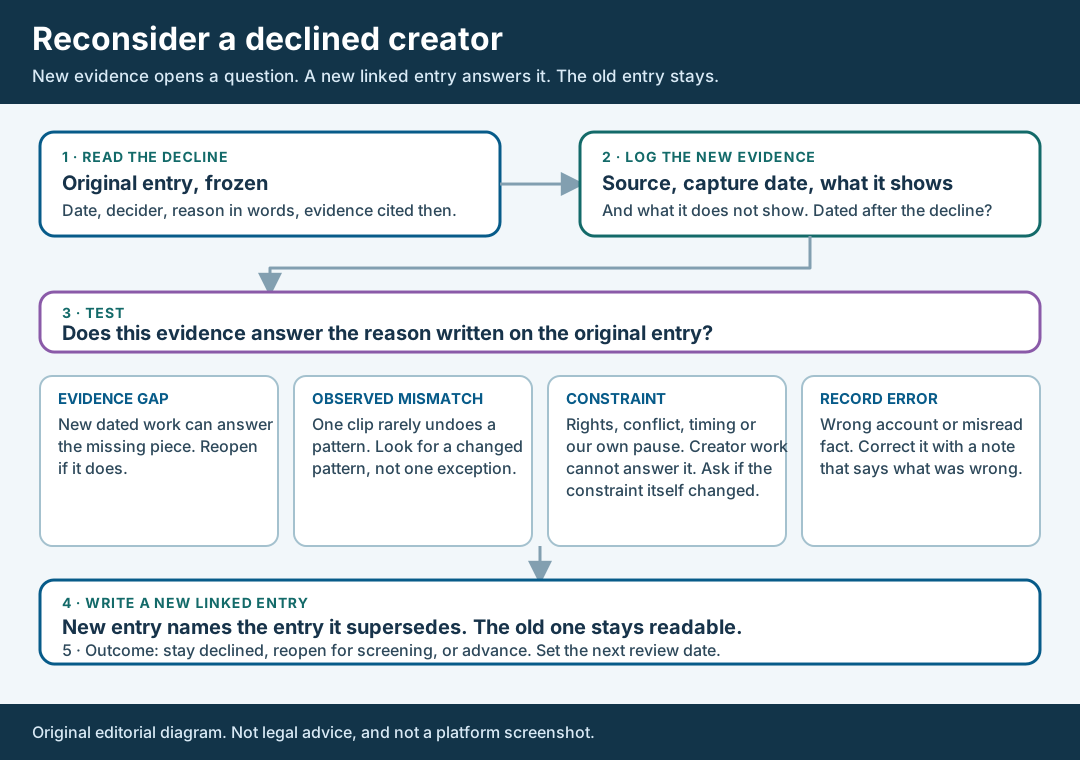
An original editorial map. New evidence opens a question; a new linked entry answers it and the old entry stays as written.
Original visual by Superdirector editorial team. Creation date not recorded.
Walk through a fictional reevaluation
Fictional exercise: no real brand, creator, task or result was inspected. A made-up brand, Brand A, needs creators who can show a reviewer a first-time setup of a scheduling tool on a laptop. In a past screening round, decision D-14 declined Creator R. The recorded reason read: “Only one dated clip in the window shows a setup walkthrough; cannot tell whether it is a habit.” The reviewer types the reason as evidence gap. The cited evidence was one clip and the written reopen condition was “none.”
Two weeks later a reviewer sees two newer uploads from Creator R. The reviewer logs each with its address, capture date and time zone, and marks both dated after D-14: yes. For the first, what it shows is a setup walkthrough on a laptop, and what it does not show is the audience or any result. For the second, the title promises a walkthrough but the video is a product comparison, so it shows no setup. The reviewer tests both against the original reason. The first answers part of the gap, since it is a second dated setup clip. The second does not help. The result is partly.
The reviewer writes a new entry, R-03, that supersedes D-14. It records that the evidence gap is partly filled by one new clip, that two clips in the window is still a thin base, and the outcome is reopen for screening with a fresh look at the creator’s other recent works, not an advance to outreach. The next review trigger is “three more dated uploads or one month.” D-14 stays exactly as written. The exercise predicts nothing about any real creator or format.
Write a new entry that links to the old one
Do not edit the old entry. Add a new entry with its own reevaluation ID and a field that names the entry it supersedes. Put in the new entry the new evidence items by address and capture date, the result of the test, the outcome, the reviewer and the review date with its time zone. Keep the original reason as a quoted line, so anyone reading only the new entry sees what it answers. The old entry should still open, unchanged, and a reader should be able to follow the link from either one to the other.
If you are changing a decision because the original was wrong, say so in plain words in the new entry: which fact was mistaken, what the correct source is and when you found out. The ICO’s accuracy guidance says a record of an error can be kept if it does not mislead about what happened, and that you may need to add a note making clear that a mistake was made. ICO: Principle (d), accuracy. For a disputed opinion, the same page says it is good practice to add a note recording the challenge and the reasons behind it. If a creator or their manager disputes something in your record, log the dispute and the date beside the entry, quoted as written, and do not summarize it.
Keep the entry factual. Describe what the evidence showed, not what you assume about the person. A line such as “three of four recent uploads were setup walkthroughs” is a count a colleague can check, while “seems serious now” is a feeling nobody can check. This is the same discipline as the buyer-task shortlist, where each judgment sits beside the clip that supports it.
Choose an outcome and set the next review
Close each entry with one outcome: stay declined, reopen for screening or advance. “Stay declined” is a real outcome, and it should be written with the evidence you looked at and why it did not answer the reason, so the next person does not repeat the check. “Reopen for screening” returns the creator to the start of your screening method with fresh checks, not to the stage where they were dropped. “Advance” moves them on only when the new evidence answers the whole original reason and nothing else in the record blocks it.
Then set the next review date or trigger and the owner. A trigger can be a date, a number of new dated works, a named change in a constraint or a request from the deal owner. Choose it by what it costs you to miss a good fit and what it costs to look repeatedly, and write the choice on the entry. We found no source that sets a review interval for declined creators, so this page does not either.
Finally, think about how long the chain should exist. The ICO’s storage limitation guidance says you must not keep personal data for longer than you need it, that the UK GDPR does not set specific time limits for different types of data, and that you should be able to justify your retention periods and review data periodically. ICO: Principle (e), storage limitation. That is one regulator’s published position, so we do not claim a period here. Set one from your purpose, your records policy and counsel, and apply it to the whole chain of entries about a creator, not just the latest one.
What this page does not decide
This method records when and why an old creator decision changed. It does not tell you whether the creator is right for the task, what to pay them, or whether to approach them. It also does not cover a creator who declined you; that is the creator’s decision and has its own conversation. Nothing here predicts results, and no example here comes from a real creator, brand or campaign.
Other pages sit next to this one. The buyer-task shortlist guide is the first-time selection of creators from a task and a set of clips; this page begins after a decision already exists and asks what a new piece of evidence does to it. The viral post admission call decides whether one high-reach post belongs in an assessment; here that post is only one possible new item. The format repeatability check counts uploads against a format definition; this page tells you when that count should be run again on a declined creator and how to file the result. The 100-point vetting rubric scores account signals broadly, and you can use it after a creator is reopened.
We did not find a primary source that sets a rule for when a rejected creator should be reconsidered, and we did not find one on how often to re-screen. The sorting into four reason types, the four test results and the linked-entry approach are editorial methods. The ICO pages cited are examples of record-keeping guidance, not statements about your legal duties. If a point turns on law, on your agreement or on a creator’s request about their data, take it to counsel rather than settling it in a comment thread.