How-To Guide
How to report an incomplete creator deliverable to a client without calling it a campaign result
Record what the agreement says and what you observed, name the gap, keep the creator’s answer, assign one owner and report it apart from results.
By the Superdirector editorial team. FTC and YouTube pages reviewed October 30, 2026.
At a glance
How should an agency report an incomplete creator deliverable accurately?
Report it as a fulfilment exception, not as a campaign outcome. For each deliverable, quote what the agreement says, record what you observed with its date, time zone and method, and state the gap as one of four statuses: delivered, partly delivered, not observed or unknown. Ask the creator, keep the reply as written, name one owner with a dated next action, and show the exception on its own line, apart from views, clicks and sales. Update the line when the status changes, and do not guess at reasons or at times you did not observe.
- Agreement, observation and status are three separate entries on one card.
- “Not observed” describes your search, not the creator’s conduct.
- One exception, one owner, one dated next action, reported apart from results.
Direct answer
Short answer: report an incomplete creator deliverable as a fulfilment exception, on its own line, with four entries. First, what was agreed: the deliverable, its source and its due date, quoted word for word. Second, what you observed: the item, the date, the time zone, your method and what that observation cannot show. Third, the gap, stated as a status (delivered, partly delivered, not observed or unknown) and one sentence naming the difference. Fourth, who owns it and what happens next: the creator’s own answer as written, one named owner and a dated action. Then keep it out of the results section.
This is for an agency account lead who is writing a client report and has found that something the client was promised has not fully arrived: a post not live, a missing second video, a cut that exists only as a draft. The decision is narrow: how to describe the shortfall truthfully, who owns fixing it, and where it appears in the report. It does not decide whether the creator is at fault, whether a fee should change, or whether the agreement was breached. Those are for the deal owner and, where the agreement is in question, for counsel.
The reason to treat this as its own kind of fact is that a client reads a report as a statement of what happened. If an unposted deliverable shows up as zero views, or a delay is described as an explanation you do not have, the report says something untrue. The blank delivery-exception card, the CSV register and the exception map keep each entry separate.
Quote what was agreed for this deliverable
Start from the agreement, not from the report. Copy the agreed deliverable word for word: the platform, the format, the count, any named elements, and the due date with its time zone. Add where the text came from (contract, order form, email thread) and the date it was agreed. A paraphrase becomes your reading of the deal, and the gap you then describe is a gap against your summary rather than against the promise.
Look for what the agreement does not say. If there is no due date, write “no date agreed”. If it says nothing about what counts as delivered, such as live and public versus delivered as a file, write “no definition”. Do not fill the silence with a rule you wish it contained. Whether a deliverable counts as one unit or several is its own question, handled in the guide on separating agency service work from creator deliverables.
Quote the client’s side too, if the client was promised something specific. The client may have been told “two videos in the first week” while the creator agreed to “two videos in the campaign window”. Those are different promises, and the difference belongs on the card, because it changes which party’s expectation is unmet. If the agreement itself is unclear, say that plainly instead of picking a reading. For a request that has changed since signing, see turning a creator campaign request into one client decision.
Record what you observed and what it cannot show
Next, write down what you saw, when, and how you looked. Record the item’s address or file reference, the date and time with its time zone, who looked, and whether they were signed in or signed out. A viewer’s view and an account owner’s view can differ, so a signed-out look is a statement about what the public could see at that moment and nothing more. An address with no time is a note, not a record.
Then write the limits. Visibility is the usual one. YouTube’s help page on video visibility says a public video is posted on the channel and can appear in search, an unlisted video can be seen by anyone with the link but does not appear on the channel’s Videos tab or in search results unless someone adds it to a public playlist, and a private video is visible only to the owner and the people they choose. YouTube Help: change video privacy settings. So on YouTube, “I could not find it” may mean it does not exist or may mean it exists at a visibility you cannot see. Your card should say which of these you can rule out, and the guide on private or unlisted YouTube review access covers how a creator can share a non-public video with you for review.
YouTube also lets a creator schedule a private video to go public at a chosen date, time and time zone. YouTube Help: schedule video publish time. That page does not say what a viewer sees before the scheduled time, so we make no claim about it. For your card the lesson is smaller: a deliverable can be made and still not be live, and a time-zone mismatch between the creator’s schedule and your due date is something to check, not assume. The same care applies to other platforms. We did not read a loading help page for Instagram or TikTok on how a pending invitation or scheduled post appears, so we say nothing about what you will or will not see there. Record what you saw and when, and treat the rest as unknown.
If the item exists and you are unsure it is the agreed one, check it against the approved version before calling it delivered. The guide on proving which cut the client approved shows how to pin that.
State the gap as a status, not a verdict
Now compare the two entries and choose one of four statuses. Delivered means what you observed matches the agreed text on every field you can check. Partly delivered means some agreed parts were observed and some were not, and you name which. Not observed means you looked by the stated method and did not see it, which says nothing about whether it exists. Unknown means you could not look, or could not tell. Then write one plain sentence for the gap: “Agreement: two videos. Observed on [date]: one public video, second not found.”
| Status | Use it when | What you may write | What you may not write |
|---|---|---|---|
| Delivered | Observed item matches the agreed text on each checkable field | “Observed on [date] by [method], matching the agreement” | That it performed, or that nothing can change later |
| Partly delivered | Some agreed parts seen, others not | Which parts were seen and which were not, each with its date | A percentage complete or a reason for the missing part |
| Not observed | You looked by a stated method and did not see it | The date, method and who looked | That it does not exist, was skipped or was removed |
| Unknown | You could not check, or the evidence is mixed | What stopped the check | Any status that implies you checked |
Notice what the statuses avoid. None says the creator failed, and none gives a cause. Verdict words (late, defaulted, ghosted) are claims about conduct and motive that an observation cannot support. They also make the report harder to correct if the creator’s answer is ordinary. Whether a missed date has changed the plan is the subject of the guide on revising a campaign after a missed publishing window, and what to do when a creator declines one required item is in the guide on partial acceptance and a missing deliverable.
Keep status and measurement apart even here. A “delivered” item is not yet a result, and a “not observed” item has no result to report. The FTC’s page on its endorsement guides says endorsements must be honest and not misleading and that a company is ultimately responsible for what others do on its behalf. FTC Endorsement Guides: What People Are Asking. That page concerns endorsements, not client reports, so we draw only a modest lesson from it: say what you can show, and do not describe the rest.
When enlarged, scroll horizontally to read the diagram.
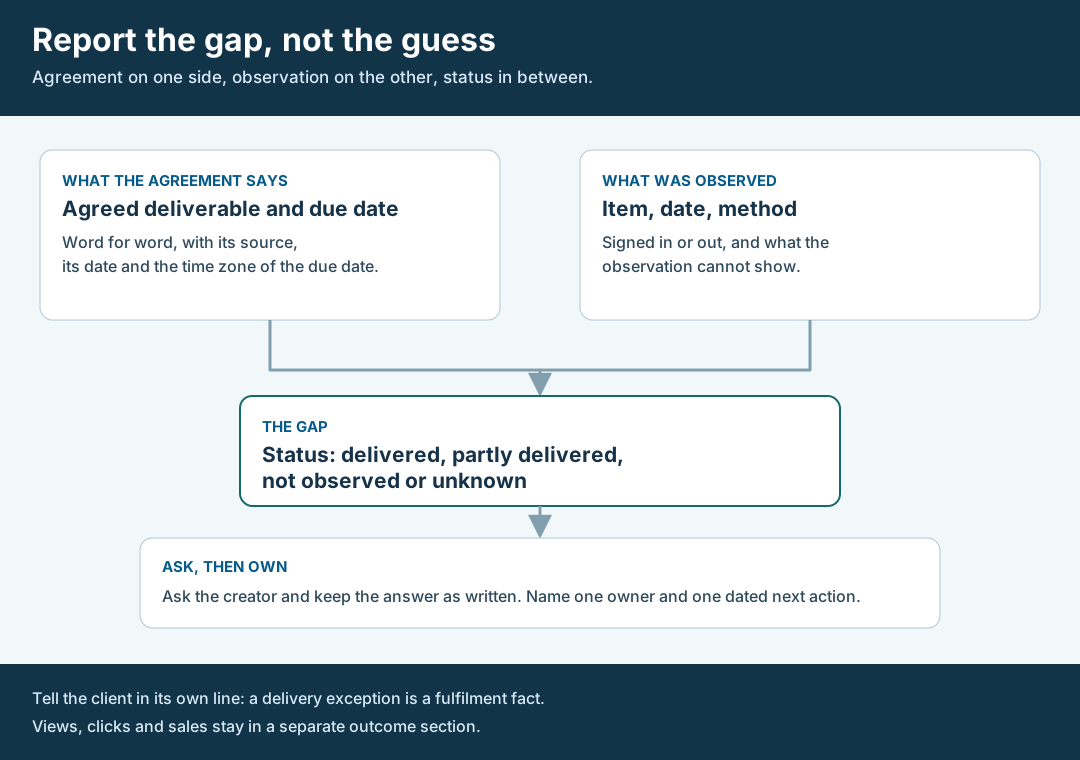
An original editorial map. Report the gap between agreement and observation, and keep it apart from results.
Original visual by Superdirector editorial team. Creation date not recorded.
Ask the creator and name one owner
Put the gap to the creator as a question with the two entries attached: “The agreement says X. On this date we looked at Y and saw Z. Can you tell us where this stands?” Name the date and method. Do not suggest a reason and do not describe their conduct. Creators have ordinary explanations: a draft awaiting approval, a post scheduled for a later hour, a platform delay, a different account. The card should leave room for each of them.
Save the reply exactly as written, with the date, time and time zone you received it. If the creator describes what they did, record it as their statement and label it as theirs until you have seen the item yourself. If there is no reply, write the date you asked, the date you chased and “no reply as of [date]”. Silence is a fact about the process. It does not change the status on its own, and it is not an admission.
Then name one owner. The owner is a person, not a team, who will take the next action and keep the card current. Write the next action and its date: “ask again on [date]”, “review the draft on [date]”, “escalate to the deal owner on [date]”. A card without an owner is a note that everyone has read and nobody holds. If the creator’s manager, not the creator, is the right contact, confirm that before relying on their word, as the guide on checking a manager can speak for a creator account explains.
Where the answer changes the plan, such as a new date or a smaller scope, record it as a proposal until the deal owner accepts it in writing. A creator saying they will post on Friday is a statement of intent. It becomes the new schedule only when the deal owner records it as agreed.
Report the exception on its own line
In the client report, give the exception its own place in a fulfilment or delivery section, separate from results. One short entry per exception is enough: the agreed deliverable, the status, the date and method of the observation, the creator’s answer if there is one, the owner and the next dated action. Keep the wording to what is on the card. Do not add a forecast, a cause or a reassurance the card does not support.
Keep numbers out of it. Views, clicks, saves and sales belong in the outcome section and only for items that were observed live, each with its own capture date. A missing deliverable should not appear as a row of zeros, because a zero asserts that something was measured and found empty. The guide on showing missing creator analytics without zeros sets out how to display a number you do not have, and the guide on freezing a report when platform data is late covers data that arrives after the report date.
Plan to update the line. When the item is observed, change the status and add the new date, and keep the earlier entry visible so the client can see how the status moved. When the deal owner closes the exception, record who closed it and when. If the client asks whether this changes the fee, the scope or the plan, do not answer from the report. Pass the question to the deal owner, because it is a decision about the agreement and not a reporting fact.
Walk through a fictional exception
Fictional exercise: no real brand, creator, campaign or result was inspected. A made-up agency, Agency A, agreed with its client, Brand B, that Creator R would deliver two videos on one platform by a stated date. The agreement text was quoted on the card with its date and the due date’s time zone. When Agency A prepared the report, the reviewer looked signed out, at a stated time, and saw one public video that matched the agreement. The second video was not found.
The card records the first video as delivered, observed on the stated date by a signed-out look. It records the second as not observed, with the same date and method, and it says the observation cannot show whether the second video is private, scheduled, on another account or not yet made. The gap sentence reads: “Agreement: two videos. Observed on [date]: one public video; second not found by this method.” The overall deliverable is partly delivered.
The reviewer asks Creator R, attaching both entries, and saves the reply as written. Suppose the reply says the second video is finished and waiting for approval. That is the creator’s statement and stays labeled as theirs. The status stays “not observed” until someone sees it, and the owner, a named account manager, schedules a check on a stated day. In the client report, the first video appears in the results section with its own capture. The second appears only in the fulfilment line, with status, owner and next date, and no number. The scenario predicts nothing about any real creator or campaign.
What this page does not decide
This page gives you a way to write down a delivery shortfall truthfully and give it an owner. It does not decide whether the shortfall is a breach, whether a fee should change, whether to replace the creator or whether to tell the client before the creator answers. Those decisions belong to the deal owner and, where the agreement’s meaning is in question, to counsel. We are not giving legal advice.
It differs from nearby pages in what it produces. The page on showing missing creator analytics is about how to display a metric you lack; this one is about an agreed item that has not fully arrived, whatever its metrics. The page on revising a campaign after a missed window is about re-planning dates; this one is about reporting the current status before anyone re-plans. The page on resolving partial acceptance covers a creator who declines one required item in negotiation; this one covers work that was agreed and has not been observed. The page on freezing a report when data is late deals with late analytics, not late deliverables. The page on verifying an Instagram Collab post is platform-specific proof of one post; this one is a platform-neutral exception card.
Nothing here measures how often creators deliver late or incompletely, how long a typical delay lasts or what clients do when told. Those numbers are not available to us and are not claimed. We also did not verify what Instagram or TikTok show for scheduled or pending posts, so this article states nothing about them. The page is an editorial method for keeping the agreement, the observation, the status and the creator’s answer apart, so each claim in a report rests on its own evidence.