How-To Guide
What to do when a creator accepts the concept but declines one required deliverable
Quote the creator’s reply item by item, trace what depends on the declined deliverable, choose one resolution and get it confirmed in writing first.
By the Superdirector editorial team. FTC and YouTube pages reviewed October 30, 2026.
At a glance
What should a team do when a creator accepts the concept but declines one required deliverable?
Treat the reply as a partial acceptance and resolve the one missing item before anything else proceeds. List every deliverable from the brief version that was sent, quote the creator’s reply for each one, and trace what the declined item carries: disclosure, claims, links, rights or other deliverables. Then choose one resolution for that item: waive it, substitute it, re-scope it or decline the whole concept. Write the choice into a new brief version and keep the creator’s written confirmation. A yes to the concept is not a yes to every line.
- Give each deliverable its own row and status, including unanswered.
- Trace dependencies before deciding; a declined item may carry a disclosure or a claim.
- One owner chooses one resolution, and the creator confirms it in writing.
Direct answer
Short answer: when a creator says yes to the concept but declines one required deliverable, stop treating the reply as an acceptance and resolve that one item before anything else moves. Do it in five moves. List every deliverable from the brief version that was sent. Quote the creator’s reply for each one. Trace what the declined item carries. Choose one resolution for it: waive it, substitute it, re-scope it or decline the whole concept. Write the choice into a new brief version and keep the creator’s written confirmation.
This is for an agency or brand marketer who sent a brief, got back something like “love it, but I won’t do the second video,” and now has to decide what happens next. The decision is narrow: which single missing obligation to resolve, how, and what record proves it. It does not decide whether the creator is being reasonable, what the fee should be, or whether anyone is in breach. Those belong to other pages, linked in the boundary section below.
The reason to slow down is that a partial acceptance is easy to read generously. Everyone is relieved that the creator is in, and the declined item gets filed as a detail. Weeks later a post is live without the thing that item carried. Use the blank decision log card, the CSV register and the decision map to keep the whole exchange in one place.
List every deliverable the brief asked for
Start from the brief version the creator actually received, not from your campaign plan and not from memory. Note its version label and its date and time with the time zone. Then copy each deliverable as it was written: the format, the platform, the count, the required elements and any date. One line per deliverable, in the brief’s own words. If a line bundles two things, such as “one video with a pinned comment,” split it into two rows now, because the creator may have accepted one half.
Beside each row write whether the brief called it required or optional, and quote the words that say so. Many briefs never say. If yours does not, write “not stated” instead of deciding afterwards that it was obviously required. The question this page answers begins with a required deliverable, so you need the brief’s own text to show that the declined item was one.
Check that the version you are reading is the one the creator replied to. If the brief changed between sending and the reply, the reply is to an older version and the rows must say so. The brief change impact guide covers amending a brief by creator stage; here you only pin what was sent. If a manager or agent replied rather than the creator, confirm they can speak for the account first, using the manager authority guide.
Quote the creator’s reply for each one
Go through the creator’s reply and give every row one status: accepted, declined, conditional or unanswered. Paste the creator’s words into the row, with the date, time and time zone of the message and a reference to the thread. Do not paraphrase. “Can’t do the stitch” and “not comfortable with the stitch” are different sentences, and the second one may be an opening. If the creator gave a reason, quote it as theirs. If they gave none, write “none given.”
The four statuses matter because they call for different next steps. Accepted needs nothing more. Declined is the item this page is about. Conditional means the creator said yes if something changes, such as a different format or a later date, and the condition is a question for you to answer, not a yes. Unanswered means the reply never mentioned the item. Do not read silence as acceptance or as refusal. Ask about it, in its own message, so the answer can be quoted cleanly.
If more than one item is declined or conditional, handle them one at a time and log them separately. The question this page answers has one missing obligation, and the order of work is simpler when each gets its own row, its own resolution and its own confirmation. Where the creator’s reply is spread over several messages, quote each message with its time and note which later one, if any, replaced an earlier statement.
Trace what the declined deliverable carries
A deliverable is rarely only itself. Before you decide anything, list what depends on the declined item and cite the brief or agreement clause that creates each dependency. Look at five places. A disclosure may be placed in that deliverable. A product claim may be made there. A tracked link or code may live there. Rights may have been agreed per asset, so a declined asset leaves a rights line with nothing under it. And another deliverable may need it, for example a cutdown that was meant to come from a longer video.
| What may depend on it | Question to ask of the brief and agreement | Where to look next |
|---|---|---|
| Disclosure | Was the paid-relationship disclosure to appear in this deliverable, and on which surface? | Disclosure check |
| Product claim | Does this deliverable carry a statement the brief required or limited? | Claim verification |
| Link or code | Is the only tracked link or code placed here? | Link test |
| Rights line | Does a channel, term or territory line name this asset? | Asset rights record |
| Another deliverable | Is another item derived from, or timed around, this one? | The brief’s own sequence, quoted row by row |
Disclosure deserves the most care, because it is where a declined line can become a risk instead of a cost. The FTC’s influencer guide says it is the influencer’s responsibility to make disclosures and not to rely on others to do it. FTC Disclosures 101 for Social Media Influencers. The rule that governs advertisers says an advertiser may be liable for a deceptive endorsement even when the endorser is not, and it lists briefing endorsers, checking compliance and acting to remedy non-compliance as steps, while stating that good faith is not a safe harbor. 16 CFR 255.1. Neither page tells you how to resolve a particular declined deliverable, so read them as the reason this row gets traced and not skipped.
The FTC’s question-and-answer page on the Endorsement Guides adds, in answer to a question about networks of endorsers, that a company should instruct them on disclosures, including exactly how it wants them made, and that reviewing posts before they go live is much easier than finding them afterwards. FTC Endorsement Guides: What People Are Asking. If the declined deliverable was where the disclosure was meant to sit, the trace shows that dropping it leaves the disclosure with no home, and the resolution must name where it goes instead.
Some dependencies are platform settings rather than words. YouTube’s Help page says that creators who feature branded content, sponsorships or endorsements have to let YouTube know by selecting the paid promotion button in the video details, and that doing so shows a disclosure label at the start of the video. YouTube Help: branded content restrictions and disclosure labels. That describes YouTube only. If the declined item was a YouTube video, the setting goes with it and must be accounted for. We did not read the equivalent pages for other platforms for this article and make no claim about them.
When enlarged, scroll horizontally to read the diagram.
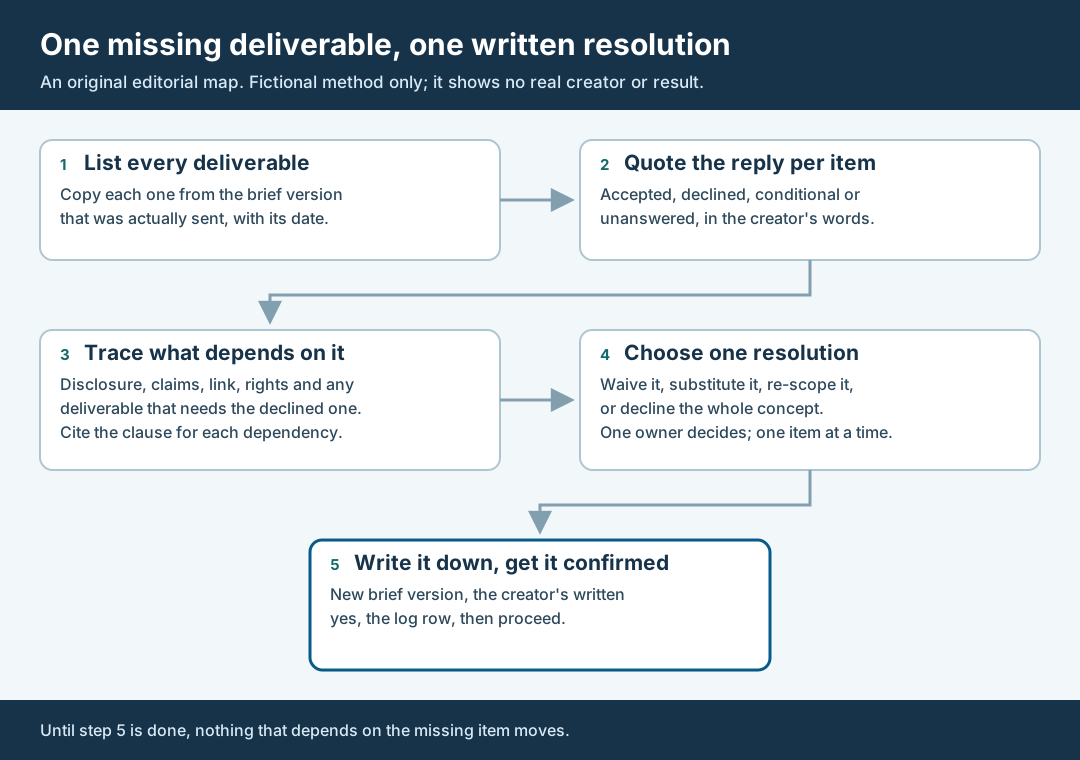
An original editorial map. One missing deliverable gets one written resolution before dependent work moves.
Original visual by Superdirector editorial team. Creation date not recorded.
Choose one resolution for the missing item
With the trace done, choose exactly one of four resolutions for the declined item and name the one person who makes the call. The four are waive, substitute, re-scope and decline the concept. Choosing is not the same as agreeing: each resolution still needs the creator’s written yes in the last step. Do not blend two of them in one message. A message that waives the item and also changes the format and also asks for a lower fee gives the creator three things to answer and you three things to track.
| Resolution | What it means in writing | Use it when the trace shows | Watch for |
|---|---|---|---|
| Waive | The item is removed from the brief and the brief says so | Nothing required depends on it, or every dependency has another carrier | A disclosure, claim or link left with no home |
| Substitute | A named different deliverable takes its place, described in full | The dependencies can move to the replacement | A replacement that is bigger or smaller than the original without anyone saying so |
| Re-scope | The item stays but changes in count, format, length or date | The creator’s objection is to the shape, not the idea | A condition the creator attached that you have not actually accepted |
| Decline the concept | You tell the creator the collaboration does not go ahead on these terms | A required dependency cannot move and the creator will not carry it | Warmth and clarity: say what was and was not agreed, once |
Fees are a separate line. If the resolution changes what the creator is being asked to produce, put the money question to the creator on its own, in writing, and keep their answer as written. This page does not say what a changed scope should cost. Use the production and posting fee guide to see which clause a payment is tied to, and the bundle quote guide if the creator quoted a package and removing one video leaves a shared cost you cannot split without guessing.
If you cannot choose because the trace turned up something you do not know, such as whether a clause covers a replacement, the resolution is not yet chosen. Record it as open, name the question, name who will answer it and set a date. Counsel is the right owner for a question about what an agreement requires. An honest open row is better than a resolution that rests on a guess.
Walk through a fictional partial acceptance
Fictional exercise: no real brand, creator, campaign or result was inspected. A made-up brand, Brand A, sends Creator Q brief version 3 with three rows: a long video, a short cutdown of it, and a pinned comment carrying the tracked link. Creator Q replies in one message that the idea is great, that the long video works, and that they do not do pinned comments. They say nothing about the cutdown.
The reviewer fills the log. Long video: accepted, quoted. Pinned comment: declined, quoted, reason “none given.” Cutdown: unanswered. The trace finds that the tracked link lives only in the pinned comment, and that the cutdown is meant to be cut from the long video. The reviewer therefore asks about the cutdown in its own message and handles the pinned comment first, because the link is the dependency with no other carrier.
The deal owner considers the four resolutions. Waiving the comment would leave the video with no tracked link. Substituting is possible if the link can sit somewhere else the creator is willing to place it, so the owner chooses to substitute and writes the replacement in full: where the link will be, what it will say and who will test it. The reviewer issues brief version 4, sends it with a single question, and saves Creator Q’s written “yes” in the log with the version it confirms. Only then does the link test begin. The scenario predicts nothing about any real creator, link or result.
Write it down and get it confirmed
A chosen resolution is still only your decision. Turn it into a new brief version with its own label and date, state the change in full and mark what stayed the same, then send it to the creator with a single question: do they confirm this version? Do not edit the old version. The earlier one is evidence of what was sent and what the creator replied to, and it should stay as it was.
Keep the creator’s confirmation as written, with its date, time and time zone, and record which version it refers to. A thumbs-up on a message that mentions several things is hard to read later, so ask for a reply that names the version. If the creator confirms with changes, those are a new conditional reply and the log starts a new row. If they do not reply, record the date you asked, the date you chased and that no reply was received. Do not proceed on an unanswered confirmation.
Finally, log the decision: the resolution chosen, who chose it and when, the dependencies it affected and the version that now governs. Then let the dependent work move, such as the link test or the first-cut review. The first-cut review guide compares the creator’s delivery with the brief, and it should be run against the version the creator confirmed, not the one you first sent. Keep the whole exchange together: the sent version, the reply, the trace, the decision, the confirmed version and the next check date.
What this page does not decide
This method resolves one missing obligation and records it. It does not tell you whether the creator’s refusal is fair, whether it breaches anything, what a reduced scope should cost, or whether a disclosure is sufficient. If a point turns on law or on what your agreement means, send it to counsel instead of settling it in a thread. We quote public sources only for the narrow facts above and give no legal advice.
Other pages sit next to this one. The agency scope table guide places each work item with the agency or the creator before any reply arrives, which is where this page begins from a reply that already did not match. The brief change impact guide amends a brief because the product changed, while here the trigger is the creator’s answer. The bundle quote guide splits a creator’s quoted package into lines and costs, and the fee ledger guide ties payments to clauses. Our artifact differs from all of them: a per-deliverable decision log with a quoted reply, a dependency trace and one written resolution.
Nothing here measures how often creators decline a deliverable, which resolution works best, or how a changed scope affects results. Those numbers are not available to us and are not claimed. We also did not read platform pages beyond the YouTube setting above, so we state nothing about what other platforms require. The page is an editorial method for keeping a creator’s reply, the brief that was sent, the dependencies and one confirmed decision apart, so each step rests on its own evidence.