How-To Guide
When to run a paid test on a creator post that already ran organically
Before boosting a creator post, write what the organic result shows, the new question a paid test answers, and mark each prerequisite met, unmet or unknown.
By the Superdirector editorial team. TikTok, Meta and FTC pages reviewed October 30, 2026.
At a glance
When should a brand test paid amplification of a creator post after organic publication?
Run a paid test only when you can write the scope of the organic result, one question the paid test would answer, and every prerequisite as met with evidence: commercial permission, platform permission for that exact post, an unchanged post, current claims and disclosure, a working destination and a separate measurement plan. Set the spend ceiling, dates and stop condition before launch. Treat it as a new test, not a reward for organic views. If any row is unknown, fix it first or do not test.
- Write what the organic result shows and cannot show before you decide anything.
- Name one question the paid test answers that the organic result cannot.
- Count an unknown prerequisite as not met, and set limits before launch.
Direct answer
Short answer: treat a paid test as a new test with its own question, not as a reward for organic views. Before any budget moves, put four things on one card. First, the scope of the organic result: what was observed, over what window, read where, and what it cannot show. Second, the question a paid test would answer. Third, a prerequisite map with each row marked met, unmet or unknown. Fourth, the limits and result rules you set before launch. Then choose one of three outcomes: run the test, fix a named prerequisite first, or do not test.
This is for an agency or brand marketer whose creator post has already been public and who is tempted to “put money behind the one that worked.” The decision is narrow: whether to start a paid test of this post, and on what terms. It does not decide how to negotiate paid usage, how to authorize the post on a platform, or how to report results afterwards. Those have their own pages, linked in the boundary section.
The reason to slow down is that organic and paid delivery answer different questions. An organic result tells you what happened to a post when the creator published it to their own audience. A paid test shows the same post to an audience you choose and pay for, so the old numbers do not transfer by themselves. Platforms can also blend the two. TikTok’s Spark Ads overview says that views, comments, shares, likes and follows from boosting are attributed to the original post, so the counter you used to admire can stop being an organic-only number. Use the blank prerequisite card, the CSV register and the prerequisite map to keep the decision in one place.
Write the scope of the organic result
Start by writing down what the organic result is, in words that someone who was not there could check. Record the post address and platform, the date and time you first saw it public, and the window the numbers cover, with a time zone. Then list each number you intend to rely on, where it was read, and its source: seen by you on the platform’s own screen, reported by the creator in a screenshot or message, or unknown. A number the creator told you about is a statement, not an observation, and the card should say so.
Next write what the result cannot show. A view count does not show who watched, whether they were people your product is for, or why the post was watched. A click count from your own link shows clicks on that link, not what the post did for people who never clicked. A comment that praises the post shows one viewer’s reaction. The point of this field is to stop a decent organic result from being quietly promoted into a claim about paid performance.
Finally, save the baseline now. Because paid engagement can be attributed to the original post on some platforms, a number you read after launch may mix both. Capture the organic numbers, the date and where you read them before anyone sets up an ad. If a post is already being pushed by someone, including your own repost, write that down as part of the scope. How to report organic and paid results apart afterwards is in the organic and paid results guide. Whether a very high-reach post even counts as evidence of creator fit is a different question, handled in the viral post fit guide.
Name the question a paid test would answer
A paid test needs a question that the organic result cannot answer. “It got a lot of views” is a reason to be interested, not a question. A usable question has the same parts every time: who you will show the post to, what outcome you will observe, where that outcome is read, and what you will compare it with. For example, in blank form: “If we show this post to [audience we define] for [dates], will [outcome we can read in a named place] be higher or lower than [named comparison]?”
Name the comparison before launch. It might be an ad you already run, a period with no spend, or a second creator post. This page does not supply a benchmark or a threshold, and we found no source that gives one for all brands. The comparison is yours, and writing it first stops the result from choosing its own yardstick afterwards. If you cannot name one, that is useful information: the test may not be ready, or the question may be too vague.
Be honest about what one test can teach. A single post, a short flight and a small number of events support limited conclusions, and the small-sample learning guide shows how to sort a finding into what you can learn, what you can only estimate and what you cannot say. The single-post test guide does the same for what one post comparison can conclude. Write your question so that a result of “not supported” and “cannot tell” are both acceptable answers.
Mark each prerequisite met, unmet or unknown
Walk the six rows below and mark each met, unmet or unknown, with an evidence reference and a date. Unknown counts as not met. The reason is practical: an unknown row is one nobody has read, and an unread permission or an unread caption is where a paid launch goes wrong. The map shows the six rows at a glance.
| Prerequisite | What “met” looks like | Where to read the detail |
|---|---|---|
| Commercial permission | A written record that paid use of this exact post is agreed, with scope and term | Paid-use agreement guide, usage term guide |
| Platform permission | The platform itself shows this post is available to this advertiser, read on a dated screen | Authorization expiry log |
| Post unchanged | The live post still matches the approved words, link and media | Edit retention guide |
| Claims and disclosure current | Someone reviewed the post as a message for a wider audience, including music and other parts | Music recheck guide |
| Destination ready | The link works, matches what the post promises and the outcome event is defined | Conversion event guide |
| Measurement split | Organic baseline saved, and paid results read where the platform reports them | Organic and paid results guide |
Read platform permission from the platform, not from memory or from the creator’s say-so. The platforms describe it in different ways. TikTok’s Spark Ads creation guide says a post’s caption cannot be edited after it has been authorized as an ad, so any caption fix has to happen first. For Instagram, Meta’s developer documentation on partnership ad codes says an ad code is created for media the caller owns and can be removed from that media with a delete call, which suggests permission is a recorded state that can be withdrawn. That page does not say whether a code expires, so we make no claim about duration. Meta’s boost-existing-post documentation lists a true-or-false permission field in its example response, another sign that permission is a recorded state to read, not an assumption.
Read claims and disclosure as if the post were new, because for the wider audience it is. In the United States, the FTC’s endorsement rule says an advertiser can be liable for misleading statements in an endorsement even when the endorser is not, and that good-faith and effective guidance, monitoring and remedial action are “not a safe harbor,” although they should reduce the odds of enforcement. Sections 255.1(b) and (c) also address whether an endorser still holds the views presented or still uses the product, so a product that changed since the post went live is worth putting to counsel. 16 CFR 255.1. Whether a creator’s line about the product is still true is your question to answer before paid delivery, and a changed product is a reason to mark the row unmet. This is a reading of the rule, not legal advice about your post.
When enlarged, scroll horizontally to read the diagram.
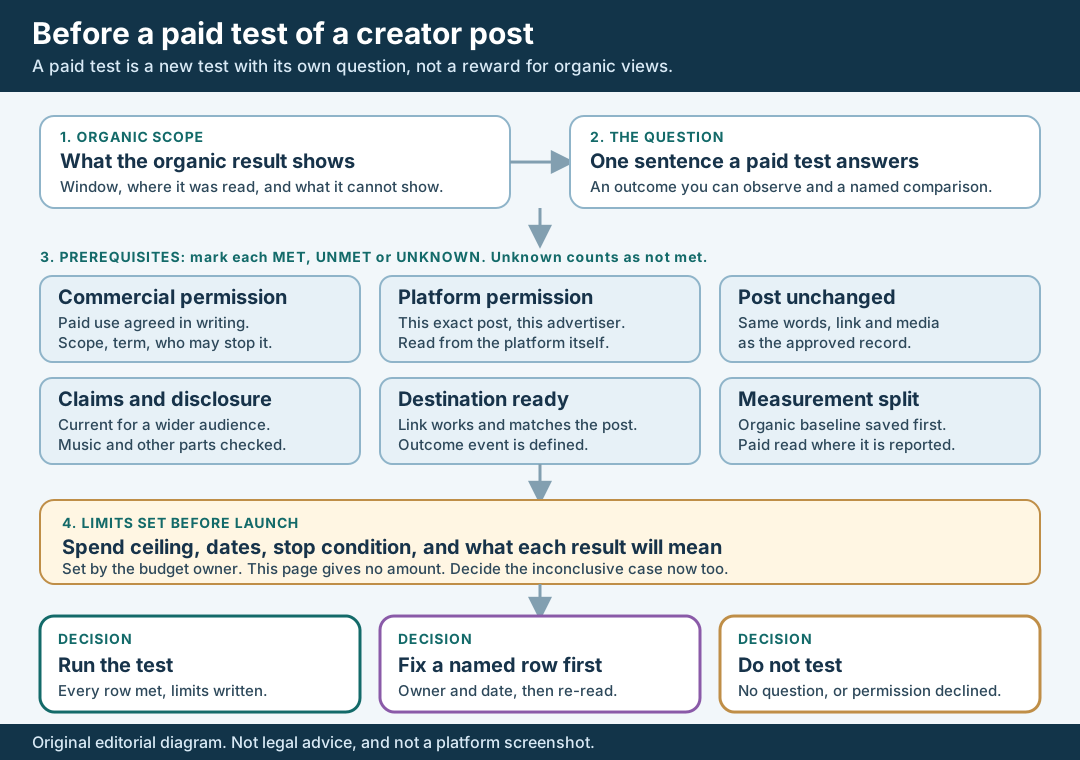
An original editorial map. Unknown counts as not met, and limits are set before launch.
Original visual by Superdirector editorial team. Creation date not recorded.
Set limits and result rules before launch
Once every row is met, set the limits before anyone builds the ad. The budget owner writes a spend ceiling, a start and end date with a time zone, and a stop condition: what would make you end the test early, and who may do it. Include the case where the creator asks you to stop. Write the amounts as your own decision; this page gives no amount and no duration, and we know of no source that would fit every brand.
Then write what each kind of result will change, in advance. There are three. If the result supports the question, say what you will do next, which may be a new test, not an automatic scale-up. If it does not support the question, say what you will stop or revise. If it is inconclusive, say what happens then, because that is the most likely outcome of a small test and the one teams improvise around. Pre-writing the three cases keeps the result from being read to fit a decision already made.
Check that the limits match the permission. A test whose end date falls after the usage term or after the platform authorization ends is a plan to use the post without permission for the tail. The expiry log is where you keep those dates, and the card’s start and end fields should sit inside them. If the post, market, advertiser, flight or edit changes later, begin a new card and keep the old one on file. A changed test is a different test.
Last, write where each outcome will be read, and confirm the baseline from step one is saved. The FTC’s question-and-answer page on endorsements says it is much easier to review posts before they go up than to search for them afterwards, and that the scope of monitoring depends on the risk of consumer harm. FTC Endorsement Guides: What People Are Asking. Read that as support for doing the review now, not as a schedule for paid-ad checks, which the page does not set.
Decide to run, fix first or not test
Choose one of three outcomes and write it on the card. Run the test means every prerequisite row is met with evidence, the question is written, the comparison is named and the limits and result rules are set. Fix a named prerequisite first means one or more rows are unmet or unknown and each has an owner and a date; when the fixes are done, you re-read the card and decide again. Do not test means the question is not clear, a permission was declined, or the cost of settling the rows is not worth the answer. The organic result stays what it was.
Record who decided and when, and set a review date. “Fix first” is not a soft yes. If a row is still open at the review date, the decision is still not to run. Keep the decision with the organic scope, the question, the rows and the limits, so the whole file shows why the test ran or did not.
Walk through a fictional card
Fictional exercise: no real brand, creator, campaign or result was inspected. A made-up brand, Brand K, commissioned Creator V for one organic post, called P-9, about a travel kettle. Two weeks later a colleague says, “P-9 did well, let’s boost it.” The reviewer opens a blank card instead of an ad account.
Organic scope. The reviewer writes the post address, the window, and the numbers as shown on the platform screen on a stated date, marking each “seen by us.” A creator message mentions that “most viewers were in one region,” which goes on the card as reported by the creator, not seen. Under “cannot show” the reviewer writes: who watched, whether they are kettle buyers, and why the post was watched. The baseline is saved before anything else happens.
Question. After a short discussion the card reads: “If we show P-9 to an audience we define for two weeks, will visits to the kettle page that reach the basket-add event be higher or lower than our existing static ad over the same weeks?” The comparison is named. No threshold is written, because none is known.
Prerequisites. Commercial permission: unmet, because the signed brief covers one organic post and says nothing clear about paid use. Platform permission: unknown, because nobody has read the platform’s own authorization screen for P-9. Post unchanged: met, with a dated capture. Claims and disclosure: unmet, because the kettle’s lid was redesigned after P-9 went live and the creator’s spoken line describes the old lid. Destination ready: met. Measurement split: met, since the baseline is saved. Three rows are not met, so the decision is fix first.
Each fix gets an owner and a date: ask Creator V about paid use through the paid-use guide, read the platform screen, and decide with the creator whether the lid line is corrected, noted or left. If Creator V declines the paid use, the card’s decision becomes do not test and the organic result stands as it was. If everything is later met, the budget owner writes the ceiling, dates and stop condition, and the three result rules. The scenario predicts nothing about any real post.
What this page does not decide
This page decides whether to start a paid test and what must be true first. It does not tell you that paid amplification will help, how much to spend, which audience to pick or what a good result looks like. It also does not judge whether a disclosure is sufficient or whether any use is lawful. Those turn on your agreement, the platform’s current rules and, where law is involved, counsel.
It differs from the closest existing pages in what it produces. The paid-use agreement guide turns an organic-only commission into a written change of use for one post and matches the platform authorization to it; use it when the commercial row is unmet. This page begins earlier, with the scope of the organic result and the question, and treats that guide as one row of a larger map. The organic and paid results guide and the single-post test guide start after a test has run and are about reporting and concluding. The viral post fit guide asks whether a high-reach post counts as evidence of creator fit. The usage term guide is about the term and fee, and the expiry log keeps one authorization’s dates. None of them decides whether to test.
Sources read October 30, 2026: the TikTok Spark Ads overview and creation guide, Meta’s developer pages on ad codes and boosting an existing post, 16 CFR 255.1 and the FTC’s endorsement question-and-answer page. The TikTok overview page is inconsistent about whether a Spark Ad’s caption can be edited at setup, so we rely only on the creation guide’s statement and tell you to read your own screen. Neither TikTok page we read gives a length for an authorization code, and Meta’s code page does not say whether a code expires, so we claim nothing about duration. We did not read Instagram’s consumer help pages.