How-To Guide
How to check a creator video’s music before paid TikTok reuse
Check music in a creator video against the planned TikTok ad route, region and placement. Record evidence, replace audio or seek rights review.
By the Superdirector editorial team. Official TikTok and US Copyright Office sources reviewed October 28, 2026.
At a glance
What must a brand recheck about a creator video's music before using that asset in a paid ad?
Recheck every audible music layer in the final file or exact post; identify each source and compare its permission evidence with the planned TikTok ad route, account, countries, placements, and term. A scoped CML use can support TikTok commercial activity, while another sound needs its own proper license review. If the source or scope is uncertain, replace or remove the music and review the new exact asset, or resolve the rights before use. A creator’s video grant, Spark code, or platform acceptance does not by itself answer the music question.
- Pin the exact asset and declared paid TikTok route before reviewing its soundtrack.
- Identify and source every audible music layer, then match evidence to region, placement and account.
- Replace or remove uncertain music, or obtain a scoped rights review before use.
Direct answer
Before a received creator video becomes a TikTok ad, inspect the final video or exact organic post for every audible music layer. Record where each sound came from and whether the planned commercial use is supported for the specific TikTok route, region, placement, account, and campaign. A track selected from TikTok’s Commercial Music Library (CML) can be an appropriate TikTok commercial route when it is available for that intended use; an ordinary popular sound, a creator’s “original sound” label, or permission to reuse the creator’s video does not by itself answer the music question. If the track or its scope cannot be established, have the creator replace or remove the music and review the revised exact asset, or ask the appropriate rights reviewer to resolve a non-CML license before use. TikTok One’s music guidance explicitly recommends checking embedded music in an uploaded collaboration video and replacing or removing uncertain music.
This is an operational evidence check, not a legal clearance certificate. The person approving the campaign should preserve the actual source and permission record. Platform acceptance or a lack of copyright warning is not proof that every right needed for the campaign has been granted. That last sentence is our inference from TikTok’s narrower statement that it *may* review a TikTok One collaboration upload and *may* reject unlicensed music, not a claim that TikTok certifies all rights.
Why the video permission and the soundtrack are different
The creator may have agreed that the brand can run their finished video as paid media. That agreement answers a question about the creator’s footage, editing, and possibly their identity or account. The music inside the file can be controlled by someone else. A creator may have selected a sound that was available to a personal account for an organic post, recorded a song playing in the room, added a licensed stock track in an editor, or embedded a short intro jingle. The brand’s creator usage grant does not automatically grant any separate music interest. Conversely, a suitable music route does not give the brand permission to use the creator’s likeness, post, or account. Keep the two records adjacent but separate.
TikTok’s CML overview says businesses cannot use its general music library for commercial usage and points to CML for commercial TikTok activity, including video ads and branded content. It also says that when a business chooses an original sound from another user or another licensed sound, its legal team should check that it has a proper license. The word “original” in a TikTok sound label therefore should not be read as “owned by this creator” or “cleared for my ad.” The label describes how a sound appears on the platform; it is not the permission document for an agency’s planned use.
For US copyright context, the US Copyright Office distinguishes a musical composition from a sound recording: copyright in a recording is not a substitute for copyright in its underlying composition. That does not tell you who owns either right in a given song, whether a specific exception applies, or which permissions a particular campaign requires. It explains why a vague note saying “the creator owns the audio” may be insufficient. If the planned use relies on a license outside TikTok’s CML route, put the actual documents and campaign scope before the brand’s qualified rights reviewer rather than treating this article as legal advice.
Step 1: Freeze the exact asset and the planned paid route
Begin with a stable review target. Save the received file’s version name and a private storage reference; if the plan is to use a creator’s existing TikTok post, save the exact post URL and post ID instead. Write down who supplied it, the date, and which revision is under consideration. A review of final-v2.mp4 does not cover final-v3.mp4 if the creator changed the soundtrack. A screenshot of a sound picker does not establish what is audible in the delivered export. If a file hash is part of your normal asset workflow, it can help tie the evidence to exact bytes, but a descriptive version and controlled storage reference are enough to make the review reproducible.
Next state the planned route before asking “is this sound cleared?” TikTok’s Spark Ads overview describes paid use of organic TikTok posts, including posts made by another creator with that creator’s authorization. A different plan may upload a received video as an ad creative. A TikTok One creator collaboration upload has its own review path. Those routes can involve different source objects and editing steps. For Spark, record the exact organic post and its authorization separately; a Spark authorization relates to paid use of the post, not by itself to the soundtrack’s rights. For a received file, identify the exact version that will be uploaded. Do not assume that changing a local export changes the creator’s already published organic post.
Record the intended TikTok account or advertiser context, target countries or regions, placement or placements, and the time window being considered. If the same file might later go to Instagram, YouTube, a website, or a sales deck, mark that as a separate future use needing its own scope review. TikTok One's music copyright guidance says Commercial Sounds are intended for use on TikTok and warns against downloading them to repost on other platforms. The same guidance says availability and usage rights may vary by track, region, account, or campaign. A general “TikTok allowed” note is therefore too coarse for the actual decision.
Decision artifact: one asset row with exact revision or post ID, planned paid route, account context, regions, placements, and review date. The blank audio decision card and CSV header provide fields without collecting campaign data on this public page.
Step 2: Listen to the complete asset and inventory each sound
Play the whole video at the speed and volume at which it will be reviewed. Identify not just the dominant song but music at the opening, ending, transitions, voiceover bed, product demonstration, and background. A faint shop radio or an edited clip from a different source can still be part of the delivered audio. The review question is what is present in this exact file or post, not what the creator remembers choosing. Record a time range for every music-like layer that needs explanation. If several sounds overlap, give each its own row or clearly numbered subentry. Speech and ordinary ambient noise can be noted without inventing a music license issue; when the boundary is uncertain, record the uncertainty and ask the creator what source they used.
For each layer, request the most specific source evidence the creator can provide: the TikTok sound page or CML track identity, an editor’s licensed-track reference, a commission or original-composition record, or the document granting commercial ad use. A filename such as royalty-free-beat.wav is only a label. “I found it on TikTok,” “everyone uses it,” and “my personal account let me post it” are descriptions of discovery or upload, not the paid-use permission. Even a sound page may show a track name without establishing rights for another baked-in layer. Make the distinction visible in the worksheet: *sound identified*, *use route supported*, and *evidence saved* are three separate fields.
An export can combine a platform-added Commercial Sound with music already baked into the video. When the layer is baked in, a later CML selection does not silently clear that earlier audio. Ask for a music-free export if that is the simplest way to replace the soundtrack, and listen again after re-export. When reviewing an existing organic post for Spark use, compare the post’s actual audible audio and displayed sound to the proposed paid use; do not substitute a different local file for the post being authorized. The audio decision flow keeps this identity check ahead of the source check.
Decision artifact: a timecoded inventory of music layers, each linked to an asset version or post ID and to a specific source reference. If the team cannot identify a layer, write “unknown”; absence of documentation is not a license category.
Step 3: Compare each sound with the intended TikTok commercial scope
Start with the actual CML option, when one exists. TikTok’s CML use instructions say to choose the campaign region when finding music and describe a filter for usable placements. The instructions also note that a Business Account’s Add Sound view presents CML sounds, while a personal account can see all sounds and must select Commercial Sounds. This matters when a creator says “TikTok showed me the sound”: the account type and tab can change what that statement means. Save the track identity and a dated note of the region and placement view used for the planned campaign. Recheck when the launch context changes; do not extrapolate from one country or placement to another.
TikTok calls CML a pre-cleared library for TikTok commercial activity. The useful operator conclusion is narrower: for the same identified track in a supported TikTok commercial route, the relevant CML availability is a strong platform-source basis for using it within the displayed scope. It is not a promise that every track is available for every region, account, campaign, or placement; TikTok’s own TikTok One note expressly limits that inference. Nor does it cover off-platform reuse or unrelated audio layers. If the video was made outside TikTok with an embedded soundtrack that happens to resemble a CML track, do not infer that the file is automatically using TikTok’s licensed CML route. Have the creator add the intended Commercial Sound through the supported workflow or have the relevant rights owner verify the embedded track and method.
If the source is not a verified CML route, ask what evidence supports *this paid use*. A third-party stock subscription, a commissioned score, a music library license, or a direct rights grant may have different permitted advertisers, territories, placements, media, edit rights, and dates. The agency should not guess from the service name or an artist’s email summary. Preserve the relevant agreement, order, or license reference privately and ask the brand’s rights reviewer whether it covers the exact composition, recording, asset, advertiser, and planned TikTok ad use. The Copyright Office distinction between composition and recording is one reason to examine that scope carefully; this article does not determine which rights are needed in a specific jurisdiction or transaction.
If a creator used TikTok’s general music library for an organic personal post, the existence of that post does not turn the sound into a brand’s commercial-use track. TikTok’s CML overview draws exactly that commercial boundary. Likewise, an “original sound” page could refer to a creator’s own music, a clip they uploaded from someone else’s work, or a mix. It cannot resolve ownership by its label. The reviewer may eventually obtain a valid outside-CML permission, but the burden is to present the actual source and scoped right, not to infer it from post visibility.
Decision artifact: for each layer, one of three evidence descriptions: identified CML use and matched commercial scope; non-CML use with documents sent for rights review; or unknown/unmatched source. This is a record of evidence status, not a universal legal verdict.
When enlarged, scroll horizontally to read the diagram.
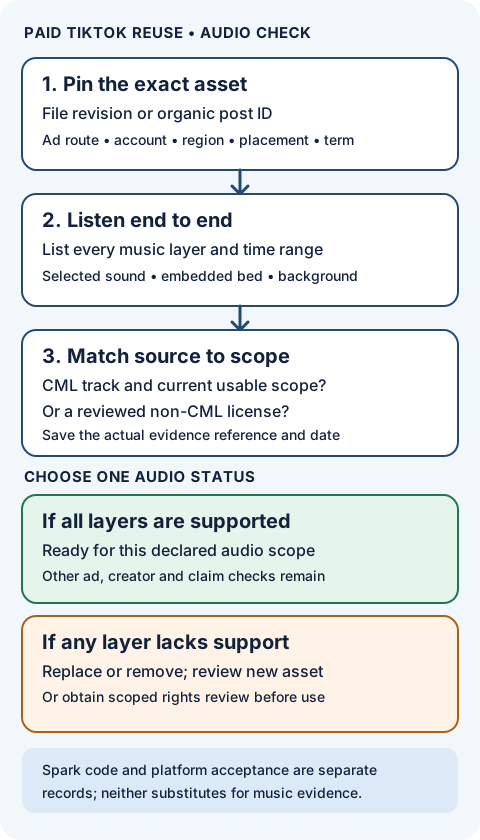
Original audio decision flow for one exact received video. A Spark code and platform acceptance are separate records, not music evidence.
Original visual by Superdirector editorial team. Creation date not recorded.
Step 4: Decide: use, revise, or resolve rights
The campaign owner now makes a practical decision on the exact asset. Use “ready for this scoped TikTok audio review” only when every music layer has an identified and supportable route for the declared paid use, the scope remains current, and the reviewer has saved the evidence reference. If the campaign has a separate legal approval requirement, that requirement must be completed as well. “Ready” here means the audio evidence question in this guide has been answered; it does not approve the creator’s video rights, factual claims, sponsorship disclosure, ad policy, or the ad itself.
Use revise and recheck when an uncertain soundtrack can be removed or replaced without losing the video’s essential meaning. TikTok One’s current guidance tells creators who are unsure whether embedded music is cleared for commercial use to replace it with a Commercial Sound or remove it. If a TikTok One upload is rejected for a music copyright issue, TikTok says to review the rejection reason, revise the video, and resubmit. After any replacement, open the newly received file or post, listen from start to finish, and update the evidence to its new revision. A rights note attached only to the old version should not be silently inherited.
Use rights review required when the team wants to retain a non-CML sound or when ownership and license scope are unresolved. Specify the missing document and intended use in the request. “Please clear the music” is not actionable; “Please confirm whether license L covers the embedded recording and composition in asset V4 for paid TikTok video ads in the US and Canada on the named account during the proposed term” gives the reviewer a concrete question. The reviewer may say the proposed license is sufficient, needs an amendment, or does not cover the plan. Record that answer with the exact asset and scope. If an approval cannot be obtained in time, choose a different sound or postpone use of that asset rather than marking the rights field complete.
Do not promote platform review to the top of the evidence hierarchy. TikTok says it *may* review a creator collaboration upload and an unlicensed music use *may* be rejected. A rejection is a specific problem to fix; an accepted upload does not document the rights owner’s grant. A muted or rejected ad also does not prove which party owns a track. The receipt should say what the platform reported and what independent source evidence exists, with neither substituted for the other.
A clearly fictional worked decision
The following people, files, and plan are hypothetical. They are included only to show how to fill a decision card; no campaign, creator account, licensed track, approval, ad result, or customer outcome was observed.
Imagine an agency receives creator-cut-v3.mp4 on October 28, 2026. It plans to upload that file as paid TikTok creative for a fictional brand in the United States and Canada. The creator says the background song came from the sound picker on their personal TikTok account, but provides neither a CML track reference nor a separate commercial-use license. The agency hears music from 00:03 through 00:24. It records the sound source as unverified personal-account sound, not as “CML cleared.” TikTok’s CML instructions say a personal account can see all sounds; merely having chosen a sound in that account does not establish that it came from Commercial Sounds. The proposed paid reuse is therefore not ready on the available audio evidence.
The agency asks for a music-free export or a replacement using a specific Commercial Sound available in the intended region and usable placement. In this hypothetical, the creator supplies creator-cut-v4.mp4 with the earlier music removed. The agency listens to all of V4 and finds no remaining music layer; it records V4 as the current reviewed file, the date, the exact intended TikTok route, and the fact that the earlier V3 decision does not carry over. If instead V4 adds a CML track, the agency must record that track and its relevant availability before marking the audio evidence ready. None of this grants the brand video usage, approves claims, or proves ad delivery. The example ends at a documented audio review decision, not an invented launch success.
There is a second possible branch. Suppose the creator wants to retain the original song and sends a license PDF. The agency should preserve that private document and request a qualified review of the named advertiser, recording, composition, commercial ad route, countries, and term. Do not paste the private license into the public worksheet. If the document supports only an organic creator post, the decision stays unresolved for the brand’s paid upload. If it supports the exact planned use, the reviewer can document that conclusion. We make no claim about what this fictional PDF actually permits.
Common mistakes at this handoff
A post code is treated as a music license. Spark authorization can let an advertiser use a creator’s organic post as a Spark Ad, according to TikTok’s Spark documentation. It is still a post authorization record. Keep the music-source question separately attached to the exact post; the code does not identify or license every audio layer. For a creator upload route, a creator collaboration approval similarly does not replace the source evidence.
The team checks a draft and launches a new cut. A final export may add a jingle, trim into a different sound segment, or contain a low-volume background layer that was absent from the reviewed draft. Version the audio decision with the asset. If the creative changes, re-open the exact new file or post and recheck it. The worksheet’s revision field exists to prevent a correct earlier decision from being copied into a different asset.
“Royalty-free” becomes a universal permission. The phrase can describe several pricing and licensing models; it does not state that this brand, in these territories, for this period, may put this exact recording into a TikTok ad. Read the actual grant. The same principle applies to music commissioned for the creator: the commission might or might not assign the rights the brand needs. The document and its scope decide, not the source category’s friendly name.
One CML observation is stretched across every market or channel. TikTok tells users to select the campaign region and filter usable placements. Its TikTok One note warns that availability and usage rights can vary by track, region, account, or campaign. Record what was checked. A US TikTok decision is not a blanket decision for Canada, another account, Instagram Reels, a website, or a future campaign. Recheck changed scope instead of copying an old green cell.
Silence is mistaken for approval. No platform warning, no creator objection, and no client complaint are not affirmative evidence of a music grant. TikTok One’s “may review” wording makes that limit especially plain. Ask for the source record or replace the uncertain soundtrack. A short, honest “audio evidence unresolved” is more useful to the launch owner than a confident but unsupported “approved.”
How to hand the decision to the ad owner
Give the ad owner a compact, dated result rather than an essay: “We reviewed [exact file revision or post ID] on [date]. Intended use: [TikTok route, account, countries, placements, term]. Music layers: [time ranges and sources]. Evidence: [CML track and scoped availability or private license reference and reviewer conclusion]. Audio status: [ready for this scope / revise and recheck / rights review required]. This status says nothing about creator usage rights, post authorization, claims, disclosure, ad approval, or delivery.” If a field is unknown, leave it explicit. The blank decision card is designed for this handoff, and its CSV header can be copied into a private campaign record.
For the next adjacent tasks, use the usage-rights checklist to document the creator’s grant for paid use of their footage and identity, and the post-versus-ad timeline to distinguish a creator’s organic publication from ad activation. The trending-audio guide helps choose a sound for new content. This guide begins later, with a received asset and a decision about its soundtrack before paid reuse. It does not claim that Superdirector reads a campaign’s actual music license or has approved any ad.
Source and scope note
Platform facts come from TikTok’s TikTok One music copyright guidance, CML overview, CML use instructions, and Spark Ads overview, checked October 28, 2026. The US Copyright Office explanation supports only the distinction between composition and sound recording. The inventory, three-way decision, and handoff text are our editorial method. We did not read a customer license, inspect a customer asset, obtain legal advice, measure a campaign, or verify search volume for this question. TikTok’s separate CML terms page was not accessible during this review; any case depending on those terms needs a direct rights review. No FTC claim is made because the narrow task is music-use evidence, not endorsement disclosure.