How-To Guide
Decide whether a creator’s viral post belongs in your fit assessment
Use a three-way admission call for one high-reach creator post: admissible, context only or out of scope for your sponsor’s exact task.
By the Superdirector editorial team. TikTok One and YouTube help pages reviewed October 30, 2026.
At a glance
When should a viral creator post be excluded from a sponsorship fit assessment?
Exclude it from carrying the fit conclusion when it does not match the sponsor’s frozen task: a different subject, a different audience task, a different format or placement, or an origin you cannot establish. Do not exclude it merely because its count is large, and do not treat it as normal output without checking other works. Sort it as admissible, context only or out of scope, with a short cited reason. That call concerns one post for one task; it is not a judgment that the creator is fraudulent or unsuitable overall.
- Judge the post against a sponsor task written down before you open it.
- Compare it with at least two other dated works from the same creator.
- Keep unknown paid or boosted status unknown, and keep the creator verdict separate.
Direct answer
Short answer: a viral post belongs in a fit assessment only if it is evidence about the job your sponsor needs done. That job has a topic, a content format, an audience task and a placement. Open the post only after those are written down, read what it actually depicts and whom it addresses, compare it with other dated works from the same creator, and then give it one of three labels: admissible, context only or out of scope. High reach is not a label. It is the reason you looked.
This page covers one narrow decision: whether one cited post may carry weight in the evidence set. It does not compare metrics across candidates (the YouTube creator metrics worksheet does that once you have a qualified set) and it does not score the whole account for quality or safety (the 100-point vetting rubric does that). Excluding a post is not a finding that the creator is fraudulent or a poor partner. It means that post cannot answer your question.
Use the blank post inclusion card, the CSV register and the original admission map. They are blank teaching and recording tools. No creator, post or metric appears in them, and no demand data for this question was measured (search volume and difficulty are N/A).
Freeze the sponsor task before opening the post
A media kit tends to lead with its best number, and a reviewer who sees that number first will judge everything after it against a pull of large reach. Reverse the order. Before opening the offered post, write four lines: the topic the creator would speak about, the format you expect (a short vertical video, a long review, a carousel), the audience task (what the viewer should understand or do after watching, such as learn what a tool does or compare two options), and the placement (organic post on the creator’s own feed, a reuse in your paid media, an embedded segment). If your team already narrowed these in a request, the campaign request guide shows how to reduce them to one decision.
Keep the wording short enough that two reviewers would agree on what it means. “Short demo of a budgeting app for people starting freelance work” can be checked against a post. “Lifestyle content” cannot. If you cannot write the task in a few lines, the problem is upstream of any post, and no amount of evidence review will repair it. Sponsor category questions, such as which kinds of brands a creator has accepted, are a different check, covered in the sponsor categories guide.
Then write down why this particular post is in front of you. Did the creator or their representative offer it? Did it come up in your own search? Was it chosen by a ranking filter? Platform tools do offer ways to sort by performance: TikTok’s creator-discovery guide for TikTok One, for example, says its search filters include median video views and engagement rate. A post surfaced because it is the peak is a different kind of evidence from a post surfaced because it was the most recent on-topic work, and the card has a field for that.
Record the exact post and what is known about it
Save the post’s URL, platform, publication date and your checked-at time with a time zone. Add where the number came from: a public page you viewed, or a screenshot or export the creator supplied. Keep that origin attached, because a creator-supplied figure and a public figure are not the same kind of fact, and you cannot reconstruct which was which a month later.
Record the post’s paid status if you know it, using only the words the evidence supports: organic, sponsored, boosted, or unknown. This matters because a post that reached a large audience through paid distribution tells you something different from one that spread without it, and a public page may not show which happened. If the creator has not said, write unknown and ask. A sponsored post for another brand is informative about what the creator has been paid to say, but it is not automatically a stronger or weaker signal for your task. When your question moves from reach to paid results, the organic and paid results guide keeps those labels apart.
Note the post’s age at the time of review. A recent post and an old one have had different amounts of time to accumulate views, so their counts are not on the same footing. YouTube’s Advanced Mode help describes comparing videos at the same stage of life, across 24-hour, 7-day and 28-day windows, so that the comparison is fair. That view is part of YouTube Studio’s analytics for a channel’s own videos, so a reviewer outside the channel should ask the creator for it. If you cannot get matched windows, say so and treat any count comparison as rough.
Read what the post depicts and whom it addressed
Now open the post and answer four questions in plain words, one at a time, before looking at its counts again. What is it about? Name the subject the way a viewer would, not the way a caption hashtags it. Whom does it speak to? Look for language, stated viewer (“if you’re new to…”), country cues, and the assumed level of knowledge. What form is it? Length, structure and style, and whether that form is the one your sponsor intends to buy. Why did it travel? If the stated reason is a trend, a news moment, a celebrity cameo, a giveaway or a meme format, write that down.
The last question is the one reviewers skip, and it is often where the decision lies. A post can be about the right topic and still have reached people for a reason that will not repeat in a sponsored integration. You cannot always know why a post spread, and you should not invent a reason; “cause unclear from public view” is a legitimate entry. What you can do is note when the visible content and the sponsor’s task point in different directions, for instance an entertainment sketch where the sponsor wants a careful product explanation.
Be careful not to treat reach as a statement about audience. YouTube’s help on unique viewers says that metric estimates how many people watched, as distinct from a count of views, and that a person watching several videos is counted once at the channel level. Public view totals are the second kind of number. They do not tell you how many separate people saw the post, or who they were. YouTube’s page says unique viewers can be viewed in Advanced mode in YouTube Studio Analytics from a computer, so ask the creator for that figure.
Compare a bounded set of other dated works
A single post cannot show whether it is typical, so you need neighbors. Open at least two other works from the same creator and record their URLs and dates. Choose them by the sponsor task and not by performance: the most recent works on a related subject, or the closest in format. If the creator has made nothing else on the subject, that is a finding too, and the card should say “no comparable work found in the pages reviewed,” naming how far you looked.
TikTok’s discovery guide points the same way. For a creator’s profile it suggests looking at how follower growth, views and engagement change over time to judge consistency, and at a content portfolio of recent organic and sponsored videos to judge style, quality and brand alignment. That supports looking past one peak. It does not tell you to remove outliers, and it does not show that median views predict how a sponsored post will perform, so use it as a reason to read a set, not as a formula.
Do not set a quota for how many works are enough. Two is the floor on the card because one comparison is only an anecdote, but the right number depends on how varied the creator’s output is. A creator who posts the same kind of video every week needs fewer than one who moves between formats. Whatever you choose, write down the boundary (“reviewed the eight most recent uploads and every video that mentions budgeting”) so that another reviewer can reproduce your set.
Mark each neighbor as matching the task, not matching, or unclear. Then look at the pattern. If several neighbors match and the viral post matches too, it is probably one strong example of normal output. If the viral post matches and the neighbors do not, the creator’s demonstrated work may lie elsewhere. If the neighbors match and the viral post does not, the post is a spike in a different direction and the fit evidence lives in the others.
Assign one category and write the reason
Give the post exactly one of three labels for this sponsor task, and attach a one- or two-sentence reason that cites what you saw. The labels are editorial categories from this method, not platform terms or statistical tests.
| Category | When it fits | What it may do |
|---|---|---|
| Admissible | Topic, audience task, format and placement context match the frozen task, and its origin is documented | Carry its exact metric names and windows into the comparison, beside the neighbors |
| Context only | Partly matches, or matches but its origin, paid status or cause of spread is unclear | Explain style or range; do not let it carry the fit conclusion |
| Out of scope | Different subject, audience task, format or placement, or no documented origin to rely on | Stay in the file as a dated note; do not use it to support or oppose fit |
Then fill in what would change your mind. If you called a post context only because the paid status was unknown, name the document that would move it: the creator confirming it was organic, for example. If you called it out of scope because the audience was clearly not your sponsor’s, say what would reopen it, such as a creator-supplied report showing the relevant market. A call with no reversal condition is harder to audit and easier to defend past the point where it deserves defending.
Keep the reasoning on the post. “Out of scope: a comedy sketch with no product explanation, and our task asks for one” is a statement about the content. “Out of scope: this creator seems unreliable” is a different claim that needs different evidence, and it does not belong on this card. The reverse also holds: an admissible post does not clear the creator on integrity or brand safety, which stay with the rubric.
Walk through a fictional case
Fictional exercise: no real creator, post, sponsor or number was inspected, and none is implied. A sponsor wants a short vertical explainer that shows a note-taking app to people starting remote work. A reviewer receives a media kit whose headline is one very popular video from Creator X, a comedy sketch about an overflowing inbox that mentions no tool.
The reviewer freezes the task, then opens the sketch. It depicts a joke, addresses people who feel overwhelmed at work generally, and names no product. The reviewer opens three other Creator X videos. Two are screen-recorded walkthroughs of productivity tools; one is another sketch. The walkthroughs match the task on format and audience; the sketches do not. The creator has not said whether the sketch was boosted, so the paid status is recorded as unknown.
The call, in this invented case: the sketch is context only. It shows comedic range and a willingness to talk about work, but it does not carry the fit conclusion, since its format and audience task differ from the sponsor’s. The two walkthroughs are the candidates for admissible status, pending documented origin for their numbers. The reversal condition on the sketch is a creator-supplied report showing that its viewers are the remote-work beginners the sponsor wants and that the audience came to the channel for explanatory work. Nothing in this case says Creator X is a good or bad choice. It says the headline post is the wrong exhibit.
The original admission map lays out the same path: task, offered post, neighbors, then one of three outcomes. It is a teaching diagram and not a screenshot of any platform.
When enlarged, scroll horizontally to read the diagram.
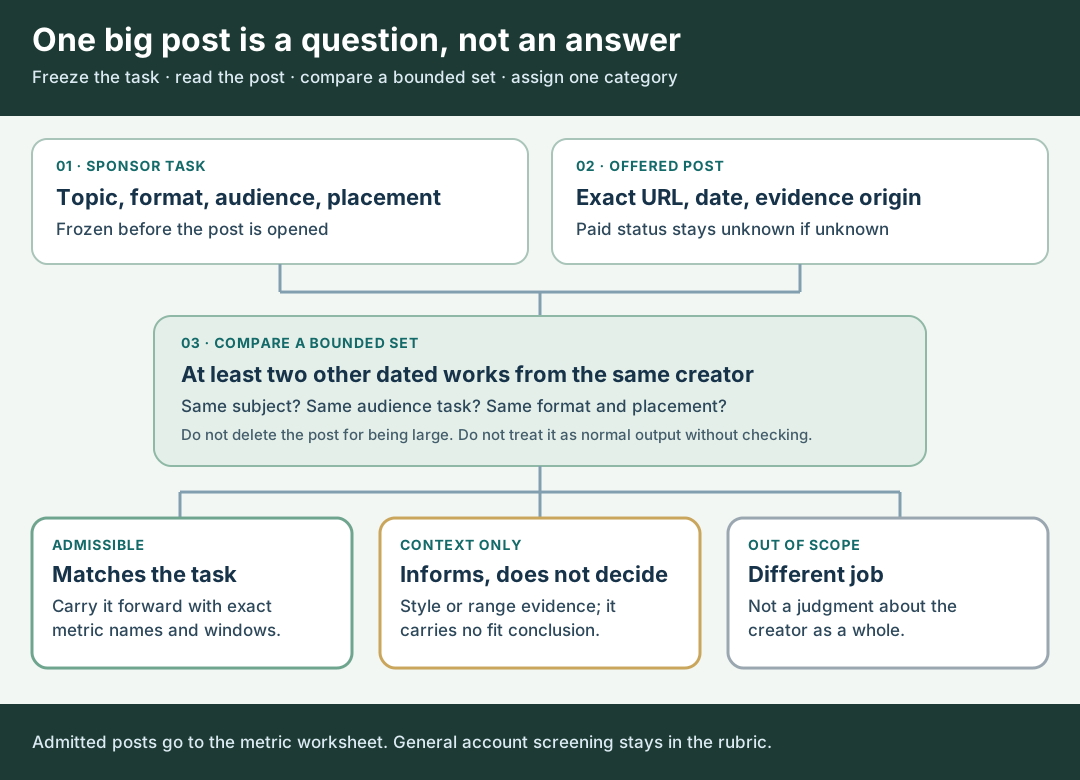
An original editorial map for one offered post. The three labels describe fit evidence for one sponsor task, not a verdict on the creator.
Original visual by Superdirector editorial team. Creation date not recorded.
Hand off the admitted set and keep the limits visible
When a post is admitted, carry it forward with the exact metric name the platform or the creator used, the reporting window, whether it was public or creator-supplied, and its date. Do not relabel “views” as “reach” or “audience.” Then take the set to the metrics worksheet, which handles label and window consistency across candidates, and run general account checks through the vetting rubric. This page ends where those begin.
State the limits in the file where the next reader will find them. The sources behind this method are help pages from platforms about their own tools. They support looking at a portfolio, comparing like with like, and keeping people and views distinct. They do not establish a rule for deleting outliers, a threshold for virality, a sample size, or a link from past views to a future sponsored result. Anything beyond those points in your decision is your own judgment, so label it that way for the person who approves the shortlist.
If your team later learns more, add a dated observation rather than rewriting the old call. A post first marked context only because its origin was unknown can be upgraded when the creator supplies a record, and the file should show both dates. That is more useful to an auditor than a tidy card that hides how the view changed.