How-To Guide
What can you conclude from one creator post or one creative variant?
List every difference between two creator posts, check whether a platform split the audience, then sort each conclusion as observed or only consistent with.
By the Superdirector editorial team. TikTok, YouTube and FTC pages reviewed October 30, 2026.
At a glance
What can a team reasonably conclude from one creator post or one creative variant?
A team can state what that post's own numbers show, with the metric, source and window. It can offer an explanation as consistent with what was seen, as long as the other differences between the posts are listed beside it. It should not call a variant the winner, say a creative caused a result, or present a general rule unless the design earned it, for example because a platform split the audience and reported a result for that metric. Sort each sentence into observed, consistent with or not supported, then name the next test.
- List every difference between the posts, not only the intended one.
- Check whether a platform split the audience and what its tool measured.
- Write each conclusion at the tier the design supports and name the next test.
Direct answer
Short answer: one creator post, or one post per creative variant, supports an observation and a hypothesis, not a verdict. You may state what each post's own numbers show, with the metric, the source and the window. You may offer an explanation as consistent with what you saw, if you list the other differences between the posts next to it. You should leave out “this variant won,” “this caused the result” and “this works for our audience” unless the design could carry them. A design can carry them when, for example, a platform divided the audience between versions and reported a result for the metric you are quoting.
This is for an agency or brand marketer who has two creator posts, or one post and a hunch, and must write a conclusion for a client or for the next brief. The decision is narrow: how strongly each sentence may be worded. It does not decide whether the result was good, whether to renew a creator, or what to test next in the campaign. Those have their own pages, linked in the boundary section below.
The method is an inference boundary card. It records the comparison as it ran, lists every difference between the posts, notes whether a platform split the audience, sorts each draft sentence into one of three tiers and names the next test. Use the blank card, the CSV register and the inference ladder to keep the work in one place. The tiers are our editorial method. They are not a platform feature, a statistical test or a standard from any source cited here.
Write the comparison as it actually ran
Start with a plain description of what happened, not what was planned. Write the post addresses and platform, the publish date and time with the time zone, the metric you are looking at, the exact window you are measuring and who read the number, with the date you read it. If the plan said “same hook, different thumbnail” but the creators filmed two different cuts, write the cuts. A plan is an intention. The record has to be what went out.
Write the metric the way the platform defines it, and keep its name. “Views,” “watch time,” “saves” and “clicks” are different quantities, and a conclusion about one does not carry to another. If you are quoting a platform's declared result, copy its label and the help page that explains it, with the date you read the page. If you are quoting a number from a screenshot or a creator's own report, say so, because a number you cannot reproduce is a number you cannot defend. Fixing the reporting window in advance is covered in the observation window guide; here, just write down the window you used.
Also write how many posts stand behind each version. “One post per version” is a complete and honest answer, and it is the single most useful fact on the card, because it tells a reader how much the numbers can carry before anyone reads them.
List every difference between the posts
Now list every difference you can name, including the ones you did not choose. Work down the same prompts each time: the creator and their audience, the day and time of posting, the caption and any text on screen, the length, the opening seconds, the thumbnail or cover, the sound, the link or call to action, any paid support behind either post, and anything that happened to the product or the market in between. Add anything else you notice. The goal is not to be exhaustive about the universe. It is to show how many things changed at once.
Two posts from two creators differ in the creator, the audience that follows them and the day they went live, at the least. If you meant to compare an opening, you have still changed those three things. That does not make the comparison useless. It means the comparison contains several differences, and the numbers cannot tell you which one mattered. A list of five differences next to a conclusion about one of them is the honest form of that sentence.
| Difference to check | Why it can move the number | What to write on the card |
|---|---|---|
| Creator and audience | Different people follow different creators for different reasons | Name both creators; write “audience not matched” |
| Day and time | The posts met viewers on different days | Record both publish times with time zones |
| Caption, text and sound | Words and music change what a viewer takes in | Paste both, side by side |
| Opening and length | Two cuts differ in more than the one second you cared about | Describe both openings and give both lengths |
| Thumbnail or cover | It is the first thing many viewers see | Save both images with their file names |
| Paid support | Paid delivery on one post and not the other changes who saw it | Mark each post paid, unpaid or unknown |
If paid delivery touched one post, separate the organic and paid readings before you compare anything; the organic and paid results guide covers how. And if the creator's own earlier work is part of the story, that is a different question, answered in the format repeatability check.
Check whether a platform split the audience
Ask one more design question: did a platform's testing tool divide viewers between the versions and report a result, or did two posts simply run side by side? The first is a designed comparison with rules written on a help page. The second is two observations. The card has a box for the answer and a box for the help page you read, because the rules differ by platform and change over time.
Two documented examples show what a designed comparison looks like. TikTok's split testing help page says the audience is divided into two equal groups, that each group sees only one ad group, and that the model selects and verifies a winning ad group only if the results are statistically significant. Its split testing variables page says you can only select one variable for each split test, and lists video hooks, the opening two to three seconds, among the creative assets you can test. Those pages describe a tool in TikTok Ads Manager that compares ads. They do not describe two organic posts from two creators, and we are not claiming they do.
YouTube describes a different design. Its A/B test help page for titles and thumbnails says you can test up to three titles or thumbnails, that the variations are shown at the same time, and that the winner is based on watch time share, not click-through rate. It names three outcomes: a winner, “performed same,” and inconclusive, and it says similar titles or thumbnails can make a test run longer or end without a winner. It also says the feature is not available for Shorts. That is a result about which title or thumbnail earned more watch time on one video. It says nothing about which creative approach is better in general.
Note the shape of what these pages share. In each, the platform controls who sees which version, and the tool states what it measured. A pair of posts you published yourself has neither. We could not read the body of Meta's “About A/B Testing” help page while preparing this article, so we say nothing here about how Meta's tool works. Check the current help page for any platform you use, record the date you read it, and do not assume one platform's rules apply to another.
If a platform did run a split, quote its result with its own label and scope, for instance “the tool reported a winner on watch time share for this video,” and treat that as tier one on the card. If it did not, the card says “posts ran side by side,” and every comparative sentence is tier two at best.
Put each conclusion in one of three tiers
Take each sentence you were about to write and sort it. Tier 1, observed: what each post's own numbers show, with the metric, source, date and window. For example, “Post 1 had more saves than Post 2 in the first seven days, as read from the creator's analytics screen on October 29.” This is always allowed, and you can write it without a test. Tier 2, consistent with: an explanation that fits what you saw, written with the other differences from your list beside it. For example, “The shorter opening is consistent with the higher completion, though the creators, days and captions also differed.” Tier 3, not supported: a winner, a cause or a rule that the design cannot carry. For example, “the short opening drives completion.”
The inference ladder shows the three tiers with the questions that decide them. Use it when a draft sentence feels stronger than the card allows. Move the sentence down a tier until it stays true, and write what remains uncertain beside it. A tier-three sentence is not banned from your thinking. It is banned from the conclusion until a better design is run.
Be careful with the move from a post to a general claim. A single post is an observation of one creator's audience on one day, and the numbers alone do not show how much a result like it would vary on another day or from another creator. We found no source that gives a sample size or a threshold for creator posts, so this page does not offer one. If a client asks “is that statistically meaningful?”, the honest answer from this design is that it was not built to be, and you can say what a design that was built to be would look like.
If you plan to use a post's result in advertising, a different rule set applies. The FTC's endorsement rule, 16 CFR 255.2, says an advertiser needs substantiation for express and implied claims made through endorsements, and that an endorsement describing a consumer's experience with a central or key attribute is likely to be read as representing what consumers will generally achieve. Whether a particular use meets that rule is a question for counsel. This page only notes that a tier-three sentence is the kind of statement that rule is concerned with, so keep it out of copy unless it has been substantiated.
When enlarged, scroll horizontally to read the diagram.
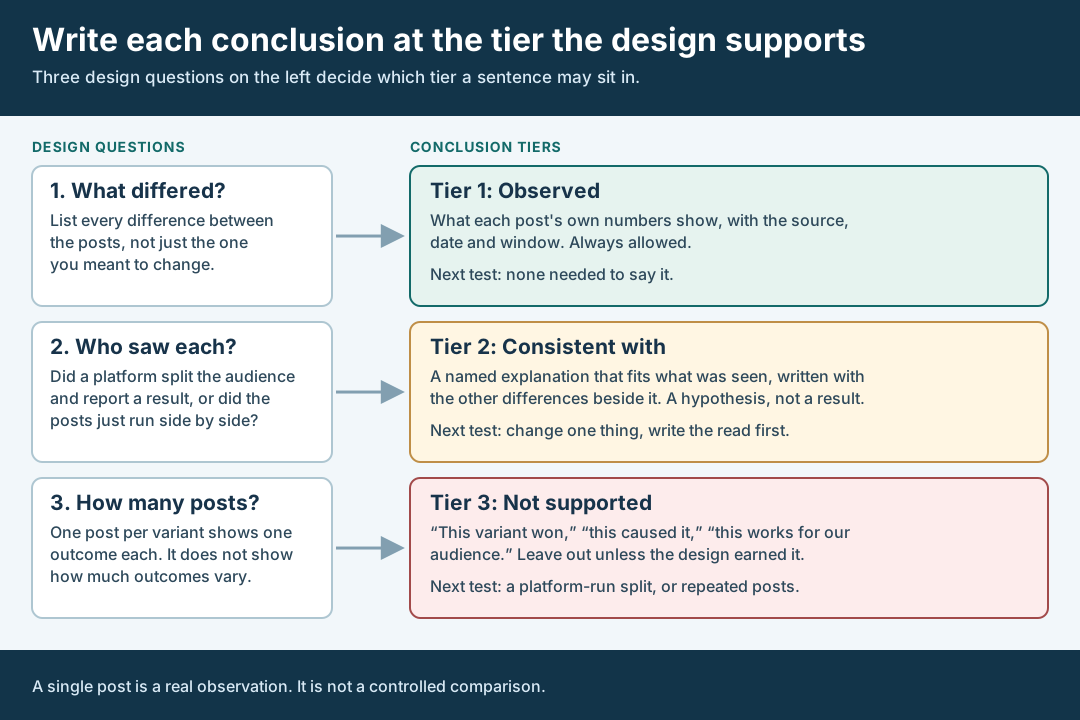
An original editorial ladder. A sentence stays at the tier the design can carry.
Original visual by Superdirector editorial team. Creation date not recorded.
Walk through a fictional comparison
Fictional exercise: no real brand, creator, campaign or result was inspected. A made-up brand, Brand A, asked Creator Q and Creator R to each post one short demonstration of the same product feature. Brand A meant to compare two openings: Creator Q opened with the finished result, and Creator R opened with the problem. Post 1 (Creator Q) later showed higher completion on the platform's own screen than Post 2 (Creator R). A teammate drafts: “Opening with the result beats opening with the problem.”
Run the card. Comparison as it ran: one post per version, two platform screens read on the same date, completion as the platform defines it, windows matched by hand. Differences: the opening, but also the creator, the audience, the publish day, the caption and the length of the video. Platform split: none; the posts ran side by side. Tiers: “Post 1 showed higher completion than Post 2 in the window, as read from each creator's screen” is tier one. “The result-first opening is consistent with the higher completion, though the creator, audience, day, caption and length also differed” is tier two. “Opening with the result beats opening with the problem” is tier three, so it comes out of the conclusion.
The reviewer does not conclude the opening is irrelevant. They write the tier-two sentence, list the five other explanations beside it and move to the next step. The scenario predicts nothing about any real creator, product or opening style.
Name the test that would upgrade the claim
For each tier-two or tier-three sentence, write the smallest next test that could move it up, and the decision that test would inform. Two routes recur. One is a platform-run comparison, if a tool exists for the surface and variable you care about, with its rules read and quoted. The other is a pair of posts built so that only the thing you care about differs, such as the same creator and the same product shot with only the opening changed, with the read written before it goes live. The second route is a hypothesis test, not a guarantee, and the card should say what result would change your mind before anyone looks.
Ask the creator before you plan a test that changes their work. The hook test request guide covers how to keep their voice intact and record their reply. Choosing which single change to test after a weak campaign is the subject of the next test guide, and carrying a learning into a brief as a hypothesis is in the past campaign learning guide.
Finish the card with an owner and a date. If the next test is not worth running, say so on the card and leave the sentence at its current tier. That is a legitimate result: the claim stays a hypothesis, and everyone can see why.
What this page does not decide
This method sorts the wording of conclusions from a creator post comparison. It does not tell you whether a result is good, whether to keep working with a creator, or whether the numbers are right. Where it differs from nearby pages: the weak campaign next test guide starts after a disappointing result and picks one hypothesis to test, while this page starts from a comparison and limits what you may say about it. The hook test request guide is about asking a creator to take part, not about reading what came back. The past campaign learning guide carries an owned record into a new brief, and the format repeatability check samples a creator's own uploads against a format definition.
Other checks sit nearby. Whether the measurement itself can be trusted is in the views-to-visits diagnostic, and when to renew a creator after mixed results is in the renewal decision guide. Any question about how a result may be described in an advertisement, or what an agreement allows, belongs with counsel.
Nothing here measures how often creator post comparisons mislead, how many posts make a result reliable, or how much any creative element matters. Those numbers are not available to us and are not claimed. The three tiers are an editorial method, the platform pages quoted describe only the tools they name, and we could not read Meta's A/B testing page, so we state nothing about it. The page exists so that each sentence in a conclusion carries only as much as the design behind it can support.