How-To Guide
Split agency service work from the creator’s promised deliverables before the brief goes out
Place each work item in a two-party scope table: creator deliverable, agency service, shared or unassigned, with one owner and one proof per row.
By the Superdirector editorial team. FTC and Copyright Office pages reviewed October 30, 2026.
At a glance
How should an agency separate its service work from a creator’s deliverables?
Put the agency’s statement of work and the creator’s agreement side by side and give every work item its own row. Place each row in one column: creator deliverable if the creator’s signed document promises it, agency service if only the agency’s document promises it to the client, shared if both touch it, or unassigned if neither names an owner. Give each row one named owner, one proof and one due date, and send unassigned rows to a decision-maker before the brief goes out. Build the creator’s brief only from creator-deliverable rows.
- Anything the creator never promised stays agency work until it is accepted in writing.
- Shared rows need two named owners and a handoff.
- Scope ownership only: no fee or pricing advice.
Direct answer
Short answer: build a two-party scope table before the brief goes to the creator. Put every work item from the agency’s statement of work and every item from the creator’s agreement in its own row, then place the row in one of four columns: creator deliverable (the creator’s own signed document promises it), agency service (only the agency’s document promises it to the client), shared (both documents touch it) or unassigned (neither names an owner). Each row needs one named owner, one proof the owner will show and one due date. Anything the agency promised its client that the creator never promised is the agency’s work until someone gets the creator to accept it in writing.
This is for an agency or brand marketer who holds two documents that were written at different times for different readers: a statement of work with the client and an agreement or brief with the creator. The decision is narrow: who owns each piece of work, and what evidence shows it was done. It is not advice on what an agency should charge, how a fee should be split or what a creator is worth. Those are commercial questions, and this page deliberately does not answer them.
The reason to do it as a table is that scope fails in the seams. A statement of work says “the agency will deliver two videos,” the creator agreement says one, and nobody notices until the second video is due. Use the blank scope table card, the CSV register and the ownership map to keep the placement visible. All three are blank; they contain no example fee, creator or result.
Collect both signed documents, not a summary
Start with two documents and one list of names. The first document is the agency’s statement of work or service agreement with the client, with its version and date. The second is the agreement, brief or accepted offer the creator actually agreed to, with its own version and date. If the creator only replied “sounds good” to a chat message, record that message as the creator document and mark it as informal; it may promise less than your internal brief assumes. The list of names is who signed or accepted for each side: which company, which person and in what role.
Do not work from your own summary of either document. A summary is where an assumption turns into an obligation. Copy the clause numbers or message timestamps, and keep the text. If either document has an annex, change log or later accepted note, list each one as its own item with who accepted it and when. A change one side proposed and the other never answered is not accepted scope.
Also record what neither document says. Common blanks are revision limits, who may speak to the client directly, who owns the raw footage, what happens if the post date moves and who pays for a reshoot. A blank is not a problem yet; it is a row you will need in the table. Mark it now so it is not discovered mid-campaign. The one client decision guide covers pinning the goal that the statement of work is supposed to serve.
List the creator’s promised deliverables
Go through the creator’s document only and write one row per thing the creator promised. Use the document’s own words: format, length, platform, account, required elements, post date, rounds of revision, any rights granted and anything the creator agreed to say, show or label. Quote it; do not rewrite it into the language of your brief. A creator who promised “one vertical video for my channel” has not promised “a campaign.”
Add a row for each dependency. A video that needs a product sample depends on the sample arriving. A post that needs approval depends on someone approving. For each dependency, write which row it depends on and who must act first. This is where you often find a deliverable whose clock starts on an agency action, such as sending the product or returning feedback. If the agreement does not say when the clock starts, mark the row as unclear rather than guessing.
Leave the agency’s own tasks out of this pass. Sourcing the creator, writing the brief, chasing the post and compiling the report may all be real work, and the creator did not promise any of them. If you mix them into the creator list, the creator’s brief later gets a request that no clause supports. The same discipline applies in the first-cut review guide: a required fix needs a quoted clause, and so does a required task.
List the agency’s service work as its own column
Now go through the agency’s statement of work only. Write one row for each activity or output the agency promised the client. Typical items include finding and shortlisting creators, drafting the brief, coordinating shipping, reviewing cuts, chasing a posting date, verifying the live post and sending a report. Use the statement’s own words again, and note the client-facing output each row creates, such as a deck, a link or a report.
Then run the most useful comparison in the exercise: for each agency row, does a creator row support it? If the statement of work promises “two videos per creator” and the creator agreement lists one, the agency has promised the client something the creator has not agreed to. The row stays in the agency column, marked as *dependent on a deliverable the creator has not promised*, and goes to a decision-maker. If the statement says the agency will “approve final content” while the creator agreement says the client approves, both documents touch the row. It is shared, and it needs two named owners and a handoff.
Keep the opposite check too. For each creator row, is there an agency row that explains where it goes? A creator who promised a video for a date that the agency never put in the client schedule has made a promise that nothing downstream is waiting for. That is not an error, but it is a seam. If a creator deliverable has no agency service row to receive, review or report it, write that down as a gap rather than assuming someone will handle it. The bundle quote comparison is the place for the cost side of a bundle; this table only tracks who does what.
When enlarged, scroll horizontally to read the diagram.
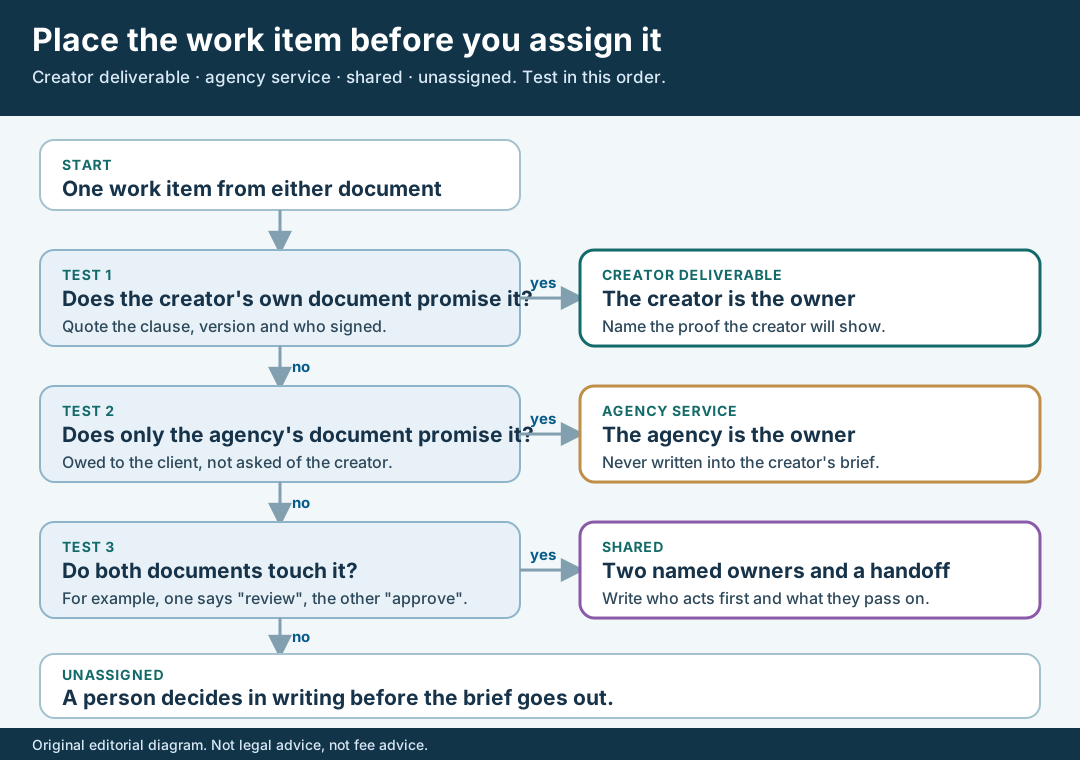
An original editorial ownership map. Only creator-deliverable rows go into the creator’s brief.
Original visual by Superdirector editorial team. Creation date not recorded.
Check the rows that outside rules attach to
Some rows are not fully settled by either contract. Before you assign them, check what the outside rule says and record the source and the date you read it. Three groups come up in creator work: honest endorsements and disclosure, the creator’s own account settings, and rights in the finished video. This section reads narrowly. It supports statements about who may answer to a regulator, not what any court would decide.
Responsibility for endorsements. The FTC’s Endorsement Guides, 16 CFR 255.1, say in paragraph (d) that an advertiser may be liable for a deceptive endorsement even when the endorser is not liable, and that advertisers should provide guidance to endorsers, monitor their compliance and take action sufficient to remedy non-compliance. Paragraph (e) says endorsers may be liable for statements made in their endorsements, and paragraph (f) says advertising agencies, public relations firms and similar intermediaries may be liable for their roles in creating or disseminating endorsements containing representations they know or should know are deceptive. The page text also says good-faith guidance, monitoring and remediation are not a safe harbor. The practical reading for the table: guidance, monitoring and remedy are real work, so they need an owner row rather than a hope.
The FTC’s Endorsement Guides: What People Are Asking page, read October 30, 2026, says that delegating part of a promotional program to an outside company does not relieve you of responsibility under the FTC Act, and that a company that recruits influencers and pays and directs them needs reasonable programs to train and monitor them. It also says a company that pre-approves influencers’ paid posts should review them. An agency should therefore not treat “the creator signed the brief” as the end of its own monitoring row, and should not write itself out of that row because the creator holds the disclosure duty.
Who makes the disclosure. The FTC’s Disclosures 101 for Social Media Influencers page, dated November 2019, tells influencers that it is their responsibility to make these disclosures. Put the disclosure itself in the creator column, because the creator is the one posting. Then add an agency row for checking it, since the page above also puts responsibility on companies that direct and pre-approve. The detail of what a clear disclosure looks like in a caption and a video is in the disclosure caption and video guide. This page only places the ownership.
Rights in the finished video. The U.S. Copyright Office’s Circular 30, Works Made for Hire, whose file metadata shows an August 22, 2024 date, says a work is made for hire in two situations: when an employee creates it as part of regular duties, and when a certain type of work is created under an express written agreement between the creator and a party specially ordering or commissioning it. The circular also describes the concept as complicated with serious consequences for both sides. For the table, that is enough: do not assume the agency or the client owns a creator’s video because they paid for it. Make “rights granted, scope and term” a row, quote the clause and send it to counsel if it is missing. Paid use of an organic post has its own page, the paid-use agreement guide.
If a row depends on a platform setting, such as a paid-partnership label or a branded-content toggle, check that setting in the platform’s own help page on the day you plan the campaign and record the date. Those pages change, and a screenshot from last year is not a source.
Give every row one owner and one proof
Now fill in the last three fields for every row. Owner: one named person or company, not “the team” and not “both.” Proof: the thing the owner will show when the work is done, such as a delivered file link, a live post URL, a dated message or a signed note. Due date: with a time zone, or the dependency row it waits on. A row with no proof is not finished work; it is a belief.
For shared rows, write two owners and a handoff: who acts first, what they hand over and what the second owner may reject. “Review the cut” becomes “agency reviews against the brief; client approves the agency’s reviewed version.” That is more words, and it removes the question of who is supposed to hit approve.
For unassigned rows, do not pick an owner just to fill the cell. Name the person who decides, say what they must choose between and set the date by which the brief cannot go out without it. Typical unassigned rows are revision limits, reshoot costs, raw-footage ownership and what happens when a post date slips. These sometimes need a conversation with the client or the creator before anything else can start.
Finally, produce the creator’s list from the table, not from memory. The brief the creator sees is built only from creator-deliverable rows, plus the shared rows the creator has accepted. Agency service rows stay out of it. The test is simple: every sentence in the creator’s brief should point to a row, and every row in the creator column should have a clause behind it. Keep the table with the campaign file so later reviewers can see who owned what when something goes wrong.
Walk through a fictional scope table
Fictional exercise: no real agency, creator, client or result was inspected. Agency A has a statement of work with Client B, and a short agreement with Creator Q. Neither contains a number here, because none is needed. The statement of work lists five items: find creators, write the brief, review cuts, make sure the post is live and send a report. It also says the agency will deliver two videos from Creator Q. Creator Q’s agreement says one video on Q’s own account, due on a stated date, with a disclosure label turned on and one round of changes.
Placing rows in order: “one video on Q’s own account” is a creator deliverable, owner Q, proof a live post URL. “Disclosure label turned on” is also creator-owned, but Agency A adds an agency row to check it before the post is accepted. “One round of changes” is a creator deliverable limited by a clause, so any request beyond it is a conversation, not an entitlement. “Find creators,” “write the brief” and “send a report” are agency services; Q promised none of them and the brief must not ask Q to do them.
Two seams appear. “Two videos” is in the agency column but depends on a deliverable the creator has not promised; it goes to the account owner with the choice to ask Q for a second video in writing or to correct the statement of work with the client. “Review cuts” is shared: the agency’s document says the agency approves, and Client B’s review process expects to approve, so Agency A writes two owners and a handoff. Finally, “who owns the raw footage” is unassigned because neither document mentions it, so the account owner takes it to counsel and the creator before the brief goes out. The scenario predicts nothing about how any real creator or client would respond.
What this page does not decide
This method places ownership of work. It does not tell you what to charge a client, how much to pay a creator, what margin is reasonable or how to split a fee. It does not say whether a given contract is enforceable, whether a platform label is enough for compliance, or who would be held responsible in a dispute. Those questions need a lawyer or the deal owner. The sources above support narrow statements about what the FTC and Copyright Office pages say; they are not a reading of your agreements.
It also sits beside other checks. Writing the brief itself is covered in the UGC content brief guide. Reviewing the first cut against that brief is in the first-cut review guide. Proving that the live post sits on the contracted account is in the account-to-post proof guide. A table that places ownership correctly does not replace any of them.
Nothing here measures how often agencies and creators disagree about scope, how many scope gaps are typical or how a table changes campaign results. Those numbers are not available to us and are not claimed. The page offers an editorial method for keeping two sets of promises apart, and it asks only that every task show an owner and a proof.