How-To Guide
Verify a creator’s product claim before it goes live
Check a creator’s exact product claim against dated evidence before posting. Use a decision register to approve, qualify, request proof, or remove it.
By the Superdirector editorial team. Research checked October 28, 2026.
At a glance
What proof should a client supply for a creator product claim?
Give the reviewer the exact proposed words and visuals, product version, claimed result and audience, plus dated evidence supporting that exact scope. Record whether to approve, qualify, request proof or remove the claim.
- Keep the source and its limitations beside the proposed wording.
- A testimonial or screen recording cannot fill a missing performance comparison.
- Check the final cut and live post against the approved words.
Short answer. Give the reviewer the creator’s exact words and visuals, the product version, the claimed result and audience, and the evidence that actually supports that scope; then record one of four decisions: approve the wording, qualify it, ask for proof, or remove the claim. A creator’s enthusiasm or one product demonstration cannot fill a missing performance study.
Capture the claim the audience will actually see
Start with the final script line, caption, on-screen text, images and planned edit. Record the exact proposed words, and skip any summary such as “time-saving claim.” An image can make a claim that the spoken line does not; in one of the FTC Endorsement Guides’ examples, a child pictured as younger than the actual testimonial subject changes the impression of what a reading program achieved. 16 CFR § 255.1(h), example 7
For each claim, write what a reasonable viewer might take away: a feature exists; one user experienced a result; typical users can expect that result; or the product performs better than an alternative. These are different claims. Include the placement and market so that a reviewer checks the same version the audience will receive.
The FTC’s Guides say an endorsement must reflect the endorser’s honest experience and cannot convey a deceptive representation that the advertiser itself could not make, and the advertiser can be responsible for misleading or unsubstantiated statements made through endorsements. 16 CFR § 255.1(a), (d)
Record to produce: the proposed spoken, written and visual claim, plus the audience interpretation you are checking.
Match proof to the exact result and conditions
Ask the product owner for the dated source behind the claim, naming the product or build, the method, the sample or observed event, the relevant conditions, the window in which it was measured, and its limitations. Put the source ID or link beside the exact words it supports. A screenshot can establish that a screen appeared in a particular build, but it does not, by itself, establish a percentage time saving across customers.
Consumer endorsements about a product’s performance are treated as claims that the product works for the depicted purpose. The advertiser must have adequate substantiation for express and implied claims; competent and reliable scientific evidence may be needed when appropriate. The testimonial itself is not scientific proof. 16 CFR § 255.2(a)
No universal document called “proof” exists, and a modest statement about a visible feature and a quantified outcome claim demand different support. Check whether the evidence and the claim differ in population, product version, use conditions or time period. Mark a missing field unknown; an absence of evidence is not a zero or a pass.
Record to produce: source, capture date, method, supported scope, and the gap between that scope and the proposed wording.
Make one of four recorded decisions
Use the claim-to-evidence register to keep the proposed line, evidence and decision together. Someone responsible for the brand’s claim should make the decision. An agency that helps create or distribute an endorsement may have its own responsibilities; handing a brief to a creator does not transfer the advertiser’s obligation. FTC endorsement guidance for intermediaries
| Decision | Use it when | Handoff |
|---|---|---|
| Approve | Evidence supports the exact wording and likely takeaway in this placement. | Freeze the approved line and source version. |
| Qualify | A narrower truthful statement is supported, but the proposed scope is too broad. | Write the narrower line and name the limit. |
| Request proof | The claim might be supportable, but the relevant source is missing or cannot be checked. | Name the needed evidence; do not publish the claim while unresolved. |
| Remove | The available record contradicts the claim or the team will not substantiate it. | Remove the spoken, visual and caption versions. |
This register is a workflow aid, not an FTC approval or a safe harbor. FTC staff recommends guidance, monitoring and correction; where a company pre-approves paid posts, it recommends reviewing them for truth-in-advertising and disclosure compliance. FTC Endorsement Guides FAQ
Record to produce: disposition, approved words if any, reviewer and decision date.
When enlarged, scroll horizontally to read the diagram.
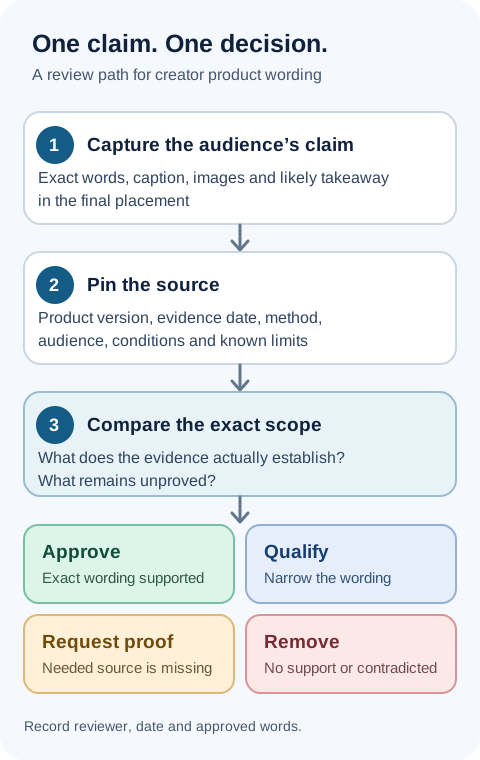
An original decision path. Use the downloadable register for the exact source, reviewer and approved words.
Original visual by Superdirector editorial team. Creation date not recorded.
Walk through a fictional unsupported number
Fictional example — no customer or product test occurred. HarborDesk is an imaginary scheduling app, and a proposed creator line says, “HarborDesk cuts shift-planning time by 80%.” The fictional brand offers only a screen recording of one manager assigning one shift. That recording could show the task being performed in the depicted build, but it says nothing about the time spent before and after, how anything was measured, other users or typical outcomes. That source does not support the 80% result, so the reviewer removes the number.
If someone verifies the recording and the relevant build, the team could consider a narrower line such as, “In this demonstration, a manager assigns a shift in HarborDesk.” Even that line must match the actual footage, and it must not be edited to imply a general time saving. A creator’s personal experience also must remain their honest experience; it cannot be supplied as a script for an experience they did not have. 16 CFR § 255.1(a)
Record to produce: rejected numeric wording, the source’s limited observation, and any separately checked replacement wording.
Check one of our own narrow claims
We checked Superdirector’s public UGC content brief guide on October 28, 2026. Its brand guardrails step asks teams to identify claims they cannot support. The live page supports the narrow statement “our guide asks readers to list unsupported claims among the must-avoids.” It does not prove that Superdirector software verifies product claims, that a creator followed the guide, or that a campaign improved. The editorial source record for this article captured the page and its production revision.
A brand should apply the same evidence discipline to a creator’s script. State exactly what was observed; leave a stronger product or outcome claim out unless its own evidence exists. The UGC brief guide shows where the approved wording belongs after this claim review.
Record to produce: a source-bound statement about our published guide, with the stronger unsupported claims explicitly excluded.
Check the final cut and the live post
Before posting, compare the final audio, captions, graphics, thumbnail and landing page against the approved wording, and keep the claim register with the source version, reviewer, decision date and final file or post URL. If the creator changes the line, review that version. Once the post is live, check it and record a correction link if a misleading claim appears.
Claim support and a material-connection disclosure are separate checks, and a substantiated product sentence does not excuse a missing paid-relationship disclosure. The FTC’s Disclosures 101 guide explains that creator disclosures should be clear and hard to miss. The advertiser’s duty to guide and monitor endorsers is in 16 CFR § 255.1(d)
Use the blank row in the downloadable register for your next proposed line. The two filled rows are an observed Superdirector guide statement and the clearly fictional HarborDesk case; neither is a real creator campaign outcome.
Record to produce: the final approved bytes or link, live-post check, and any dated correction.