How-To Guide
What an agency should verify when a manager negotiates for a creator account
Record who wrote, find the account’s own contact path, ask the manager what they may agree, and confirm each term with the creator before you agree it.
By the Superdirector editorial team. FTC and platform pages reviewed October 30, 2026.
At a glance
What should an agency verify when a manager negotiates for a creator account?
Verify two separate things before you agree any term: whether the person writing may agree that term for the creator, and which account will carry the work and who controls it. Record how the manager reached you, read the creator’s own account for a contact path it shows, ask the manager to state in writing which terms they may agree, and confirm those terms with the creator through a route the manager did not supply. Label each term confirmed, stated or unknown, and agree only what is confirmed.
- Quote what the manager says they are; do not upgrade it to a fact.
- Confirm with the creator through a route you found yourself.
- Ask separately who agrees, who holds the login and who is paid.
Direct answer
Short answer: answer two questions in two separate columns before you agree anything with a manager. Who can agree? Record who wrote to you, ask them to state in writing which terms they may agree for the creator, and confirm those terms with the creator through a route the manager did not supply. Who owns the destination? Name the exact creator account, read it on a dated visit, and ask who holds the login and who will post. Then label every term confirmed, stated or unknown, and agree only the confirmed ones.
This is for an agency or brand sourcer who has found a creator, received a reply from someone who says they manage the creator, and is about to talk price, scope or dates. Managers are an ordinary and useful part of creator work, and nothing here treats one as a problem. The decision is narrow: how far to rely on a manager’s word for each term, and what evidence moves a term from stated to confirmed. It does not say whether any manager is genuine, and it does not decide the commercial terms themselves.
The reason to keep the two questions apart is that they fail separately. A manager can fully speak for a creator on price and still not be the person who logs in to the account that posts. A creator can own the account and have handed price talks to someone else for this one deal. Use the blank authority card, the CSV register and the authority map to keep each term’s status in one place.
Record who wrote to you and how they found you
Start with your own outreach record, because it is the one piece of evidence you hold that nobody else wrote. Save the first message in the thread, with the date, time and time zone. Note whether you reached out or they did, which address you wrote to, and which address replied. If you wrote to an address you found on the creator’s own account and a different person answered, that is a useful fact: it suggests the message was passed on, but it does not say who by or on whose instruction.
Then copy, exactly as written, three things the sender says: their name and sending address, the role they claim (manager, agent, assistant, producer or something else), and the sentence that says who they act for. Quote the words rather than summarizing them. “I manage Creator Q” and “I help Creator Q with brand deals” may both be true, but they are not the same statement, and you will want the exact one when you later decide how far to rely on it.
Record also what the sender has not said. Did they name the creator’s account, or only the creator’s name? Did they say whether the creator has seen your request? Did they say which terms they handle? Blanks are information. Leave them blank on the card and fill them only from something written. For the question of which agency work belongs to whom in a deal that already exists, see separating agency service work from creator deliverables; here the deal has not been agreed yet.
Check the account’s own public contact path
Now open the creator’s account yourself. Write down the exact profile address and platform, the handle as you read it and the date and time of your visit. The point is to evidence the destination from the account, not from the manager’s message. If the manager sent you a link, open it, but also reach the account from a route you found independently, such as a link from the creator’s other public pages, and note whether both lead to the same account.
Look for a contact route the account itself shows publicly, and record it as seen, not seen or not checked. YouTube is one documented example. Its Help page on business inquiry emails says viewers open the channel’s About section and select “View email address”, and that you can only view an address if the channel owner has provided one. YouTube Help: Business Inquiry Emails. So a visible address on a YouTube channel is a contact path the channel owner chose to show, and a missing one tells you only that none is shown there. It does not tell you the creator has no manager, and it does not tell you whether a manager’s address and the public address are connected.
We did not read a loading Help Center page for Instagram or TikTok on how a creator shows contact details on a profile while preparing this article, so we make no statement about what those platforms display or allow. Look at the profile yourself, record what is there on the day, and check the platform’s current help page if the contact route matters to your decision.
A public route is not proof of authority on its own. What it gives you is a way to ask the creator a short question without relying on the manager to pass it on. If the account shows a route and the manager’s address differs, that difference is normal and not a finding. Write both down. If the account shows no route at all, note that too, and ask the manager how they would like confirmation handled. The existing account proof guide covers the later step of matching a published post to an account; this step happens before any post exists.
Walk through a fictional manager reply
Fictional exercise: no real brand, creator, manager, campaign or result was inspected. A made-up agency, Agency A, writes to the address shown on Creator Q’s public channel. A person at a made-up company, Studio Z, replies from a different address and writes, “I manage Creator Q and handle all brand deals.” The agency saves the first message, both addresses and the quoted sentence, and marks the role as stated.
Agency A opens Creator Q’s channel on its own and records the address and the date. The channel shows a business address, and it is not Studio Z’s. The agency notes both addresses side by side without drawing a conclusion. It asks the manager which of five listed terms they may agree. The manager answers that price, scope and dates are theirs to agree and that rights and exclusivity need Creator Q’s sign-off.
Agency A sends Creator Q one short message at the address on the channel, naming Studio Z and the three terms. Suppose Creator Q replies, “Yes, Studio Z handles price and dates for this one.” The agency pastes the reply as written, marks price, scope and dates confirmed, marks rights and exclusivity stated: creator’s sign-off needed, and marks the login and payee unknown because nobody has answered. It agrees the three confirmed terms and leaves the rest open. The scenario predicts nothing about any real creator or manager.
Separate who can agree from who owns the account
Give every term one of three labels. Confirmed means the creator told you so through a route you found. Stated means the manager said so and nothing else supports it yet. Unknown means nobody has said. Put the label beside the quote so a colleague reading the card next month can see why you relied on a term. Do not average the labels or round “stated” up to “confirmed” because the manager has been reliable so far.
Then handle the destination as its own column. Ask who holds the login to the account that will post, whether anyone else posts for it, and who is named to receive payment. These can be three different answers. Platform roles are one place where they differ. YouTube’s Help page on channel permissions lists roles that can act in YouTube Studio. It says the Owner role can manage permissions and cannot transfer ownership to other users, the Manager role can manage permissions, and the Editor role can upload and publish content but cannot manage permissions or enter into contracts. YouTube Help: Channel permissions. Read that as evidence that access to an account and the power to bind its owner are different things on at least that platform. It does not say what a Manager role may agree commercially, and we are not claiming that it does.
The same caution runs the other way. Someone who can post to an account may have no say in the deal, and someone who can agree the deal may have no login. If the work will be posted by a person other than the creator, record who, and record that you asked. When the account sits with an agency that is leaving, or the creator’s own team, the YouTube agency offboarding guide shows how to prove who controls a channel; that guide concerns a client channel, so use it as a pattern and not as a rule for creator accounts.
Keep the legal and regulatory frame in view, and no further. The FTC’s Endorsement Guides questions page says delegating part of a promotional program to an outside company does not relieve a company of responsibility under the FTC Act, and that a company is ultimately responsible for what others do on its behalf. FTC Endorsement Guides: What People Are Asking. The Guides’ own text, 16 CFR 255.1, says an advertiser may be liable for a deceptive endorsement even when the endorser is not, and that advertising agencies and similar intermediaries may be liable for their roles in creating or disseminating endorsements containing representations they know or should know are deceptive, or that fail to disclose unexpected material connections. Cornell LII: 16 CFR 255.1. That is a reason to know who is actually posting and under whose direction. It is not a statement about what your agreement with a manager should say, which is for counsel.
When enlarged, scroll horizontally to read the diagram.
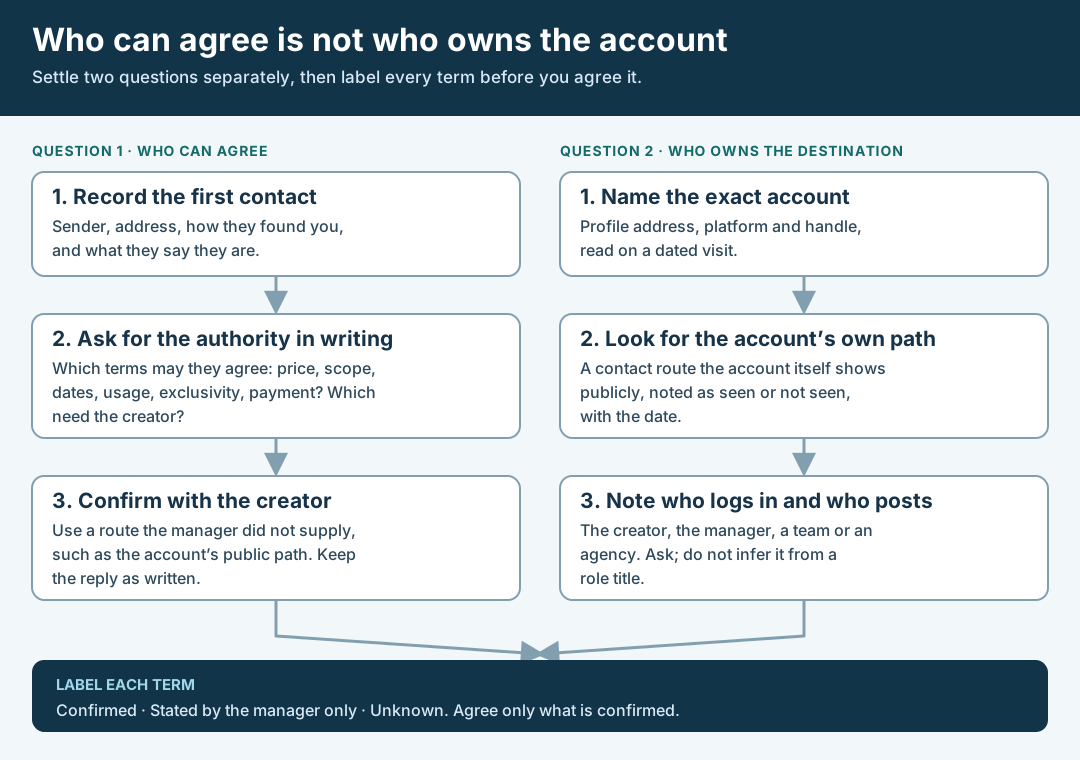
An original editorial map. Who can agree and who owns the account are settled separately.
Original visual by Superdirector editorial team. Creation date not recorded.
Close with a confirmed record or an open question
Close the card with one decision per term: agree it because it is confirmed, hold it because it is stated or unknown, or escalate it to the deal owner. Write the name of the person who decided and the date. If a term is held, write the open question that would release it, for example “creator to confirm payee” or “creator to confirm who posts”, and who will ask it. A hold with a named question is a plan. A hold with no question tends to become an assumption.
Set a next-check date for anything still stated or unknown, and for every term you did agree. Arrangements between creators and managers can change, and a confirmation given for this campaign is not a standing instruction for the next. When you return to the same creator later, start a new card or add a dated section instead of reusing the old status. The file also helps if a different colleague takes over the thread.
Keep the whole record together: the first message and both addresses, the dated account visit, the manager’s written answer, the creator’s reply as written, the label for each term, the decision and the next-check date. This page does not state how long to keep it, because the sources we read did not give a period. Set that from your agreement, your records policy and counsel.
What this page does not decide
This method decides how far to rely on whose word, for which term. It does not tell you whether a manager is genuine, whether a contract is valid, whether a manager may bind a creator under the law that applies, or what to put in your agreement. Those are questions for counsel. It also does not say that a creator must be contacted directly in every case; it says that at least one confirmation should arrive by a route you did not receive from the person whose authority you are testing.
Other pages sit next to this one and cover different decisions. The account proof guide matches a published post to the account in an agreement, which happens after posting. The YouTube agency offboarding guide proves a client’s control of a channel before an agency’s access is removed. The sponsor categories guide checks a creator’s recent sponsors against a competitor rule. The usage rights record captures rights by channel, term and territory once someone has agreed them. This page covers the earlier step: before any of those, who may agree, and who controls the account.
Nothing here measures how often managers act without authority, how often creators confirm, or how any approach affects deal outcomes. Those numbers are not available to us and are not claimed. We also did not verify what Instagram or TikTok show for contact details, so this article states nothing about them. The page is an editorial method for keeping a manager’s statement, a creator’s confirmation and an account observation apart, so each decision rests on its own evidence.