How-To Guide
How to turn a vague creator request into one client decision
Turn “we need more creator content” into one client-reviewable choice with a goal-to-decision worksheet, evidence, alternatives, and a review trigger.
By the Superdirector editorial team. Research checked October 28, 2026.
At a glance
How can an agency turn a vague creator campaign request into one decision the client can inspect?
Keep the request as written, name the buyer task and desired result, compare two feasible options, and propose one along with its evidence and limits. Before briefing a creator, ask the client to accept, amend or reject that versioned choice.
- Keep the client’s exact words and the alternative you deferred.
- Mark product behavior and how outcomes get collected as unverified until their owners check them.
- Record who owns the choice, the date, the client's response and what would make you reconsider.
“We need more creator videos next month” gives an agency a quantity, but no reason to choose one creator or story over another. Before building a shortlist, turn that request into one decision the client can accept, amend, or reject. The goal-to-decision worksheet below keeps the client's words, names the buyer task, compares two options, and records what is known; it is a way to agree on a direction before a creative brief, not a forecast of what a campaign will achieve.
Download the blank goal-to-decision worksheet or use its CSV version. The completed example in both files is explicitly fictional.
A content request is an output, not a campaign decision
An output request says what to make: “12 videos,” “five creators,” or “more posts.” A business objective says what the organization hopes will change. Between them is a choice the client must make now: which buyer task should the first creator work help explain, and what alternative are we setting aside?
AMEC's Integrated Evaluation Framework separates communication outputs from audience responses, outcomes, and organizational impact, and that distinction matters here. Publishing a video proves you delivered an output. It does not prove that a buyer understood a product, requested a demo, or purchased anything. AMEC's planning worksheet also starts with the organizational purpose and the human problem before choosing communication activity. The worksheet on this page applies that logic to a narrower agency handoff; it is an original decision record, not a copy of AMEC's template.
| If the client says… | Record it as… | Do not silently turn it into… |
|---|---|---|
| “We need 12 creator videos.” | Requested output and timing | Evidence that 12 videos are the right plan |
| “We want more qualified demos.” | Desired business result | A measured outcome or guaranteed target |
| “Start with a creator who can explain the manager's shift-coverage task.” | Proposed campaign decision | An approved creator brief before the client responds |
| “Count demo-request submissions from the campaign destination.” | Candidate observable signal | A working measurement system before the destination is checked |
The third row holds the decision. The other rows inform it but cannot make it for the client.
Ask three questions before suggesting a creator
What buyer task is the content supposed to help with? Ask what a potential customer must understand or do next, in ordinary language. “Improve awareness” is too broad to choose between a product demo and a testimonial. “Help a café manager see how to review an uncovered shift” can change the kind of creator work you look for. Confirm that the product can actually do the task as described before you brief anyone to show it.
Which organizational result does that task support? The client may want qualified demo conversations, trial starts, or something else. Write that down as a desired result, with an owner. Do not swap it for reach, likes, or video count just because those are easier to collect. If you have no credible way to observe the result yet, mark that gap. A later plan for measuring it can decide what is feasible; this handoff decides what work to pursue.
What choice must the client make now? Give two plausible options and recommend one. For example, explaining the product workflow may be more useful than a generic endorsement if the buyer first needs to understand a specific task. Back the recommendation with a reason tied to the client request and the available evidence. “Try both” dodges the decision and leaves a future brief to guess.
A concise decision statement is:
For [buyer and task], approve [one creator-content direction] before [alternative], because [dated evidence] supports the choice. Reconsider if [specific new evidence] changes it.
If the evidence slot is empty, the statement is a proposal awaiting discovery, not an approved campaign goal.
Put the uncertainty beside the proposal
The smallest useful record has four parts: the exact request, the choice, the evidence you have now, and what would reverse the choice. Give the source and date for each product or audience fact, and keep a client's stated priority apart from verified product behavior. You cannot describe a feature demo that works only in an internal build as a public customer outcome.
Do not manufacture a numeric target to make the decision look complete. A candidate signal such as a demo-request submission is worth recording, but mark whether anyone has actually checked its link, form, attribution, and qualification rule. A click is not a qualified lead by definition, and a set of views is not proof of a sale. The worksheet has separate fields for candidate signal and evidence status, so the next planning step can resolve that uncertainty.
The worksheet also records the alternatives. “Broad testimonials are deferred because the client's immediate buyer question is how the workflow looks” is a reason anyone can inspect; “Broad testimonials are bad” is an unsupported generalization. If new buyer evidence points elsewhere, the client can revisit the choice without rewriting the original request.
Worked example: one fictional request, one amended decision
Everything in this example is fiction, written for teaching. It is not a Superdirector client, an actual product test, a creator result, or a performance claim.
A fictional software client writes, “Can we get 12 creator videos next month?” Its invented intake note, F-INTAKE-01 dated 2026-10-27, names more qualified demo conversations with café operations managers as the desired result and describes a manager reviewing an uncovered shift. The note also says the software “automatically detects” gaps, but nobody has verified that wording, and nobody has viewed the product walkthrough it offers. The agency's unapproved v1 proposal repeats the automatic-detection claim. The client's later correction changes the proposed brief to the manager-review task. The requested count and schedule stay in the record, but not as an approved plan.
| Decision-record field | Fictional entry |
|---|---|
| Request, unchanged | “Can we get 12 creator videos next month?” |
| Buyer task and desired result | Café manager reviews an uncovered shift; client hopes for qualified demo conversations. Neither is a measured campaign outcome. |
| Initial proposal, v1, not approved | Show the software “automatically detecting” an uncovered shift and alerting a manager; defer generic endorsements. This repeats an unverified claim from the intake note. |
| Evidence now | Fictional client intake note F-INTAKE-01, dated 2026-10-27: buyer task and qualified-demo goal; unverified automation wording and an offered walkthrough. The walkthrough has not been viewed. |
| Missing evidence | Offered walkthrough, product-owner confirmation of the releasable screen and permitted wording, and destination and demo-request measurement checks. |
| Client disposition | Fictional reply F-REPLY-02, dated 2026-10-28: Amend — remove the automatic-detection claim and describe a manager reviewing an uncovered shift. This is a correction, not acceptance of v2. |
| Revised proposal, v2, pending | Prioritize a creator explanation of the manager-review task for the first brief; show a product screen only after the product owner verifies the current build. Defer generic endorsements. Return v2 for the client to accept. |
| Reconsideration trigger | The workflow is unavailable in the releasable product, or buyer research identifies a different first task. |
The useful outcome of this exchange is not “12 videos approved.” It is a visible v1-to-v2 change: the proposal drops the unverified automation demonstration and puts a manager-review explanation in its place. Before instructing a creator to film it, the agency must check the product and return v2 for the client to accept.
Ask the client to accept, amend, or reject the record
Send a short decision note, not a long questionnaire. Put the proposed choice, the alternative, and the unresolved facts on one screen. Here is a fictional example of that note:
Decision proposed: Explain the manager-review task to café operations managers if the current product build supports it; defer broad endorsements. Why: In this example, that is the buyer task you identified. Still to verify: The releasable product screen, allowed wording, and the demo-request path. Please reply: Accept this direction, amend the task or wording, or reject it and name the higher-priority buyer question.
Write the client's response, owner, date, and version into the record. “Amend” means update the decision and return it for the client to accept; it does not turn the earlier proposal into approval. If the client does not respond, keep the decision pending. The worksheet includes a reconsideration trigger, so an accepted direction can change for a stated reason and not drift unnoticed.
When enlarged, scroll horizontally to read the diagram.
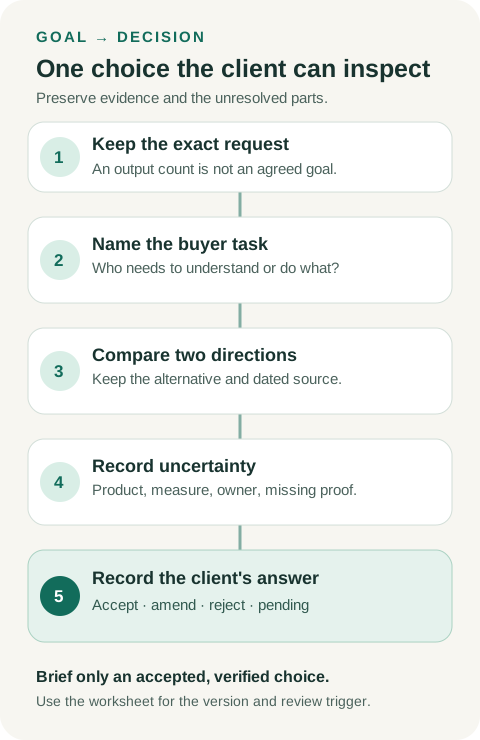
An original sequence for one client-inspectable decision. The worksheet holds the source, alternative, response and review trigger.
Original visual by Superdirector editorial team. Creation date not recorded.
Carry the accepted decision into the next work
An account-wide client onboarding process captures broader context, access, reporting and approval rules. This one-page record settles one campaign choice that an ambiguous request left open. Once the client accepts it and someone has verified the product claim, use it to decide which creator experience matters and what evidence a shortlist must show. Then carry the same buyer task and allowed wording into a UGC content brief, which covers creative direction, specifications and rights.
Plan measurement next. Keep the desired business result separate from a candidate signal until someone has checked the destination and event. Report only what the tracking actually observes, and leave the business impact unknown until you have evidence for it.
The immediate deliverable is modest but valuable: one dated, client-owned decision that can change the shortlist and survive the handoff into a brief. Use the blank worksheet to make that decision visible before you commission creator work. If you are evaluating tools for the next step, see how Superdirector currently works before you assign the approved task.