How-To Guide
Verify an Instagram Collab before counting creator delivery
Check whether an Instagram Collab invite became an accepted coauthored post and whether its publisher matches the creator campaign’s agreed delivery.
By the Superdirector editorial team. Meta’s primary Collabs and creator-marketplace guidance reviewed October 29, 2026.
At a glance
Does sending an Instagram Collab invite count as a delivered coauthored post?
No. Meta says an invited account becomes a coauthor after it accepts, and the post can then appear on each account’s profile. First compare the originating account and coauthor role the agreement requires with the exact live post. Then check, through the invited account and the observed post relationship, that the invite was accepted. Record a live source post with only a sent invite as acceptance unverified; do not count it as the agreed Collab unit until the evidence supports both the role match and the acceptance.
- Freeze the contract’s publisher and coauthor roles before viewing the post.
- Treat the invite, its acceptance, the live post and the origin as separate facts.
- Record one exact post identity and one supported delivery status; keep metrics separate.
Direct answer
Short answer: an Instagram Collab invitation is a request, not a completed coauthored post. Meta says invited accounts become coauthors once they accept; the content can then appear on each collaborator’s profile. To count a campaign deliverable, first read the publisher and coauthor roles the agreement requires. Then inspect the exact live post, its visible account relationship, and either the invited account’s acceptance or an authorized account-side record. Record a published post with a pending invite as source post live, Collab unverified. If the deal required the creator to originate the post, a brand-origin post on the creator’s grid does not by itself prove the creator kept that promise. Meta’s Collabs description.
This is a delivery-verification method for a brand or agency after the planned Instagram Reel, feed post, or carousel is published. It decides whether the agreed Collab unit exists, not how many people saw it. The account-to-post proof guide checks the contracted account across platforms; this page follows the additional Instagram-specific part: the invite, whether it was accepted, and the coauthor relationship. The client reporting guide can use the resulting receipt without counting one coauthored post twice.
Use the blank Collab delivery card, CSV status register, and original two-party state map. They are teaching and recording assets only; no account is connected and no live campaign is represented.
Define exactly what the agreement bought
Before opening Instagram, read the accepted brief or agreement. Does it require a creator-origin post, a brand-origin post coauthored by the creator, or either route if both accounts accept? Name the contracted creator account, brand account, format, content version, due time and any agreed visibility window. Do not assume “creator posts with us” always means the same platform relationship. If the agreement is silent on origin, record that the agreement does not say where the post must originate and ask the deal owner to settle it from the actual written promise; an agency should not quietly pick the easier reading once the post is live.
Keep the planned post count distinct from the number of profile grids that may display it. Meta describes an accepted Collab as coauthoring a feed post, carousel or Reel, with the content appearing on each collaborator’s profile. For this worksheet, record the exact post URL once even when it appears on more than one profile; the contract decides whether that post satisfies one promised unit. It does not create two promised posts merely because two profile pages show it. Meta’s Collabs announcement.
The minimum contract anchor is: exact party/profile URLs, agreed origin and coauthor roles, content reference, format, due time, any disclosure instruction, and who is authorized to confirm a changed deliverable. Save a stable account identifier if your authorized workflow already has one; a display name alone is weak because it can change or be copied. Private agreement terms and account evidence belong in the owned campaign record, not in a public template.
Freeze the one live post you are judging
When a creator or brand sends a link, open the actual Instagram post or Reel. Record its URL or shortcode, the account profile reached from its header, the media and caption version, a checked-at time with time zone, and the viewer context. If the post is private or unavailable to the reviewer, record that limit; do not turn a screenshot into a public-delivery claim. If the post has been replaced or reposted, leave the old row untouched and record the new post in its own row; do not edit history.
Check how the post currently shows its author and coauthor, and look at the relevant profiles, but keep what you see separate from any conclusion about origin. Meta says an accepted Collab can appear on each coauthor’s profile grid. Thus a post that shows up on the creator grid is consistent with a creator-origin post *or* a post that another account initiated and the creator accepted. The general account-proof guide gives the broader account identity method. If the agreement specifically requires creator origin and the public view cannot establish it, request a permitted account-side record from the channel owner showing how the post was published and leave origin unresolved until then.
Do not use the upload date printed in a screenshot as a precise receipt for when the post first went live. A dated reviewer observation proves what was reachable under that viewer context at that time. If meeting the deadline depends on the exact posting time, use an authorized source that actually records the event; otherwise say “reachable by [time]” and do not invent the publish minute.
Walk through a fictional delivery mismatch
Fictional exercise — no real creator, account, post or campaign was inspected. An accepted brief says Creator B will originate one Reel and invite Brand A as a collaborator. The brand team instead publishes the approved file on Brand A’s account and invites Creator B. Creator B accepts, and a reviewer sees both names on the post. That is evidence of a coauthored post in the fictional scenario, but it does not satisfy the brief’s creator-origin wording. The reviewer records the live post and coauthor relationship, then marks the creator-origin requirement as unresolved or mismatched, depending on what the source record shows. The deal owner decides any authorized change to the promise; the reporting row does not silently convert it.
In a second fictional branch, Creator B originates the agreed Reel, Brand A accepts the invite, and the campaign has an authorized creator-side record showing that Creator B published the exact post. A reviewer also sees the same post with both accounts in the live relationship. Under the scenario’s stated evidence, the Collab delivery can be recorded as verified for the agreed unit. This does not prove the content’s claims, its disclosure, whether it stays visible later, or how it performs; those checks keep their own sources and dates.
The two-party state map shows why the acceptance and origin questions cannot be compressed into “seen on both grids.” It is a fictional teaching diagram, not a screenshot of Instagram or a campaign receipt.
When enlarged, scroll horizontally to read the diagram.
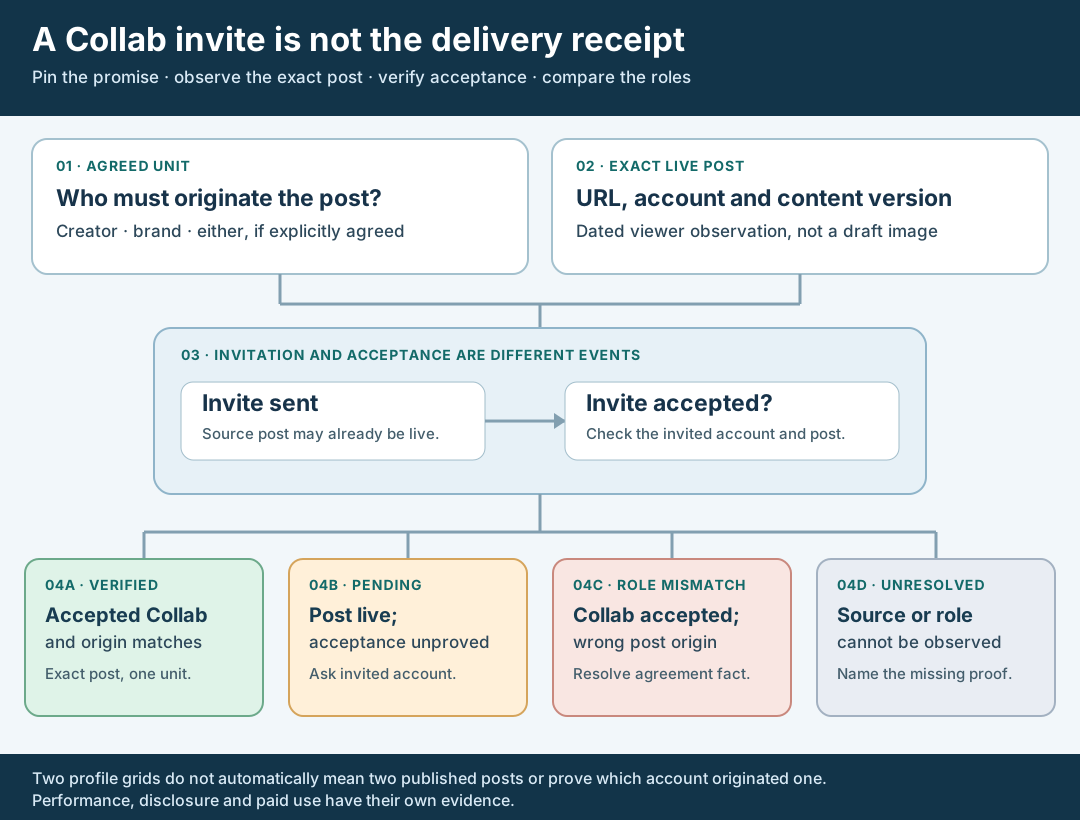
An original state map for a single Collab publication. Both profile grids are observations of the same post unless a separate post is proved.
Original visual by Superdirector editorial team. Creation date not recorded.
Write one truthful publication receipt
Save a record with four linked parts: promise (contracted accounts, origin rule, format and due time), post (exact URL/shortcode, version and observed viewer context), Collab (invite and acceptance evidence, and the observed coauthor relationship), and decision (verified, live-but-pending, role mismatch or unresolved, with owner and checked-at time). If a collaborator later leaves or the post changes, add a new dated entry and leave the earlier one as it was. The blank Collab delivery card and CSV register give each evidence layer its own field.
A client-facing sentence should name only what the evidence establishes: “At [review time and viewer context], the exact post [URL] displayed [account relationship]. [Invited account] acceptance was [source/unknown]. Against the agreement’s [origin rule], this unit is [verified/pending/mismatch/unresolved].” Leave future reach, ad delivery, claim accuracy and ongoing visibility to their separate records. A grid screenshot alone does not carry all four parts.