How-To Guide
How to file creator content so a later reuse request is checked against the rights granted for that exact file
Give each creator file an ID, a fingerprint, its quoted grant and a parent link, then mark every later reuse request covered, not covered or ask.
How should an agency file creator content so future reuse respects the rights granted for each asset?
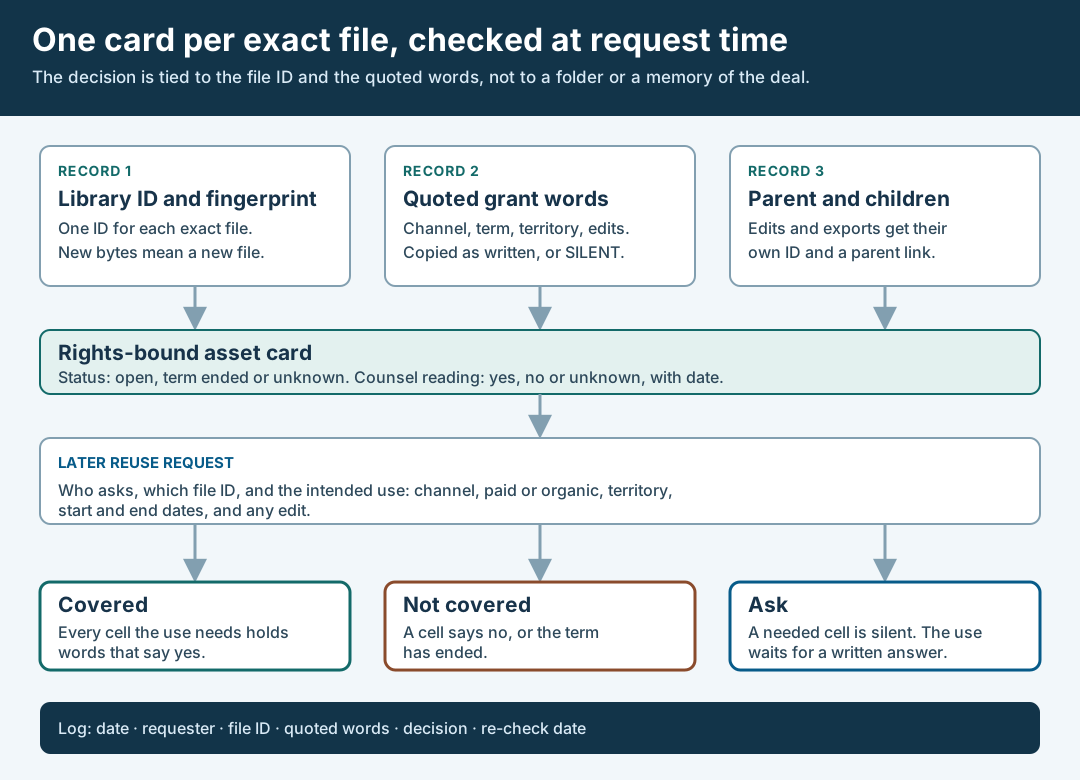
File each exact file as its own record with a library ID, a fingerprint of its bytes, the grant words quoted from the signed agreement (or SILENT), and a link to any parent file. When someone later asks to reuse it, write the request as a specific use and compare it with that file’s card: covered, not covered or ask. Edits and re-exports are new files that carry their parents’ limits. Log each decision against the file ID and the quoted words, and set a date to look at the card again.
- One card per exact file, found by ID and fingerprint, not by name or folder.
- Quote the grant; write SILENT where the words say nothing.
- Decide each request as covered, not covered or ask, and log it.
Direct answer
Short answer: file every creator file as one library record per exact file, and make that record carry five things. A library ID your library assigns. A fingerprint of the file’s bytes. The grant, quoted from the signed agreement, or the word SILENT where the words say nothing. A parent link if the file was made from another file. A reuse log that grows each time someone asks to use it again. When a request arrives, decide it against that file’s own record, never against a folder name, a campaign name or someone’s memory of the deal, and mark it covered, not covered or ask.
This is for an agency whose library of creator content keeps growing, where the person asking to reuse a file was not on the deal. The decision is narrow: may this exact file be used for this exact use, on the words we hold? It does not decide whether a use is lawful, how to read an ambiguous clause or what to pay for more rights.
A library blurs rights in predictable ways: a file is renamed and nobody can say which delivery it was, a cutdown sits beside the original and looks the same, a folder is named for the creator so everything inside seems to share one permission. A record ties the decision to the file itself. The blank asset card, the CSV register and the card map hold the fields.
An original editorial map. A reuse request is decided against one file’s card, not against a folder.
Open the blank asset card (HTML)Download the blank asset register (CSV)
 Superdirector
Make it work for your brand
Find it. Remake it. Post it. Superdirector turns the viral formats in your niche into your brand's carousels, X posts and video scripts, and keeps the calendar full.
Give every file one library ID and a fingerprint
Start with identity. Assign each delivered file a library ID your team issues, such as L-0001, and write it on the card. Do not use the creator’s file name or your folder path as the identifier: names change when people rename, re-download or export, so a name cannot tell you which delivery a file came from.
Next record a fingerprint: a hash of the file’s bytes, with the algorithm written beside the value. The approved cut receipt guide and the handoff manifest guide use SHA-256 for the same reason. On a Mac, shasum -a 256 <file> prints it; on Linux, sha256sum <file> does. Add the size in bytes, the date received and who delivered it.
The fingerprint answers what a name cannot: is this the file the card describes? A file whose hash matches no card is unfiled. Treat unfiled as unknown, not as “probably L-0001.” Two exports of one edit are two files with two fingerprints, and each needs its own card.
If you hold no bytes, only a link or a post you can view, give it an ID and a card anyway, mark the fingerprint no bytes held and note the date you viewed it. Every reuse request for it is an ask, because you cannot show which version the words were meant to cover.
Attach the grant to the file, not to the folder
Give each file a card that quotes the grant that applies to it. One folder can hold files with different coverage, such as a final video the agreement names and a still it never mentions, so the card belongs to the file. The rights matrix guide shows how to read a clause into cells at signing; this card stores those cells next to the file for whoever asks later.
| Card field | What goes in | If it is not known |
|---|---|---|
| Agreement | Agreement name, date and the clause numbers you relied on | Write “no clause names this file” and leave the grant cells SILENT |
| Channel | The accounts, platforms or placements the clause names, in its words, and whether it names paid use | List what is not named; do not extend the named ones to the rest |
| Term | Start trigger, end trigger and the dates your records give | A length with no trigger is a length with no calendar; say so |
| Territory and edits | The places and the changes the clause names, each in its words | SILENT. Do not write “worldwide” or “minor edits” on the clause’s behalf |
| Third-party material | People on camera, music, other brands’ products or screens you noticed in this file | “Not checked” is a valid entry; “none” is a claim you must be able to support |
| Platform permission | Where a platform authorization exists, its record and its own end date | Leave empty if none; never let it stand in for the agreement |
| Counsel reading | Whether counsel reviewed this reading, who, and when | Write “unknown”, not “reviewed” |
One paragraph of an agreement may genuinely cover several files. That is fine if each file’s card points to it by clause number; a file the paragraph does not name gets its own card that says so. Preservation-metadata practice offers a precedent for this shape. PREMIS is a preservation-metadata standard maintained at the Library of Congress. Its version 3.0 dictionary defines a rights statement as an assertion of rights or permissions pertaining to an object, lets a repository link from statement to object or object to statement, and says a statement should be repeated when different acts have different bases. We use it only as a model for the data shape.
Embedded metadata is not a substitute. The IPTC Photo Metadata Standard defines Rights Usage Terms as the image’s licensing parameters in free text, one value at most, and notes that other IPTC Extension rights properties can be used alongside it for more controlled terms. One free-text line cannot hold four quoted cells, a parent link and a log. We did not test which tools keep embedded fields, so any line you write into a file should point to the card, never replace it.
Keep the counsel line honest. This page does not say counsel must review every card; it says to record whether anyone has. If counsel read the clause, write who and when. If not, write “unknown” or “no.”
Check a reuse request against the exact file
A reuse request is useful only when specific. Ask for the file ID, channel, paid or organic, territory, start and end dates and any planned edit, plus name, team and date. “Can we use the Creator Q video again?” cannot be checked. “Run L-0001 as a paid ad on the brand’s own accounts, in these places, between these dates, trimmed to fifteen seconds” can.
Compare the request with the card cell by cell and use three marks. Covered: every cell the use needs holds quoted words that say yes. Not covered: a cell holds words that say no, or the term has ended. Ask: at least one needed cell is SILENT or can honestly be read two ways. Add no fourth mark such as “probably fine.” The rights matrix guide uses the same three marks.
What does not count as coverage matters as much. The requester’s seniority, the campaign the file came from, the creator’s friendly relationship with the brand, a folder named for the deal and the creator’s post still being public are not grants. The statute gives the copyright owner, subject to sections 107 through 122, the exclusive right “to do and to authorize” the acts it lists, including reproducing the work and preparing derivative works (17 U.S.C. § 106), and the Copyright Office’s What is copyright? page says owners can authorize others. Authorization is something you hold in words, and the card is where they live.
For each ask, send the creator one question answerable in a sentence: the file ID, the planned use and the one missing cell. The use waits. When the answer comes, record whether it is a signed change to the agreement or only a message; the card’s quoted words change only for the first. Where a cell turns on how a clause is read, write “counsel review” and the date.
Two checks sit outside the grant cells. For a paid placement through a platform, record that permission and its end date in its own field; the TikTok Spark authorization guide explains why that clock can differ from the agreement’s. For a file with music, the music reuse guide explains why the recheck belongs to the specific file. When the term end date passes, set the card to term ended so later requests read not covered.
Treat edits and exports as new files with parents
A cutdown, a crop, a caption burn-in, a re-export and a re-edit from raw clips are all new files. Give each its own library ID, fingerprint and card, and write the parent ID on it. Otherwise a vertical crop saved beside the original inherits the original’s name in everyone’s head, and the library answers a question about the crop with the original’s words.
Section 106 lists the right to prepare derivative works among the owner’s exclusive rights, and section 101 defines a derivative work as one based on a preexisting work, including any form in which a work may be recast, transformed or adapted. Whether your crop is a derivative work in law is for counsel. The library keeps the question visible: the child’s card quotes the edits cell from the parent’s grant, and if it is SILENT, any use of the child is an ask naming both IDs.
Record who made the child and how you know its parent. A file built from three raw clips and a stock track has three parents and new third-party material none of their cards mention. For a file with several parents, every parent’s card must cover the use: the most restrictive cell governs, and if any parent reads ask, the child reads ask. Add new third-party material to the child’s card, because the creator’s grant cannot be assumed to reach music or footage a later editor added.
File the raw clips with their own cards. Whether raw footage was a separate deliverable is covered in the raw footage guide. If the agreement says raw clips were delivered “for the archive” and nothing more, their card says exactly that, and a plan to re-cut them is an ask. The crop review guide covers the visual check.
Log the decision and re-check on a date
Every decision gets a log entry on the file’s card: request ID, who asked and when, the use as written, the mark, the cell that decided it with its quoted words, any question and written answer, and the decision with who made it. Tie it to the library ID, fingerprint and card version you read, so after a signed amendment you can see which version a past decision used.
A covered mark is narrow. It covers the use, channel, territory and dates in that request and nothing else; a different channel on the same file is a new entry and a new comparison. Put the shortest clock on the entry: the agreement’s term end, a platform permission end or the planned end, whichever is first. The creator ad stop guide covers switching a live placement off; the library holds the date so someone is told to look.
Set a re-check date and owner on the card. Reasons to look again include a term end, a platform permission end, a signed amendment, a creator’s written change or a new request on the same file. If the agreement is silent on what happens at the end, write “no clause” and take the question to counsel.
When an answer expands what you may do, record exactly what changed and where it is written. The statute says a transfer of copyright ownership, other than by operation of law, is not valid unless an instrument of conveyance, or a note or memorandum of the transfer, is in writing and signed by the owner of the rights conveyed or the owner’s authorized agent (17 U.S.C. § 204); section 101 treats an exclusive license as a transfer and excludes a nonexclusive one. We make no claim about which category your arrangement is in. Keep the signed document, not a summary, and its reference on the card.
Walk through a fictional library
Fictional exercise: no real brand, creator, agreement or result was inspected. A made-up agency holds three made-up files from Creator Q: L-0001, the final vertical video; L-0002, one raw clip behind it; and L-0003, a square crop of L-0001 its editor made. The made-up agreement lets the brand post the video “on the brand’s own social accounts” and says nothing about territory, edits or the raw clips beyond “delivered for the archive.”
Request one. A teammate who was not on the deal asks to run L-0003 as a paid ad. Its card names L-0001 as parent and quotes the parent’s channel words. Paid placement is not named, and territory and edits are SILENT, so the mark is ask. The question names both IDs, the paid use and the missing cells. The ad waits.
Request two. Someone finds “final_v3” in a shared drive and asks to post it. Its hash matches no card, so it is unfiled. The log says “unfiled; no decision” until it is matched to a delivery or given a card.
Request three. The brand asks to re-cut L-0002 into a longer film. The card quotes “delivered for the archive,” the edits cell is SILENT and a note records an unchecked background track. The mark is ask, with “counsel review” because the open point is whether archiving and re-editing are the same permission. When the creator answers about L-0001 in writing, only L-0001 gets a new card version; L-0003 is re-read against it. The scenario predicts no real creator’s answer.
What this page does not decide
This page is about the library and the moment someone asks to use a file again. Four existing pages sit closest. The rights matrix guide reads one agreement into cells at signing; this page stores those cells beside an exact file with a fingerprint, lineage and request log, and decides later requests. The handoff manifest guide inspects files at delivery; this page starts once they are accepted. The ad stop guide manages end dates for live placements; this page decides whether a new placement may start. The approved cut receipt guide proves what the client approved; this page records what the creator allowed.
A filled card is evidence of what the words say and of what you decided on a date. It is not a statement that a use is lawful, that a platform will accept it or that the creator agrees with your reading. When a request ends in ask or counsel review, the use waits.
What the sources say and do not say
The statements above rest on a short list of sources, each with a limit. The Cornell pages for § 106, § 101 and § 204 support only the quoted statements. The Copyright Office page supports that owners can authorize others. PREMIS and IPTC support only what is said about their own fields, as design precedents. None says what any particular agreement means or whether a particular crop is a derivative work. We read no platform help page, so no claim is made about platforms. No figure on reuse frequency, grant length or rights cost is claimed.