How-To Guide
What are the best UGC platforms for brands to hire creators?
Compare human UGC procurement routes, creator selection, rights, prepaid balances and subscription commitments, with an eight-video funding example.
By the Superdirector editorial team. Vendor and reference captures from November 4, 2026, fully re-read November 5; the public Superdirector planning page was read November 5. No platform purchase, account or delivery test.
At a glance
What are the best UGC platforms for brands to hire creators?
For new human-made UGC files, investigate Billo when prepaid video pricing fits, Trend for creator credits with two-video or five-photo hires, Collabstr for named profile hires, or JoinBrands for content-only jobs. Insense adds a subscription around briefs, contracting and creator payments. Cohley offers a quoted platform or managed service; Aspire describes inbound applications without establishing the complete platform price. Choose the required deliverable and operating model before comparing advertised video prices.
- A delivered video file, permission to reuse an existing post and a post on a creator’s account buy different things. Archive’s retained page supports discovery, collection and usage workflows; it does not establish a priced new-video hiring route.
- Prepaid funding is not the same as this batch’s consumed cost. In the worked eight-video example, Billo’s $1,000 pack can leave a balance; Trend credits buy creator hires, not one video per credit.
- Superdirector is our product. Its public UGC page describes planning before procurement, not a hiring or payment marketplace. Vendor captures are November 4, 2026, re-read November 5; no account, purchase or campaign test was performed.
Choose the asset procurement route
Write the purchase as an output before opening a marketplace: who makes what, where it will appear, and what your team must receive. This guide compares procurement of human-created assets for a brand. It does not select an AI actor or promise that a creator’s personal audience will see a delivered file.
| What you need | What the order must buy | Where to investigate |
|---|---|---|
| New footage made to your brief | Human creator production and specified delivered files. Creator posting is a separate line if needed. | The commissioning routes below: video balance, creator credits, named hire, applicant brief or quoted service. |
| An existing customer/creator post you want to reuse | Locate the actual post and obtain the required reuse permission; discovery alone does not supply a license. | Archive describes capturing mentions, creator search and usage/whitelisting. Its retained home page does not establish a priced new-video commissioning flow. |
| Publication to a creator’s audience | An agreed account, post, timing and any content files or ad authorization you also require. | Some listed vendors sell this alongside assets. See the UGC versus influencer comparison and influencer platform comparison for that different selection. |
JoinBrands makes the distinction explicit: Content Only delivers an asset for your use, while Content + Posting also includes the creator publishing to their account and is described as a paid-plan feature. Its $5 AI video listing is another product; it is not the human creator price. Buying a finished file does not by itself buy audience distribution or a measurable sales result.
The comparison order follows procurement shape, then the work retained by your team. It is an editorial way to narrow a shortlist, not a vendor score. Eight retained third-party guides were read in full, including seller-written rankings that mix human production, AI tools and old prices. Their rankings, testimonials and performance assertions are not evidence that a vendor will fill your brief.
Shortlist for the work your team will own
| Route and vendor | How your request reaches creators | What your team still needs to establish |
|---|---|---|
| Prepaid video balance — Billo | Browse and prepare a brief free; a pack is required to publish that brief on Billo. The video cost draws from that balance. Its pricing includes creator fee, basic editing and platform/transaction fees. | A suitable creator and exact quote for your length, editing and add-ons. The $99 starting video is 15 seconds from a regular creator, not every specification. Packs need no marketplace subscription; optional CreativeOps/Managed subscriptions are separate. |
| Creator-credit package — Trend | Create a project, select applicants, ship the product and agree dates in platform messaging. A hire costs 20, 40 or 60 credits and initially delivers two videos or five photos; later assets also consume credits. | The creator tier and output specification. A credit is not one video. The retained page announces joining forces with soona; it does not establish a changed order, account transfer or future package availability. |
| Named direct hire — Collabstr | Free permits purchases from profiles, with escrow and a brand hiring fee. A posted campaign that creators apply to starts on Pro. | The particular package, deliverables and agreed rights. Free direct hiring cannot stand in for a paid applicant campaign merely because both return content. |
| Content-only jobs — JoinBrands | Its home describes campaign applicants or marketplace invitations. The pricing page separates Content Only from Content + Posting. Human UGC videos start from $25. | The actual creator/job price, revision allowance and posting requirement. Free access is not free production. Availability icons are not fully preserved in flattened source text, so confirm the plan-specific workflow. |
| Subscription briefs — Insense | Self-service briefs, contracting and payments use its creator marketplace; creator compensation and transaction fees remain extra. Trial allows one campaign and up to ten creators. | A demonstrated match to your brief, required ad access and actual plan. Screening and scouting are vendor-described services, not proof suitable applicants will arrive. |
| Quoted platform or service — Cohley | Platform includes a dedicated customer success manager; Managed Services adds strategy, budgeting and full creator-relationship management. All plans are custom-priced; an optional three-month paid pilot is described. | An actual order identifying content, creator compensation, fees and operator responsibilities. A success manager does not mean every campaign is operated for you. |
| Inbound application route — Aspire | The marketplace page describes publishing a campaign and reviewing applicants. Its no-fee/no-commission wording concerns inbound interest. | The complete platform price, creator budget, rights and service scope. The retained page gives no price; the historical pricing URL returned 404. Neither fact establishes free software or free creator work. |
Check a real portfolio and the required location/language/product setup before treating a network as supply. Billo’s home names creators in the US, Canada and UK. Insense’s marketplace page describes a global pool but says city-level targeting is not available yet, suggesting a screening question instead. Cohley’s home describes a fit for mid-market and enterprise physical-product brands in the US and Canada, with one-off needs or services/apps potentially better served elsewhere. None of these descriptions proves a creator is available for your date or product.
Match the level of service to the work your team can perform: creator selection, product shipping, feedback, rights verification and file delivery. A broad network count cannot settle those tasks. Nor does an AI campaign assistant mean that human production, approval and accountability disappear.
Separate order cost from cash you must fund
Keep four lines: the work being purchased, fees/access charges, cash required now and unused prepaid value. Only apply a credit when the actual order shows it applies. For a fee-based order, calculate the stated percentage on its named base; do not assume every subscription includes creator pay or every credited dollar reduces the fee.
Illustration: eight content-only videos from four human creators, two videos each. The requested specification is 15 seconds with basic editing for paid brand-account use; no creator publication, raw-footage add-on, product, shipping, tax or ad spend is included. Assume all required creators accept and the necessary rights/specification are confirmed. For the fee-based examples, assume $100 per video on each vendor’s fee base: a gross order price on Collabstr and a creator payment on JoinBrands or Insense. Equal $100 fee bases do not establish equal creator take-home. Listed $ amounts are not currency-converted invoice quotes.
| Route | Illustrative funding or cash requirement | Consumed work and important conditions |
|---|---|---|
| Billo Essential | A $1,000 pack must be purchased first. | If eight qualifying base videos are available at $99 each, $792 draws from the pack and $208 remains. This is conditional order arithmetic, not a claim all eight are quoted/available or the balance is refundable cash. |
| Trend Essential, all four hires at 20 credits | The displayed $1,045 pack supplies 140 credits. | Four hires ×20 =80 credits for eight videos; 60 credits remain. Starter’s 60 credits cannot cover this roster. If all hires need 40 or 60 credits, the roster needs 160 or 240: the displayed 280-credit Growth pack at $1,980 covers either, leaving 120 or 40. These are sufficient listed packs, not a cheapest top-up calculation; video length/editing still need confirmation. |
| Collabstr Free | Eight $100 gross order prices +10% brand hiring fee = $880. | The $800 gross order base and $80 brand fee buy named direct hires, not a posted applicant campaign. Collabstr separately charges creators a 15% payout fee; the assumed $100 order price is not promised take-home. |
| JoinBrands Free | Eight assumed $100 creator payments +15% platform fee = $920. | The $800 creator-payment fee base and $120 brand fee assume matching content-only jobs at those quotes; creator net pay is not established. The $25 advertised starting point is not substituted for this specification. |
| Insense Trial, one month | At the advertised starting access price: $650 +$800 creator payments +20%×$800 = from $1,610. | One campaign/four creators fits the stated hire limit, assuming each delivers the two agreed videos. Trial starting price and creator quotes may be higher. It upgrades to quarterly Brand unless canceled at least 48 hours before its end. |
| Insense Brand, one quarter | At the advertised starting access price: $1,500 +$800 creator payments +10%×$800 = from $2,380. | The access line buys a quarter, even if this batch finishes sooner. Annual access is separately advertised from $4,800; neither option includes creator compensation. |
These totals explain funding, not which vendor is cheaper for equivalent accepted assets. Billo’s $792 is conditional pack consumption, not the $1,000 initial cash outlay; Trend’s $1,045 includes credits beyond this roster. A higher-tier Trend creator can change the pack required without changing the number of delivered videos. Billo’s balance and Trend credits expire after 12 months. Residual funds/credits are not interchangeable or automatically recoverable.
Optional subscriptions can also change the commitment. Collabstr Pro’s $249/month equivalent is billed annually: $2,988 for the year, with a 10% brand fee. Premium’s $333 equivalent is $3,996 billed annually with a 5% fee. Do not budget it as a freely purchasable $999 quarter or invent flexible-month prices from savings text. Buying applicants, team tools or a lower fee is a different decision from placing a few direct orders.
JoinBrands monthly Start-up/Pro/Max list $99/$299/$499, fees of 12%/10%/8% and monthly Roll Over Cash of $30/$90/$150 for creator payments. Its FAQ says credits accumulate while paid but are lost on cancellation or a downgrade to Free. The retained text does not settle the exact fee/credit debit sequence for your order; a universal “subscription minus credit” net price would assume redemption and fee treatment that have not been checked. Record both the invoice and credit actually consumed.
Cohley and Aspire require a complete quote for this same brief rather than an invented comparable total. For any route, add actual shipping, taxes, processing, currency conversion, extra edits and paid service work. A direct creator agreement also has operator and payment costs. Use the published UGC price guide to examine the quote; do not infer a market rate from this illustration.
When enlarged, scroll horizontally to read the diagram.
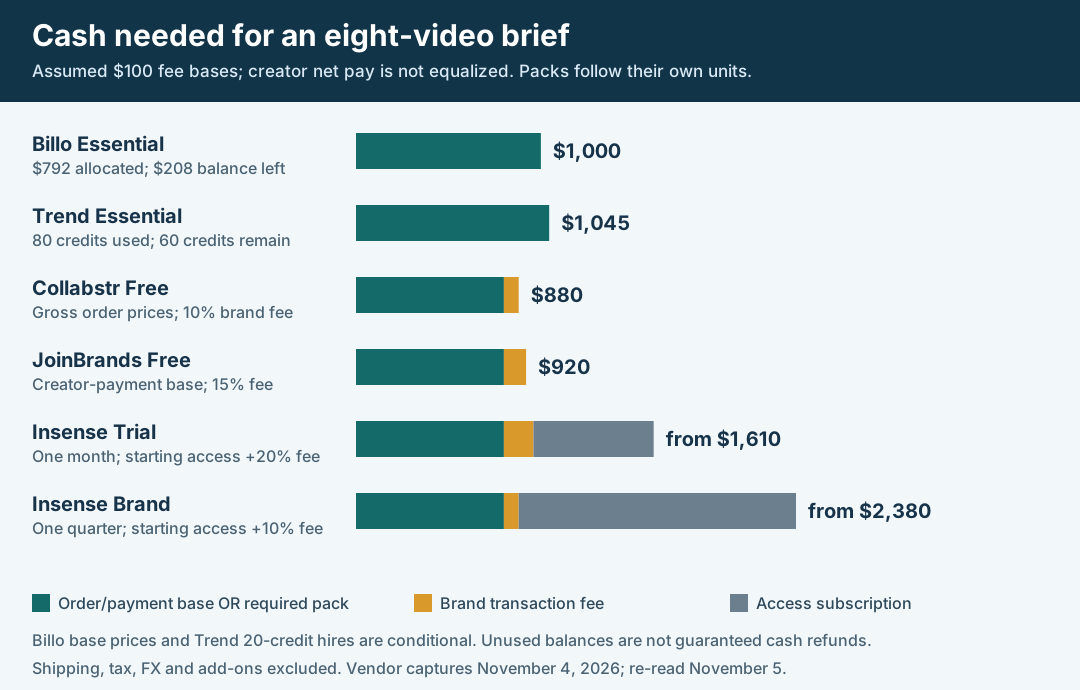
Original funding illustration for the eight-video example. The vendor-specific fee bases are hypothetical and do not equalize creator take-home; Billo base videos and Trend 20-credit hires are conditional. Starting Insense prices and actual quotes may rise. Unused pack value is not a guaranteed cash refund. Vendor captures November 4, 2026; re-read November 5.
Original visual by Superdirector editorial team. Creation date not recorded.
Verify rights and the delivery agreement
A purchased asset, copyright ownership, a usage license and authorization to run an ad from a creator’s handle are different things to verify. Ask for the exact permitted media, duration, edits, territory, music/likeness permissions and required delivery files. If creator-handle ads are needed, request the actual authorization and term as well. A brand-account file license does not itself prove that access.
| Vendor source | What the retained text supports | What remains to verify |
|---|---|---|
| Billo Brand Terms, effective September 23, 2026 | §8.1 describes creator assignment after full Order Fee payment and acceptance, worldwide for the rights’ duration unless otherwise agreed. It restricts materially AI-altered creator depictions without specific separate written consent; §8.4 retains a platform operation/promotion license. | §8.3 does not guarantee effective assignment or usability. Confirm the actual order and permissions; broad assignment wording does not remove the named conditions. |
| Insense pricing feature and FAQ | The feature says full digital copyright; the FAQ instead says creators retain copyright and grant perpetual digital usage rights after approval/payment. | The applicable agreement and actual grant. Preserve this source conflict rather than promise ownership from the feature card. |
| JoinBrands pricing and home FAQ | Pricing says unlimited usage rights; home FAQ claims client ownership and retains JoinBrands marketing use. | The rights granted for your delivered asset and intended use. “Unlimited” does not independently prove every music, likeness or ad-account permission. |
| Trend pricing | The page describes 100% licensing/distribution rights, including social, websites and ads. | The actual license and requested outputs. A licensing claim is not a statement that copyright transfers. |
| Collabstr home/pricing | Deliverables, timelines and usage rights are agreed with the creator before payment/order. | The individual order’s permissions and release/refund mechanics; escrow alone does not establish recovery for every dispute. |
| Cohley pricing | Platform and Managed Services list perpetual usage rights across channels. | Your quote/agreement, content inclusions and any permission not established by that high-level description. |
| Aspire retained marketplace page | No rights term established in that capture. | The applicable agreement before treating an application or asset as usable. |
Billo’s old pricing/home-only rights gap is not a conclusion about the vendor: its retained Brand Terms now supply the conditional language above. Its pricing page also advertises unused-fund refunds if no suitable creator is found within 30 days of the first brief, but Brand Terms §§5.3/6.9 add a limited request window, vendor discretion about money or credit and a 25% administrative deduction if a pack refund is granted. Do not treat an unused balance as a guaranteed cash refund. This is a summary of retained vendor language, not legal validation.
Delivery promises use different clocks. Insense’s retained home describes applications within 48 hours and first assets within 14 days, dependent on shipping and edits. JoinBrands pricing describes content starting within 3–7 days of launch, while its home FAQ measures images/videos within 5/10 days after product receipt. Trend describes 2–3 weeks on average for all content. These are vendor statements, not measured comparable turnaround or a launch-date guarantee. Agree product receipt, first draft, revision and final-file dates for the actual brief.
Confirm included revisions and who answers when a creator or file does not meet the agreed scope. The retained sources do not provide a tested comparison of support quality. Keep approved briefs, permissions, invoices and final masters accessible to your team, and check any promised export or post-cancellation access before relying on it; no complete migration capability was tested here.
Choose a bounded order and measure usable assets
Choose one or two routes for a real reason: a named creator already fits; the prepaid allocation fits a repeatable asset need; an applicant brief solves sourcing; or a managed scope covers work your team cannot own. First inspect available portfolios, a demonstration or an order quote. A paid campaign on two platforms is not required to make this comparison, and a larger prepaid purchase is not justified merely by a lower advertised unit rate.
Before commissioning, write a UGC content brief or use the creator brief template. Define the required product proof, duration, file format, audible speech, accurate product claims, approved usage and any cutdowns. Revisions should answer the agreed brief, not an unrecorded new assignment. Count deliverables individually: a raw take, an edited master and a cropped export need not be three independently filmed ideas.
If an authorized test order is useful and fits your budget, start with a bounded scope the chosen route actually permits. Record quoted versus charged cash, consumed balance/credits, product receipt, accepted files, revisions and unresolved permissions. For example, a fictional final batch cost of $1,200 with six accepted assets gives $200 per accepted asset. Eight ordered files would not make that $150 per usable asset if two fail your agreed requirements. This is arithmetic, not an observed acceptance rate or performance forecast.
Where our product fits: the current Superdirector UGC planning page describes preparing account context, selected-reference research and script direction before procurement. Your team reviews the brief and chooses how to hire or produce. Superdirector is the publisher’s product; it is not ranked as a creator hiring or payment route. A clear written brief may be all you need for the purchase.
No vendor account, checkout, trial, creator availability, support response, rights execution, delivery, migration or ad outcome was tested for this guide. Vendor/reference captures date to November 4, 2026 and were fully read on November 5; the public Superdirector planning page was read on November 5. The references are snapshots: current checkout and your actual order must settle missing prices, scope and terms.