How-To Guide
What are the best Influencity alternatives for agencies?
Compare Influencity alternatives for agency CRM, client controls and reporting. Check annual terms, usage caps and migration against retained vendor evidence.
By the Superdirector editorial team. Vendor captures dated November 4, 2026; editorial review November 5. No tool was bought or trialled.
At a glance
What are the best Influencity alternatives for agencies?
For an agency replacing client workspaces and reporting, start with HypeAuditor for campaign-level client review and white-label reports, and Sprout Social Influencer Marketing for dedicated client workspaces. Campaign-level separation does not establish isolation of the whole creator CRM. Heepsy and Modash offer published prices and creator CRM, but the client-access boundary needs checking. Upfluence merits a quote for commerce-led programs; CreatorIQ for multi-brand governance. Keep Influencity if a replacement cannot preserve the client controls and relationship history you use.
- Compare a complete agency brief: users, clients, campaigns, required networks and formats, content collection, report metrics, CRM history, outputs and payment scope.
- Heepsy Projects and Upfluence role permissions do not by themselves establish isolated client access. Vendor statements are not tested controls.
- Prices and features below come from November 4, 2026 captures; nothing was purchased or trialled.
Which Influencity alternatives should an agency shortlist?
Start with the job you must preserve. HypeAuditor is the first candidate here for campaign-level client review and white-label reports; its campaign-level statements do not establish isolation of the whole creator CRM. Sprout Social Influencer Marketing is the dedicated-client-workspace candidate. Heepsy and Modash are candidates when priced creator research and relationship management matter most, subject to access and reporting checks. Upfluence and CreatorIQ address commerce-led operations and multi-brand governance respectively. These are editorial fits from vendor pages, not product-test winners.
An agency replacement must carry the relationship record and client handoff, not merely find another creator. A marketplace for hiring a small cohort, an owned-post tracker and a report-delivery app can each solve a narrower problem. The monthly agency reporting workflow covers the reporting operation; this page decides which creator platform could preserve its inputs and client controls.
Disclosure and method. Superdirector publishes this comparison and is not ranked in it. We read retained vendor pages captured on November 4, 2026, plus nine comparison articles. Several references sell their first-ranked tool; Amplitude explicitly syndicates Sprout. Their lists supplied leads and structure, not proof of superiority. No product was bought, trialled or benchmarked.
List the agency jobs Influencity must keep
Do not start from the premise that Influencity is just search. Its home page describes discovery, relationship management, outreach, campaign operations, payments, reporting, social management and listening. Make a replacement inventory from what your agency actually uses:
- Client control: Influencity says each client has a dedicated workspace, with agency control over users, permissions and account management. Verify the plan and roles you currently hold before making these requirements.
- Creator relationship record: its IRM description includes custom information, internal notes and pricing histories. Identify which client owns each record, the relationship status, follow-up owner and evidence behind agreed terms.
- Reporting: branded white-label reports and live dashboards are stated. Save a finished example and its metric definitions, source links and reporting window as the replacement brief.
- Execution: the source describes own-email outreach, proposals, negotiations, usage-rights and deadline handling, content approvals and consolidated creator-payment invoices. Mark the parts in use; a search-only subscription is not a full replacement for them.
- Other subscriptions: if you use its social management or listening, decide whether those stay or need separate replacements. Do not silently omit them from the cost comparison.
The pricing capture has no numeric subscription amount. It states a 7-day trial and possible usage limits on analyses, tracked creators and other actions. Ask for your actual invoice, current caps and a renewal quote. Its home and platform pages use different creator-count figures without a harmonized definition in the text, so a bigger database number is not a useful replacement verdict.
When keeping Influencity is the better decision
- Keep the existing setup when its client controls, report output and relationship record meet the brief and a candidate has not demonstrated an equivalent.
- If cost is the problem, compare the actual renewal with complete replacement quotes, including other tools or manual work that remain. A low entry price alone does not establish savings.
- If only discovery is weak, evaluate a research supplement before migrating the entire CRM. If only report delivery is weak, first define the missing deliverable.
- For an active campaign, plan a dated handoff around its outstanding approvals, posts, reporting and payments. There is no universal safe switching date or automatic transfer of creator agreements.
Compare the six alternatives by client control
| Option | Price basis in retained capture | Agency controls described | Decision and unresolved scope |
|---|---|---|---|
| Influencity, baseline | No numeric amount; quote actual current scope | Dedicated client workspaces; central permissions; white-label reports | Keep unless the replacement demonstrates the jobs you need. |
| HypeAuditor | Demo/plan quote; no numeric amount | Separate campaign dashboard/list/feed/report; white-label reports; client review without an account | Candidate for campaign review/reporting; whole-CRM isolation unverified. Confirm active-campaign caps and guest permissions. |
| Sprout Social Influencer Marketing | Demo/quote; social-management seat prices are a different product | Dedicated workspaces by client/sub-brand with distinct brand-safety and performance settings | Candidate for workspace control; confirm influencer-product contract, access and report branding. |
| Heepsy | Starter $69, Plus $149, Advanced $229/month equivalent on annual selection; $89/$199/$299 billed monthly | Multi-client Projects; CRM; Plus lists campaign/project reporting | Priced research/CRM candidate. Projects do not establish client isolation; white-label wording not found in captures. |
| Modash | Essentials $2,388/year ($199/month equivalent); Performance $5,988/year ($499 equivalent); Enterprise from $14,700/year | CRM, team inbox, ownership and campaign exports | Priced relationship/tracking candidate. Dedicated client tenancy and white-label reports not established in captures. |
| Upfluence | Custom module quote; stated minimum contract 12 months | Role permissions on all three plans; CRM starts at Scale; payouts at Autopilot | Commerce-led candidate. Role controls do not establish per-client workspaces or white-label output. |
| CreatorIQ | Pricing/packages by call; no numeric amount | Multi-brand/market/team operations and governance | Candidate for broader governance; dedicated agency client access and white-label tier not established. |
Table and figure summarize page statements, not tested security or access behavior. “Not established” means the retained pages did not settle the question. It does not mean the tool lacks the feature. All details are bounded to the November 4 captures.
When enlarged, scroll horizontally to read the diagram.
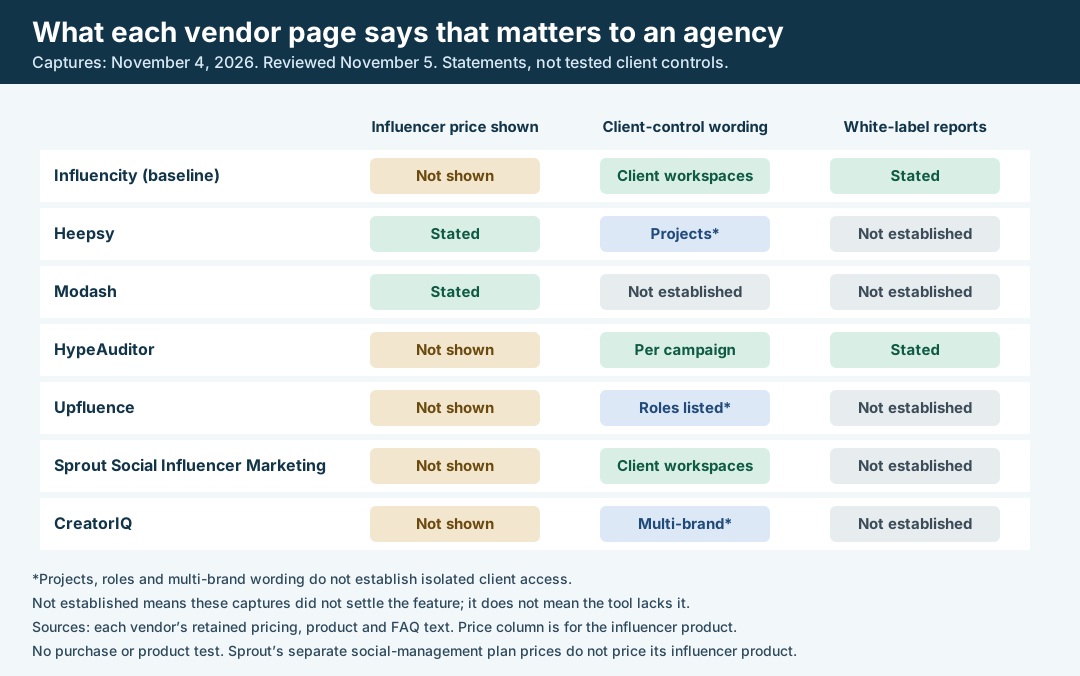
Original editorial comparison of retained November 4, 2026 vendor text, reviewed November 5. A stated feature was not tested. Projects, roles and multi-brand support are not proof of isolated client access; not established means the pages did not settle it.
Original visual by Superdirector editorial team. Creation date not recorded.
HypeAuditor: campaign-level review and reports, price by quote
The HypeAuditor FAQ explicitly describes multiple agency clients, a dashboard, creator list, content feed and report for each campaign, white-label reports, and client review/approval without an account. It also describes private creator lists for assigned teammates. These statements make it a relevant replacement candidate; they do not demonstrate the exact permission behavior your agency needs.
Pick for: an agency whose missing requirement is client-separated campaign review and branded reports. Check before choosing: active-campaign capacity depends on the plan, and the pricing page gives no numeric amount in its retained text. Ask for client guest roles, CRM history import and report/export limits on the quoted tier.
Keep platform scope separate: discovery and analytics are described for Instagram, TikTok, YouTube, Twitch, X and Snapchat, with metrics varying by network. Its campaign-content FAQ specifically names tracking on Instagram, TikTok and YouTube; creators can upload Instagram Stories through personal links. Do not infer six-network automatic campaign collection from the discovery list. Its fraud-detection marketing is not comparative accuracy evidence.
Sprout Influencer Marketing: dedicated client workspaces
Sprout’s influencer-product page describes dedicated workspaces for clients or sub-brands, each with its own brand-fit configuration, safety parameters and performance metrics. It also describes CRM, outreach, contracting, content approvals and payments in one workflow. That is a broader replacement lead than a social-account dashboard alone.
Pick for: an agency needing workspace-specific brand controls alongside the relationship and campaign workflow. Check before choosing: client guest roles, report branding, exports, required seats and the actual influencer-product quote. The pricing page’s Influencer Marketing block says no Sprout plan is required and offers a demo; its separate social-management dollar prices do not price this product. No numeric influencer-product amount appears in the retained block.
Heepsy: priced Projects and CRM, access boundaries to confirm
Heepsy pricing displays Free at $0, Starter at $69, Plus at $149 and Advanced at $229 per month on the annual selection; the paid monthly-billed alternatives are $89, $199 and $299. Free lists 500 search results and 10 advanced profiles per month, with one Project. Starter lists 100 advanced profiles per month and five tracked creators. Plus adds the listed campaign/project reporting, creator payments and audience-authenticity filters, with 500 advanced profiles per month and 100 tracked creators. Those Plus features should not be priced at Starter’s entry rate.
Its home page describes campaigns for multiple clients in organized Projects and shareable/exportable client reports. Search is described across Instagram, TikTok, YouTube and LinkedIn. Pick for: a buyer who wants priced discovery and CRM with project-based organization. Check before choosing: Projects are not evidence of isolated client permissions. White-label report wording was not found in these captures; verify branding, guest access and seat allowances. The FAQ offers custom agency pricing, but client count alone does not prove the listed plans insufficient.
Modash: priced creator CRM, monthly usage and concurrent caps
The Modash pricing capture prints annual invoices: Essentials $2,388, displayed as $199/month, and Performance $5,988, displayed as $499/month. Essentials has two team members, 300 profile opens per month, 150 email unlocks or CRM profile exports per month, and up to 100 creators tracked simultaneously. Performance has five members, 800 opens, 400 unlocks/exports and 250 simultaneously tracked creators. Enterprise starts at $14,700/year with customized limits. No month-to-month checkout amount is printed in the retained cards; do not reconstruct one from the discount FAQ.
The platform describes relationship statuses, notes, documents, custom columns, team ownership and a shared inbox, plus creator-list CSV export and campaign CSV/Excel export. Core discovery covers Instagram, TikTok and YouTube. Pick for: a team needing creator research, relationship management and content tracking at a stated annual cost. Check before choosing: dedicated client access boundaries and white-label reporting were not established in these captures. Its agency API navigation does not imply agencies can only use the API.
For commerce, Shopify enables the described automatic sales, affiliate and gifting workflows. The FAQ restricts affiliate management to Performance Annual and Enterprise. Performance Annual has one combined Payments + Affiliates fee-free payout pool of $10,000/year, then 5% on the excess; Enterprise describes different tiers beginning at $100,000/year. Broad “every plan” wording elsewhere does not settle fees or entitlement on your chosen billing term. Monthly-plan affiliate entitlement is not established by these captures; the stated eligibility remains Performance Annual and Enterprise. Get the applicable scope and terms in writing.
Upfluence: quote the CRM module and 12-month commitment
Upfluence’s plan matrix distinguishes finding/contacting creators from running the full program. Its first plan lists search and outreach; Scale adds CRM, drip sequences, commerce integrations and sales analytics; Autopilot adds budget management and payouts. Role-based permissions and 2FA appear in all three columns. The FAQ explicitly states a 12-month minimum contract.
Pick for: a commerce-led agency replacing campaign operations as well as discovery. Check before choosing: price the module that actually includes CRM, plus users, client access, reports and payments. The stated zero fee on tracked sales does not mean a free subscription or zero payout costs. Dedicated client workspaces and white-label report output were not established in the captures. Its home page labels 12+ million as a marketplace, while pricing names a 14M+ database; these are different population labels, not proof of a database contradiction or quality advantage.
CreatorIQ: multi-brand governance, agency access to confirm
CreatorIQ positions its platform for operations spanning brands, markets and teams, with governance and integrations. It says it is trusted by 1,300+ brands and agencies; that is a vendor statement, not an independently counted active-customer sample. Its content-search description, including up to 12 months refreshed daily, is not a guarantee of complete history for every creator.
Pick for: an agency evaluating broader multi-brand governance and integration requirements. Check before choosing: whether the quoted package fits its actual client count, CRM continuity, client guest roles and reporting requirements. No numeric price, dedicated client-tenant promise or white-label tier was established in the read pages. Enterprise positioning alone does not prove the product unsuitable for a smaller agency.
Price your real client workload
Use one brief for all quotes: number of operator seats, clients and active campaigns; required social networks and content formats; required content-collection method, coverage and reporting metrics; profile-reading and contact needs; concurrently monitored creators; client access; report format/branding; and payment volume. Specify what must be collected automatically and what may be supplied manually. Ask each vendor to confirm that scope on the quoted plan; coverage not established in these captures remains unknown. Ask which unit resets, whether reopening a profile counts again, and which allowance is shared. A profile open, an advanced-profile analysis and a tracked creator are not interchangeable units.
| Illustrative split across ten clients | Heepsy Plus | Modash Essentials |
|---|---|---|
| Subscription basis shown | $149/month equivalent on annual selection, or $199 billed monthly; confirm annual invoice and terms | $2,388 paid yearly, equivalent to $199/month; monthly checkout quote not shown |
| Monthly research allowance, if evenly shared | 500 advanced profiles ÷ 10 = 50 per client | 300 profile opens ÷ 10 = 30 per client; opens are actions, not guaranteed unique creators |
| Tracked creators, if evenly shared | 100 listed tracked creators ÷ 10 = 10; ask how the tracking limit is measured | 100 simultaneous creators ÷ 10 = 10 active at once, not 10 new creators per month |
| Operator seats | Not established in this capture; quote the required count | Two included for the entire account, not two per client |
| Agency completeness still to verify | Client permissions, branding, access, all required fields and fees | Client permissions, branding, access, all required fields and fees |
This is allocation arithmetic, not an equivalent-scope cost ranking or an agency capacity benchmark. It assumes one allowance can serve ten clients and is divided evenly; neither is a client entitlement. Your clients may need different amounts. Heepsy Plus and Modash Essentials meter different research actions, and the client-control brief is unresolved for both. Get complete quotes before declaring either cheaper, sufficient or a full Influencity replacement.
Rebuild two client records and reports
Our proposed agency pilot is to rebuild one recent creator relationship and one finished report for each of two authorized client contexts. Two contexts let you examine the client boundary; this is an example test design, not a test performed here or an industry sample size. Use permitted records or representative test data and agree the required fields and outputs before starting.
- Relationship continuity: bring over the creator identifier, source links, client association, status, follow-up owner, notes and the references to agreed deliverables. Mark fields that need manual reconstruction; a successful CSV upload is not complete CRM migration.
- Client access: with the intended operator and client roles, check what each can see or change across both contexts. Look at lists, notes, attachments, reports and shared links. A Project label or workspace description alone cannot settle the result.
- Report reproduction: recreate the client’s actual deliverable with the same metric labels, sources, cutoff and cost records. Check branding, export/link access, approvals and whether historical evidence stays attributable. The client social media report guide supplies a report structure.
- Buyer judgment: record unmet requirements, manual repair work, missing fields and the complete quoted cost. Decide against the requirements the agency set, not an invented creator-overlap percentage or a universal time-saved promise.
If you separately need to judge the creators in that record, the 100-point vetting rubric covers broader account screening. It does not validate a software migration or certify the new platform’s audience data.
Confirm exports, rights and the handoff
Ask Influencity and the replacement vendor which fields and files can actually be exported and imported, in what format, with what access deadline. Reconcile identifiers, client associations, notes, conversation context, report versions, agreements, approvals and payment references after import. Preserve authorized copies of the evidence you need; a transferred record does not establish that contractual permissions or usage rights have transferred.
The Influencity pricing FAQ says a monthly plan can be cancelled before the next billing cycle and an annual subscription remains active to period end. It mentions post-cancellation storage for an unspecified limited period. The retained pages do not settle full-history export formats or an export-access deadline. Get those answers before cancellation; data retention is not a portability guarantee.
Modash describes creator import by CSV, handles or email, list export to CSV and campaign export to CSV/Excel. It asks users to export before the subscription ends, says access ends at expiry, and describes 90-day data retention after cancellation. Retention does not mean continued free access. Heepsy describes saved-creator Excel/CSV output with basic data; contact emails require an unlocked advanced profile and a public address. Neither statement proves that correspondence, rights, approvals or payment history will migrate intact.
Give the remaining campaign work a dated owner: approvals still due, posts still to verify, invoices still to reconcile and the final report cutoff. Choose cancellation timing from the actual contract and the demonstrated handoff. Keep a list of unresolved exceptions instead of treating an import count as completion.
Why these six, and what the comparison cannot prove
The six recur in the retained comparison material and had readable primary vendor pages for this review. That is a bounded convenience shortlist, not a census of the market. Traackr, Aspire, Influencer Hero and others may be relevant, but their primary product scope was not studied here. Cards are grouped by the agency decision: explicit client-control statements first, then priced research/CRM, then commerce and multi-brand governance. The order is not a measured quality ranking.
All 25 successful captures were read in full across the editor and an editorial source helper: 16 primary captures and nine reference captures. Short form/index captures add little feature evidence; failed URLs provide none. Source text may omit scripted plan cards. No live product behavior, complete migration, actual contract, tax treatment, accuracy, support or performance was verified. “Not found” remains a bounded source gap. New prices, terms and access must be checked for the actual purchase.
The useful next step is a complete agency brief and a demonstrable two-client handoff, not another universal winner list. For other practical methods, browse the marketing how-to guides.