How-To Guide
What to tell a client who asks how many sales an awareness creator campaign caused
Answer a client's after-the-fact sales question on an awareness creator campaign with a card that sorts each statement as supported, credited or unknown.
What can an agency say when an awareness campaign gets a sales question?
Say three separate things. First, restate the original goal and measurement plan exactly as written before launch. Second, report what owned records show actually happened, such as orders with a creator code or a tagged link, with their dates and limits. Third, say plainly which parts no record you hold can answer, especially how many sales the campaign caused. Label each statement supported, credited by a named tool under a named rule, or unknown. If sales now matter, agree a new dated goal for future posts rather than rewriting the old one.
- Keep the original goal unedited and quote it.
- Report happened, credited and caused as three different claims.
- Treat what no record answers as unknown and name the record that would answer it.
Direct answer
Short answer: answer the question you can answer, and say clearly which parts you cannot. Use one answer card with three labels. A statement is supported when a record you own or can read shows it, such as an order list or a code redemption report. It is credited when a named tool assigned the sale to the campaign under a stated rule. It is unknown when no record you hold answers it. Then keep the original goal exactly as it was written, and if sales now matter, write a new dated goal for future posts.
This is for an agency whose creator campaign was planned and agreed for awareness, and whose client now asks how many sales it caused. The decision is narrow: what you can honestly say today, without bending the original goal to fit a new question. It does not decide whether the campaign was a good idea, whether the client should be unhappy, or what the fee should have been. Those are other conversations.
The trap is understandable. A client asks a fair question, you have a spreadsheet with some orders in it, and a number feels better than a pause. But a number built from whatever is visible will be read as the whole truth. The card below makes you write down what each record shows and cannot show before any sentence goes to the client. Use the blank answer card, the CSV register and the answer map to keep the work in one place.
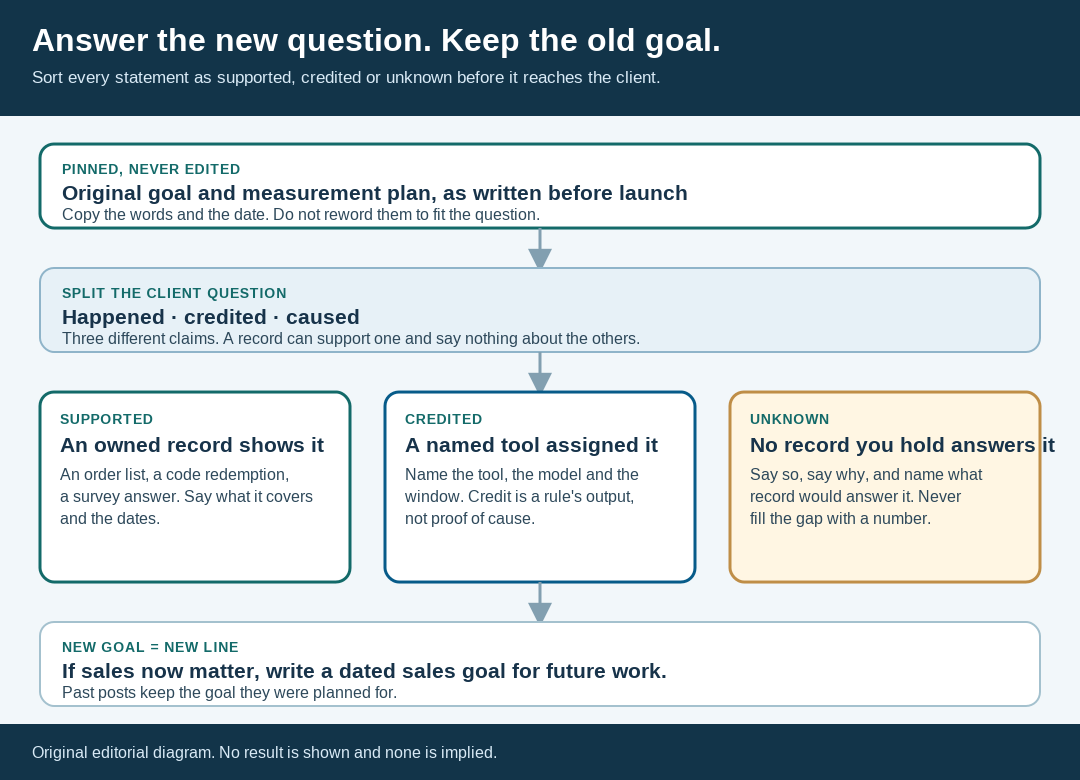
An original editorial map. Answer the new question, keep the old goal, and label every statement.
Open the blank sales answer card (HTML)Download the blank answer register (CSV)
 Superdirector
Make it work for your brand
Find it. Remake it. Post it. Superdirector turns the viral formats in your niche into your brand's carousels, X posts and video scripts, and keeps the calendar full.
Pin the original goal and measurement plan
Start by finding what was written before the campaign launched. Copy the goal word for word, the date it was written, who agreed to it and where the copy lives. Copy the measurement plan too: what was meant to be counted, from which system, over which dates. If the plan never named a sales measure, write that down as a fact. “The plan did not name a sales measure” is an accurate statement of the past, and it is the reason a sales number does not exist yet.
Keep this record read-only. Do not tidy the wording, add a sales clause because the client has now mentioned sales, or describe the goal in softer terms. The point of pinning it is that every later statement can be checked against it. If the original goal said the campaign was for awareness, the correct opening sentence of your answer is that the campaign was planned and agreed for awareness, quoting the line and its date.
If you cannot find a written goal, say that instead of reconstructing one from memory. Then ask whoever agreed the brief to confirm in writing what the campaign was for, and record their answer with its date as a new entry. How a goal and a conversion event should be written down in the first place is covered in the guide to defining the conversion event before the first post; this page starts from the case where that step was not done for sales.
Split the client's question into three claims
“How many sales did it cause?” contains three different claims, and most records support at most one of them. Write each one out so the client and your team are not answering different questions.
| Claim | Plain meaning | What kind of record could support it | What it does not say |
|---|---|---|---|
| Happened | An order exists and carries a sign tying it to the campaign | Your own order list, a code redemption report, a survey answer saved to the order | That the order would not have happened without the campaign |
| Credited | A named tool assigned the sale to the campaign under a stated rule | An analytics report, with its model, window and tagging rules named | That the tool's rule matches how the buyer actually decided |
| Caused | Sales that would not have happened otherwise | A comparison with a group that did not see the content, set up before exposure | Anything about posts that were not part of that comparison |
Be strict about which claim each sentence belongs to. “The order list shows orders carrying the creator's code” would be a happened statement if an order list showed it; nothing in this article reports a real count. “The analytics report credited orders to the campaign” is a credited statement. “The campaign caused those orders” is a caused statement, and a code report or an analytics report on its own does not support it.
Google's own Analytics help describes attribution as the act of assigning credit for key events, and says a model can be a rule, a set of rules or a data-driven algorithm. Google Analytics Help: attribution overview. That is a description of what the tool does: it assigns credit. It does not claim that credited sales are sales that would not have happened otherwise, so this page keeps the two claims apart. The post test conclusions guide applies the same discipline to comparing two posts, and the client request guide covers turning a vague request into a single choice before work starts.
List the sales records you can actually see
Now list every record or signal that could bear on sales, and for each one write six things: what it is, who holds it, the dates and time zone it covers, whether you can read it now, what it shows and what it cannot show. Include records that exist but are not in your hands. A client's order system that you have never seen is not evidence yet, but it is the most likely place an answer lives, and the card should say so.
The usual candidates are the client's own order list, a code redemption report, a tagged-link click or session report, any survey answer saved to an order, and the analytics tool's attribution report. Do not assume any of them exists. If the campaign never issued a code, there is no code report. If links were never tagged, a tagged-link report has nothing to show. Writing “does not exist” in the visible column is a finding, and it feeds the unknown group in the next step.
Read each signal with its limits in hand. Google's help on manual tagging says that when you add parameters to a URL you should always use utm_source, utm_medium and utm_campaign, that values are case sensitive so utm_source=google and utm_source=Google are different, and that missing parameters will result in “(not set)” values in reporting. Google Analytics Help: manual tagging. So a tagged-link report is only as good as the tags the creator's link carried, and a link posted without them says nothing about that traffic.
Know what the analytics tool leaves out by design. Its default channel group defines Direct as users arriving via a saved link or by entering your URL, and says default channel groups cannot be edited. Google Analytics Help: default channel group. The attribution overview adds that all attribution models exclude direct visits from receiving credit, unless the entire path was direct. Google Analytics Help: attribution overview. Put those two together and you see why a viewer who watched a post and later typed your address can be invisible to a credited report. We cannot say how many people do that for any campaign, and neither can the report. Record it as a limit of the signal, not as a guess about the campaign.
If the same order might appear in several reports, deal with that before totalling anything. The guide to counting one order once and the coupon and link reconciliation guide describe how to keep one row per order. When a report is missing a field or a period, mark the cell with its reason using the missing analytics guide instead of leaving a zero.
Sort each statement as supported, credited or unknown
Write the sentences you are tempted to send, one per line, and give each one a label. The label follows from the evidence behind it, not from how reasonable the sentence sounds. The answer map shows the three groups side by side.
| Label | Use it when | How to word it | Move it to unknown if |
|---|---|---|---|
| Supported | A record you own or can read shows it, for the dates it covers | “The client's order list for these dates shows orders carrying the creator's code.” Name the record and the dates. | You have only been told about the record and have not read it |
| Credited | A named tool assigned the sale under a stated rule | “Analytics credited these orders to the campaign under its Paid and organic last click model.” Name the tool, model and window. | You cannot say which model, window or tagging produced the figure |
| Unknown | No record you hold answers the sentence | “We do not know how many sales the campaign caused. No record we hold compares buyers who saw the content with buyers who did not.” | It never moves out until a record answers it |
Give every unknown a reason and a next step. The reason is one of a few plain facts: the plan never named a sales measure, the link was untagged, the order system is not shared with you, or no comparison was ever set up. The next step is the record that would settle it and who holds it: “the client's order list with a field for a code or a survey answer,” or “nothing recoverable, because a comparison has to be designed before the exposure.”
That last point is worth stating carefully. Google documents Conversion Lift based on users as a measure of the causal, incremental impact of campaigns, comparing conversions from a group that saw ads with a control group held back from them, and says it intentionally ignores the standard conversion tracking settings. Google Ads Help: Conversion Lift. That is Google's description of its own tool for its own ad campaigns. It is useful here only as an example of what a causal answer requires: a comparison built before the exposure. It is not a method for recovering sales caused by creator posts that already ran, and this page does not claim one exists.
Send the answer and write any new goal as new
Send the card, or a plain message built from it, in a fixed order. First, quote the original goal and its date. Second, give the supported statements with their records and dates. Third, give the credited statements with their tool, model and window. Fourth, give the unknowns with their reasons and next steps. Keep the order the same every time so the client learns where to look, and do not bury an unknown in the middle of a paragraph of numbers.
Then offer the forward step, separately and in a sentence of its own. If sales now matter to the client, propose a new goal with its own date, applying to posts that have not yet been planned, together with the measurement plan it needs: for example, a code per creator, tagged links, a survey question saved to the order, or a comparison designed before launch. Mark it as new. Do not edit the first goal, and do not judge the finished posts against the new one. They were planned for something else, and the record should show that.
Keep the client's response in the file too, with its date. If they accept the answer, record that. If they disagree with a label, record the disagreement and the evidence either side offered. If the client later shares an order list, treat that as a new record and rerun the sort. Some earlier unknowns may become supported, and the card should show the date that happened. If the numbers are still arriving, the guide to freezing a report with late platform data explains how to stamp a report as of one moment. For the next campaign, turning a weak campaign into one next test and choosing an objective you can measure cover what to agree before the first post.
Walk through a fictional answer
Fictional exercise: no real brand, creator, campaign or result was inspected, and no figures are given. A made-up agency, Agency A, ran a creator campaign for a made-up brand, Brand B. The written brief, dated before launch, says the campaign is for awareness of a new product. The measurement plan names views and saves but no sales measure. After the posts end, Brand B's manager writes: “How many sales did this cause?”
The agency fills in the card. Section A quotes the brief and its date. The manager's question is split: it asks for caused, and the agency notes that it can speak to happened and credited only if it can see records. It lists the signals. Brand B's order list exists but the agency has never seen it, so “visible: client holds it, not yet shared.” The creators were given links, but the agency cannot confirm they were tagged, so that report is “not checked.” No code was issued, so “code report: does not exist.” A survey question was never added to checkout, so “survey: does not exist.”
The sorted answer says four things. Supported: none yet, because no record has been read. Credited: none yet, pending a check of the link tags and a look at the analytics report with its model named. Unknown: how many sales the campaign caused, because no comparison was designed before launch and the plan named no sales measure. The agency asks for a read-only export of Brand B's orders for the campaign dates with whatever source field exists, and says it will rerun the sort when it arrives. The forward line proposes that the next campaign, if sales matter, carries a dated sales goal, a code per creator and a survey question. The first goal is untouched.
What this page does not decide
This card helps you answer a new question honestly. It does not decide whether the campaign was worth its cost, whether sales are the right goal, or how many sales any creator post causes. We have no benchmark for what share of awareness-campaign viewers later buy, no typical result and no range to compare against, and we state none. Search demand for this question is not measured here and we make no claim about it.
Nearby pages cover adjacent decisions, and this one differs from each. Choose a measurable creator campaign objective and define the conversion event before the first post both work before launch; this page starts after the goal has been set and the posts have run. Reconcile creator coupon codes with tagged-link visits and count one order once across code and link reports merge records that exist; this page decides what may be said when records are partial or absent. Show missing creator analytics without zeros marks missing report cells; this page covers the wording of the answer to a different goal. State what one creator post test can conclude limits what two posts can show; this page limits what a goal-mismatched question can show.
We did not verify how any particular platform, shop system or analytics setup reports sales for your account, so check your own. Nothing here is legal, tax or accounting advice. If an agreement says the agency owed a sales result, or if the client disputes a fee, send that to counsel rather than settling it in a comparison table. This is an editorial method for keeping the original goal, the records, the labels and the new goal apart so each claim rests on its own evidence.