How-To Guide
What is the difference between UGC and influencer marketing for a brand?
UGC and influencer marketing differ in whose account the content sits on, who can reuse it, what you can change and what you measure. Read Nov 4, 2026.
By the Superdirector editorial team. Platform help pages, 16 CFR Part 255 and vendor and agency pages read November 4, 2026.
At a glance
What is the difference between UGC and influencer marketing for a brand?
In our framing, the difference is whose account the content sits on and who may reuse it. An influencer post lives on the creator’s feed and reaches their followers. UGC is made by someone who is not the brand and runs on the brand’s own channels or ads, either as a customer’s post used with permission or as content a creator made for the brand. Sources define UGC differently: Reddit for Business says content by the average person, Socially Powerful says unpaid, and Billo applies the word to creators it supplies for pay. Name which meaning you intend before you compare offers.
- Customer content: ask the customer before you use it in marketing; Reddit for Business says a post with your hashtag does not automatically give you reuse rights.
- Creator-made content runs on your account under your contract. An influencer post stays on the creator’s account even when you boost it.
- Payment, free product or a prize can be a material connection the FTC’s Endorsement Guides say to disclose when the audience would not expect it, for paid creators and customer contests alike. If a paid creator is presented as an ordinary customer, take legal advice.
Direct answer
Short answer, in our framing: the practical difference is whose account the content sits on and who may reuse it. An influencer post is published on the creator’s own feed for the creator’s followers. UGC is made by someone who is not the brand, then runs on the brand’s own channels or ads, either because a customer posted it (organic UGC) or because the brand commissioned it (creator-made content for your channels). Payment does not separate the three cases: a customer may be given a prize, a commissioned creator is paid, and an influencer may be paid in cash or in product. Definitions differ by source. Reddit for Business defines UGC as content by the average person; Socially Powerful goes further and says UGC is unpaid; Billo applies the word to creators it supplies for pay. Say which meaning you intend before you compare offers, and for a choice by goal, see the section on when each one fits.
This page sets what platforms and regulators publish beside what six vendor and agency pages say (each read in full): Billo, Socially Powerful, Kurve, The Social Cat, Popfly, Sundae Collective. We read them on November 4, 2026. The page states no price figures, because the only ones we found are vendor claims we could not verify, and it does not say that either format sells more. It is not legal advice.
Superdirector is our product. Nothing on this page depends on using it.
The three cases side by side
Read the columns as three different jobs. One creator can do two of them for the same brand; that is covered in the section on when each one fits.
| Compare | Customer posts it (organic UGC) | Creator makes it for your channels | Influencer posts it on their feed |
|---|---|---|---|
| What the brand pays for | No fee for the post. Brands sometimes offer a prize or free product (Socially Powerful lists contests, hashtags and product seeding), which changes the disclosure answer: see step 6. | A finished video or photo to run on its own channels (Billo, The Social Cat). | A post on the creator’s own feed, in front of the creator’s followers (Billo). The pay can be cash or free product (our observation). |
| Account it sits on | The customer’s own account. | The brand’s page or ad account (Popfly’s table: brand channels, organic and paid). | The creator’s account (Popfly’s table says the influencer’s channels, with the note “brand may repurpose”). Repurposing needs a licence: see the next row. |
| Reuse needs | The customer’s permission. Reddit for Business says a hashtag post does not automatically give you rights to use it in email or ads. | Whatever the contract grants. Billo, a vendor, says UGC contracts usually hand the brand full rights, though elsewhere its page says creators may not have rights once the file is handed over (step 3). | The contract, plus on TikTok the creator’s authorization to run the post as an ad. Billo, a vendor, says influencer licences typically run 30 to 90 days, after which extra fees apply; ask what happens after your window ends. |
| Disclosure | Needed when there is a connection the audience would not reasonably expect, such as a prize or free product (16 CFR 255.5). | Payment is a connection. If you present a paid creator as an ordinary customer, take legal advice: 16 CFR 255.5 turns on whether viewers would expect that person to be paid or supplied by you. | Same FTC Guides. YouTube adds a paid promotion label for branded content. |
| Where results show | On the customer’s post and wherever you reuse it. | In your own ad account or channel analytics. Kurve’s UGC measures are conversion rate and CPA. | On the creator’s post. Kurve says its team reads influencers on reach and earned media value. TikTok credits a boosted post’s engagement to the creator’s organic post. |
| Choose it when | You want real customer voices and can ask each customer for permission. | You need assets that run on your own account and a say over the brief and the edit. | You want the post in front of the creator’s followers. |
| Watch for | You cannot brief it, time it or count on more of it (our reading). | Billo lists no built-in distribution as a con: you need owned channels or ad spend. | Less control of the final post (a con in Billo’s list) and edits that go through the creator (step 4). |
Sources for the cells: the vendor and agency pages named in each cell, TikTok’s Spark Ads page, Reddit for Business, YouTube’s branded content page, 16 CFR Part 255, the FTC’s Endorsement Guides. Statements from a company that sells creator services are labelled as vendor claims. We do not rely on any vendor claim for a rule.
Why the sources disagree about what UGC means
Reddit for Business defines user-generated content as “any content created by the average person rather than brands or professional creators”; it does not say whether the person is paid. Socially Powerful is the page here that states payment: it writes that UGC “is unpaid.” Kurve says that where “there is a contract and a fee involved for the post itself,” the content falls under the influencer umbrella. Billo, which runs a platform for hiring creators, calls the creators it supplies UGC creators and says the difference “is contractual and operational,” depending “on how the content gets used, not who made it.”
Each page is consistent inside its own definition. They differ on whether a fee turns customer-style content into something else. Kurve describes one kind of UGC as “content made by professional creators that looks like user content,” yet puts a post with a contract and a fee under influencer marketing; Billo, by contrast, says UGC creators “are paid to produce specific content for brands.” The TikTok and Meta pages we quote avoid the word. TikTok writes about organic posts and creators, and Meta defines branded content as content that “features or is influenced by a brand partner for an exchange of value.”
This page therefore keeps three cases apart under plain names: customer-posted content, creator-made content for your channels, and an influencer post. When a vendor or agency says UGC, check which of the three it means.
When enlarged, scroll horizontally to read the diagram.
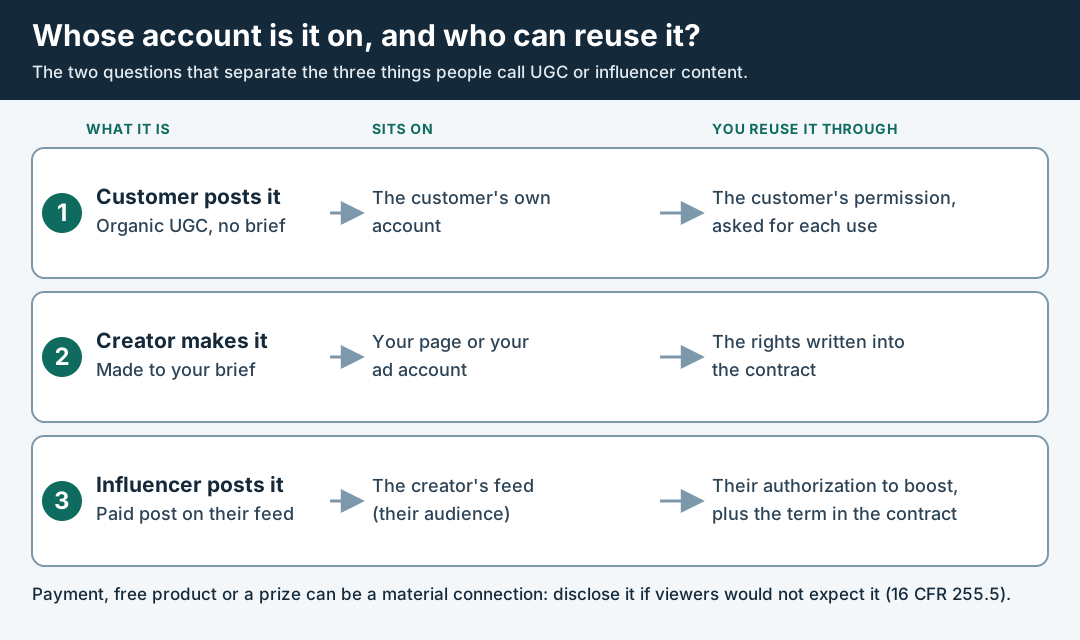
An original diagram of the two questions that separate the three cases. It states no price and no result.
Original visual by Superdirector editorial team. Creation date not recorded.
Name which kind of content you are buying
Write one sentence before you brief anyone: “This content will sit on [account], be reused under [permission or contract], and be measured on [metric].” If you cannot fill the first blank, you have not decided yet.
- A customer posted it. You did not commission it, so to use it you ask. A brand that offers a prize or free product for posts still lands here, but the offer changes the disclosure answer (step 6).
- A creator made it for you. Billo and The Social Cat describe UGC this way, and Popfly’s UGC column also lists customers, fans and micro-creators. The creator films, edits and hands over the file, and the brand posts it. You write the brief, and the rights come from your contract.
- An influencer publishes it. The creator posts on their own account. Your contract covers the post, its disclosure and any later use.
For the first case, the UGC glossary entry defines the term. For the second, the UGC content brief guide shows what to put in the brief. If your real question is about customers versus influencers by credibility, the KOC versus influencer entry covers that pair.
Check whose account the content runs on
The account decides who can delete a post, who sees its comments and where its numbers sit. Platforms document this for paid creator posts.
- TikTok. Spark Ads can run your own account’s posts or “organic posts made by other creators (with their authorization).” The page says engagement from the promotion is “attributed to the original organic post.” A creator’s post stays the creator’s post even while you pay to boost it.
- Meta. In Meta’s developer documentation, the creator publishes the post and tags the brand partner, and the creator decides whether the partner may boost it directly. A Page can moderate comments on a branded content post another Page created, “without needing the creator to take action.” That documentation covers Facebook Page posts. Instagram’s help pages came back empty or blocked, so we state nothing here about Instagram.
- YouTube. A creator must flag branded content with the paid promotion button, which adds “a disclosure label” at the start of the video (YouTube Help).
- Creator-made content for your channels. In Billo’s skincare example, the creator ships back the finished video and the brand’s media buyer loads it into the ad account, and The Social Cat says it is “usually never posted on the creator’s own profile.” In our reading, the comments and the edit are yours.
Settle who can reuse it, where and for how long
This is where the cases differ most in practice, and where vendor pages make confident claims you should not rely on. For each piece of content, write down the channel (organic feed, paid ads, email, store page), the term and the territory. The usage rights guide gives a record format.
- Customer content. Ask before each new use (our advice). Reddit for Business says a photo shared with your hashtag “doesn’t automatically grant you the rights to use it in email campaigns or advertisements,” and the American Marketing Association advises “Always request permission.”
- Creator-made content. Billo says UGC contracts usually give the brand full rights, yet the same page says UGC creators “may not necessarily have rights” once the file is handed over. The page points both ways, so put the transfer in your own contract and name the channels.
- Influencer posts. Billo says the creator keeps the rights by default and the brand must negotiate and pay for usage beyond the original post (a vendor claim). On TikTok the creator also issues an authorization for the ad, and the Spark Ads page says the authorization duration can be customized “to meet campaign needs.” Log the expiry per post (TikTok authorization guide) and agree paid use before you boost (paid use guide).
- Exclusivity. Our advice is to write exclusivity in, and price it, if you want it, and to check the contract does not imply it if you do not. Sundae Collective says long-term creator partnerships can “lock out competition,” but its page does not discuss exclusivity clauses.
Find out what you can change after it exists
Ask this before you sign, because the answer differs by platform.
- Meta branded content. The documentation says changes to post content with a brand ID on the web or on mobile devices “are not supported.” On Facebook Pages, a sponsor can be added or changed through the Marketing API. Ask the creator to get the caption right before the tag goes on.
- TikTok boosted posts. The Spark Ads page says a video needs to be “un-authorized as a Spark Ad” before it can be deleted from the organic account. A creator who wants to remove a post has to deal with your authorization first.
- Creator-made content. The Social Cat says “You control the brief, the messaging, and the edit.” Put the number of revision rounds in the brief, since a vendor page does not set them for you.
- Influencer posts. Billo lists less creative control as a con of influencer content. Brief the message, the must-say points and the review step, then leave the style to the creator.
- Customer content. You choose whether to use it, and the customer can still edit or delete the original (our observation, not a sourced rule). If you want to crop, caption or cut it for an ad, include that in the permission you ask for, and say whether you may keep running it if the customer deletes the original.
Pick the measure that fits the account
The account from step 2 decides where the numbers are. Kurve says its team looks at “Earned Media Value” and reach for influencers, and at conversion rate and CPA for UGC. That is one agency’s habit, not a standard. We found no benchmark we could check on the pages we read, so this page sets none.
- Influencer post. The numbers sit on the creator’s post. Ask the creator for a screen of the post’s analytics on an agreed date, and decide who pays for any boost before the post goes live.
- Boosted TikTok post. TikTok’s page defines paid metrics by a window, for example paid likes as “the number of likes the video creative received within 1 day of a user seeing a paid ad.” Read each metric’s definition before you compare two campaigns. The organic and paid results guide shows how to keep them apart.
- Creator-made content run as your ad. The results are in your own ad account, so the measure is yours to define. Define it before launch, not after the first report.
- Customer content. Judge it on the page or ad where you reuse it, since the original post is not yours to measure.
Disclose payment, product and prizes in every version
The Federal Trade Commission’s Endorsement Guides (16 CFR Part 255) treat an endorsement as any advertising, marketing, or promotional message for a product that consumers are likely to believe reflects the opinions, beliefs, findings, or experiences of a party other than the sponsoring advertiser. Section 255.5 covers a connection between that person and the seller “that might materially affect the weight or credibility of the endorsement, and that connection is not reasonably expected by the audience”; such a connection “must be disclosed clearly and conspicuously.” In plain terms: if a paid creator is presented as an ordinary customer, take legal advice before you publish. This page is not legal advice.
- What counts as a connection. The Guides say material connections can include “monetary payment or the provision of free or discounted products,” and name “the possibility of being paid, of winning a prize” among other benefits. They also say some connections are too insignificant to matter, so a prize or product does not settle the question by itself. A customer who posts in a contest has a connection to weigh. A customer who posts unprompted and receives nothing has none, on the Guides’ wording. Featuring such a post in your own marketing is a different question: in the Guides’ example, a review submitted to the manufacturer’s own site and highlighted on its homepage is an endorsement even with no connection, so accuracy still matters (our reading).
- Who is responsible. The Guides say “An advertiser may be liable for a deceptive endorsement even when the endorser is not liable,” and say advertisers should give guidance to endorsers and “monitor their endorsers’ compliance.” “Should” is guidance, not a command, but the practical step is the same: state the disclosure in the brief and check the posts.
- Platform labels. YouTube’s branded content page says the label is added when a creator selects the paid promotion button, and that creators and their partners are also responsible for understanding and complying with applicable legal requirements. This page quotes no TikTok or Meta label rules, so ask the creator which built-in label they will use.
- Example wording (ours, not legal advice). “Paid partnership with [brand]” or “[Brand] sent me this product for free.” Put it where viewers see it without opening the caption, and write the line into the brief.
The disclosure review guide walks through a caption and video check.
When each one fits, and when it does not
Customer posts fit a brand that already has customers posting about it. They cannot supply content for a brand with no customers yet; Kurve says that in that case “you have no one to create ugc.”
Creator-made content for your channels fits a brand that wants assets on its own account and a say over the brief and edit. It does not give you the creator’s audience. Plan where the content will run, since you supply the distribution.
An influencer post fits a brand that wants the creator’s followers to see it. It does not fit a brand that needs the finished video inside its own ads on its own terms without a usage agreement.
Doing both with one creator is normal. Billo describes the same person filming a video for a brand’s ad account and later posting a sponsored reel to their own followers. Write two lines in the contract, one for the file you receive and one for the post they publish. For the planning side of a UGC campaign, see the UGC campaign planning page.
Pick by goal. Popfly’s table lists the goal of UGC as authenticity, a content library and social proof, and of influencer marketing as reach, awareness, direct sales and credibility by association. Building on that, here is our reading (not a sourced rule, and not evidence that either format sells more):
- Reach and awareness among a creator’s followers: an influencer post, with paid use agreed before you boost it.
- Ads you control, running on your own account: creator-made content, with the rights and the revision rounds written into the contract.
- Social proof from real customers: customer posts, each used with the customer’s permission.
- No customers yet: customer posts cannot supply anything; Kurve says that is where influencer partnerships become essential. Creator-made content is the other option.
- Any route: if you will run the content as a paid ad, check that every file has written paid-use rights.
What drives the cost. This page gives no figures. The pages we read name two cost drivers: usage rights beyond the original post (Billo) and the length of a TikTok authorization (TikTok’s page says customizing it can “minimize costs”). In our reading, exclusivity, revision rounds and running the content as a paid ad also change the price. Vendor pages publish price ranges that we could not verify and do not repeat. To compare offers, ask each seller to quote the same channels, term and territory.
A low-risk first test (our suggestion). Pick one product, one case and one channel. Ask five customers who already tagged you for permission, or commission one creator-made video with the rights written in, and run it on one account for a set period. Before you start, write the pass line using the measure from step 5, for example “conversion rate at or above our current ad’s” for a creator-made video, or “five yeses out of five asks” for customer posts. Stop after the term you wrote down and compare.
A permission message you can adapt (our wording, not legal advice). “Hi [name], we loved your post of [product]. May we use it on [channel] for [length of time], including as a paid ad if we choose, with a credit to @[handle]? Reply yes and we will keep your answer on file.” For a creator contract, the lines to cover are the channels, the term, the territory, whether you may edit or crop, exclusivity, the revision rounds and who writes the disclosure.
Terms used above (our plain-language definitions, not the sources’ wording). Spark Ads are TikTok’s format for running a creator’s or your own organic post as an ad. Authorization is the creator’s permission, given on TikTok, for you to do that. Earned media value (EMV) is an estimate of what coverage would have cost to buy. CPA is cost per acquisition, the ad spend divided by the customers it brought.
What this page could not verify
Instagram’s and Meta’s help pages were blocked by robots.txt or came back empty, so the Meta facts here come only from Meta’s developer documentation for Facebook Pages. For TikTok we quote only the Spark Ads overview. The FTC’s plain-language guidance returned an error, so we quote the Guides’ text instead. Every price, market-size and performance statistic on the vendor pages is that vendor’s own claim, and we repeat none of them. We have no data of our own on either format. Page dates vary: Popfly shows “Updated: November 3, 2026,” Socially Powerful shows an update of September 11, 2026, Billo shows September 4, 2026, Reddit’s page is dated August 5, 2025, and The Social Cat’s says “Updated 7 months ago.” We found no date on the Kurve and Sundae Collective pages. We read the pages on November 4, 2026 (US Pacific time) and they can change.