How-To Guide
What are the best AI tools for making UGC-style video ads for an ecommerce brand?
Choose a synthetic presenter by product depiction, actor and voice permissions, required plan and casting costs. A generated performer is not a real customer.
By the Superdirector editorial team. Current primary texts captured/read November 5, 2026; no generation, account trial or ad test performed.
At a glance
What are the best AI tools for making UGC-style video ads for an ecommerce brand?
Compare Arcads for script-led actor variants and MakeUGC for a product-in-hand assignment, after checking the required plan, the actual shot and the permitted uses. First decide whether a synthetic performer can truthfully deliver the brief. If you need someone’s real experience, a verified buyer or their audience, hire a real creator. Count each script, actor, language and rerun before buying credits; a low subscription price does not establish usable output.
- An actor holding a generated product image does not prove that the product works or that anyone used it.
- Stock actor licenses, your own likeness/voice permissions and the rights granted back to the vendor need separate review.
- The worked casting case below is fictional: twelve new performances plus three reruns, not twelve accepted ads or a measured campaign.
Choose between a performer and a real customer
“AI UGC” here means a creator-style ad performed by a synthetic actor. It is a production choice, not user testimony. Write what the speaker is being asked to do before comparing faces or prices: explain supported product facts, show a recognizable item, report genuine personal experience, or publish to an existing audience.
| What the brief actually needs | Suitable production decision | Evidence still needed |
|---|---|---|
| A scripted presenter explaining supported features | Investigate a synthetic actor | Approved facts, a suitable performance and permission for the intended use |
| A person reporting their own product experience | Commission a real person who has that experience | The actual experience, truthful wording and agreed work |
| A demonstration that proves fit, handling or performance | Use inspectable product evidence, including real footage where needed | The real item and the specific demonstrated result |
| A post to a creator’s followers | Commission that creator-account placement | The account, agreed post and actual publication |
Original fictional brief: a brand sells a self-watering planter. It has verified dimensions and instructions, and wants a presenter to explain the refill opening in two languages. A generated scene may illustrate the opening. It cannot establish a week-long watering result or supply a customer who tried it. No real brand, product, performer or result is represented.
For U.S.-relevant endorsements, FTC staff guidance says people cannot describe experience with an untried product or invent claims requiring proof the advertiser lacks. Arcads’ own guidance says AI actors are not real customers. Calling the style a testimonial does not create the experience.
If the main job is assembling product photos, store-page facts or owned footage into placement-ready ads, use the separate ecommerce ad-maker guide. If you need a real creator, the creator brief template helps define that commission.
Check the product, actor and voice permissions
Keep three records: the product facts and reference images you can supply; the actor/voice rights for the intended use; and the vendor’s rights in the material you upload or generate. Paying for generation answers none of those automatically. A stock face and a custom likeness also have different permission sources.
| Source you are using | What to retain | What to inspect |
|---|---|---|
| Stock actor or voice | The chosen asset and current license/restrictions | Product category, modifications, permitted destinations and any withdrawal provision |
| Your founder, employee or hired spokesperson | The person’s documented consent and agreed synthetic uses | Voice and likeness, commercial use, languages, changes and vendor processing |
| A product image or filmed demonstration | The real SKU reference and the rights in the supplied media | Shape, label, size, handling and the claim the shot appears to make |
Arcads has a license, not an unrestricted ownership promise. Its October 16, 2026 terms, section 13, describe the video license as non-exclusive, personal and non-transferable. They enumerate permitted changes such as cropping, captions, music, B-roll, format changes and the client’s branding; other changes need written approval. They also restrict feeding the video into other AI/software to alter the image, voice or speech. Stock creators can restrict fields or uses, and a creator withdrawal can require removal of videos. Confirm the actual actor and intended edit; do not assume a generation can be freely recast in another tool.
MakeUGC’s output rights come with separate reuse provisions. Its October 30, 2026 terms, sections 3–4, condition output assignment on payment and compliance, and do not guarantee exclusive or protectable copyright. They license stock actors/voices as part of the output, not as standalone assets to extract or clone. The same terms reserve broad provider reuse rights and default library use. A library opt-out needs written confirmation, is prospective and does not remove every other reuse purpose. Custom avatar/voice reuse for other users or MakeUGC’s own marketing has a separate written-consent provision.
Those differences can decide the purchase before realism does. For a private launch or a contracted spokesperson, have the responsible person check the actual upload, reuse and likeness terms before supplying the material. Preserve any written exception with the project. These are source-bound contract points, not a complete legal clearance or a universal license summary.
Match Arcads or MakeUGC to the required shot
These are two candidates for this narrow synthetic-performer job, not a market-wide ranking. The comparison uses current vendor text; we did not inspect generated performances, product fidelity, lip sync or ad results.
| Assignment | Candidate and documented mechanism | Required plan or unresolved cost |
|---|---|---|
| Several new performances of approved scripts | Arcads: select an actor, script, language/accent and generate a talking video. Each actor is a separate video. | Its current pricing help lists Starter 8,000 and Creator 16,000 monthly credits. Workflows start on Creator; custom actors and team seats start on Pro. Current dollar prices are in the app, which we did not inspect. |
| A synthetic presenter with a supplied product image | MakeUGC: add a product photo for the actor to hold; Product in Hand and batch tools are listed in its plan cards. | Starter shows $29/month billed yearly, 500 monthly credits and 480p/720p. Growth shows $39/month billed yearly, 1,000 credits, one custom avatar and model-dependent HD/2K/4K. Confirm the chosen model and required resolution. |
The MakeUGC prices imply $348 or $468 over twelve months by multiplication, before other charges; they are not flexible one-month offers. The $1 start is a trial whose duration and renewal amount appear at checkout. Do not copy a third-party claim that every trial lasts 72 hours or every actor video costs 100 credits. The current pricing text meters model, duration and resolution rather than publishing one universal video charge.
Arcads’ product-holding workflow first makes an image of the actor with the product, then a talking video. That extra step needs its own review and cost. Its pricing help also distinguishes Arcads 1.0 from Audio-Driven/OmniHuman and translated-video operations. Ask for the exact operation rather than pricing every workflow as the cheapest talking clip.
For the fictional planter, inspect whether the opening, lid, scale and any visible instructions match the real item. If the generated hand conceals the refill point or the geometry changes, it fails that shot’s purpose. Replace it with a correct reference or real product footage; a plausible-looking image is not product proof.
Count the cast before buying credits
Count new performances separately from scripts, translated copies, edited exports and accepted ads. A small casting matrix can multiply quickly even when the spoken copy is short.
| Fictional new-performance plan | Count | What the count means |
|---|---|---|
| 2 approved scripts × 3 stock actors × 2 languages | 12 new talking videos | Each combination is a separate new generation, not a free language setting. |
| An allowance for 3 additional completed attempts | 3 reruns | A budget assumption, not an observed failure rate or refund promise. |
| 12 new videos + 3 reruns | 15 generation requests | Still not a guarantee of 15 usable files, approved ads or live placements. |
Arcads base illustration: assume every request uses Arcads 1.0 at its published standard rate of 800 credits for a talking-actor video up to 2 minutes. Twelve cost 9,600 credits; fifteen cost 12,000. Starter’s 8,000 does not cover even the twelve. Creator’s 16,000 covers this base calculation and includes Workflows, leaving 4,000 after the assumed reruns. Add any separate product-image, caption, translation or other charged operation and confirm the cost shown in the actual account; the help says account rates/plan sizes can differ.
This example creates each language performance anew. Using Translate Video instead is a different workflow with a published charge of 240 credits per started 30 seconds per language; it must be quoted as that operation. Do not add both meters for the same operation or silently substitute one for the other.
For MakeUGC, enter the chosen model, duration, resolution and displayed charge for every operation before deciding whether 500 or 1,000 monthly credits cover the matrix. Its terms say completed generations that disappoint are not automatically recredited. A subscription balance or one cheap trial does not establish the cost of fifteen acceptable product-in-hand scenes. Dollar signs here follow the vendor display; confirm invoice currency, tax, billing term and all required charges.
When enlarged, scroll horizontally to read the diagram.
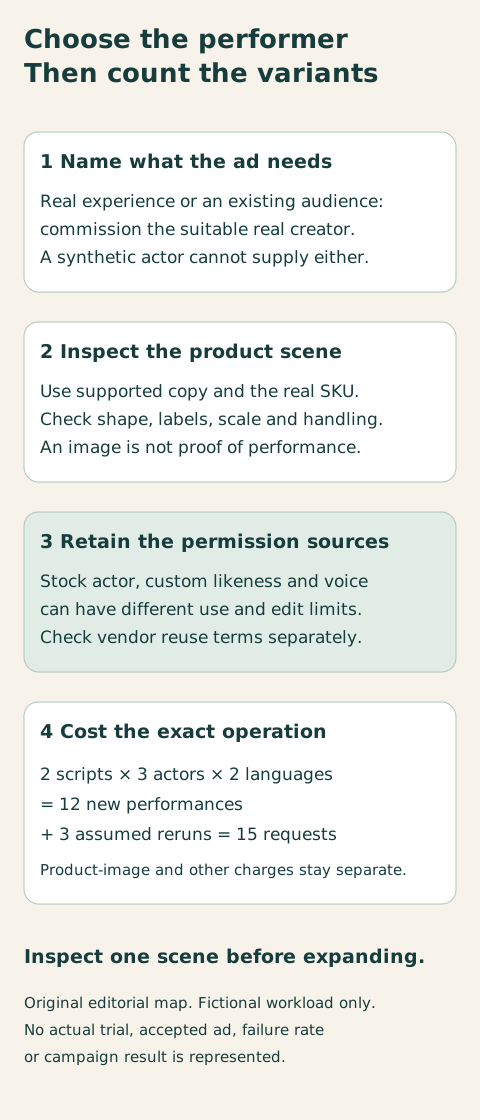
Original editorial decision map. The casting counts are fictional workload arithmetic, not accepted output, a failure rate or a campaign result.
Original visual by Superdirector editorial team. Creation date not recorded.
Review a short scene before commissioning a batch
Use the actor and depiction card or blank CSV to retain the assignment, source facts, permissions, actual operation and the reason a scene passes or needs repair. They are manual local aids, with no account connection or automatic saving.
- Keep the exact script beside its factual basis. Replace invented first-person experience with a truthful presenter explanation; real customer material needs its own accurate attribution and permissions.
- Inspect the full scene and voice: the real product, readable labels, body/hand interaction, pronunciation, language meaning and any implication of actual use. A thumbnail cannot answer these questions.
- Record stock/custom actor and voice restrictions, vendor reuse terms and any written exception. Keep the selected file/version and the person approving its use.
- Record actual credit charges and separate charged regeneration from permitted manual editing. Inspect the delivered file at its required resolution before expanding the cast.
- Check the current disclosure and advertising rules for the actual placement. A platform upload label, a vendor’s commercial-use statement and an approved ad are different facts.
Stop the synthetic route when the assignment requires real experience, a product action you cannot accurately depict, or rights you cannot secure. Otherwise, select the candidate whose inspected scene and actual terms fit the brief. The decision here is production suitability; this guide provides no paid-media winner or conversion forecast.
Publisher interest: we sell Superdirector. Its current work includes scripts and storyboards from brand context; finished AI video and video posting are upcoming, not available yet. Use the script guide to prepare supported copy, then obtain and review the final media through the chosen production route.
Sources and remaining unknowns
Three retained comparison texts—Creatify, Flowjam and Higgsfield—were read in full for their comparison structures and questions. Their publisher interests, rival prices, realism judgments and performance figures are not independent tests. The current facts above use full Arcads help/terms, MakeUGC product/pricing/terms and FTC staff text captured November 5, 2026. Some same-day primary captures were reused unchanged from our other source readings.
The remaining decisions require the actual account or project: Arcads’ dollar quote and selected actor restrictions; MakeUGC’s model charge, term and any reuse exception; the actual product depiction, language performance and destination requirements. No account, checkout, model generation, creator, file quality or campaign was tested. Historical search observations remain dated research, not current rank, exact-question volume or a quality score.