How-To Guide
How do you hire an influencer for a brand campaign?
Hire an influencer through seven handoffs: goal, shortlist, evidence, brief, terms, verified delivery, and payment and measurement records for your brand.
By Bell Chen, founder of Superdirector — how the analysis works.
At a glance
How do you hire an influencer for a brand campaign?
Define what you are buying, shortlist creators with relevant work, check the actual evidence and business contact, and give an interested creator enough scope to quote. Agree deliverables, rights, disclosure and payment terms in writing. Review the exact work, verify each agreed delivery, then reconcile payment and evaluate the result using the metrics and records appropriate to your goal.
- A creator post, a commissioned file, a license and a gift without required content are different arrangements.
- One owner and a concrete completion record for each handoff prevent interest, approval and publication from becoming the same status.
- Payment follows the agreed route and milestones; views, delivered work and verified sales remain separate results.
Define the purchase and the outcome
To hire an influencer, decide what you are commissioning before searching for a person. A post on the creator’s account, a video file for your own channels and a product gift without a posting obligation are different arrangements. Write the intended audience, supported message, format, distribution and business question in one short commissioning note.
| Arrangement | What you are asking for | What must be explicit |
|---|---|---|
| Sponsored creator post | A specified publication on the agreed creator account | Format, account, timing, disclosure and any period the post should remain live |
| Commissioned content asset | The agreed file or files for stated use | Delivery format, content requirements, license and any editing or ad permissions |
| Post plus reusable asset | Both publication and file delivery | Each deliverable and its separate rights, deadlines and acceptance basis |
| Gift without a required post | Permission to send a product with no promised publication | No disguised content obligation; disclosure can still matter if an endorsement follows |
Set an outcome you can actually observe. For an awareness commission, it might be delivery to the right audience with defined native reach evidence. For a product demonstration, it may be an accurate usable asset. If sales are the business question, decide which destination records, links or codes and attribution window you can read. A high view count does not establish purchases.
Original fictional example carried through this guide: a small brand is launching a travel pouch. It wants one paid Instagram Reel showing the real packing layout, plus delivery of the agreed video file for a defined use. The launch period is provisional. No creator, fee, result or actual campaign is being described.
Use the seven-handoff hiring card or its blank CSV. This is a manual record for one commissioning decision: each handoff has an owner, an input still needed and evidence of what was settled. It has no sourcing, messaging, payment or automatic-saving connection.
Build a shortlist around the actual buyer task
Look for creators whose recent work can explain the product to the intended audience. Keep a public post or portfolio link beside the reason each person belongs on the shortlist. Audience size is one descriptive field; it does not establish relevant viewers, a truthful product demonstration or the ability to deliver your chosen format.
For the fictional pouch project, one candidate’s packing-layout videos may show the right instructional skill. Another candidate may make excellent lifestyle images while providing no evidence of the demonstration you need. Record that missing evidence rather than turning an unrelated strength into a guaranteed fit.
You can search manually, invite a creator through their published business contact or use an actual marketplace. Meta’s Instagram marketplace explanation describes filtering by creator and audience attributes and viewing portfolios. Access and usable information depend on the actual account and route; no marketplace recommendation or result is established by this guide.
Supplier workflows also differ. We read the full current home-page texts of Collabstr, Aspire and Cohley. They describe separate discovery, brief, approval, payment and reporting functions. These descriptions help identify handoffs to ask about; they do not prove that a particular plan completes your project or that vendor performance claims apply to you. For a software purchase, use the separate creator platform comparison.
Check the work, audience evidence and contact ownership
Read or watch the relevant samples, including the sponsored work when available. Record the observed content format, explanation quality, product handling and audience conversation. A selection note should point to the actual evidence and say what is unknown. Do not certify audience authenticity or future performance from one headline number or a promotional screenshot.
| Check | Evidence to retain | Decision it informs |
|---|---|---|
| The work itself | Specific post/portfolio URLs and what you actually watched | Can this creator execute the intended explanation and format? |
| The intended audience | Available native audience information with its date, population and missing fields | Does the observed audience fit the market and buyer task? |
| Commercial experience | A relevant disclosed example, if present | What support may the creator need for the brief and review process? |
| Who is negotiating | The public business route and the person’s stated role | Are you discussing the right account and actual offer with the right contact? |
A manager’s listed business address can be the proper route. Confirm identity and the payment recipient through the agreed professional conversation before making a transfer; do not use a follower badge, display name or a newly supplied payment link alone as proof. This is practical verification advice, not a claim that a particular platform checks every business identity for you.
Use the media-kit verification guide for supplied audience and performance evidence. If the available evidence does not answer a necessary question, ask it plainly or select another candidate; an unknown should stay visible.
Send a specific brief and discuss a complete quote
Once the creator is interested, send the work they are being asked to price. The initial contact can be short; the commissioning brief needs enough detail to prevent two different interpretations of the same offer. Use the first-contact guide for approaching the creator and the creator brief template for the document itself.
- Name the product and the supported message; include actual source material for any factual claims.
- Specify the output: account and post format, files, aspect ratio or duration where needed, and whether publication and asset delivery are both required.
- Identify the intended audience and what creative choices the creator owns. Supply necessary constraints without scripting a false personal experience.
- Give the product-availability, shipping, draft-review and intended publication dates. Mark provisional timing honestly.
- State the requested use, review/revision scope and what the quote must include, so the creator can price the same job you intend to buy.
In the fictional pouch project, a useful question is whether the quote covers both the Reel and the named file delivery, and what licensed use of that file it includes. A low headline fee with missing rights or required deliverables is not the same offer as a complete quote. If the launch date is still uncertain, resolve a workable timing arrangement rather than promising availability you cannot support.
FTC staff guidance says an endorser cannot describe experience with a product they have not tried or make claims requiring proof the advertiser does not have. Let the creator’s real experience determine the opinion. Approving the commercial work does not make an invented testimonial truthful.
Record scope, rights and payment terms before work begins
Put the agreed deal in writing and retain the exact version both parties accepted. The influencer agreement guide covers the clauses; this overview does not supply a replacement contract or determine legal rights for every jurisdiction.
| Decision to settle | Concrete question |
|---|---|
| Deliverables and schedule | Which account publishes what, which files are delivered, and which dates are firm? |
| Review and revisions | Who responds, what is checked, how many or what kind of changes are included, and what happens if scope changes? |
| Use of the work | Which channels, uses, territories and period are licensed; are raw files, edits or ads included? |
| Compensation and payment | What amount and currency, fees/taxes where applicable, payee, invoice and payment milestones are agreed? |
| Disclosure and claims | Who supplies substantiation, checks the actual endorsement and addresses a missing or misleading disclosure? |
| Changes and problems | What process applies to late product arrival, cancellation, non-delivery, disputed work or an altered brief? |
Receiving a file does not by itself answer what use you commissioned. A post on the creator’s feed and permission to run ads from it also need their actual terms and platform permissions. Keep each decision in the same accepted record; do not assume that paying a creator silently buys every future use.
Payment sequence depends on the agreement and route. For example, Collabstr’s order guide says the brand’s payment is captured upfront and held until content approval; it also says usage rights are not always automatically included. That is its documented order route, not a universal instruction to pay every creator after posting. Read your actual checkout, written terms and any fees or dispute rules.
Pay any agreed deposit or milestone when it is due. This guide does not invent a rate, require a universal deposit percentage, promise escrow outside a route that provides it, or change a payment condition after the creator has accepted.
Review the exact work and verify the agreed delivery
Assign one brand contact to give clear, consolidated feedback against the accepted brief. Watch or read the actual submitted work, rather than approving a filename or thumbnail. Check product facts, the agreed format and supported claims, and distinguish a correction required by the brief from new work you have added.
For a sponsored endorsement, check the disclosure in the actual reading or viewing context. FTC staff guidance says a disclosure should accompany the endorsement, that a video’s disclosure should be in the video, and that a platform tool alone is not assumed sufficient. Apply the requirements for the real market and platform; the word “collab” alone is not a universal disclosure.
The FTC’s advertiser-responsibilities discussion calls for reasonable training and monitoring, including explaining supported product claims, instructing on disclosure and addressing questionable practices. Delegating work to a marketplace or agency does not remove advertiser responsibility under the FTC Act. Its staff discussion gives no universal monitoring period; do not turn the end of an internal task into a legal all-clear.
| Receipt | What you can honestly say | What remains separate |
|---|---|---|
| A reviewed draft or export | The named version was checked against the agreed brief | The creator’s publication, file delivery and later changes |
| The agreed file delivered | The named bytes or downloadable file were received | Their license, the creator-account post and business performance |
| A live creator post checked at its URL | The named account published the observed version at the observed time | Future availability, the agreed live period and measured results |
| The required platform permission observed | The specific permission exists for its stated account/scope | The broader contract, actual ad launch and any ad result |
For the fictional Reel, check the correct creator account, the packing demonstration and the actual caption/video disclosure; then retain the live URL and observation time. Confirm the separately agreed file delivery too. A draft approval or co-author invitation is not enough to mark both deliverables finished. The Instagram delivery guide handles the native co-author case.
Reconcile payment and evaluate the commissioned result
Reconcile the agreed payment milestones with invoices and actual payment receipts. Payment may already have occurred in whole or part; this final handoff checks the record rather than moving every payment to the end. Record a dispute or missing deliverable accurately and use the agreed remedy process instead of inventing a new performance condition.
Gather only the measurements appropriate to the original question. Retain the platform’s metric name, post or campaign, observation date, measurement window and whether paid distribution was included. If a creator sends a screenshot, keep its boundaries and missing fields visible. For an asset-only commission, acceptance and usable delivery can be the immediate result without a creator-account reach figure.
When the goal includes sales, inspect the destination records you planned to use. A code redemption or tracked visit may be associated with a creator route; neither an aggregate revenue movement nor a view count proves that hiring this creator caused the change. Use the influencer metrics guide for definitions and measurement decisions.
Finish with one decision backed by what happened: rehire for the same task, change the brief, gather missing evidence or stop. For the fictional pouch project, an accurate Reel and delivered licensed file could justify considering a similar commission; a sales claim would still need the actual records. There is no measured example result here.
When enlarged, scroll horizontally to read the diagram.
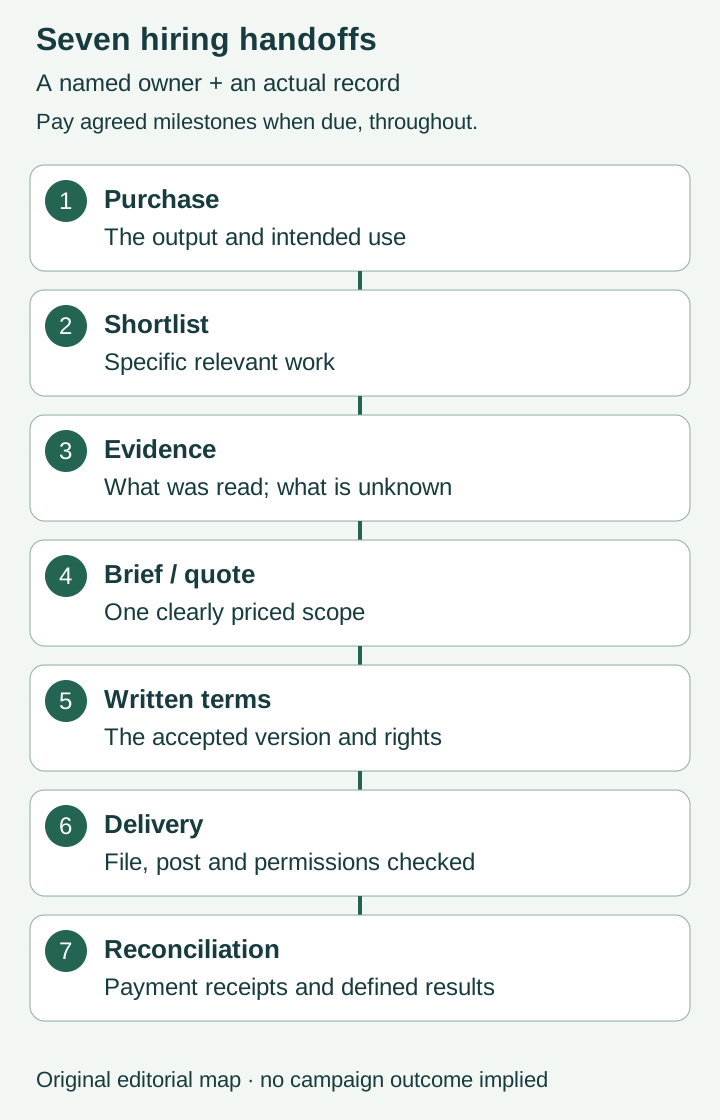
Original editorial handoff map. Agreed payment milestones may occur earlier; final reconciliation checks actual receipts.
Original visual by Superdirector editorial team. Creation date not recorded.
Sources, method and limits
We read current full source text on November 5, 2026 for Collabstr, Aspire and Cohley’s home pages, Collabstr’s order guidance, Meta’s marketplace explanation and FTC Disclosures 101. We also read the advertiser-responsibilities portion of the longer FTC Endorsement Guides FAQ; this is not a full reading of every FAQ topic. Platform and supplier text describes the documented route, not a hands-on hiring or software test.
No completed exact “how to hire an influencer” AI answer was present in the retained topic panel. The three supplier anatomy studies came from a separate November 4 answer about UGC platforms for brands to hire creators. Those citations are adjacent research, not exact-query exposure, proof those pages rank for this question or a comparison of creator-post hiring quality. Historical keyword evidence also lacks a verified current window and locale.
The seven handoffs, fictional project, diagram and manual card are original editorial instruction. We hired nobody, inspected no private accounts, tested no payment or publication route, and measured no campaign, reply rate or sales result. Source page images and phone layouts were not inspected. Superdirector publishes this guide; jurisdiction-specific legal and tax decisions require the actual arrangement.