How-To Guide
Should a candle brand use founder-led or gifted-creator videos for first-time buyers?
Founder-led or gifted-creator videos for first-time candle buyers: what each answers, how to test both for two weeks, and what the numbers cannot prove.
By the Superdirector editorial team. System1's Creator Effectiveness Playbook summary, four agency and vendor comparisons, Google Analytics UTM help, 16 CFR Part 255, CMA creator guidance and National Candle Association safety tips read November 6, 2026. Method only; no sales benchmarks.
At a glance
Should a candle brand use founder-led or gifted-creator videos for first-time buyers?
Use both and let a small test decide. Founder-led videos answer who makes the candle and whether to trust it; gifted-creator videos show what it is like in a home like the buyer's. Give each its own tracked link, ask every new buyer how they heard about you, run both for the same two weeks, and compare first-time orders.
- With no customers yet, start with the founder; add gifted creators when product and shipping are affordable.
- Choose creators for fit: System1's study of 1,217 paid ads on TikTok favoured brand fit over creator fame.
- Gifted posts need a clear ad label, and every video should follow basic candle burning safety.
The short answer
A candle brand does not have to pick one. Founder-led videos and gifted-creator videos answer different first-time buyer questions, so use both and let a small test show which brings first orders. The founder answers "who makes this, and can I trust it?": the scent story, how the candle is poured, how to burn it safely. A gifted creator answers "what is it like in a home like mine?". Give each its own tracked link, ask every new buyer how they heard about you, run both for the same two weeks with the same offer, and read the result with its limits in mind.
If you only have time for one this month and have no customers yet, start with the founder. A brand with no customer base has no customer content to borrow, and nobody can explain a scent you designed better than you. Add gifted creators when you can afford the product and the shipping.
We found no public source that has measured founder videos against creator videos for candles. MHI Growth Engine, which reports on founder ads across its own client accounts, says neither one wins everywhere, admits it holds no direct comparison of the two, and tells brands to run both in one ad account. That is the advice here too.
Two questions, two kinds of video
Idukki splits the job in two: the founder makes people trust the company, while customers show that the product suits someone like the viewer. For a candle, both questions are real. A first-time buyer cannot smell the candle through a screen, so they lean on the person describing it.
| Founder-led video | Gifted-creator video | |
|---|---|---|
| Answers | Who makes this, why this scent, is it made carefully | What it looks and smells like in an ordinary home |
| Strong shots | Pouring, wick trimming, the scent notes written down, the first burn | Unboxing, lighting it in their own room, the melt pool after an hour |
| Describes the scent by | What went into it and why | What it reminded them of, in their own words |
| Risk | Sounds like an advert if it only praises the product | The brand feels bolted on if the creator's world does not suit candles |
| Disclosure | Clear that they are the founder | Ad label: they were gifted the candle |
| Costs you | Your time | Product, packaging and shipping, plus your time to find creators |
4D's guide recommends founder-led content for young brands that do not yet have buyers whose videos they could reuse, and creator content for categories where watching an actual person with the product does the convincing. Candles sit between the two, which is why a test beats a rule.
Choose creators for fit, not follower count
A large public study of creator ads points at fit. In the Creator Effectiveness Playbook, System1, WPP Media and TikTok scored 1,217 paid ads on TikTok from eight markets and found three things that predicted whether viewers remembered the brand: how good the ad was, how well known the creator was, and how naturally the product belonged in the creator's world. Where a brand can only have one of the last two, the report favours fit; a modest creator with a natural use for the product beat a bigger one where the product looked stuck on. Follower numbers were a poor guide to whether an audience recognised a creator.
That study measured brand memory from paid TikTok ads, not first orders from gifted posts, so treat it as a guide to choosing creators, not a sales forecast. For a candle brand, fit means a creator whose videos already happen at home in the evening: reading, cooking, cleaning, a small flat they decorate. A creator who never films indoors is a poor fit at any size.
In the same data, engagement rate accounted for almost none of the variation in brand memory, roughly 0.2 per cent. Do not pick the winner of your test by likes.
Run a two-week test without an attribution stack
You do not need paid software to compare the two. You need separate links, one question at checkout and a fixed window.
- Pick one candle and one offer for both sources, so the product and price are not what differs.
- Make one link per source and per video. Google's URL builder guide says utm parameters on destination URLs let you see which campaigns refer traffic, with the values shown in the Traffic acquisition report. Use utm_content to tell videos apart, keep one utm_source per platform, and use all lowercase with identical spelling.
- Add a required "How did you hear about us?" question at checkout or in the order confirmation, with options for the founder's videos, each creator by name, a friend, search and other.
- Post the founder videos and send the gifted candles so that both sets of videos go live in the same week.
- Run for two weeks from the first post. Log clicks, first-time orders by link, and the checkout answers in the two-week test sheet.
- Compare first-time orders, not views. Then read the answers to the checkout question beside the link data.
Example links, with your own domain and names: ?utm_source=instagram&utm_medium=social&utm_campaign=first_buyer_test&utm_content=founder_pour_video and ?utm_source=instagram&utm_medium=social&utm_campaign=first_buyer_test&utm_content=creator_ana_unboxing.
For naming conventions, see our UTM tracking for influencer campaigns guide. If you are still deciding whether a creator test is worth the cost at all, see choosing in-house video or a creator for the next test.
When enlarged, scroll horizontally to read the diagram.
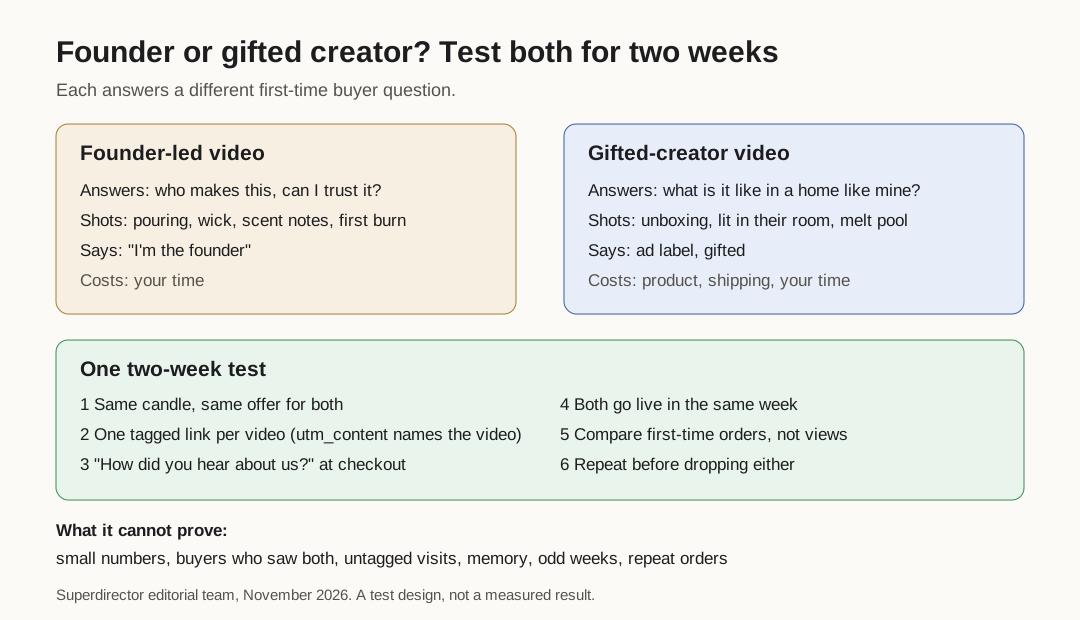
Original diagram. A test design, not a measured result.
Original visual by Superdirector editorial team. Creation date not recorded.
What the numbers cannot prove
A two-week test with a small brand's numbers will show you a direction, not a proof. Read it with these limits written next to the result.
- Small numbers: five orders against three is not a winner. Keep testing until the gap holds over more than one window.
- People see both: someone who watched the founder and then bought through a creator's link is counted once, for the creator.
- Missing links: people who type your name into search, or tap a link a friend sent, arrive without the tag. The checkout question catches some of them.
- Memory is unreliable: "How did you hear about us?" answers are what buyers remember, which is not always what moved them.
- Different weeks: a holiday, a sale or a viral post in one week will swamp the comparison.
- First orders only: the test says nothing about who buys again.
If both sources bring first orders, keep both. If one brings almost none after two windows, change what that source is doing (the creator, the shots, the scent description) before you drop it.
Disclosure and safety on camera
A gifted candle has to be disclosed like a paid post. In the US, the FTC's endorsement guides count a free or discounted product as a possible material connection even if the brand asked for nothing back. A connection viewers would not expect, and that could change how they judge the post, has to be disclosed clearly. On social media the disclosure should be unavoidable, so a line on the profile page is not enough. In the UK, the CMA's guidance for creators says posts about gifts need an ad label even when there was no obligation to post. Idukki puts the founder's side bluntly: a founder should appear as the founder and never pose as a customer.
Candle videos often break basic burning safety for a nicer shot: a candle on a bedside table under curtains, or several lit candles touching. The National Candle Association's fire safety tips say to keep candles at least 12 inches from furniture, drapes, bedding, carpets and books, to place burning candles at least 3 inches apart, never to leave them unattended, and to keep them out of reach of children and pets. Put those in the brief for both the founder and every creator, so no first-time buyer copies a dangerous setup.
For a brief that covers both points, start from the UGC creator brief template and our gifted collaboration agreement guide.