How-To Guide
How to evaluate a creator’s unsolicited request for a free sample before you promise product
Log the request as received, count spare units, check written fit criteria and pick one of four replies before any product or promise leaves your team.
By the Superdirector editorial team. FTC and Cornell LII pages reviewed October 30, 2026.
At a glance
How should a brand evaluate an unsolicited creator sample request before promising product?
Do three things before you reply. First, log the request exactly as received. Second, have the person who owns the inventory count the spare units, meaning units on hand minus units reserved for named commitments minus units unusable or needed back. Third, check the creator against fit criteria you wrote before the request arrived, marking each met, not met or cannot tell from dated public work. Then choose one reply, decline, ask, offer a sample with stated terms or redirect, and record what you promised and what you did not. A sample is not free of consequences: the FTC describes free products as a material connection to be disclosed.
- Count spare units first. A request you cannot supply is a redirect or a decline.
- Write fit criteria before the request, so the creator does not set the standard.
- Promise only what the reply says, and file what you did not promise.
Direct answer
Short answer: answer two questions before you say yes to a creator who writes asking for a free sample. Can we supply it? That is a count of spare units made by whoever owns the inventory. Does the request fit? That is a check against criteria you wrote before the request arrived, using the creator’s dated public work. Only then choose one reply: decline, ask, offer a sample with stated terms or redirect to another route. Keep the request, the count, the fit marks, the reply and your non-promises in one record.
This is for a brand or agency that has received an unsolicited message from a creator asking for product, with no brief, agreement or offer from you. The decision is narrow: whether to promise a unit, and on what terms. It is not an evaluation of how much a creator will sell, and it does not set a rate. No sample count, response rate or result appears on this page, and nothing in it is a benchmark.
A free sample feels small, which is why teams say yes by reflex. But a sent unit is a unit you no longer hold, a promise is hard to take back, and the creator may later post about it. The FTC’s influencer guide treats free products as part of a financial relationship that should be disclosed. Use the blank decision sheet, the CSV register and the decision diagram to keep every request on the same path.
Log the request as received, not as you read it
Paste the message word for word before you interpret it. Record the date, time and time zone, the channel, and the sender’s account or address. Then write down three plain facts in separate boxes: what they asked for (which product, variant and quantity, if they said), what they offered in return, if anything, and what they did not say. “Happy to feature it” is an offer to feature; it is not an agreed deliverable and it is not a commitment to any particular post.
Many requests are templated. Do not assume that one is, and do not assume that the sender has read your product page. Note what in the message is specific to your product, if anything. That is an observation about the message, not a score. If the sender wrote through an agent or manager, record that too and continue to the manager authority check before you send anything to an address.
Keep personal contact and shipping details in your authorized system, not in a shared sheet. If the message already asks for a postal address from you, or gives theirs, do not copy it into the decision sheet. The sheet needs the facts that support the decision, and the address is not one of them.
Count the spare units before anything else
Ask the person who owns the inventory, not the person who read the message, for three numbers on a named date. Units on hand of the variant asked for. Units reserved, each tied to a named commitment such as a creator already agreed, a client demonstration or a replacement promised to someone. Units unusable or needed back, such as damaged units or loan units due to return. Spare units is what remains after subtracting the second and third from the first. Write the count date, because a count goes stale.
If the count is zero or below, the answer to “can we supply it?” is no for now, and the reply is a decline or a redirect, never a promise to “see what we can do”. If the variant asked for is not one you have, say so in the log. A retail listing, a production plan or a product photo is not a unit you can send; the one-sample schedule guide makes the same point about a unit you intend to circulate.
A spare unit is not the same as a unit you want to give away. Decide, before the next request arrives, how many spare units you are willing to commit to unsolicited requests at any one time, and write the number and who set it. We do not know the right figure for your product and do not suggest one. What this page asks is that the figure exist as your decision, stated once, so the thirtieth request is not judged by the mood of the day.
Look at the decision diagram: supply sits before fit on purpose. A request that fits perfectly but cannot be supplied still needs a different reply, and it is easier to write that reply before you have admired the creator’s work.
When enlarged, scroll horizontally to read the diagram.
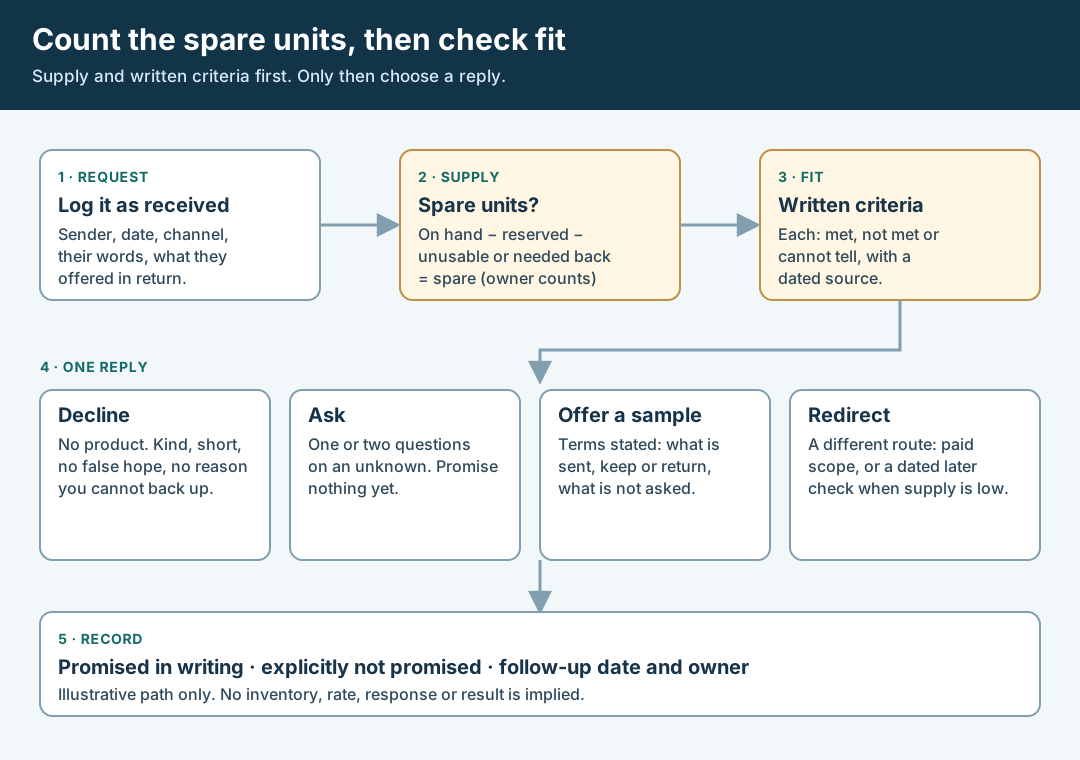
An original editorial diagram. Supply comes before fit, and every reply ends with a record of what was not promised.
Original visual by Superdirector editorial team. Creation date not recorded.
Check the request against criteria written in advance
Write two to four fit criteria before you read the request, from the product and the reader you want to reach, and date the list. Good criteria are checkable in public work: the creator makes the kind of video your product needs, shows the kind of use the product is for, and has no conflict with a rule your campaign already holds. A criterion such as “seems like a good fit” cannot be marked. A criterion such as “has posted at least one demonstration of a comparable product in use” can.
Then look at the creator’s dated public work and mark each criterion met, not met or cannot tell. Save the address and capture date beside every mark. A public post shows only what is visible in it: it does not show audience makeup, availability or rights. “Cannot tell” is a real answer and it points to a question, not to a rejection.
| Fit check | A checkable version | What a public capture can show | What it cannot show |
|---|---|---|---|
| Format | Makes the video type the product needs | Dated uploads that match the type, or none do | How often they will make it for you |
| Use | Shows a comparable product in real use | A clip where a similar item is used | Whether your product would suit their setup |
| Conflict | No active rule from your campaign applies | Sponsor labels and named brands in recent posts | Private deals they have not disclosed |
| History | No earlier request or decline on file | Nothing; this is your own record | Why an earlier decision was made, unless you wrote it |
Two existing checks can fill in a mark. The format repeatability guide shows how to sample a fixed window of uploads, and the sponsor category guide shows how to read sponsorship cues without assuming every mention is paid. Use them for the mark; do not rerun a whole review for a single unit.
If you previously declined this creator, the log should say so, and a new request is not by itself new evidence. The decline reevaluation guide covers when a decline should be reopened. If the creator is a repeat requester you have already supplied, the history row is yours to fill from your own record.
Pick one of four replies and state its terms
Choose one reply from the supply count and the fit marks. Decline when there is no spare unit or a criterion is clearly not met: say it plainly and kindly, give no reason you cannot back up, and keep the door as open as you actually mean it to be. Ask when one or two marks are “cannot tell”: send the specific question and promise nothing in the same message. Offer a sample when there is a spare unit and the marks support it: state the terms below. Redirect when the request is not really for a sample, for example when the creator’s offer is a post that needs a brief, or when you will have units later: point to the other route or give a dated check-back, and do not call a redirect a yes.
If you offer a sample, put the terms in the same message. What is sent, by variant. Whether the creator keeps it or returns it. Who pays to ship it, if that is a decision your team has made. What you are asking for, and what you are not. If a post is part of the exchange, it is no longer only a sample: it is a deliverable with its own scope, and the budget reply guide covers how to write that scope before any number is named. Our gifting versus paid template compares the two arrangements side by side.
Say plainly if you expect nothing in return. Do not make that sentence mean something else: “no obligation” in a sample note, and then a later demand for a post, is a promise broken in the other direction. If you plan to ask for a tag or a disclosure, say so in the note rather than later.
Disclosure belongs in the terms because the rules treat a free product as a connection. The FTC’s Disclosures 101 for Social Media Influencers, dated November 2019, says a financial relationship includes getting products for free or at a discount, and that you should disclose it even if you weren’t asked to mention the product. It also says disclosing is the influencer’s job. The federal rule text at 16 CFR 255.5 lists free or discounted products among connections that may need to be disclosed, and gives a woodworking example in which a manufacturer sends an influencer a free lathe.
A company has a role as well. In the FTC’s Endorsement Guides question-and-answer page, an answer on influencers who receive only free products says training alone is not enough: the company should ask for clear disclosure, explain how to make it, ask for brand tags and monitor tagged posts. Another answer says that a disclosure is needed regardless of whether the company shipped the product, provided a code or reimbursed a purchase. None of this tells you which words to use in a given post, and it is not a ruling on any creator. Send questions of law to counsel.
Walk through a fictional request
Fictional exercise: no real brand, creator, inventory or result was inspected. Brand A makes a made-up desk lamp. Creator Q writes asking for “a lamp in the oak finish” and offers to “show it to my followers”. The reviewer logs the message word for word, records the date and the channel, and writes in the boxes: asked for, one lamp, oak; offered, a mention; not said, any wish to be paid or any post count.
The inventory owner counts on a stated date: the oak finish has some units on hand, some reserved for named commitments and one unusable because of a chipped base. After subtracting, the sheet shows a spare count the owner has written, and Brand A’s own written rule on how many spare units may go to unsolicited requests allows one. Both numbers are the made-up owner’s, not data.
Brand A’s criteria, written the month before, are: makes desk-setup videos, shows a comparable lamp in use, and has no active sponsor of a competing lamp in recent posts. The reviewer checks three dated public uploads. Format: met. Use: cannot tell, because the lamps in the clips are different kinds. Conflict: cannot tell, because one clip names a brand without saying whether it is paid. Two marks are unresolved, so the reply is ask: one question about the setup the lamp would be used in, and a note that no unit is promised yet. The reviewer files the sheet, the reply and a follow-up date. The example predicts nothing about any real creator.
Record what you promised and what you did not
Close each request with one filed record: the logged message, the spare-unit count and its date, the fit marks with their captures, the reply as sent with the time and time zone, what was promised in writing and what was explicitly not promised. The last box matters more than it looks. “No unit is reserved,” “this is not a commitment to future product” and “we are not asking for a post” are all statements you can quote back when memory differs.
If you sent a sample, update the supply count at once so the next request sees the right number, and mark the unit as with the creator only when you have evidence it left. Write the next check: the date you will look at the tagged post, if there is one, and who will look. The FTC’s Q&A page says no set time period makes sense for all circumstances, that contracted endorsers should be monitored for the length of the contract, and that for free-product-only arrangements it would probably be reasonable to monitor for at least a few months. It does not give a schedule or a number of captures, so choose a period you can keep and write it down. The post edit retention guide shows how to keep a post record once it is live.
If the answer was ask or redirect, file the date by which you will reconsider, and the one thing that would change your answer. A request that sits with no next date has become a promise by delay. Review the register at a set interval, and close or reopen each open row on that day.
What this page does not decide
This page is about the first decision: whether to promise a unit to someone who asked unprompted. It is not about what happens after you decide to send. For a single physical unit that several creators will use in turn, see the one-sample schedule guide, which starts from a unit you already mean to circulate. For a creator who asks about money before the work is defined, see the budget reply guide. For a creator you have already declined, see the decline reevaluation guide.
It also does not duplicate the earlier checks it borrows. The format repeatability guide and the sponsor category guide are sampling methods for a deal you are already weighing. Here, the new thing is the sample-request decision sheet: a supply count first, written criteria second, and one of four replies with its non-promises filed.
Nothing here estimates what a sample is worth, how many requests are normal, how often samples lead to posts, or how a post performs. Those numbers are not available to us and are not claimed. This page is not legal advice: it quotes public sources, and whether a particular disclosure or arrangement is adequate is a question for counsel. It is an editorial method for keeping supply, fit and promises apart, so that each reply rests on its own evidence.