How-To Guide
When to ask a creator for a shipping address for a sample
Confirm a real shipment first, list each address field with its reason, send a purpose note and hand the sender only what it needs. Includes a blank card.
By the Superdirector editorial team. Regulator, FTC and USPS pages reviewed October 30, 2026.
At a glance
When should a brand ask a creator for a shipping address for a sample?
Ask only when a real shipment exists: scope is agreed in writing, the product and variant are named, the destination region is known and someone will receive the parcel. Before you ask, list each field with the carrier or customs reason for it. Send a short note saying what you collect, why, who sees it and your plan for keeping it. Hand the sender only those fields, and after delivery delete the address or record why you keep it. An address requested without a shipment has no purpose behind it.
- Gate first: scope, product, region and a recipient, then ask.
- Every field gets a reason, and a field with no reason is not requested.
- Close the record after delivery: delete it or write down why it stays.
Direct answer
Short answer: ask a creator for a shipping address only when a real shipment exists, and ask only for the fields the shipping route needs. A real shipment means four things are already settled: the scope is agreed in writing, the product and variant are named, the destination country or region is known and someone is identified to receive the parcel. Until those four are in place, an address has no shipment to serve, and asking for one only creates data you must now protect and eventually delete.
This page is for an agency or brand marketer who runs outreach for product samples and has reached the moment where someone on the team wants to “just get the address.” The decision is narrow: when to ask, which fields to ask for, who may see the answers and when to close the record. It does not decide whether to send a sample at all, how to schedule several creators around one unit, or what the creator owes in return. Those have their own pages, linked in the boundary section.
The working idea is data minimisation, which this page uses as an editorial habit and not as legal advice. Article 5(1)(c) of the GDPR describes personal data as “adequate, relevant and limited to what is necessary” for the purposes it is processed for. GDPR Article 5 gives the full wording. Whether that law applies to you or to a given creator depends on where each of you is, and we make no claim about your case. The habit is useful either way: name the purpose, collect what serves it and no more. Use the handoff map, the blank handoff card and the blank CSV register to keep each shipment’s decisions in one place.
Confirm a real shipment exists before you ask
Treat the address request as the last step before shipping and not the first step of a relationship. Check four items and write the result on the card. First, agreed scope: a message or document, which you can point to, that says what the creator will make and what they receive. Second, the exact product and variant that will ship, because a size, colour or region version can change the parcel and, for an international route, its customs description. Third, the destination country or region, which you can ask for without asking for a street address. Fourth, who will receive the parcel, as the creator names them.
If any of the four is missing, do not ask for an address. Ask for the missing item instead. A creator who has not accepted the scope may decline, and a declined creator has then shared a home address with a brand they will not work with. A product variant that is not decided may mean the sample cannot be sent from the stock you hold. A destination you have not checked may turn out to be a route your sender does not serve. Each of these is cheaper to learn before any personal data changes hands.
Finally, confirm that you are talking to the person who can agree to the scope. If a manager or agency speaks for the creator, the manager authority check tells you what to verify first. A manager may be the right person to receive the parcel, or to name the recipient, but only the creator’s own arrangement can say so.
List the fields the route needs and why
Before you write to the creator, open the card and list every field you intend to request. Next to each, write the reason in one short phrase tied to the route: the carrier needs it to deliver, a customs form asks for it, or a sender needs it to contact the recipient about a delivery problem. A field with no reason beside it does not go in the request. This is the step that makes the whole process smaller, because most over-collection happens when a template form asks for more than any shipment uses.
The baseline for most parcels is a recipient name, a delivery address and the country. Beyond that, the right answer depends on the route and you should read the carrier’s own current instructions. As one documented example, the USPS Postal Bulletin revision effective November 28, 2024 lists, for some destination countries, a request that the mailer include the addressee’s telephone number, email address or both on the customs declaration form. USPS: IMM Revision, Individual Country Listings. For Afghanistan and India, for instance, it asks for both the telephone number (preferably mobile) and the email address, if available. That page describes USPS-bound international mail and a particular revision. It does not say what any other carrier asks for, and it does not mean a domestic parcel needs a phone number.
| Field | Ask when | Reason to write on the card | Do not ask when |
|---|---|---|---|
| Recipient name | Always, for a real shipment | Carrier label | The creator has named a different recipient: take that name |
| Delivery address | Gate met and scope accepted | Delivery | A pickup or digital sample replaces the shipment |
| Country or region | At the gate, before the street address | Route and cost check | Never skipped; ask early |
| Phone number | The route or sender names it | Carrier or customs listing, or delivery contact | No listing or sender asks for it |
| Email address | The route names it or you have none for the creator | Customs listing, or tracking notice | You already have a channel for delivery notices |
| Anything else (date of birth, ID number, social handles beyond the agreed account) | Only if the route or a law you can cite requires it | Cite the rule | Almost always. Do not ask by habit |
Notice the last row. The table does not say that a government identifier is never needed for any route. It says you should ask only if you can name the rule that requires it, and if you cannot, the field stays out. The same goes for a “nice to have” such as a work address in addition to the home one. If the sender can reach the creator through the channel you already use, you do not need a second.
Also write down who will see the answers. A creator’s address in a shared spreadsheet that fifteen people can open is a different thing from an address in a restricted file seen by the person packing the parcel. The handoff map shows where the personal data begins: nothing is held before the ask, and the list of fields you wrote here is what the sender later receives.
When enlarged, scroll horizontally to read the diagram.
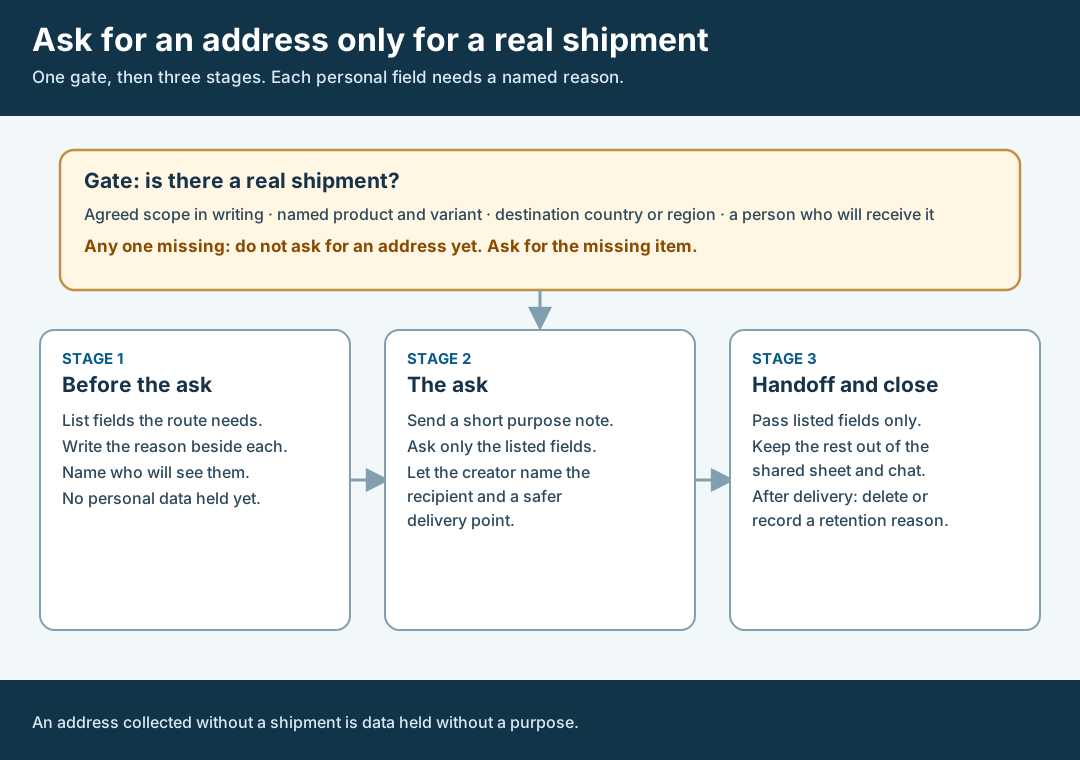
An original editorial map. No personal data is held until the gate is met and every field has a reason.
Original visual by Superdirector editorial team. Creation date not recorded.
Send a short purpose note with the request
Put the request in a short message that says what you are collecting and why. A workable note has five parts: the fields you are asking for, the purpose (to ship the agreed sample), who will see them (named roles, such as the person who packs and the carrier), how long you plan to keep them, and how the creator can ask you to correct or delete them. Keep it plain and short enough to read on a phone. The request should not look like a form with no explanation.
This habit mirrors what privacy rules commonly ask for at the moment of collection, though the duties differ by place and this page is not legal advice. Article 13 of the GDPR lists what a controller gives a person when collecting their data, including the purposes, the recipients or categories of recipients and how long the data will be stored or the criteria for deciding. GDPR Article 13. The California Attorney General’s CCPA page says a notice at collection lists the categories of personal information collected and the purposes for which they are used, and that it must be given at or before the point of collection. California Attorney General: CCPA. We cite both only to show that “what, why, who, how long” is a familiar shape. Neither page tells you what your own note must contain, because that turns on whether and how the law applies to you.
Let the creator choose the recipient and the delivery point. Some creators prefer a studio, a manager’s office, a post office box where the route allows it or a pickup point. Say so in the note: “If you would rather we ship to another person or place, tell us the name and address you want us to use.” Record the choice as theirs. You do not need to know whose home or office it is, and a request to explain it is itself an over-collection.
A free sample is also a fact that may need disclosure later. The FTC’s influencer guide says a brand giving free or discounted products is a material connection that should be disclosed, and that if a creator later mentions any of the brand’s products they should disclose even if not asked to mention that product. FTC Disclosures 101 for Social Media Influencers. That duty is separate from the privacy note, and the disclosure check handles it. Mentioning it in the same message is optional; keeping the two topics distinct in your records is not.
Walk through a fictional request
Fictional exercise: no real brand, creator, parcel or result was inspected. A made-up brand, Brand A, plans to send one pair of its made-up headphones, in the black variant, to Creator Q, who has accepted a written scope for two short videos. Creator Q lives in a country Brand A’s sender serves. On the card, Brand A marks the gate: scope accepted in an email dated that week, product and variant named, region confirmed, recipient to be named by Creator Q.
Brand A lists its fields. It writes recipient name (label), delivery address (delivery) and country (route). For the phone number, it checks the sender’s instructions for this destination and writes “not required by sender; do not ask.” For the email address, it already has Creator Q’s email from the thread, so it writes “already held; not requested again.” Anything else, such as a date of birth, is left off with the note “no rule requires it.”
The purpose note says, in a few sentences, that Brand A is asking for the three listed fields only to ship the agreed headphones, that the person who packs the parcel and the carrier will see them, that Brand A plans to review and delete the address after delivery is confirmed, and that Creator Q can name a different recipient or place. Creator Q replies with a studio address and a studio contact name. Brand A saves the reply as written, notes “recipient named by creator,” and hands the sender the name, address and country, and nothing else. After the delivery confirmation, Brand A deletes the address from the restricted file and writes the date on the card. The scenario predicts nothing about any real creator, sender or route.
Hand the sender only the fields it needs
When the reply comes, do not forward the whole thread. Copy only the listed fields into the place the sender works from, whether that is an order form, a fulfilment tool or a restricted sheet. The thread may include the creator’s rates, their comments about other brands, a personal note or a private phone number that served no shipping purpose. The sender does not need those, and forwarding them widens who holds the data.
Save the creator’s reply exactly as written, with the date, time and time zone, in the same restricted place as the card, not in a shared campaign tracker. On the card, record where it is saved and do not paste the address into the card itself. The card should be safe to hand to a colleague or a client who needs to see that the process was followed, because it shows the decisions and not the data.
Close the record after delivery
A shipment ends when the creator confirms they received the parcel or the carrier shows it as delivered, and you have decided what to do with the address. Record the delivery date and who confirmed it. Then pick one of two paths. Either delete the address from every place it was copied, or write down the reason you keep it and a date to review that reason. “It might be useful later” is not a reason you can name. A future sample for the same creator is, if it is actually planned and the creator knows.
The reason to close the record is the same as the reason to limit the request. Article 5(1)(e) of the GDPR describes keeping personal data in identifiable form for no longer than necessary for its purposes. GDPR Article 5. The ICO, the UK regulator, describes data minimisation as holding data that is adequate, relevant and limited, and advises reviewing the data you hold from time to time and deleting what you no longer need. ICO: data minimisation. Neither page gives a number of days or months, and this page does not either. Your counsel and your records policy set the period.
Keep the card itself. It contains no address, only the decisions: the gate you checked, the fields and reasons, the date and text of the note, the fields handed over, the delivery date and the deletion or retention decision. If a creator, a client or a colleague later asks whether you collected more than the shipment needed, the card answers from your own record.
What this page does not decide
This method decides when to ask for an address and what to collect. It does not tell you whether the privacy law of any country applies to your campaign, whether you need a formal notice, a lawful basis or a processor contract, or whether a creator may refuse. The legal sources cited here show the shape of common duties and do not state yours. For those questions, ask counsel.
It is also narrower than the neighbouring pages. The single-sample scheduling guide is about who holds one unit when, and what condition record to keep as it moves. The manager authority check is about whether the person you are talking to can bind the creator. The budget-first reply guide is about answering a creator who asks about money before scope, which is the stage that comes before the gate in this page. This page begins where those end: scope is agreed, a person is authorised, and the question is what personal data a parcel requires.
Nothing here measures how often creators decline to share an address, how many fields are typical or how a request affects acceptance. We have no such numbers and claim none. We also did not read any carrier’s domestic requirements, any fulfilment service’s data terms or any platform’s rules on sending addresses in direct messages, so this page states nothing about them. It is an editorial method for keeping each address request tied to a shipment, a reason and an end date.