How-To Guide
How to ask a creator to test an opening without rewriting their voice
Test the opening claim, not the creator: lock their voice, offer claims that differ, ask before filming and keep their reply as written.
By the Superdirector editorial team. FTC, TikTok and YouTube pages reviewed October 30, 2026.
At a glance
How should a brand request a creator hook test while leaving the creator’s voice intact?
Test the opening claim and nothing else. Write down the one claim the current opening makes, list what the creator keeps (their words, delivery, format and honest opinion), then offer two or three alternatives that each claim something different, described as intent rather than script. Send them as a question before anything is filmed, keep the creator’s reply exactly as written, and let them decline or propose their own opening. Record which alternatives stay, and say what the test can and cannot show.
- Change the claim, never the person who says it.
- Ask first: the creator can use, change or decline each alternative.
- State the test unit and its limit before any result arrives.
Direct answer
Short answer: ask the creator to test what the opening claims, and leave how they say it alone. In practice that is five moves. Name the one claim the current opening makes. Lock what the creator keeps: their words, delivery, format, pacing and honest opinion. Offer two or three alternatives that claim different things, described as intent rather than a script. Ask the creator before anything is filmed and keep the reply exactly as written. Then record the decision and say what the test can and cannot show.
This is for an agency or brand marketer who has a creator’s draft or an earlier post and a hypothesis about its opening, for example that a different first claim would give viewers a clearer reason to stay. The decision is narrow: how to word the request so the creator can say yes, change it or say no without losing their own voice. It does not decide which opening wins, how to run the split, or whether a result is good. Those have their own pages, listed in the boundary section below.
The reason to separate claim from voice is practical and, in part, regulatory. A request that says “open with this sentence” changes two things at once, so you cannot tell whether a different outcome came from the claim or from a creator reading someone else’s line. A request that names a claim and leaves the words to the creator changes one thing. Use the blank hook alternatives card, the CSV register and the hook test map to keep the request in one place.
Name the one claim the opening makes
Start by writing down what a viewer would take away from the opening, as one sentence. Not the creator’s wording, not your summary of the whole video: the statement the first moments make. An opening can show a problem, state a feature, promise an outcome, ask a question or make a comparison. Each of those is a different claim, and naming which one the current opening makes is what lets you offer a real alternative later instead of a rewording.
Then tie that sentence to something you can check: a product fact with its version and the proof you hold, or a plain note that the opening makes no product claim at all. If the claim is about what the product does, use the version you have actually verified, as in the versioned product facts guide. If it is a number or a result, the claim verification guide comes first, because a hook test must not become the way an unsupported statement gets into a video.
Write down what the claim cannot say. A feature claim may not imply a result the feature does not give. A before-and-after opening may not show an outcome the creator did not get. These limits go on the card next to the claim, because they are what you will hold every alternative to.
Be honest about the timing question too. TikTok’s creative best-practices page for performance ads says to prioritize the hook in the first 6 seconds and to introduce the content proposition in the first 3 seconds, and it suggests building the hook with suspense, surprise or other emotions. TikTok: creative best practices for performance ads. That is guidance for ads on one platform. It does not say that any particular opening is better, and it does not set a length for a creator’s organic post, so use it only to decide which moments of the video “the opening” covers for your test, and write that span on the card.
Lock what the creator keeps
Before you write any alternative, list what the test will not touch. A workable lock list has at least five lines: the creator’s own words, their delivery (tone, pace, humour, accent, how they address the camera), their format (the way they usually structure a video), their pacing and their honest opinion of the product. Add anything else the creator has told you matters to their audience. Put the list at the top of the request, so the first thing the creator reads is what you are not asking them to change.
There is a reason to treat the last item as a hard line and not a courtesy. The FTC’s Endorsement Guides, in 16 CFR 255.1, say that endorsements must reflect the honest opinions, findings, beliefs or experience of the endorser, and that an endorsement may not be presented out of context or reworded so as to distort the endorser’s opinion or experience. The same section says advertisers can be liable for misleading or unsubstantiated statements made through endorsements, and that an advertiser may be liable for a deceptive endorsement even when the endorser is not. It also describes guidance, monitoring and corrective action as steps for advertisers, while saying they are not a safe harbor. This page does not apply that rule to your case. It uses the rule to explain why the request should ask for a claim the creator can truthfully make, and why it should not hand them a claim to say.
The lock also protects the experiment. If the creator’s delivery changes between alternatives, you will not know whether a difference came from the claim or from a performance. Keeping the creator’s voice constant is not only polite, it is how the claim becomes the only thing that varies.
| Item | Locked for the creator | Open to the test |
|---|---|---|
| Words | Every sentence the creator says | Nothing: you suggest a claim, not a line |
| Delivery | Tone, pace, humour, framing to camera | Nothing |
| Format | Their usual structure and length habits | Which claim the first moments carry |
| Opinion | What they honestly think of the product | Nothing: a claim they would not make is a decline, not a problem |
| Proof shown | How they show the product | Which verified fact the opening points to |
Write openings that differ in claim, not voice
Now write two or three alternatives, each as a single line of intent in the grid on the card: the claim, the proof you hold, and what a viewer should be able to see or hear first. Describe, do not script. “Open on the problem of losing a file between devices” is intent. “Say: ‘Stop losing your files’” is a script, and it takes the words away from the creator.
Make the alternatives differ in the claim, not in polish. Three versions of the same promise in different words are one alternative three times, and a creator will rightly ask what you want. TikTok’s best-practices page says that, as a general rule, it is better to use creatives with big differences, especially when testing, and recommends continuous testing and learning. It does not say that the differences should be in the hook, and it does not describe how to ask a creator for them. Treat “differ in the claim” as this page’s own rule, borrowing only the general point that near-identical versions teach little.
YouTube’s help page for its title and thumbnail test makes a similar point from the other side: it says very similar variations can make a test run longer or end without a winner. YouTube Help: A/B test titles and thumbnails. Note what that tool compares, though. It tests titles and thumbnails, up to three of them, by watch time share, and the page lists Shorts as not testable. It is a platform feature for packaging, and it does not test a spoken opening. Each tool has its own unit, so write down the unit for your test.
Check every alternative against the “cannot say” line from the first step. If an alternative needs a claim you have not verified, drop it or verify the claim first. Keep one alternative that is the creator’s current opening, described as they made it, so the creator is never asked to judge only your ideas.
When enlarged, scroll horizontally to read the diagram.
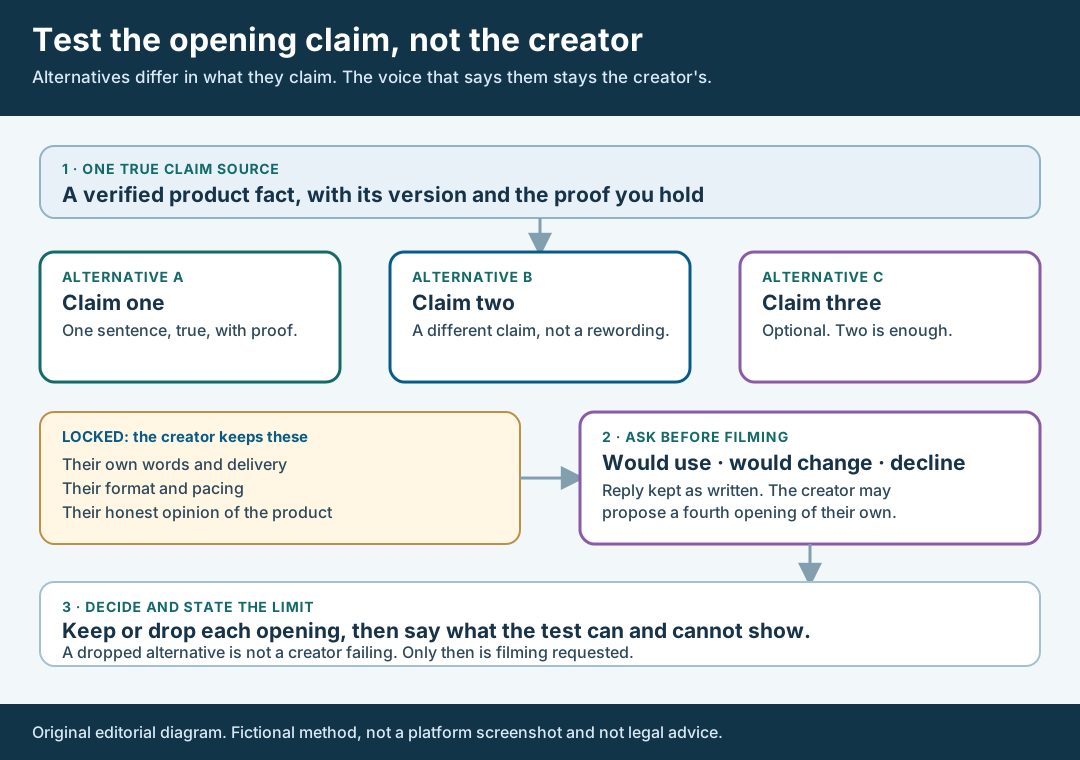
An original editorial map. The alternatives differ in the claim, and the voice that says them stays the creator’s.
Original visual by Superdirector editorial team. Creation date not recorded.
Ask the creator before anything is filmed
Send the grid to the creator as a question, not an instruction, and before any filming. Lead with the lock list so they see what you are not changing. Then ask three things for each alternative: would you use it as it is, would you change it, or would you decline it? And ask what they would say instead. Offer them room to propose a fourth opening of their own that makes one of your claims true in their words, because a creator often knows what their audience will accept in a way a brief cannot.
Give them an easy way to refuse. Say that declining an alternative is a normal answer, that you will keep their original opening if none fits, and that a decline will not be treated as non-cooperation. The reply you want is the creator’s real view, and a request that punishes “no” collects polite yeses.
Save the reply exactly as written, with the date, time and time zone you received it, in the reply column of the card. Do not summarize it, and do not merge two creators’ answers. If the creator proposes wording of their own, paste that verbatim and mark it as theirs. If they ask a question, such as whether a claim is accurate for the current version, answer it before asking again, and keep the thread together with the grid. If no reply comes, record the date you asked and the date you chased and that none was received. An unanswered request is a fact about the process and not a verdict on any alternative.
Record the decision and what the test can show
For each alternative, write one decision: keep it, drop it, or ask again with a changed claim. Record who decided and when, and quote the creator’s reply beside the decision. An alternative the creator declined is dropped, not argued. An alternative the creator would change goes forward only in the creator’s changed version, which you then check against the “cannot say” line again. Only after this step do you ask for filming, and the request should name the alternatives that remain and nothing else.
Then write what the test compares and what it cannot show, before any result exists. The unit might be two posts, a post and an ad built from it, or two ad creatives. Each of those has its own confounds: two organic posts differ in date and audience as well as in opening, and an ad needs the creator’s agreement to be run at all. Rights to run a creator’s organic post as an ad are covered in the paid-use agreement guide, and keeping organic and paid readings apart is in the organic and paid results guide. Write down the window, and do not change the title or thumbnail or any compared element mid-test if the tool you use ends a test when you do: YouTube’s page says changing a title or thumbnail during its test stops the test, and that tests should be completed within two weeks.
Also write the reading limits. A difference between two openings does not show why viewers behaved differently, it does not carry over to another creator or product, and a small difference may be noise. YouTube’s page describes three outcomes, a winner, performed the same and inconclusive, and shows the first uploaded title or title and thumbnail combination to everyone when there is no clear winner. Decide in advance that “no clear difference” is an acceptable result, and that you will then keep the creator’s original opening.
Close by deciding what a result may change. A result can change your next brief, for example by favouring one kind of claim for that creator’s next post. It should not change the creator’s lock list, and it should not be used to argue the creator back toward wording they declined. If you want a structured way to turn a weak outcome into one next change, the next-test worksheet does that after the fact; this page makes the request before the fact.
Walk through a fictional hook request
Fictional exercise: no real brand, creator, campaign or result was inspected. A made-up brand, Brand A, sells a note-taking app with a verified fact, version 3.2: notes sync between phone and laptop. Creator Q’s earlier video opens on a messy desk and says, in Q’s own words, that the app tidied things up. The reviewer names the current opening claim as an outcome claim, “this app makes you organized,” and notes that Brand A holds no proof of that outcome, so the claim is written on the card as not supportable as stated.
The lock list says Q keeps their words, delivery, format, pacing and opinion. The reviewer writes two alternatives as intent. Alternative A: open on the problem of a note missing on the second device, with the proof being the version 3.2 sync record. Alternative B: open on a plain demonstration of the same note appearing on the laptop, with the same proof. Both are claims Brand A can support and both differ in what they claim, one a problem and one a demonstration. The reviewer also lists Q’s current opening as alternative C, described as Q made it, with its outcome claim flagged.
Creator Q replies in writing. Suppose the reply says A feels natural, B feels like an advertisement and they would not say C’s outcome line any more, because they were never sure it was true. Brand A pastes that reply as written, marks A keep, B drop, and C drop because the claim cannot be supported. The test unit is stated as two ads built from two posts over a stated window, and the “will not show” line says the test cannot show why viewers behaved differently. The scenario predicts nothing about any real creator or product.
What this page does not decide
This method makes a request about an opening. It does not tell you which opening is best, how to run or read the experiment, or whether a result is meaningful. Whether a claim is supported belongs to the claim verification guide and, for disclosures, to the FTC’s own guidance. If a point turns on law or on the meaning of your agreement, send it to counsel.
How it differs from the closest pages. The next-test worksheet starts after a campaign underdelivers and turns the result into one changed variable; this page starts before filming and produces a request to the creator. The first-cut review guide sorts comments on a cut that exists; this page shapes an opening that has not been filmed. The buyer objection brief guide briefs a creator from one quoted objection and proof you own; this page offers claim alternatives for an opening that already exists. The CTA rehearsal guide checks the closing call to action against the first screen of the destination, where this page concerns the opening claim. The software proof screens guide plans what to show on screen for a software task; here the subject is what the first moments claim, and the creator’s voice is the fixed element.
Nothing here measures how often a different opening beats an original, how much any opening matters or what a creator’s audience will accept. Those numbers are not available to us and are not claimed. We also did not verify Meta’s A/B testing documentation, so this page says nothing about it, and the TikTok and YouTube pages quoted above describe their own tools and ads guidance only. The page is an editorial method for keeping claim, voice, the creator’s reply and the limits of a test apart, so each statement about a hook rests on its own evidence.