How-To Guide
Turn one buyer objection into a creator video brief without scripting the creator’s opinion
Quote one buyer objection, pair it with proof you own, and brief a creator on what to show while their experience stays in their own words.
By the Superdirector editorial team. FTC endorsement guidance reviewed October 30, 2026.
At a glance
How should one buyer objection shape a creator video?
Quote one objection exactly as the buyer wrote it, with its source and date. Name something a viewer could see or check that would answer it, and confirm a named owner holds that proof for the product version you verified. Then split the brief in two: a short list of facts the creator must state or show exactly, each with its source, and an open space for what the creator tried and noticed in their own words. Brief them as a request they can accept or decline, and check the first cut for the proof, not for a recited sentence.
- One objection, one source, one date, no claim about how common it is.
- Answer it with a showable proof, not a slogan.
- Facts carry sources; the opinion stays the creator’s.
Direct answer
Short answer: pick one reservation a real buyer expressed, copy it down word for word, and decide what a viewer could see or check that would answer it. Make sure someone on your side owns that proof for the product version you verified. Then write the creator brief in two parts: the few facts that must be exact, each with its source, and an open space for what the creator actually tried, noticed or thought. The creator is asked to show the proof, not to recite a sentence that answers the objection for you.
This is for an agency or brand marketer who has heard a buyer worry (“I already have a spreadsheet for this”, “it looks too complicated for my team”) and wants a creator video to address it. The decision is narrow: which proof to ask the creator to show for this one worry, and which words to leave to the creator. It does not decide whether the objection is common, whether the video will change a buyer’s mind, or which creator should make it. No evidence about those questions is available to us, and none is claimed here.
The reason to work from an objection and not from a feature list is that a feature list answers a question nobody asked. The reason to avoid scripting the answer is that the video then sounds like the brand talking through someone else’s mouth, and the person speaking may be asked to say things they have not experienced. Use the blank objection-to-proof card, the CSV register and the path map. All three are blank or fictional teaching aids, and none represents a real campaign, buyer or creator.
Quote one objection in the buyer’s own words
Start with a sentence a buyer actually wrote or said, not a theme your team summarized. Copy it exactly, including the awkward phrasing, and record where it came from (a support message, a sales call note, a public review or comment), when it was written and who the writer was in that source, such as a prospect who had not bought or a customer who had. If a colleague retold it, label it as a retelling. A retelling is useful for finding what to look into, but it is no longer the buyer’s language.
Then write one line the source cannot tell you. A single message does not say how many buyers feel the same way, whether the writer is typical of the audience a creator reaches, or whether the worry was resolved by something else. Keep that line on the card. It is the guard against the most common slide in this kind of work, which is turning “one person said this” into “buyers think this”. If the source is private, such as a support ticket, note that someone with authority over the record must confirm you may use the wording before it is shown anywhere public.
Choose one objection per brief. Two objections in one short video compete for the same few seconds, and the creator cannot tell which one matters. A third objection can be a second card and a second video. If you cannot decide which to take first, that is a signal to look at your own records again and not to include both. How to choose which creators to approach for a particular buyer task is covered separately in the buyer-task shortlist guide.
Name the proof that would answer it
For the quoted objection, write one sentence that starts “A viewer could see…” or “A viewer could check…”. The sentence must name something observable: a task completed on screen, a side-by-side of the old way and the new way, a setting a buyer can find, a document a buyer can read. “The product is simple” is not a proof; it is a conclusion. “A viewer sees the first task finished in the order the product presents it” is a proof, provided it is true for the version you are using.
Check the proof against the objection, not against your feature list. If the worry was “I already have a spreadsheet for this”, a screen tour of unrelated features does not answer it, while showing the same everyday task done the old way and in the product might. If the worry was about cost, a proof has to be a published price or a stated plan on a page the viewer can open, not a creator’s feeling that it was worth it. If you cannot name a viewable proof, record that plainly: the objection is not answerable in video today.
Tie the proof to the exact product version and the date you looked at it. Interfaces change, and a proof that was true last quarter can be wrong in the creator’s footage. The method for choosing which screens to capture is in the software proof screens guide; this page decides which objection that capture is for. Keep the two decisions apart, so the shot list is never invented before the worry it answers has been written down.
Find an owner and a source for each proof
For each proof, record who can vouch for it, what record supports it and when that record was captured. The owner might be the product lead for a workflow, the finance contact for a price, or the support lead for a policy. The record might be a dated screen capture, a published page with its capture date, or a written confirmation. If you only have a colleague’s memory, record it as unconfirmed and ask for the record before you brief anyone.
The legal reason to do this is plain. Under the FTC’s Endorsement Guides, 16 CFR 255.1 says an endorsement may not convey a representation that would be deceptive if the advertiser made it directly, and says advertisers can be liable for misleading or unsubstantiated statements made through endorsements. A proof with no owner and no record is a claim waiting to be repeated by a creator. Read the rule itself; this page only summarizes the parts it relies on, and it is not legal advice.
Allow three honest results for each proof: it exists, it exists in part or it does not exist. A partial proof should say which part is missing. When the result is “does not exist”, do one of three things: replace the objection with one you can answer, hold it until the owner can produce the proof, or drop it. Do not put the objection in the brief and rely on the creator to make the point charmingly. If the claim involves a performance statement that must be supported before posting, the creator product claims guide covers the evidence step.
When enlarged, scroll horizontally to read the diagram.
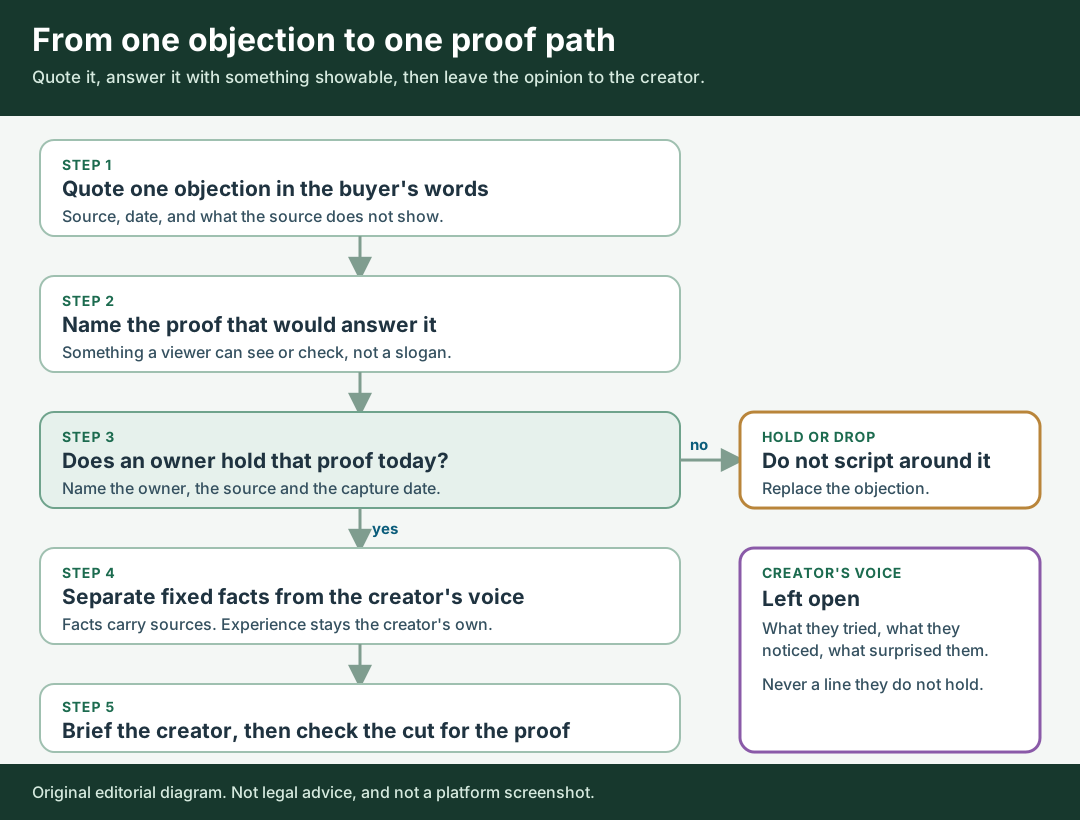
An original editorial path map. An objection with no proof you can show stays open and is not turned into a script line.
Original visual by Superdirector editorial team. Creation date not recorded.
Separate fixed facts from the creator’s voice
Now split the brief in two. The fixed facts list holds only statements that must be exact because getting them wrong would mislead a viewer: a product name, a price on a stated date, what a plan includes, a limit, an availability condition. Each fact carries its source and version. Keep this list short. Every fixed fact is something the creator must check against your record, so a long list is a sign that you are scripting.
The creator’s voice list is what you leave open on purpose: what they tried, what they noticed, what was unclear to them, what they would tell a friend. This is not generosity; it is the part the rule protects. 16 CFR 255.1(a) says an endorsement must reflect the honest opinions, findings, beliefs or experience of the endorser. A sentence they did not form from their own use cannot be offered as their experience. The FTC’s Endorsement Guides question-and-answer page separately says pre-written posts are not inherently wrong when the influencer is truthful, and that training material should describe what endorsers can and cannot say about your products. So a written script is not banned. This method simply keeps the opinion where it can be true.
Add a third short list: lines the creator may not say unless supported, with the person to ask. This is where you put the claims your records do not support, such as a result, a comparison or a guarantee. The same FTC page warns that an endorser who is not an expert may be liable for misleading or unsubstantiated statements, including statements that go beyond their own experience, so a creator needs a clear way to ask instead of guessing. Give them a name and a way to reach it. For the facts that sales and product teams disagree about, settle them first using the versioned product facts guide, then bring only the settled ones here.
Walk through a fictional objection
Fictional exercise: no real brand, buyer, creator, product or result was inspected. A made-up brand, Brand A, sells a scheduling tool. A made-up prospect wrote to Brand A’s sales inbox: “I already track this in a spreadsheet, so why would I move?” The team copies it onto the card with its date, labels the writer a prospect who had not bought, and records that the message does not show how many prospects share the worry.
The proof sentence reads: “A viewer could see the same weekly schedule built in a spreadsheet and in the tool, in the order a first-time user would do it.” The product lead is named owner and supplies a dated capture of the tool’s first-run screens for the checked version. The spreadsheet half is something the creator can film themselves. The team notes that the capture covers the first run only, so the brief will not ask the creator to say anything about advanced features.
Fixed facts: the product’s name as written, and the plan the creator was given for filming, with its source. Creator’s voice: how long each approach felt to them, anything confusing, and whether they would keep using either. Lines not to say without support: any claim about time saved or about how other teams work. If the product lead had produced no capture, the card would end in “hold”, and the team would pick another objection. The scenario predicts nothing about a real video, a real audience or any result.
Brief the creator, then check the cut for the proof
Send the creator the proof path as a request: the worry in neutral terms (not necessarily the buyer’s words), the proof you would like shown, the fixed facts with sources, the open space and the lines that need support first. Say plainly that they may adjust the approach, tell you if the product does not behave as the brief expects, or decline. If the creator reports that the proof does not hold up in their hands, that is a finding about the product or the brief, and it should go to the owner before anyone edits the video to hide it. The general structure of a creator brief is in the UGC content brief guide.
Ask the creator to confirm in their own words what they will say about their experience. This is a short written note, not a script, and it lets you see early whether the opinion is theirs. Do not supply replacement wording for it. If the note makes a statement your records cannot support, send it to the proof owner and let the owner answer.
When the first cut arrives, look for the proof, not for a recited answer. Is the task shown the way the brief described? Does the on-screen product match the version you checked? Are the fixed facts exact? Has the creator said anything on your unsupported list? Record each finding against the card, then use the first-cut review guide to sort comments into obligations, outside-rule gates, brief gaps and preferences. A disclosure of the paid relationship is its own check, covered in the disclosure caption and video guide.
Close the card by writing which of four outcomes applies: used, objection replaced, objection dropped or held for proof. Record the next owner and date. Nothing on the card claims that the video persuaded anyone. If you later measure a result, record it elsewhere with its own method and window, and do not edit the card to match it.
What this page does not decide
This method links one quoted worry to one showable proof and keeps the creator’s opinion their own. It does not replace the checks around it: choosing the creators in the first place, handing them settled product facts, planning the screens, reviewing the cut and confirming the published post. Each has its own page, linked above.
It also does not say how common any objection is, how many buyers a video reaches, whether answering a worry changes a purchase, or how to word a legal disclosure. The sources used are two FTC pages, the endorsement rule at 16 CFR 255.1 and the question-and-answer page, both read on October 30, 2026. They support the narrow statements made about honest opinion, advertiser responsibility and truthful pre-written content. They do not say that any particular video is lawful. Send legal questions to counsel.