How-To Guide
What does a sample influencer contract look like, clause by clause?
A twelve-clause sample influencer contract for one paid post, with copyable wording, blanks marked, payment after the post is live, and a dated example.
By the Superdirector editorial team. FTC, Copyright Act, YouTube and vendor pages read November 3 and 4, 2026; vendor numbers are labeled as theirs. Sample wording for US deals only. Not legal advice.
At a glance
What does a sample influencer contract look like, clause by clause?
A one-post influencer contract has nine parts and twelve numbered clauses: parties, deliverable and window, approval, disclosure, fee and payment trigger, content rights, exclusivity and keep-live, ending early, and signatures. Pay the fee after the post is live, license the content for named uses and day counts, and set the planned publish date and the end of the window once, then count the approval, payment, license and keep-live dates from the publish date (payment also waits for the brand's confirmation window). This page prints sample wording for US deals. It is not legal advice.
- Disclosure has the most outside law behind it: the FTC Guides put liability on the advertiser as well as the creator.
- A license for named uses and dates is lighter than a transfer, which needs a signed writing.
- Payment splits, exclusivity lengths and keep-live periods have no sourced market norm. Write dates, not adjectives.
Direct answer
Short answer: a sample influencer contract for one paid post has nine parts: the parties, the deliverable and post window, approval, disclosure, the fee and when it is paid, content rights, exclusivity and a keep-live period, ending early, and signatures. Written out, that is twelve numbered clauses. Each clause below comes with wording you can copy, a [BRACKET] for every choice that is yours, and a line on why the clause is there.
This page is for a brand marketer or founder who has to send a creator a first agreement for one Reel, Short or TikTok. Not legal advice, US only: no lawyer has reviewed this wording, and no clause is a standard or recommended term. This is the page to copy wording from; the clause guide is the page for why each choice exists. One choice differs from most samples: the fee is paid after the post is live and checked, with no deposit. That is our preference, not a market norm.
We read the sample contracts and clause guides that Gemini cited for this query on November 3 and 4, 2026, the FTC Endorsement Guides on eCFR, two sections of the Copyright Act (17 U.S.C. 101 and 204) and YouTube's branded-content help page. Numbers from vendor pages are labeled as theirs. We could not read Instagram's current label help page, so this page describes a platform setting only for YouTube.
The skeleton on one page
Read this table first. It shows which clause settles which question, so you can find the part you are missing. Before you send any of it to a creator, check their media kit.
| Part | Clauses | What it settles | Blanks you fill |
|---|---|---|---|
| Parties | 1 | Who is bound | Legal names, handle, date |
| Deliverable and window | 2, 3 | What is made, where it posts, by when | Format, length, account, dates |
| Approval | 4 | Who reviews the draft and how fast | Rounds, business days, or none |
| Disclosure | 5 | How the post is marked as paid | Wording, fix deadline |
| Fee and payment | 6, 7 | How much, and the event that triggers payment | Amount, business days, method |
| Content rights | 8 | What the brand may do with the video, until when | Uses, platforms, countries, end date |
| Exclusivity and keep-live | 9, 10 | Competitor limits and how long the post stays up | Category, competitors, days |
| Ending early | 11 | Notice, fix period, pay for work done | Notice days |
| Status and signatures | 12 | Contractor status, changes in writing, governing law | State, signers |
Name the parties, the deliverable and the post window
Start with what is made, where it appears and by when. A deal priced on one creator's audience only works if the post lands on that creator's account, so name the account.
1. PARTIES. This agreement is made on [DATE] between [BRAND LEGAL NAME] ("Brand") and [CREATOR LEGAL NAME], known online as [HANDLE] ("Creator").

2. DELIVERABLE. Creator will produce and publish one [FORMAT, e.g. Instagram Reel] of [LENGTH, e.g. 30 to 60 seconds] on the account [HANDLE]. The post will [tag @BRAND HANDLE / add Brand as a collaborator], show [PRODUCT OR FEATURE], and put [LINK OR CODE] in the [CAPTION / BIO]. Creator confirms the video is original and that Creator has the right to use all music, images and other material in it. Creator keeps creative control over script, tone and style inside these requirements. Brand will not ask Creator to make claims about [BANNED CLAIMS].

3. POST WINDOW. Creator will publish on [PLANNED DATE] and no later than [END DATE]. If Creator cannot publish by the end date, Creator tells Brand at least [3] days before the end date and both agree a new date in writing. The planned date can be moved the same way, by agreement in writing.
Of the four we read, most skip this part or leave it generic. The sample on Collabstr's page is a general freelancer contract: it says "The Client will pay the Influencer a rate of $99.00 (USD) per hour" and "This Contract is ongoing, until ended by the Client or the Influencer." That fits a retainer. It has no post, no account and no window, which are the three things a single paid post is about.
Put the brief's must-haves in clause 2 and keep the rest in a separate creator brief, so a changed hashtag does not mean a new contract.
Set approval and the disclosure line
Two clauses protect both sides before anything goes live. Approval says who reviews the draft and how fast. Disclosure says how the post is marked as paid. Choose one approval option and delete the other.
4. APPROVAL. [Option A: No approval step. Creator publishes within the requirements in clause 2.]
[Option B: Creator sends a draft [7] days before the planned publish date in clause 3. Brand replies once, in writing, within [2] business days. Creator makes one round of changes within [2] business days. If Brand does not reply in time, the draft is approved.]

5. DISCLOSURE. Creator will mark the post as paid on every platform where it appears, using the platform's paid-partnership or branded-content setting and a plain statement at the start of the caption (for example "#ad" or "Paid partnership with [BRAND]"). In video, the disclosure is also shown on screen near the start, and said aloud when the endorsement is spoken. Brand will not ask Creator to hide the relationship. Brand may check the live post and ask for a fix, and Creator will make it within [24] hours of notice.
The disclosure clause carries the most outside law. Under the FTC Endorsement Guides, a connection that might materially affect the weight or credibility of an endorsement, and that the audience would not expect, "must be disclosed clearly and conspicuously", and clear and conspicuous means "difficult to miss" and easily understandable by ordinary consumers. The same text says an advertiser may be liable for a deceptive endorsement, and the regulation says this holds even if the endorser is not liable, and that endorsers may be liable too. So the brand has a reason to write the duty down and to check the post.
The Guides also say good faith and effective guidance, monitoring and remedial action are "not a safe harbor" but should reduce an advertiser's enforcement risk. Clause 5 is the guidance, and the check and the fix deadline are the monitoring and the remedy. On YouTube, the paid promotion button adds a label at the start of the video.
On wording, Inhouse's guide names "#ad" and "Sponsored by [your brand]" as labels that will generally do at the start of a post, and says that vaguer tags or a brand tag on its own will not. Treat that as one vendor's reading. The FTC text does not list approved words. It does give an example where a disclosure only on the profile page was not clear and conspicuous.
Option B's rule that silence means approval is a choice, and it favors the creator. It stops a draft from sitting in an inbox. Use a count you can meet.
Pay the fee after the post is live
This is where our sample differs from most. We prefer to pay the fee after the agreed post is live and verified, with no upfront payment and no 50/50 split, and that is a preference, not a norm. The sample therefore has two payment clauses and no deposit line: one for the amount and one for the event that triggers it. Expect some creators to ask for a deposit on a first paid post; the fallback line below is for that case.
6. FEE. Brand will pay Creator [AMOUNT] [CURRENCY] for the deliverable in clause 2. No other fee, expense or bonus is owed except under clause 8(c) or unless this agreement is changed in writing. [Optional: Creator also receives [PRODUCT OR ACCESS].]

7. WHEN PAYMENT IS DUE. Brand confirms within [2] business days of the post going live that it matches clauses 2 and 5, or lists what must change. Creator makes the listed changes within the fix time in clause 5 and tells Brand when they are done, and Brand confirms them within [2] business days. Payment is due [7] business days after the post goes live or [3] business days after Brand's final confirmation, whichever is later, by [PAYPAL / BANK TRANSFER] to the details Creator gives in writing. If Brand does not confirm or list changes within those times, the post is treated as accepted, the last day for Brand to confirm counts as the final confirmation, and the payment date still runs. Except as clause 11 provides, nothing is paid before the post is live. If Creator does not make the listed changes in that time, clause 11 applies.
Sources split on this. InfluencerFee says "The standard payment structure for influencer contracts is 50% upfront, 50% on delivery and approval", with no method behind it. Inhouse's guide says to tie payment to delivery, for example "half on signing and half once the post goes live and meets the brief." Talentir, a payout vendor, says "Pay on approval or delivery is the low-risk modern default" and that upfront "fits untested partners only." None of the three gives data, so we treat the split as open. Pick one on purpose and write it down.
If you decide to offer a deposit, add it as a separate line with its own date and say what happens to it if no post goes live. Do not blur it into clause 7, but add “or clause 6A” to the sentence in clause 7 that begins “Except as clause 11 provides”. A fallback line: “6A. DEPOSIT. Brand pays [AMOUNT] within [5] business days after signing. If no post goes live by [END DATE] for a reason other than Brand’s breach, Creator refunds it within [7] days. The deposit is deducted from the fee in clause 6.” Whatever you choose, name a date or a count of business days. Flag Red warns that terms like "payment upon completion" without a specific date can delay your earnings.
The amount itself is a business decision this page cannot give you. For ranges and the method behind them, see how much to pay influencers and UGC price per video.
License the content, do not transfer it
Paying for a post does not by itself give the brand the video. Inhouse's guide puts it this way: "Absent a written agreement, the creator owns the content." Most brands need a license for the uses they plan, not ownership. The clause below lists the uses and gives each an end.
8. CONTENT RIGHTS. Creator owns the video and keeps all rights not listed here. Creator gives Brand a non-exclusive, royalty-free license to: (a) repost or share the post on Brand's own accounts with credit to Creator, for [90] days after the post is published; (b) show screenshots or clips of the post in Brand marketing with credit, for [90] days after the post is published; [(c) run the post as a paid ad from Creator's handle or Brand's account, on [PLATFORMS], in [COUNTRIES], for [60] days after the post is published, for an added fee of [AMOUNT] paid with the fee in clause 7]. Each use ends when its period ends. Any other use needs Creator's written permission. Brand may [add captions and trim for length / not edit the video].The law behind this is short. A transfer of copyright ownership "is not valid unless" it is in a writing signed by the owner or the owner's duly authorized agent, with exceptions such as transfers by operation of law. The statute counts an exclusive license as a transfer and leaves a nonexclusive license out of that definition. A license limited to named uses and dates is the lighter ask and the easier one for a creator to sign.
Some samples go the other way. Collabstr's sample says the creator "hereby gives the Client this work product once the Client pays for it in full." LawDepot's preview calls the intellectual property a "work made for hire", a status that gives the commissioning party the rights from the start. The Copyright Act defines a commissioned work as made for hire only when it falls in a listed category and the parties sign a writing saying so. Whether a creator's short video fits a listed category is a question for counsel, and a license avoids it.
For paid ads, the license is only part of the work: whitelisting and partnership ads need the creator's account permissions too. For the fee, see pricing a usage-rights request. Inhouse's guide suggests a set period, often 3 to 12 months in the US; that is practice, not law. Treat a wider license as an optional extra and price it as its own line. The usage rights checklist covers the grant in more depth.
Limit exclusivity and set a keep-live period
Exclusivity stops the creator from posting for a competitor around your post. Keep-live stops the post from vanishing the week after you paid for it. Both need a number and a start date, and both are choices with no sourced market norm.
9. EXCLUSIVITY. [Option A: None. Creator may work with any brand at any time.]
[Option B: For [30] days after the post is published, Creator will not post paid content for [CATEGORY, e.g. AI video analysis tools], including [COMPETITOR 1] and [COMPETITOR 2].]

10. KEEP-LIVE. The post stays live on Creator's account, unedited except under clauses 5, 7 and this clause, for at least [90] days after it is published. If Creator removes it earlier, other than to fix it under clause 5 or 7, Creator will repost it or refund [AMOUNT OR SHARE OF THE FEE]. Brand may ask Creator to edit or take down the post within [48] hours of notice if it contains a statement that is false or breaks a law or platform rule; the keep-live period then ends.
Name the category and a few competitors, not "all brands". Compare how open-ended some samples are: the Collabstr sample says the creator "won't work for a competitor of the Client until this Contract ends", which for a contract that runs until either side ends it is a ban with no fixed end. Count the days from the publish date so these dates hang from one event.
The 30 and 90 days here are example picks, not market figures. Price exclusivity as its own line if you ask for it.
Add termination, status and signatures
The last two clauses cover what happens if the deal breaks and the legal basics. A one-post agreement does not need every boilerplate clause that a general contractor template carries. Add a confidentiality line if you share unreleased features or pricing.
11. ENDING EARLY. Either party may end this agreement by [7] days' written notice if the other breaches a term and does not fix it within that time. If Brand ends it after Creator has begun production, Brand pays for the work completed, in proportion. If Creator does not deliver and gave no notice, no fee is owed.

12. STATUS AND GENERAL. Creator is an independent contractor, pays their own taxes and is not Brand's employee. This is the whole agreement. Changes must be in writing and signed by both parties. The law of [STATE] governs. [Disputes go first to good-faith talks, then to [ARBITRATION / COURT] in [CITY].]

Signed: [BRAND SIGNER, TITLE] ______________  Date ________
        [CREATOR NAME] ______________  Date ________
Clause 11 pays for work done and nothing for a no-show, which is the main exception to the pay-after-posting rule in clause 7. Some vendors price a cancellation more heavily; InfluencerFee lists a kill fee of "25–50% of total fee if cancelled after brief received but before production begins", a range with no stated method. A kill fee only makes sense if you pay upfront or the creator has booked time; decide it with the payment terms.
A filled example with dates
To check that the clauses fit together, hang the dates from the post date. This is a fictional deal signed on Monday, November 16, 2026, using option B for approval, a fee of $1,200 and a paid-ad license add-on of $300 (both made-up figures). The table assumes the brand lists no fixes after the post goes live. The day counts are the brackets in clauses 4, 7, 8, 9 and 10 above; the planned post date is the one date you pick: here Tuesday, December 8, with the post window ending Tuesday, December 15.
| Date | Event | Clause |
|---|---|---|
| Mon Nov 16, 2026 | Agreement signed | 12 |
| Tue Dec 1 | Draft due, 7 days before the post | 4 |
| Thu Dec 3 | Brand replies, 2 business days | 4 |
| Mon Dec 7 | Creator's changes due, 2 business days | 4 |
| Tue Dec 8 | Post goes live with the paid label and start-of-caption disclosure | 3, 5 |
| Thu Dec 10 | Brand confirms the post or lists fixes, 2 business days | 7 |
| Thu Dec 17 | Fee paid, 7 business days after the post went live ($1,200, plus $300 for the paid-ad license, both fictional) | 7 |
| Thu Jan 7, 2027 | Exclusivity ends, 30 days after the post | 9 |
| Sat Feb 6, 2027 | Paid-ad license ends, 60 days after the post | 8 |
| Mon Mar 8, 2027 | Keep-live period and the 90-day repost and screenshot licenses end, 90 days after the post | 8, 10 |
Notice that the dates after the post move if the post moves. That is the point of counting from the publish date. If the creator and brand agree in writing under clause 3 that the post goes live on December 11 instead, the confirmation, fee, exclusivity, license and keep-live dates all move with it. The draft and approval dates were counted back from the planned date, so reset them too. The end of the post window in clause 3 holds unless both sides agree a new date in writing, so check that the new date still falls before it.
When enlarged, scroll horizontally to read the diagram.
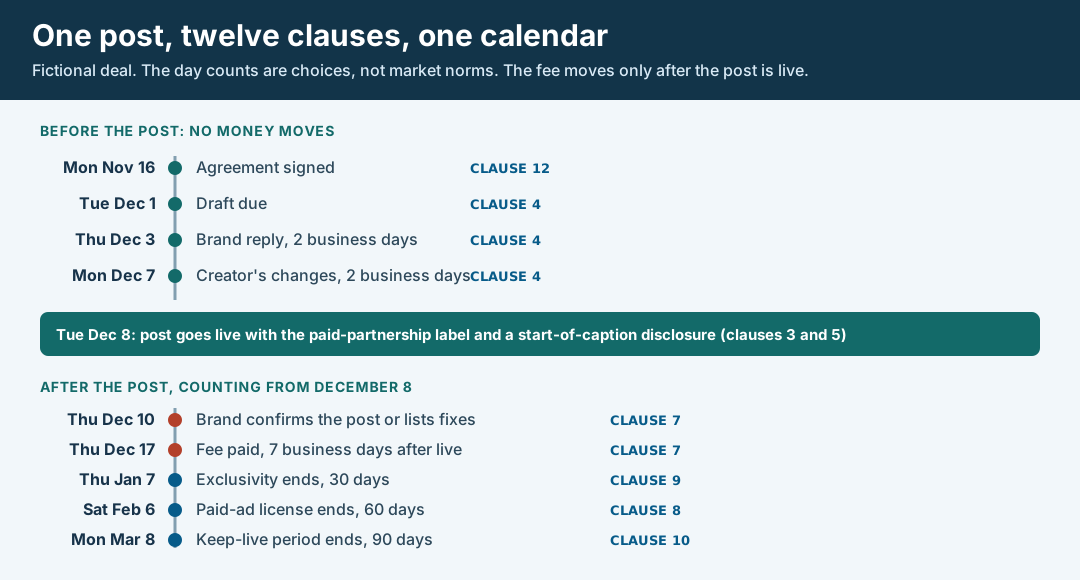
An original diagram of a hypothetical deal. The day counts are choices, not market norms.
Original visual by Superdirector editorial team. Creation date not recorded.
What the free samples in the results leave out
Most pages Gemini cited for this query are generators and clause lists. We read the four below; LawDepot's was a preview only. Their gaps are specific to a one-post deal, and they are not wrong for the uses they were made for.
| Page | What we read | Gap for one paid post |
|---|---|---|
| Collabstr sample | An 11-section general contract: hourly rate, ongoing term, all work product to the client | No post, no account, no window; ownership passes after payment |
| LawDepot preview | Preview text only: about two dozen headed clauses with blanks; IP called work made for hire | Approval is a form option on the page, but the preview text has no approval clause and no disclosure timing |
| InfluencerFee | A list of ten clauses with vendor numbers: 50% upfront, kill fee ranges | No wording to copy, and the numbers have no stated method |
| Inhouse (legal-services guide) | Terms, FTC points and a pre-signing checklist; a one-page contract described | Describes the contract; does not print it |
Two things we took from these pages. Inhouse's guide ends with a pre-signing checklist, so this page opens with a skeleton table you can tick through. And Modash's guide says that if you will not go to the trouble of enforcing a full contract, "written agreements are just as good as an influencer contract." That is the guide's own view, not a legal test. It argues for a short written agreement of deliverables in a low-stakes trial.
When a sample is not enough
A sample is a starting point for a simple, one-post, US deal. Inhouse's guide says to have a licensed attorney look first when the creator is a minor or a union member, when the deal asks for perpetual rights or paid ads, or when the post makes health or financial claims. We would add three cases from this page: an exclusive license, an assignment of ownership, and a creator in another country or with a manager on the other side. In those, bring the deal and this skeleton to a lawyer.
Use the clause guide for the reasoning behind each choice, and record the usage grant after signing so later reuse matches what was granted.
Limits and nearby pages
This page is not legal advice, covers US deals only, and no lawyer has reviewed it. It does not cover non-US law, privacy law, minors, unions, affiliate-only deals or gifting without a fee. We left out indemnity, limitation of liability, tax forms, and a performance-reporting clause on purpose: they depend on the deal and are for counsel. The governing-law and contractor-status wording in clause 12 is the part most likely to need local changes. If a fix means deleting and reposting, say in writing whether the payment, license and keep-live counts restart from the new post. Every number in brackets is a placeholder, and none is a market standard. The FTC pages on ftc.gov would not load for us, so the FTC position is taken from the eCFR text of 16 CFR Part 255.
Next, check the live post against clause 5 with reviewing a creator's disclosure.