How-To Guide
What should a brand write in a thank-you note to an influencer?
Adapt six thank-you notes by moment: gifts, posts, delivered work, candid feedback, disrupted plans and repeat collaborations. Keep new requests separate.
By Bell Chen, founder of Superdirector — how the analysis works.
At a glance
What should a brand write in a thank-you note to an influencer?
Name the person, the real moment and one specific thing you appreciated, then close without attaching another request. Adapt the six original examples for an accepted gift, published post, delivered work, candid feedback, disrupted attempt or repeat collaboration. A gift does not promise a post; an acknowledgment does not grant rights, settle obligations or promise future work.
- Use a detail you actually observed; remove invented praise, sales claims and personal familiarity.
- A new deliverable, report, usage request or repeat invitation belongs in its own work conversation.
- Public endorsement disclosure remains a separate market/platform question even when a gift has no posting obligation.
Choose the moment before choosing the words
A useful thank-you note names the person, the thing you genuinely appreciated and one detail that makes the message theirs. Then it ends. If you need another post, a response, a license, a correction or a new agreement, write that request plainly in its own message. Appreciation should not make the creator guess what else you want.
This page is for a brand acknowledging a known moment: an accepted gift, a post you saw, delivered work, candid feedback, a disrupted attempt or another collaboration. It is not an invitation sequence. Use the separate creator outreach template when the job is to propose work, and the follow-up template when the actual job is a follow-up.
The six notes below are original fictional examples, not messages sent to creators or quotations from a campaign. Replace each placeholder with something you can support, and delete a sentence if it is not true. No reply rate, posting lift or relationship outcome was measured.
Open the editable note worksheet or download the examples as CSV. The worksheet is a printable local form without automatic saving, importing or sending. It contains examples, not a contact list.
Six short thank-you note examples
Choose the moment that actually occurred. A note about a gift going into the box has a different basis from a note about a video you already watched. The “leave out” column is part of the example; it prevents a polite line from becoming a new commitment.
| Moment | Original note to adapt | Leave out or check |
|---|---|---|
| A gift the creator already agreed to receive | Hi [Name], thank you for agreeing to receive [Product]. Inside are [actual contents]. There is no expectation to post. [Your name], [Brand]. | Do not use no-expectation wording for work that already has agreed deliverables. |
| After a post you actually watched | Hi [Name], thank you for the care you put into [post or video]. The [specific visible detail] made the explanation easy to follow. I appreciated seeing your approach. [Your name]. | Replace the praise with your actual observation; do not invent sales or reach. |
| After receiving agreed creative work | Hi [Name], thank you for the thought you brought to [named piece]. I especially appreciated [specific detail]. It was good working through this with you. [Your name]. | Keep any factual correction, acceptance decision or unresolved obligation in its proper conversation. |
| After candid or critical feedback | Hi [Name], thank you for being clear about [specific difficulty]. The detail about [constraint] helped me understand your experience. I appreciate the honest feedback. [Your name]. | Do not promise a product fix, replacement or future role unless separately authorized and true. |
| After a disrupted attempt or missed plan | Hi [Name], thank you for letting us know about [actual issue]. I appreciate the clear update and the time you spent on [known effort]. [Your name]. | If the issue needs a remedy or delivery discussion, continue that separately; this note does not resolve it. |
| After another collaboration with the same creator | Hi [Name], thank you again for the care you brought to [named project]. This time, [specific detail] stood out to me. I appreciate the work we have done together. [Your name]. | A future collaboration is a new proposal, not the final line of this thank-you. |
For the after-post example, name an observable detail such as the close-up that showed the closure or the caption explaining the setup. “You drove our sales” is a different assertion and needs actual records and a defensible association. A high view count is not that evidence. Plain thanks works without a performance claim.
For the disrupted-plan example, thank only the update or effort you know occurred. Do not thank someone for publishing a post that does not exist. A considerate acknowledgment can sit beside a separate, necessary discussion about the real problem; it neither excuses nor closes an obligation.
Keep another request in its own message
Read the last sentence as the recipient would. “Could you send the raw files?”, “Please post by Friday”, “Can we use this in ads?” and “Let’s do another video” are requests, even when they follow a warm thank-you. Move them to the actual work conversation, where scope and terms can be understood.
| If you mean… | Keep this in the thank-you | Put this in a separate conversation |
|---|---|---|
| Appreciation after a post | The exact detail you appreciated | A report request, new deliverable or content-use permission |
| A gift with no posting obligation | What was actually sent and a truthful no-expectation statement | Any proposed paid work, deadline or required post |
| Another project with a familiar creator | Thanks for the named work already done | The new scope, timing and invitation to discuss it |
| A problem still needs attention | Thanks for the candid update or known effort | The factual issue, next responsible owner and any actual agreed remedy |
This is an editorial choice for making the message easy to understand, not a claim that every mixed-purpose email is prohibited. Some references combine gratitude with a new offer. Here the thank-you has one job. A repeat invitation is valuable when it is written as an invitation, rather than hidden inside appreciation.
The original message map below asks one question: is the next sentence still appreciation, or has it become another piece of work? The note ends after the specific thanks; a new request gets its own clear context.
When enlarged, scroll horizontally to read the diagram.
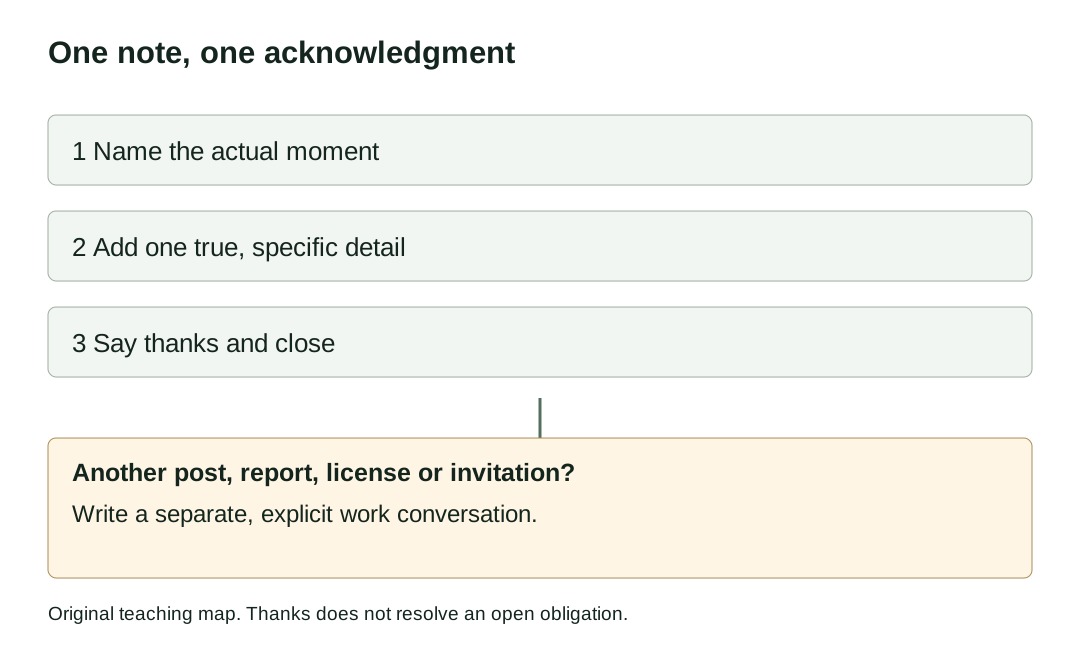
Original message map: appreciation ends before a new request begins. This does not close an unresolved obligation.
Original visual by Superdirector editorial team. Creation date not recorded.
Check the facts and the relationship
Before using a note, check the exact name and work reference, whether the event happened, whether you actually read or watched it, and whether the praise reflects your view. Sign as the real person writing for the brand. Use the agreed contact route; a thank-you does not require finding a private postal address or publicly naming the creator.
A genuine gift without a promised post stays a gift. If a post or other deliverable was already agreed, do not insert “no expectation to post” to make the note sound friendlier; preserve the actual agreement. The creator brief template handles the separate work request. This note grants no reuse rights and makes no payment or future-project promise.
Public endorsement disclosure is a separate question from private appreciation. In its U.S. staff guidance, the FTC says a free or discounted product can be a material connection, and a subsequent endorsement can need disclosure even if the brand did not ask for the mention. It says disclosure belongs with the endorsement and warns against assuming a platform tool alone is sufficient. A no-posting-obligation gift is not automatically a no-disclosure gift.
The FTC also warns that a stand-alone “thanks” is vague as a disclosure. That concerns the creator’s audience-facing endorsement; it is not a ban on using “thank you” in a private note. Instagram’s public creator guidance says content paid in any form needs a Paid Partnership label and includes gifted products in its FAQ. Apply the actual market and platform rules; these notes are not compliance clearance or a universal disclosure script.
If you need to examine the finished endorsement, use the caption-and-video disclosure review. The broader how-to library covers briefs, content and reporting; this page’s usable result is a short, truthful acknowledgment.
What informed these examples
Five reference texts were read in full on November 5, 2026: eReleases, Statusphere, How To Say Guide, Tons of Thanks and Cheerful. They show concise guidance, specific-content references and scenario groupings, but also contain offers, follow-on asks or performance claims that these examples do not adopt.
In a retained November 3 answer to the thank-you-note query, eReleases was the inline citation; Statusphere, How To Say Guide and Tons of Thanks appeared in its wider source list. Cheerful appeared in the separate gifting-query source list. Source-list inclusion is not proof that their wording was quoted. The separate gifting query and an unsuccessful Gemini attempt do not establish that this article’s exact question was observed in a grounded answer. Current search volume and the effect of these examples remain unknown.
The FTC and Instagram pages support only the narrow disclosure context above. Source text was read; source illustrations, private messages and live account tools were not inspected. Superdirector publishes this article. The six examples, worksheet and message map are original editorial material, and nothing on this page sends outreach or promises an outcome.